By Ikaros Kyriakou
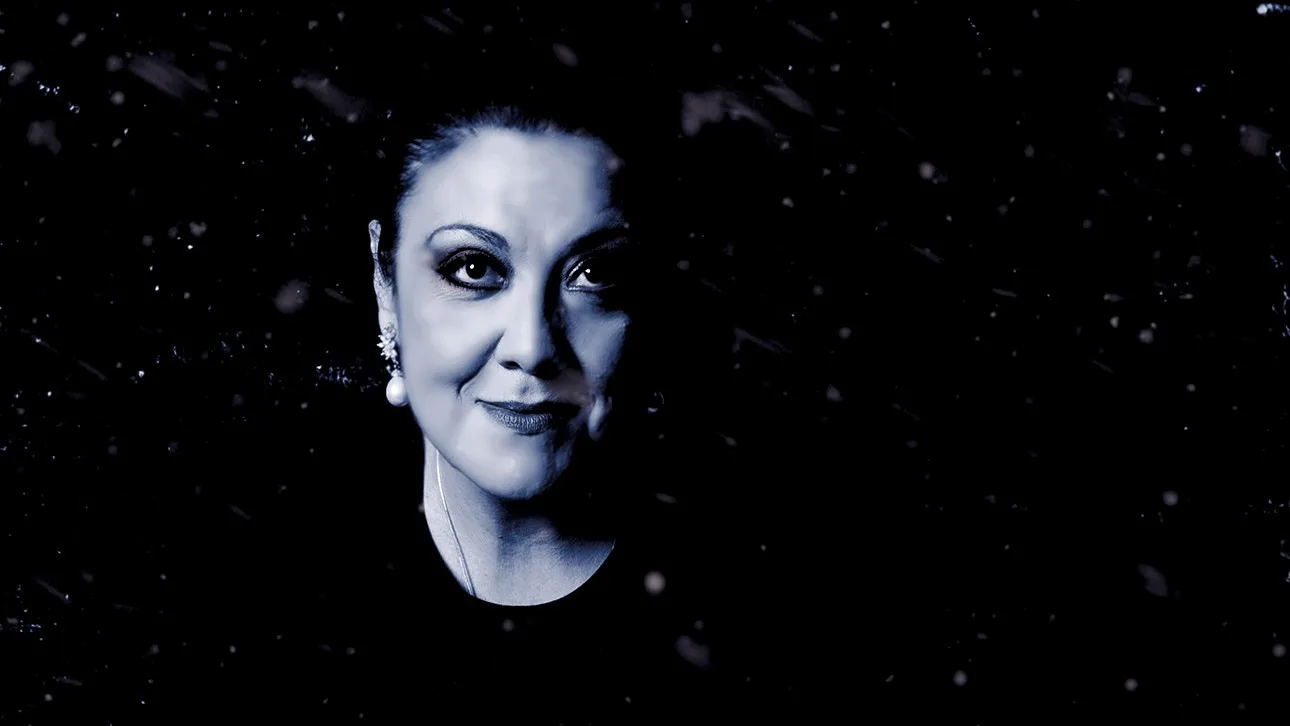
Discussions surrounding a possible Australian tour by internationally acclaimed Greek contralto Marita Paparizou have already generated strong interest among music lovers. Paparizou has appeared on some of Europe’s most respected operatic stages, earning recognition for her expressive interpretations, technical precision and the distinctive colour of her voice. With a career spanning demanding roles from the classical repertoire, contemporary works and major international collaborations, she is regarded as one of the most accomplished Greek operatic voices of her generation.
Born and raised in Greece, Paparizou showed a natural affinity for music and lyrical singing from an early age. She went on to study classical singing and advanced music theory before continuing her artistic training in leading European opera centres under renowned vocal instructors. Her career has since become closely associated with Italian, French and German repertoire, with performances in major opera houses and concert halls across Europe, collaborating with respected orchestras and conductors.
Reflecting on her musical identity, Paparizou describes herself as deeply versatile, both vocally and artistically.
“I would describe myself as a true multi-tool, in every sense of the word. I have sung everything from pre-classical and Baroque music to 21st-century composers; from jazz to Mikis Theodorakis and Manos Hadjidakis; from Sougioul to traditional Greek and even Sephardic music. On stage, I have embodied both women’s and men’s roles.”
As a contralto – one of the rarest voice types – Paparizou explains that her vocal range has shaped the trajectory of her career.
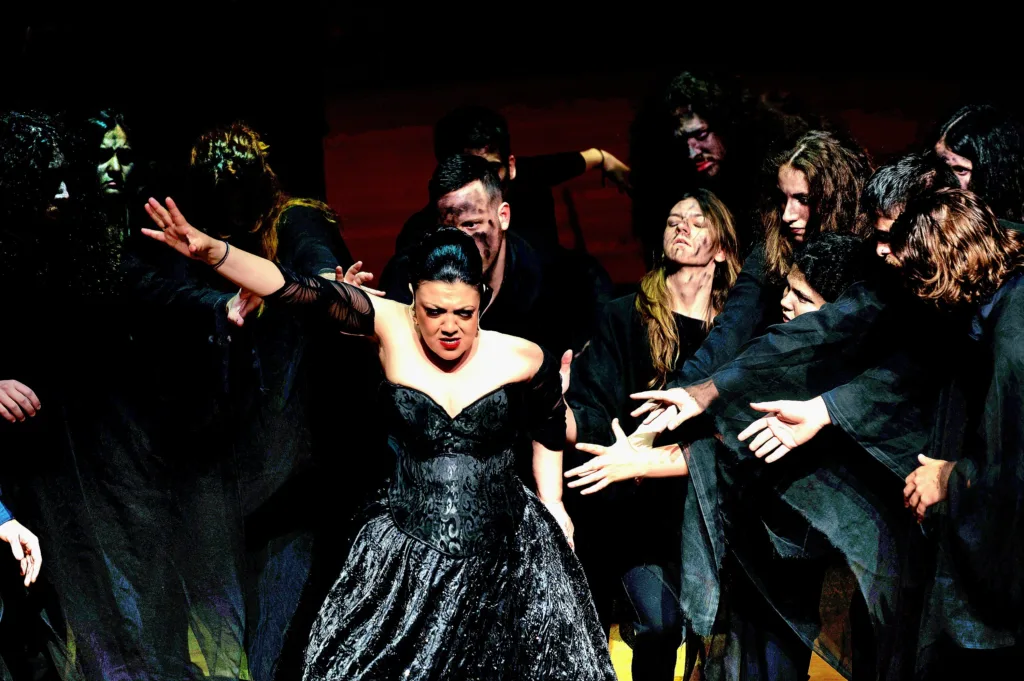
“The contralto is characterised by a velvety middle register, a deeply dark lower register, and the ability – briefly – to rise into the soprano tessitura with brilliance. This is why contraltos replaced the castrati, and why many composers originally wrote male roles for female contraltos.”
Looking back on the defining moments of her artistic journey, Paparizou recalls that, like all artists, her debut remains etched in her memory. That first appearance took place in Genoa during the modern-era revival of Nicola Porpora’s Ariadne in Naxos. Another pivotal moment followed with her first collaboration with legendary conductor Claudio Scimone at the Théâtre des Champs-Élysées in Paris.
She also cites major roles that further shaped her international profile, including Tancredi in Rossini’s Tancredi in Monte Carlo, Orpheus in Gluck’s Orpheus and Eurydice at the Hermitage Theatre in St Petersburg, and Circe in Gluck’s Telemachus, performed in both London and at the Odeon of Herodes Atticus.
Scimone, she notes, was not only a mentor but a defining influence.
“Beyond being a student of our own Dimitri Mitropoulos, he became my artistic ‘father’ – a noble figure in music and art, truly unique.”
Despite her extensive international career, Paparizou speaks of opera not merely as a profession but as a lifelong anchor.
“It has been, is, and always will be my great love — my foundation and my harbour. Through opera, I have travelled the world, worn countless costumes, and portrayed heroes and heroines, victims and perpetrators, lovers and beloveds, witches, knights, queens and kings.”
Yet, she admits that the anticipation of stepping onto the stage has never diminished.
“I still long to step onto the stage as if it were the first time — even when performing a concert rather than a full role.”
Among the composers who resonate most deeply with her voice and spirit, Paparizou points to Antonio Vivaldi, George Frideric Handel and Gioachino Rossini.
“Each for different reasons, but above all for the way they elevate the human voice – through psychological depth, dazzling coloratura that feels like fireworks, and legato lines that resemble melted chocolate.”
Even now, there are roles she continues to dream of performing, ranging from Ulrica in Un Ballo in Maschera and Azucena in Il Trovatore, to Dalila in Samson and Delilah and even Julius Caesar in Handel’s Giulio Cesare.
When approaching a new role, Paparizou says her process begins with deep respect for the work itself.
“I immerse myself in the libretto. Often, the words guide the music – and therefore the voice. Each era demands its own approach; you cannot sing Baroque as if it were Verdi, nor Mozart as Wagner.”
Some of her most indelible memories come from moments of complete stillness after a performance – moments that test both vulnerability and confidence.
“Twice, actually, I experienced that silence: once at the final performance of Dido and Aeneas in Corfu, and again at the premiere of Tancredi in Monte Carlo. Those seconds feel endless. Then comes the eruption – applause, cheers, Brava! Those moments make you forget the hardships of this profession.”
On the subject of international productions, Paparizou is careful not to draw distinctions that diminish Greece’s artistic standing.
“It is a mistake to separate Greek from international productions. That diminishes the Greece of Callas, Baltsa and Mitropoulos. Every production deserves the same professionalism. Artists have no schedule – we must always be prepared.”
While discussions are underway regarding a possible Australian tour, Paparizou remains discreet,“In our profession, announcements only come once contracts are signed. Hopefully, we will meet very soon.”
What she hopes to offer Australian audiences, however, is clear, “A symbol. An idea. A woman. Greece.”
Her connection to Greek communities abroad, she believes, transcends geography.
“Greek hospitality is always the same. All of Greece is one embrace – even when we are far from home.”
Looking ahead, Paparizou hints at presenting a program that audiences can easily connect with – one rooted not in traditional classical form, but in a 20th-century period spanning from the early 1900s to the 1970s.
For Paparizou, promoting Greek musical tradition internationally is not simply an artistic choice, but a deeply emotional one.
“Tradition is the most universal value there is. I have seen audiences moved to genuine tears by Greek song – even far from Greece – because migration, memory and heritage speak to everyone.”
She describes opera as a form of elite endurance, requiring constant discipline and emotional resilience.
“Practice never stops. Emotional balance is personal – some need family and companionship, others solitude. There is no formula.”
Ultimately, she says, applause is both sustenance and reward – but knowing when to step away is the profession’s greatest challenge.
“It is painful to see great artists diminish themselves by refusing to accept the end.”
As for what lies ahead, Paparizou recently performed once again with I Solisti Veneti at the Stavros Niarchos Hall and will appear in 2026 with the Athens State Orchestra, alongside further performances in Greece and Italy.
Asked to leave a message for Greek and Greek-Australian audiences, her words are simple and heartfelt, “Stay strong, my Greece.”
