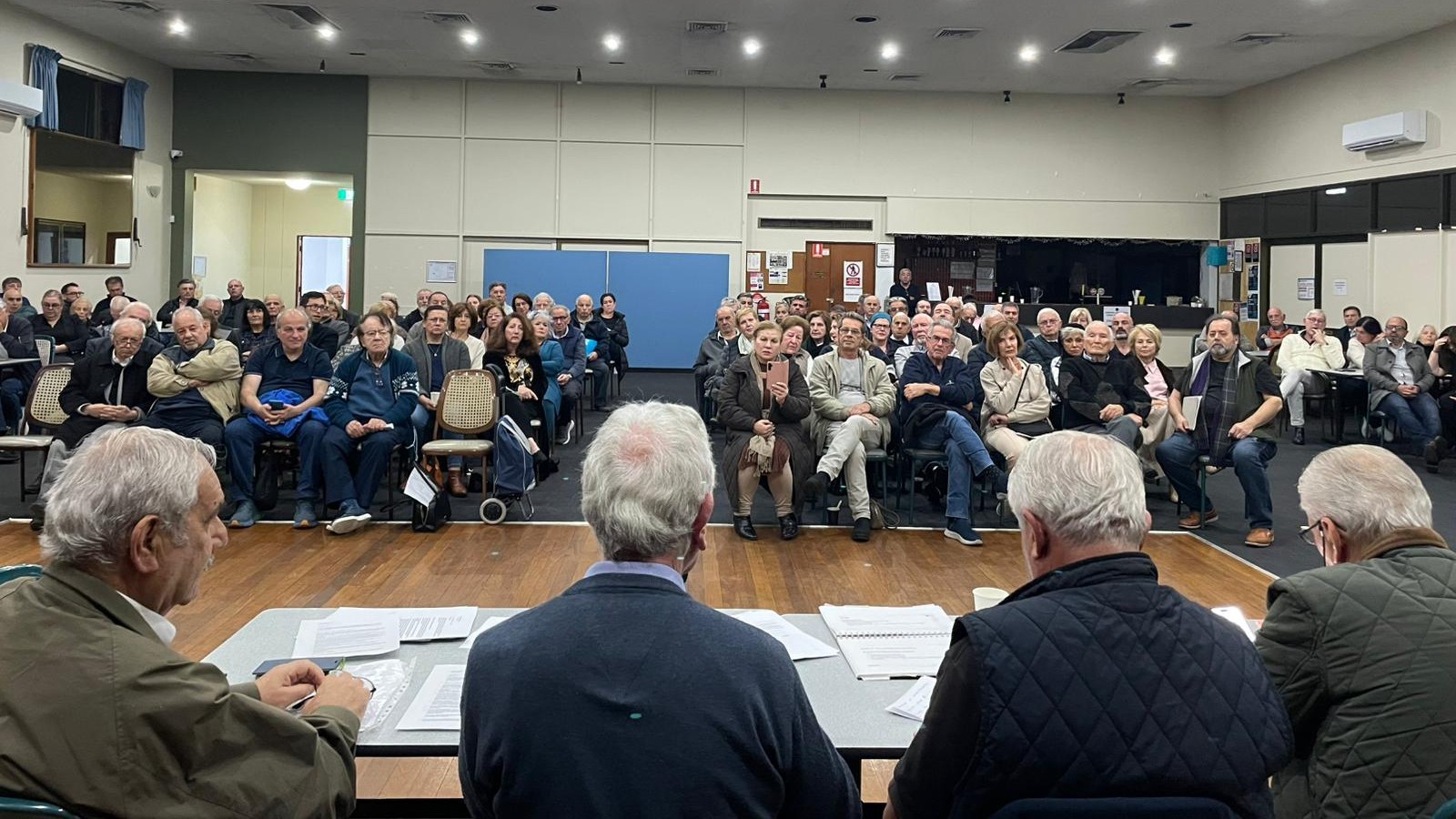
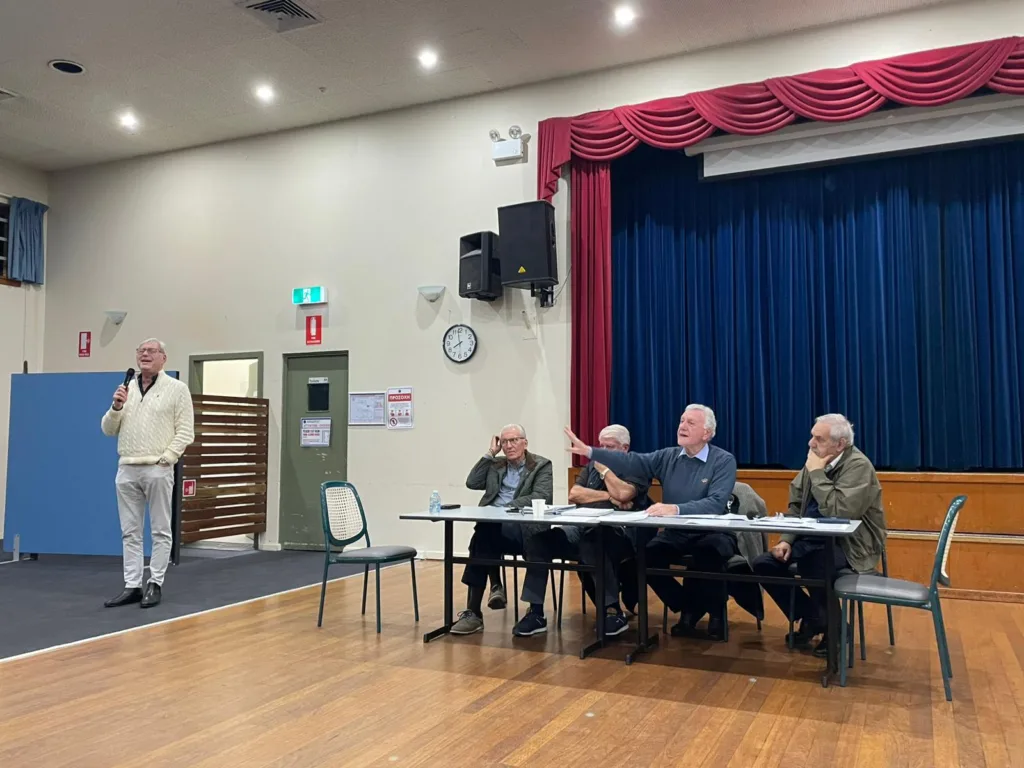
More than 120 members of Sydney’s Greek community gathered at the Greek Orthodox Community Club in Lakemba on Monday, June 1, for an emotionally charged public meeting over the future of the Hellenic Village sale proceeds, with repeated calls for unity and demands that the project’s “original vision” be preserved for future generations.
The gathering, chaired by solicitor and former Hellenic Village president Constantine Vertzayias, centred on the pending sale of the long-held Austral property for $119.5 million and the growing divide over how the proceeds should ultimately be distributed.
At the heart of the debate is whether the funds should remain largely within the 21 shareholder organisations* that contributed to the original purchase decades ago, or whether most of the money should instead be directed into a central charitable structure and major community infrastructure projects.
The meeting repeatedly returned to a central theme: that the land was acquired for the benefit of the entire Greek Australian community and not simply as a future financial asset for individual associations.
Mr Vertzayias described the decisions facing the community as “the most important in the 125 years of our organised community.”
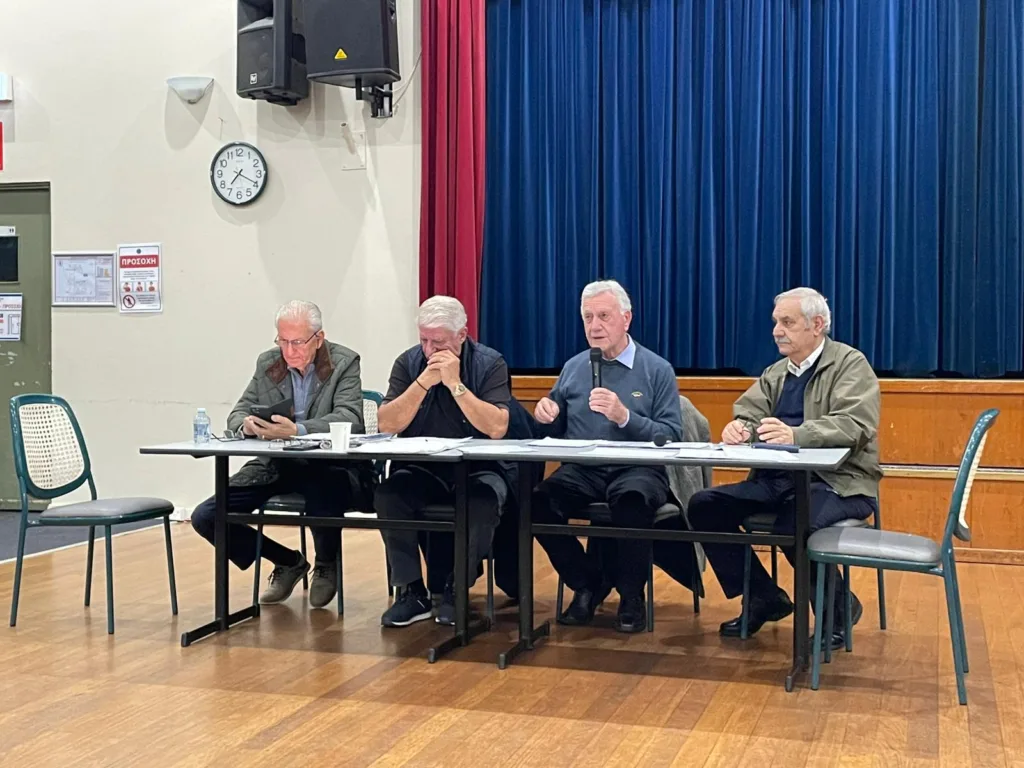
Sale process and Australian Hellenic Future Fund
The public gathering comes as the Hellenic Village Board continues progressing the sale of the approximately 105-acre Austral site to developer Castle Group, with settlement currently expected by November 2026.
The Board has already confirmed contracts have been exchanged and that more than $14.9 million in non-refundable payments has been received as part of the transaction.
Alongside the sale, the Board has established the Australian Hellenic Future Fund (AHFF), a charitable sub-fund operating under Australian Philanthropic Services Foundation, with more than $14 million already pledged by seven shareholder organisations.
The AHFF has been promoted by the Board as a mechanism to support education, medical research, youth initiatives and aged care programs, while allowing tax-deductible donations under Australian government-regulated charitable structures.
The Board has also stated that the 21 unit-holder organisations maintain “absolute entitlement” to their share of the proceeds and therefore retain responsibility for deciding how those funds are distributed.
The final amount ultimately available for distribution remains uncertain, with speakers noting that taxation obligations, transaction costs and the individual circumstances of individual organisations may affect the net proceeds ultimately received.
However, Monday night’s meeting demonstrated growing concern among sections of the community about whether the sale proceeds may drift away from what many attendees described as the original collective vision behind Hellenic Village.
‘This land was for all Hellenism’
Throughout the evening, speakers repeatedly stressed that the Austral land was never intended to function as a private windfall for individual organisations.
“This land was given for the needs of Hellenism – for all Hellenism,” Mr Vertzayias told the crowd. “It was not purchased so that organisations could simply divide the money amongst themselves.”
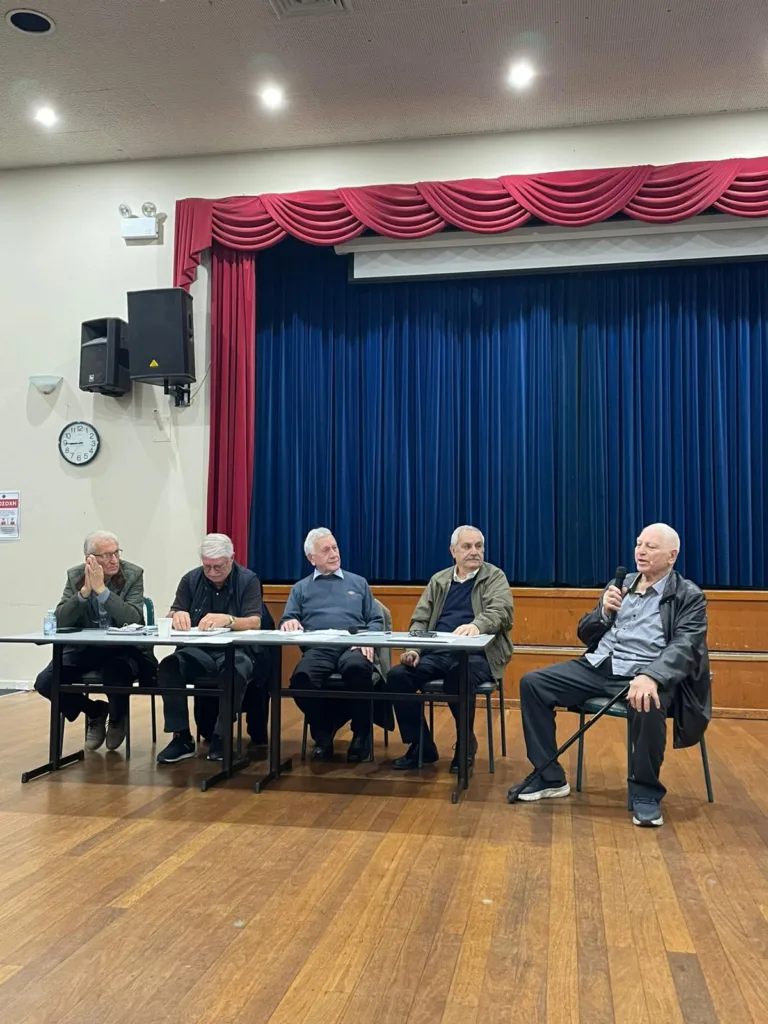
Former leaders involved in the original acquisition recounted how the property was first granted to the Federation of Hellenic Associations and Communities (OFSE) in 1987 before being purchased outright following years of fundraising and negotiations.
Speakers described how organisations struggled to raise the required $500,000 purchase price, eventually relying on contributions from multiple associations including AHEPA, the Hellenic Club of Sydney, Apollo Sports Club and the Greek Taxi Drivers’ Association.
A particularly emotional moment came with the appearance of Con Vassiniotis, who served as OFSE secretary during the original purchase negotiations. Mr Vassiniotis reminded attendees that the land had originally been handed to OFSE by the Pan-Arcadian Brotherhood rather than retained privately.
Constitution dispute and the Hellenic Village name change
One of the most contentious parts of the evening centred on the original OFSE constitution and the legal structure underpinning Hellenic Village.
Former Hellenic Village president John Kallimanis claimed the organisation was still effectively operating under the original 1978 OFSE constitution, despite later structural changes and the eventual transition to the Hellenic Village name.
According to Mr Kallimanis, Article 3 of the original constitution restricted membership to regional Greek associations, meaning some organisations later brought into the structure technically did not qualify under the original constitutional framework.
He alleged those organisations were included because additional funds were urgently needed to complete the purchase of the land.
Mr Kallimanis further argued that legal advice obtained in later years recommended the creation of a separate company structure so only the 21 contributing organisations would remain attached to the property asset before the name was formally changed from OFSE to Hellenic Village in 2010.
He also claimed the name change itself was approved unanimously by the Board rather than through a broader general meeting process.
The debate intensified further when attendee Harry Fantakis insisted the original constitutional agreement should remain in force and effectively limit how much shareholder organisations should individually receive from the proceeds.
The comments triggered strong reactions throughout the hall and further intensified calls for all constitutional documents, trust structures and legal advice to be publicly released before final allocation decisions are made.
Tensions over direction
The atmosphere became increasingly tense as speakers revisited internal disputes and leadership changes within Hellenic Village over the past decade.
Mr Kallimanis alleged tensions escalated after current President George Mpliokas and Board Member George Siomos became involved in the organisation’s leadership structure, claiming this period marked the beginning of stronger pressure for direct financial distributions to organisations rather than maintaining a unified charitable structure.
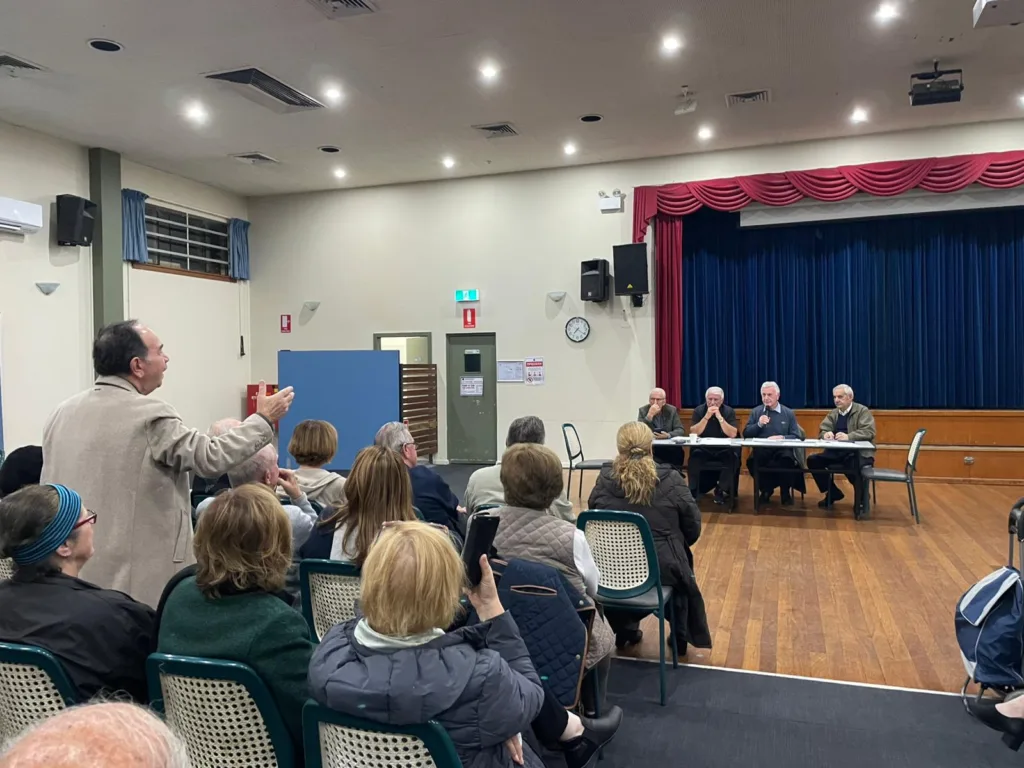
Several attendees questioned whether sufficient consultation had occurred with the broader community before contracts were exchanged and called for greater transparency regarding governance arrangements, legal advice and the future management of sale proceeds.
Critics argued that a transaction of this scale carries responsibilities extending beyond the shareholder organisations themselves and affects the future direction of the wider Greek Australian community.
At several points, audience members interrupted proceedings, objecting to references made about private correspondence and historical disputes between organisations.
Former Hellenic Club president George Katsaros sought to redirect the discussion away from historical disputes and toward the broader question of how the proceeds should be used for the benefit of the community.
Speaking in a personal capacity, Mr Katsaros reflected on his involvement in the original acquisition of the land and reiterated his view that the property had been acquired for the benefit of the wider Greek Australian community.
“What are we going to do with this money?” he asked attendees. “How can it remain within the Greek community for the benefit of everyone?”
Mr Katsaros said the focus should be on determining the most effective long-term structure for managing the proceeds and ensuring they continue to serve future generations of Greek Australians.
The Hellenic Village Board has previously stated that donations to the AHFF are voluntary and that each shareholder organisation retains legal entitlement to determine how its allocation is used.
Cultural Centre vision revived
Despite the disagreements, the strongest point of consensus throughout the evening was support for creating major community infrastructure tied to the sale proceeds.
Speakers repeatedly revived the decades-old vision of a major Greek Cultural Centre in Sydney featuring theatre space, exhibition halls, libraries, educational facilities and commercial operations capable of generating ongoing income.
Asterios Tzintsas told attendees that “the dream and vision for decades was the cultural centre and now was the time.”
Several speakers proposed that approximately half the eventual proceeds be preserved within a charitable trust structure, while the remaining funds be reserved specifically for future cultural infrastructure projects.
Committee elected as resolutions pass unanimously
By the end of the night, attendees unanimously passed a series of resolutions aimed at increasing community involvement in the process.
These included calls for:
- the establishment of a community committee to meet both the Hellenic Village Board and all 21 shareholder organisations;
- the issuing of a public media release and petition;
- a future public meeting organised directly by the Hellenic Village Board; and
- shareholder organisations to convene special meetings of their own members before making final decisions on allocation of funds.
The five-member committee elected on the night consists of Katerina Vetsikas, Elena Matsouka, Dimitris Kametopoulos, Georgia Gravanis and Jim Tsolakis.
While attendees differed sharply on governance, constitutional history and the future distribution of proceeds, many speakers shared a common concern that the sale represents a once-in-a-generation opportunity whose impact will extend well beyond the organisations directly involved.
As the meeting concluded, organisers urged attendees to continue lobbying their associations to preserve what they described as the community purpose behind Hellenic Village and ensure the proceeds remain aligned with the vision many speakers said had guided the project from its inception.
*The 21 Greek associations who make up the Hellenic Village Ltd are:
- Order of AHEPA NSW INC – 3 shares
- AHEPA Heracles INC – 3 shares
- Apollo Sports and Cultural Club – 1 share.
- Cyprus Hellene Club Inc – 2 shares.
- Diakofton Association – 3 shares.
- Elassona Philanthropic Association – 3 shares
- Greek Taxi Drivers’ Assoc. – 1 share
- Hassion Philanthropic Assoc – 3 shares
- Hellenic Club of Sydney – 3 shares
- Helmos Philanthropic Association – 3 shares
- Kalavryton Society (NSW) ‘Aghia Lavra’ Inc – 3 shares
- Lefkadian Brotherhood of NSW LTD – 2 shares
- Messolonghi Association – 3 PO
- Meteora Association – 3 shares
- Pan-Arcadian Association of NSW – 2 shares
- Pan-Korinthian Association of NSW – 2 shares
- Pan-Nafpaktian Association ‘Nafpaktos’ – 2 shares
- Pan-Thessalian Federation – 2 shares
- Pan-Thracian Association of NSW ‘Democritus’ – 2 shares
- Association of Plataneon ‘O Platanos’ – 3 shares
- Saint Barbara Philanthropic Association – 2 shares
