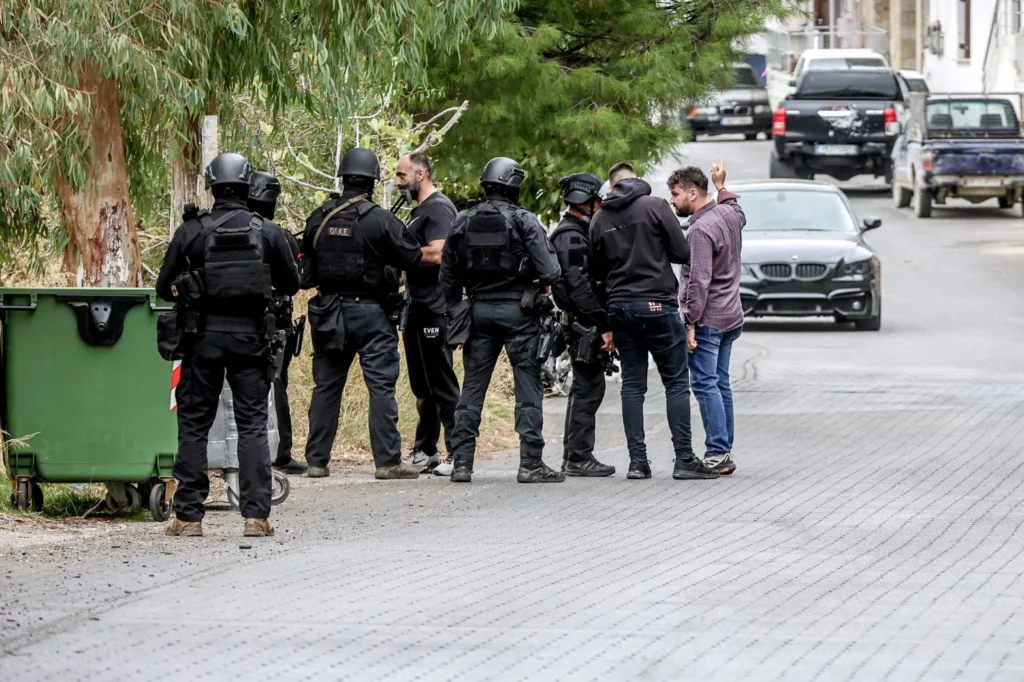
Greek police have arrested one suspect and detained another after a violent clash in the Cretan village of Vorizia, near Iraklio, left two people dead and four others injured on Saturday, November 1.
Authorities believe the bloodshed stems from a long-running dispute between the Kargakis and Frangiadakis families over grazing land, an intergenerational feud that officials now fear could flare up again despite heavy police presence.
Forensic investigations revealed that one of the victims, a 56-year-old woman, died from a gunshot wound, not a heart attack as initially believed.
The second victim, a 39-year-old man, is reportedly linked to the Kargakis family. His funeral has been postponed pending the completion of the forensic report.
At least ten homes have been searched so far, with evidence reportedly recovered from two of them.
“The investigation will continue until all parties involved are brought to justice,” a police spokesperson said, adding that the search will expand to nearby villages in the coming days.
Photo: Stefanos Rapanis / Eurokinissi.
Greece’s police chief, Dimitris Mallios, and head of criminal investigations, Fotis Douitsis, have travelled to Crete to coordinate the operation.
A 10-member elite investigative unit, often referred to as the “Greek FBI,” has been deployed, alongside EKAM counterterrorism officers flown in from Athens.
The gunfight followed a bomb explosion at a nearby construction site one day earlier. Witnesses said armed men stormed Vorizia in apparent retaliation, firing Kalashnikov rifles in what police estimate amounted to “thousands of rounds.”
Tensions remain high at Venizeleio General Hospital in Iraklio, where families have gathered for updates on the victims. Riot police have cordoned off the area to prevent further clashes.
Police say the investigation remains active, with both detained individuals under questioning as they work to determine who orchestrated the deadly assault.
Scientists are warning of the “slow death” of the Prespes Lakes in northern Greece, as water levels have dropped to their lowest point in 35 years, according to an article by Giorgos Lialios in ekathimerini.com.
“Until now we hoped that the change would not be so great. Now we are sure that Great Prespa will cease to be what it was. But the truly painful change will occur in Little Prespa. If it continues like this, within a few years it will disappear before our eyes,” says biologist Giorgos Catsadorakis, scientific adviser at the Society for the Protection of Prespa.
Experts note that the water level of Great Prespa has nearly matched its lowest point from 1990, creating serious environmental and agricultural challenges. “The lake level this year is close to the lowest recorded in 1990. If it continues like this, the lake water will no longer be usable for irrigation. Climate change is not just about lake levels: Last year, producers threshed beans in February instead of October. This is the third year they are being subsidized by the state for the damage, as they have minimal production,” he adds.
The Prespes region, home to rare bird species and vital ecosystems, is now at risk due to prolonged drought and rising temperatures. Scientists stress that without immediate conservation measures, Little Prespa could dry up completely in the coming years, marking an ecological disaster for one of Greece’s most unique natural habitats.
Tourists staying in the Municipality of Zagori will now pay a €0.75 “culture fee” per night for hotel or short-term rental accommodations – the first measure of its kind in Greece, according to an article by Sofia Christou by ekathimerini.com.
The initiative, approved by Interior Minister Theodoros Livanios and Culture Minister Lina Mendoni, comes after Zagori’s inclusion on UNESCO’s World Heritage List.
Under the new rule, visitors will pay the fee after their stay and before departure, with the charge appearing on the accommodation invoice. All proceeds will go directly to the Municipality of Zagori.
“The joint ministerial decision has just been issued. Next, a committee will be formed with members from the Municipality of Zagori, the Ministry of Culture, and the Ministry of the Interior, which will decide which projects the revenue will fund,” said Mayor of Zagori Giorgos Soukouvelos in an interview with Kathimerini.
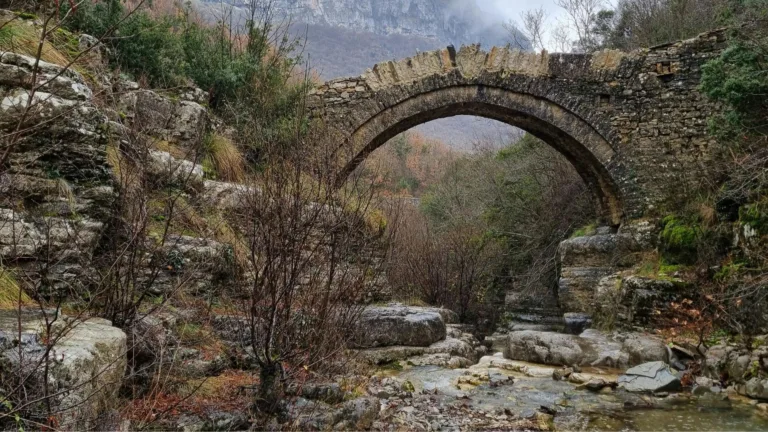
Zagori, a region of 46 villages in northwestern Greece, is famed for its well-preserved traditional stone architecture, scenic bridges, and cobbled pathways that weave through mountainous landscapes.
In recent years, the area has experienced rapid tourism growth, with a surge in hotels, guesthouses, and short-term rentals. Local officials hope the new fee will help preserve the cultural and architectural heritage that attracts visitors while supporting sustainable development in this UNESCO-listed destination.
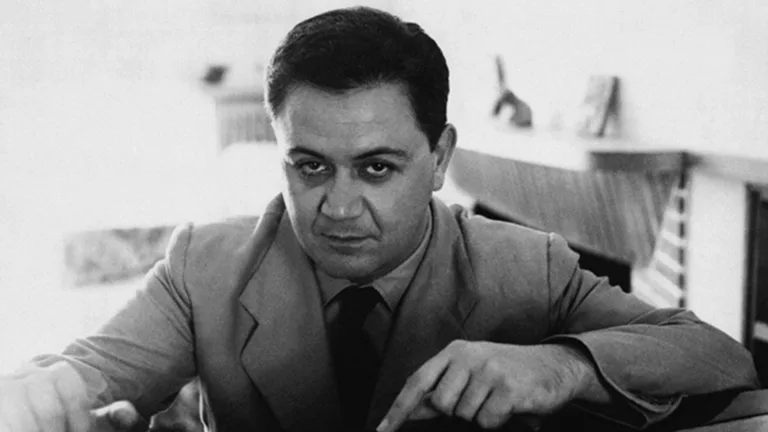
The Greek Ministry of Culture has proclaimed 2026 a year dedicated to honoring Manos Hadjidakis, the visionary composer who bridged classical music with Greek folk traditions and elevated popular song to an art form in the postwar era, tovima.com, has reported.
The initiative celebrates Hadjidakis’s enduring influence—a legacy defined by intellect, emotional depth, and an unwavering devotion to Greek culture. Through his teaching and public engagement, he promoted education, freedom, and humanistic values, standing firmly against vulgar populism. More than thirty years after his death, his music continues to move and inspire listeners worldwide.
Minister of Culture Lina Mendoni highlighted that Hadjidakis, both as an artist and thinker, reshaped modern Greek music and enriched public discourse through his liberal ideals.
Throughout 2026, the Ministry of Culture and its affiliated institutions will organize a wide-ranging program of concerts, exhibitions, and educational events to celebrate and reinterpret Hadjidakis’s contribution. The goal is to reintroduce his art and philosophy to younger generations, deepening their appreciation for his role in shaping Greece’s modern cultural identity.
Born in Xanthi in 1925, Hadjidakis’s career began in 1944 with The Last White Crow at Karolos Koun’s Art Theatre, leading to acclaimed compositions for stage and film, including the Oscar-winning Never on Sunday (1960). His later work, from Reflections to the founding of the Orchestra of Colors, cemented his reputation as a pioneering force in Greek and international music.
Greece’s Education Ministry will remove over 285,000 inactive students from university records in December, Education Minister Sofia Zacharaki announced this week, according to tovima.com.
Under Law 5224/2025, so-called “perpetual students” – those who have exceeded both the standard study duration and the legally allowed extension – will be permanently deleted from university registers. The reform targets a long-standing issue in Greek higher education: tens of thousands of students who remain enrolled for decades without completing their degrees.
According to ministry data, 83,970 of these students are still listed at the National and Kapodistrian University of Athens, Greece’s oldest university.
Since the law was introduced, about 30,000 students have submitted applications to finish their studies before the deadline. Those who fail to do so will be automatically deregistered by year’s end. Universities have already begun notifying those affected.
The legislation specifies that students admitted before 2016 will be removed two months after September 2025’s re-examination results are published. While the ministry allows for limited exceptions or extensions, these apply only to students who formally request them within the set timeframe.
At the Athens University of Economics and Business, records still include names of students who first enrolled in 1933 – a striking example of how long the problem has persisted.
Education Minister Zacharaki described the reform as “a clear commitment to the future of Greek universities and to the students who work hard to succeed.”
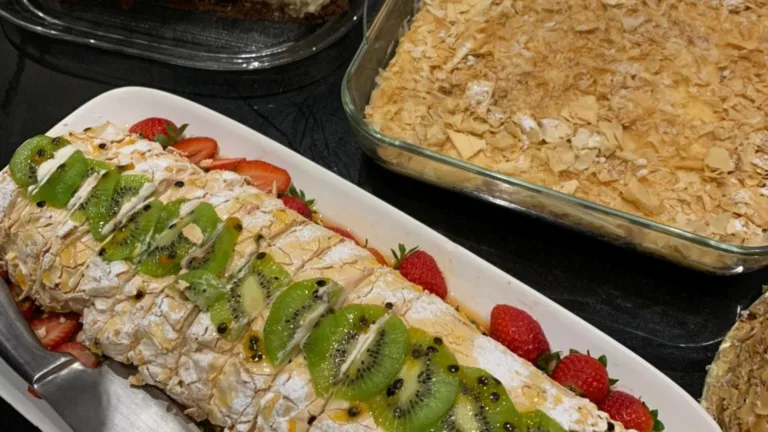
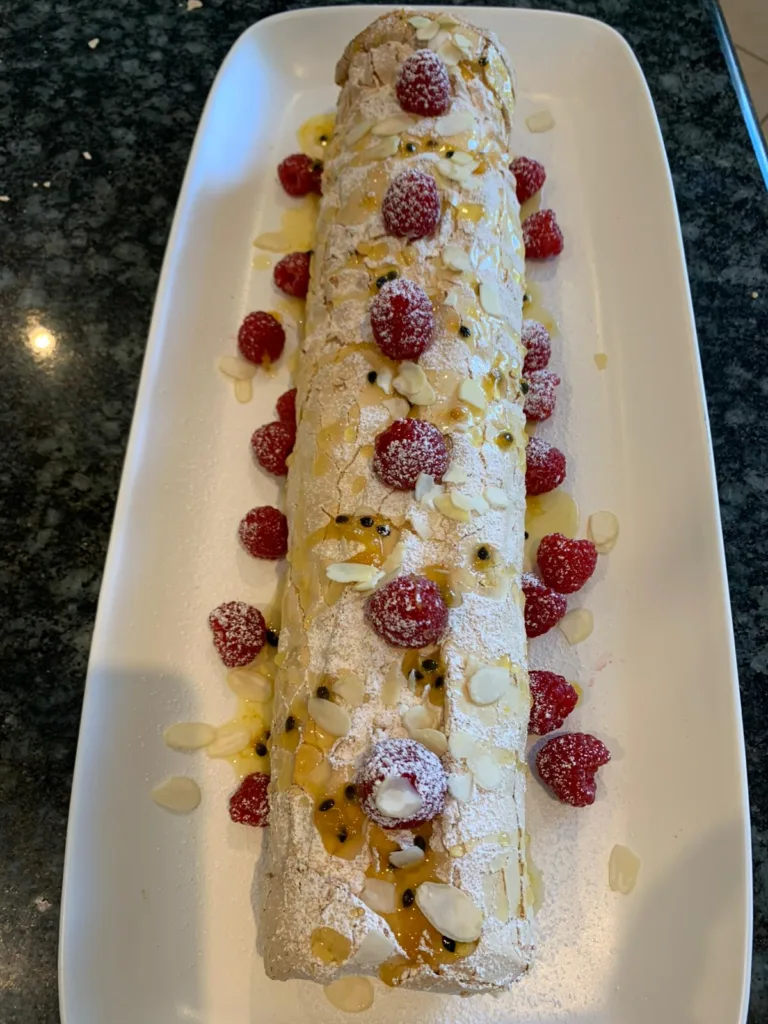
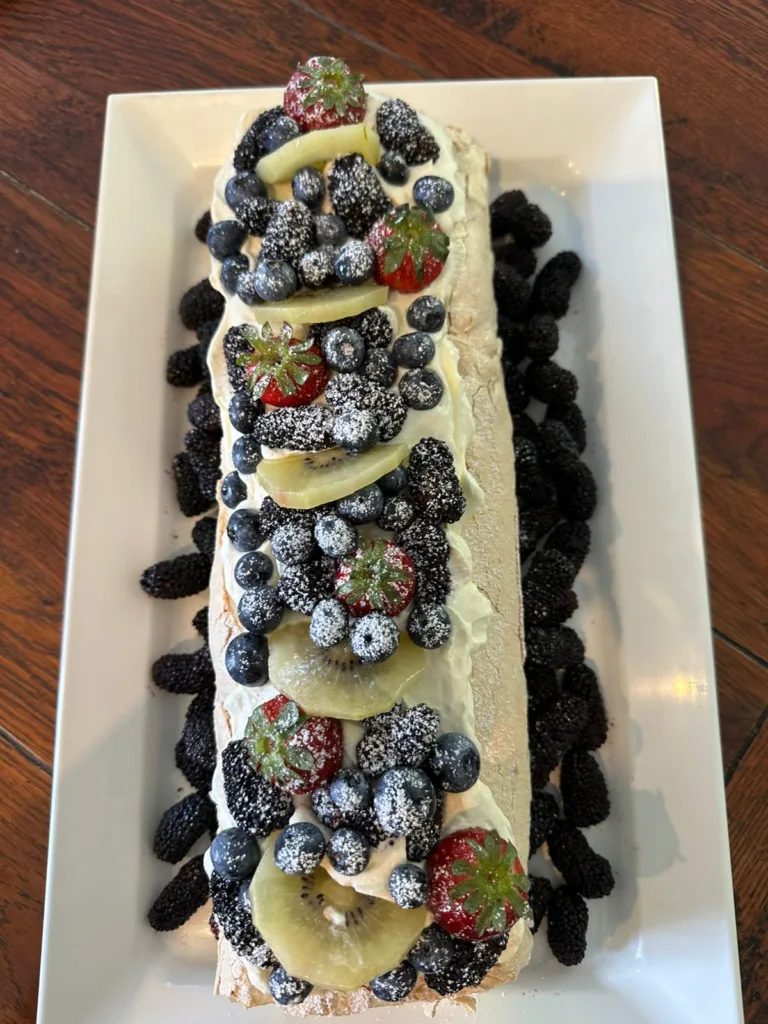
Niki Louca from My Greek Kitchen shares her favourite recipe for a pavlova roll with The Greek Herald. You can follow her on Instagram @mygreekkitchen for more!
Ingredients:
6 large eggs (I use 800 gm size eggs)- egg white only
300 gm caster sugar – see note 1.
2 tsp vanilla paste
2 tsp cornflour
1 tsp cream of tartar
Filling:
500 ml thick cream – whipped
1 tbsp icing sugar
1 tsp vanilla paste – optional
Berries, passionfruit to decorate
Method:
You must preheat oven first – 200C fan force.
Make sure you bowl is clean and free of any oils. To make sure wipe it down with a kitchen paper towel with some vinegar on it.
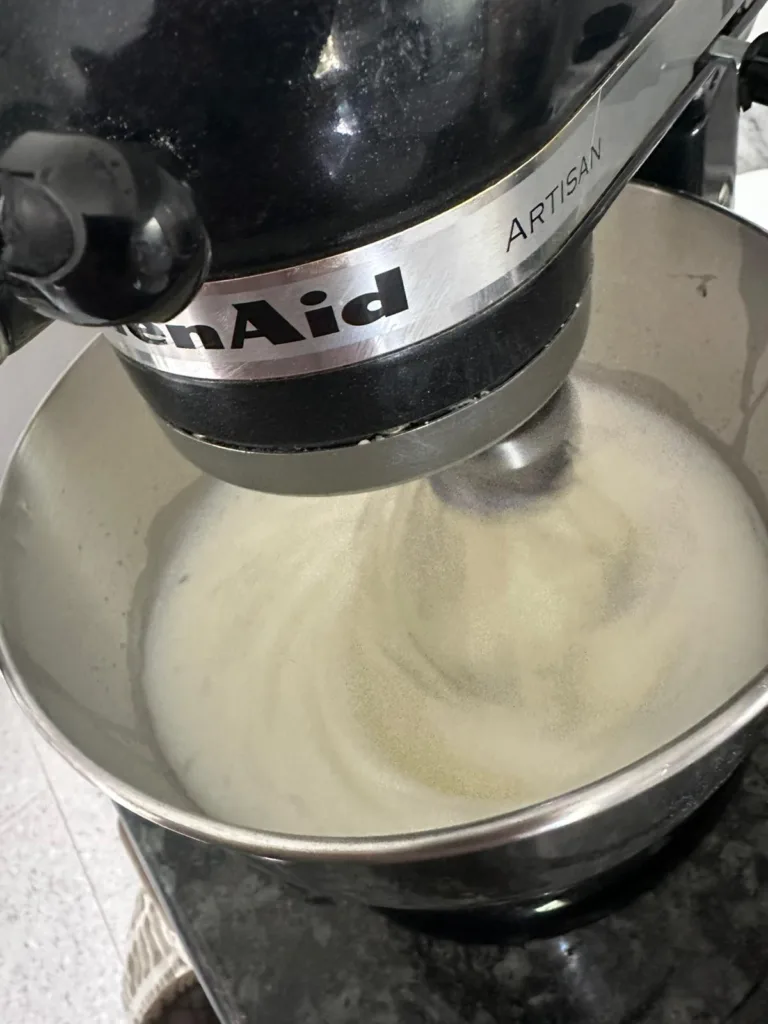
Place your egg whites into the bowl from your standalone mixer. Whisk on high till whites start to froth. Start adding your sugar at a slow and steady pace. Keep whisking till stiff peaks form. This will take about 6-7 minutes. Check to see if the sugar is fully dissolved by rubbing a bit of the meringue between two fingers. If it feels grainy it means the sugar is not fully dissolved so keep whisking for another minute or so. Recheck once you’ve done that.
Now you can add your vanilla paste, cornflour and cream of tartar. Whisk on low for about a minute till they’re fully combined.
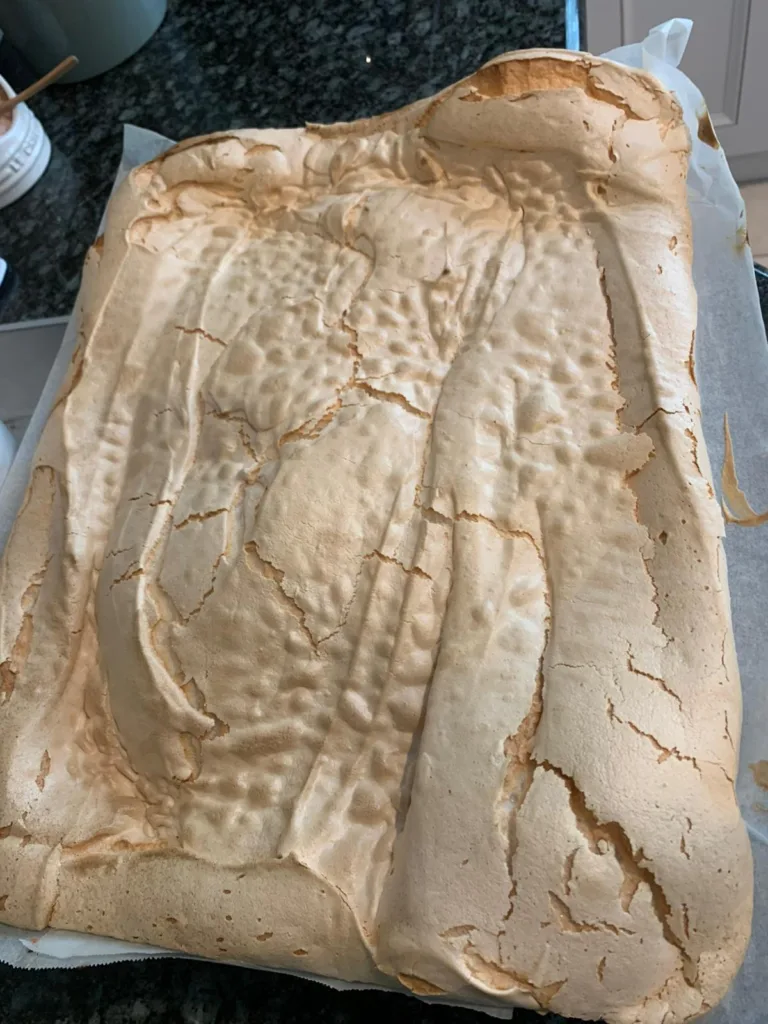
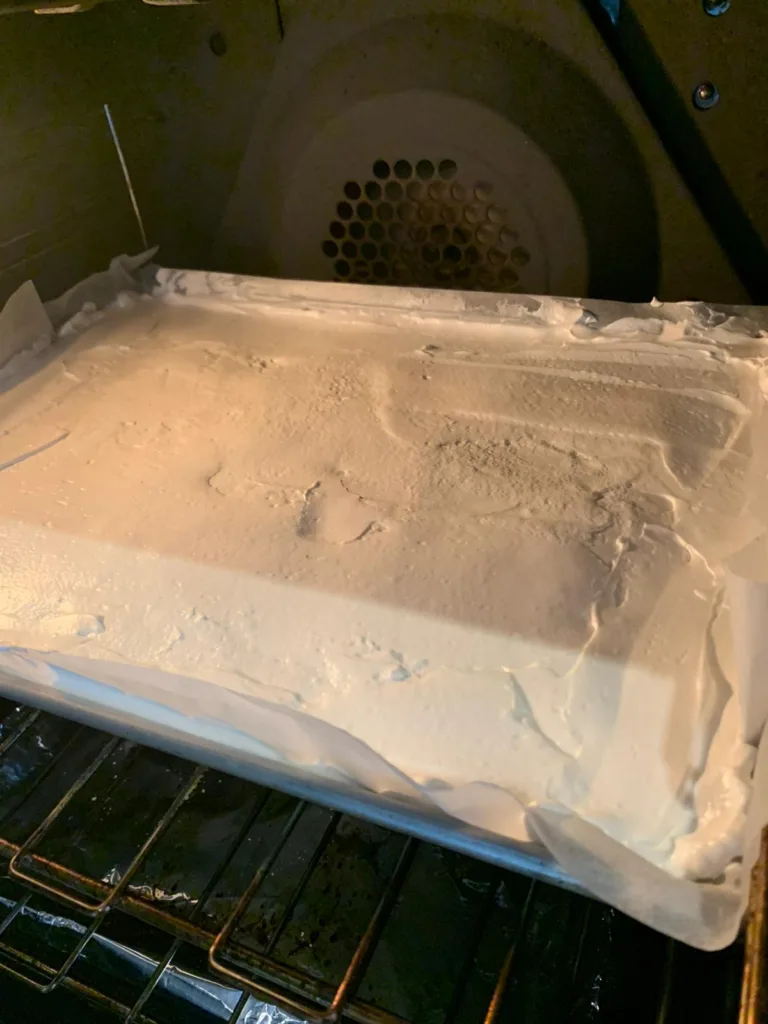
Spoon your meringue onto a lined baking tray of approximately 30×35 cm size. Spread the meringue as evenly possible and place it in the oven. Reduce your heat to 180C, and bake for approximately 30-35 minutes. It should still be a pale colour not brownish. Remove from the oven and allow to fully cool in baking tray. It will deflate – do not despair. If you are to use it the following day, cover it with a clean tea towel and set aside till then. See note 2.
When it is fully cooled, place a clean tea towel over the pav and quickly turn it upside down, so the top of the pavlova is now on the bottom and the bottom of the pav (the smooth side) is now on the top. Gently remove the baking paper and discard.
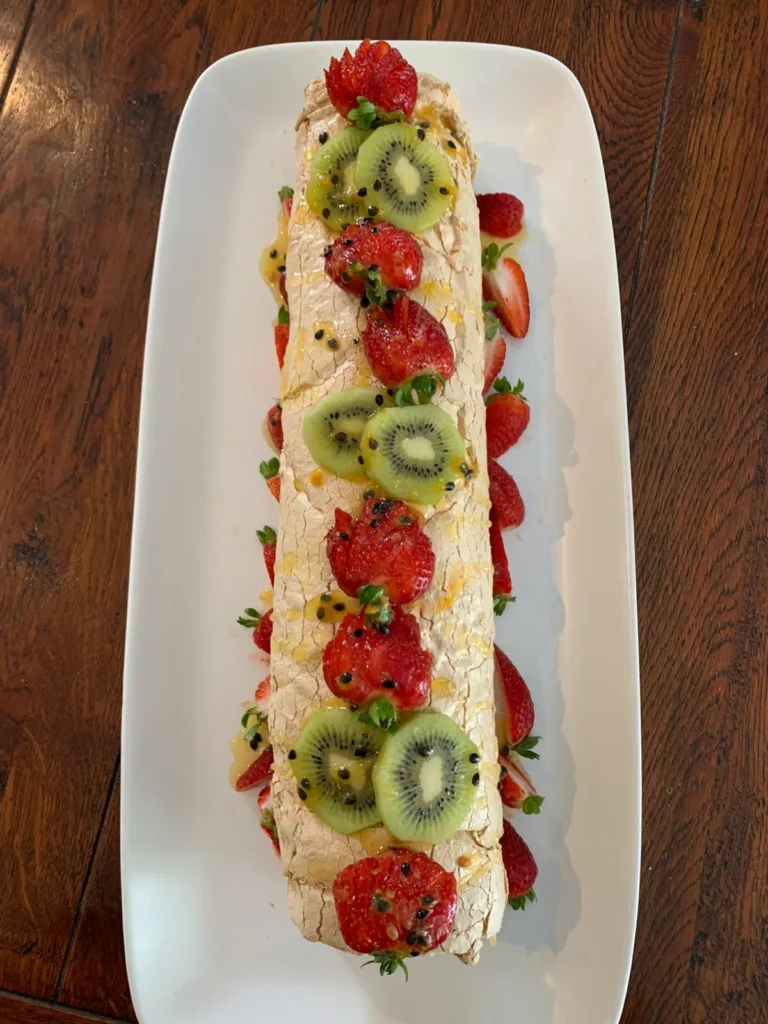
Whip your cream with icing sugar and vanilla paste if using, with a hand held mixer till stiff. Spread the cream (reserve some for the top), evenly over the pavlova and spread some of the fruit of your choice making sure they are cut into small pieces. Using the tea towel to help you, gently roll the pav forward on the long side, making sure the seam is at the bottom.
Use the remainder of the cream and fruit to decorate the top of the pav as you choose. I mainly use different berries, passion fruit and kiwi.
Note 1: In regards to how much sugar you use – I have found a lot of the pavlova recipes use too much sugar for my liking. Over the years I have tested various quantities of sugar depending on the size of the eggs I use. I have found the following works best and the pavlovas are never too sweet.
50gm of sugar per extra-large egg (800 gm ones)
45gm of sugar per large egg (700 gm ones)
40gm of sugar per small eggs(600 gm ones)
Note 2: Lining the baking tray. I have found when lining the tray with baking paper, it is easier when the paper exceeds a little over the tray size. This makes it easier when you remove the pav from the baking tray as it won’t stick to the sides.
LAMDA Development’s team recently visited Australia to promote residences in The Ellinikon, the major redevelopment project on the site of Athens’ former airport. The visit comes as Australians emerge among the top three groups of foreign buyers, newsmoney.gr, has reported.
Americans – many of them of Greek descent – lead with 21% of total foreign purchases, followed by Britons at 11%, and Australians in third place with 9%. Canadians and Germans round out the top five nationalities investing in the project.
According to data from the investment body overseeing the redevelopment in Athens’ southern suburbs, international interest remains strong, with potential buyers from 110 different countries expressing intent to invest.
In response, LAMDA has intensified global presentations of The Ellinikon in recent months, targeting even more distant markets.
The company aims for the first homeowners – likely those in the low-rise residences near the coastal front – to move into their properties between late 2026 and early 2027.
The Ellinikon project, one of Europe’s largest urban regeneration initiatives, is transforming the former airport site into a modern coastal city featuring luxury residences, green spaces, and commercial areas, attracting international investors seeking both lifestyle and opportunity in Greece’s booming real estate market.
The Church of Greece has stepped into the era of artificial intelligence with the launch of LOGOS, an AI tool created by the Metropolis of Nea Ionia, Filadelfia, Iraklio, and Halkidona in partnership with the University of the Aegean, ekathimerini.com, has reported.
LOGOS serves as a digital “library,” compiling knowledge about the Christian faith and providing clear, practical answers to users’ questions. When asked if it could receive confession, the application responded that it could not but offered guidance and prayers for spiritual preparation.
Metropolitan Gabriel, the project’s initiator, explained that the tool is not meant to replace clergy but “acts as a guide bringing the believer to the next step, the Church.” He added that it is essential for the Church to engage with technology, stressing, “Technology should serve humanity, not the other way around.”
Aimed particularly at younger generations, LOGOS provides a safe and reliable source of information on Orthodox Christianity, helping users navigate a digital landscape often filled with misinformation or harmful content.
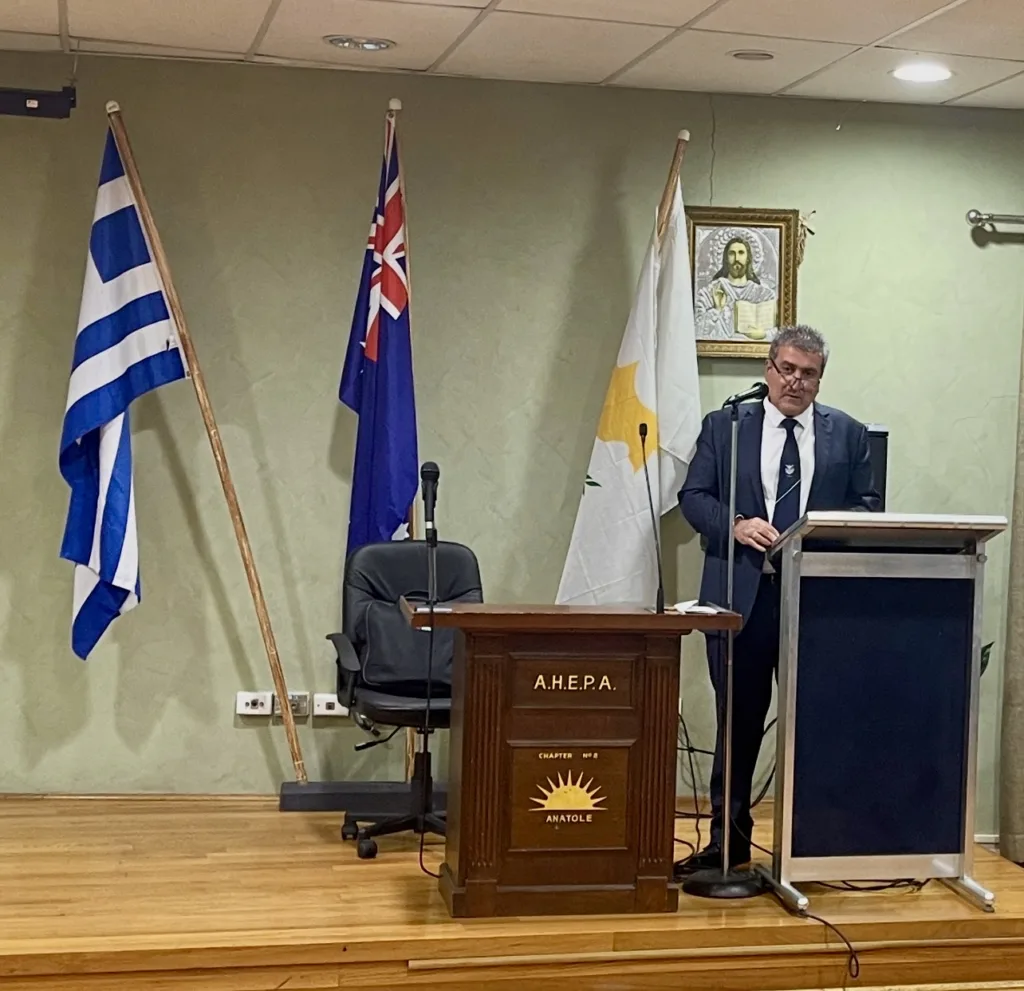
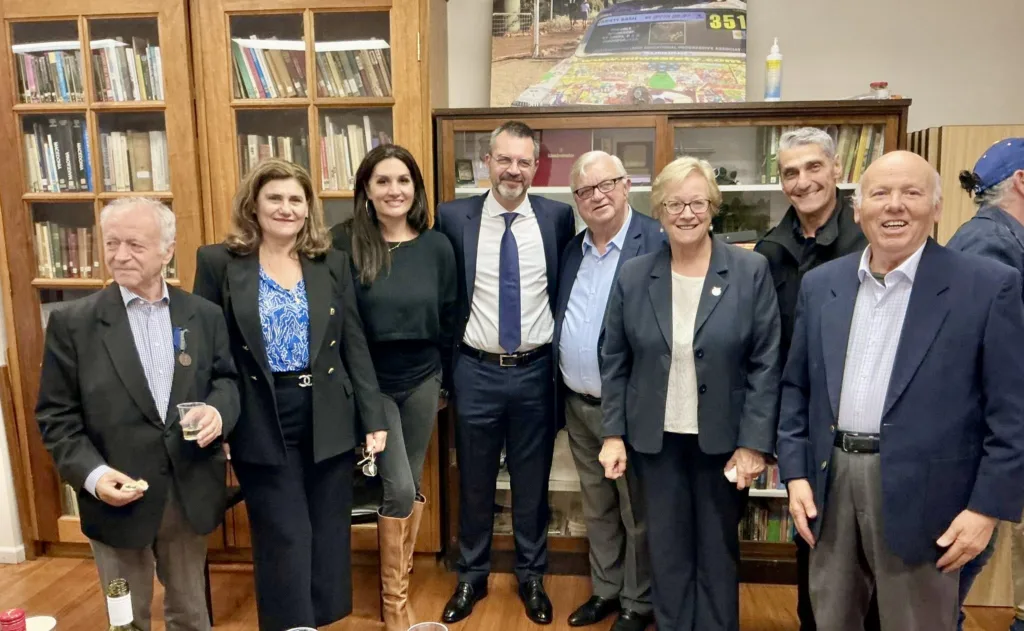
On Wednesday, October 29, AHEPA Sydney & NSW Inc proudly held a commemorative event in honour of OXI Day, marking Greece’s historic stand against fascism on October 28, 1940.
On the above date, 85 years ago, Greece issued a memorable “No” to fascism, defending their homes and their freedom, defeating the Italian attempt of invasion of their motherland.
The event paid tribute to the bravery and resilience of the Greek people and underscored the importance of passing the enduring values of freedom, justice, and liberty to future generations.
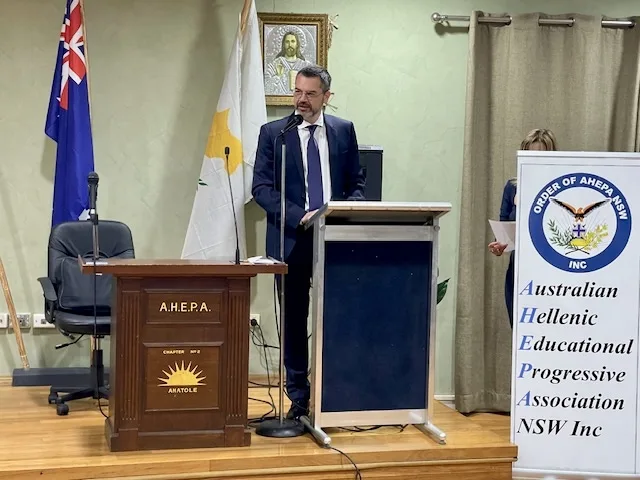
The ceremony welcomed distinguished guests including the Greek Consul General in Sydney, George Skemperis, who delivered a heartfelt address reflecting on Greece’s pivotal role in World War II and the enduring relevance of OXI Day in today’s world.
The President of AHEPA Sydney & NSW Inc, Jim Papanagiotou, emphasised the organisation’s commitment to preserving Hellenic heritage and fostering intergenerational dialogue.
Consul General. Jim Papanagiotou.
There were a plethora of representatives from Greek associations, including Michael Kyriakou, President of the Cypriot Community of NSW; Anastasia Karakominakis, President of the Pan-Macedonian Association of NSW; Cathy Valis, President of the Athenian Association of NSW; Christos Pazaridis, President of the Panthracicos Association ‘Dimokritos’; Linda Legas, President of the Laconian Federation NSW; Theofilos Premetis, President of the Macquarie Greek Studies Foundation; Paul Tsanis, Vice President of the Intercommunities Council of the Greek Archdiocese in Australia; Vivian Nikolareas, Secretary of the Feneos Association; Stamatis Belivanis, Secretary from the Cretan Youth Association; Dr Vasilis Adrachtas, Convenor of Greek Studies UNSW; Dimitris Kametopoulos, Principal of Bankstown Senior College; media representatives including The Greek Herald‘s George Tserdanis; and many more.
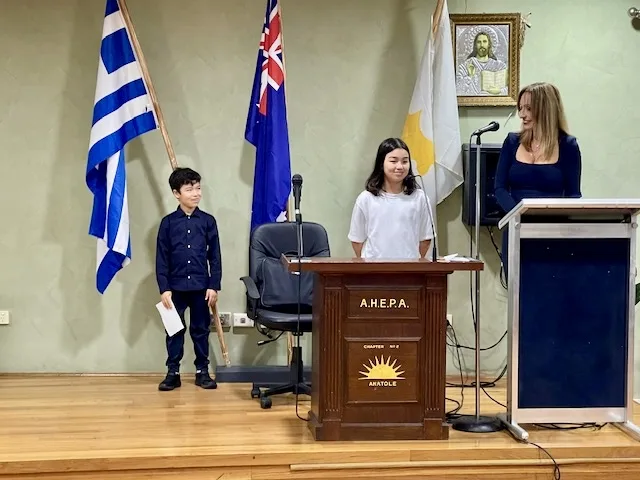
A highlight of the program was the participation of two young students, Katerina and Alexandros from St Gerasimos Greek Language School in Leichhardt, who recited poems that beautifully captured the spirit of OXI Day. The poems were thoughtfully arranged by Charoulla Themistokleous.
The national anthems were performed by Jim Tsolakis from the Australian Hellenic Choir, and the Ode by Peter Tsigounis, President of the Greek Returned Servicemen League.
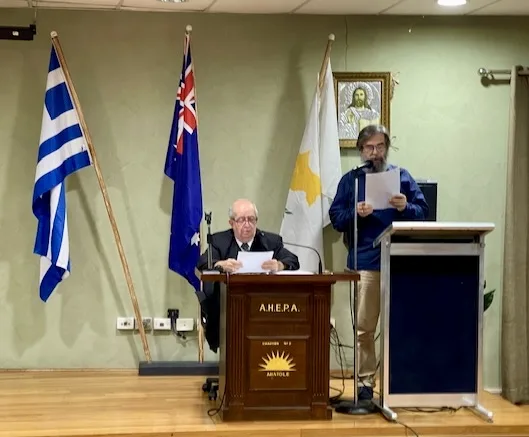
The keynote address was delivered by Ioannis Theodoridis, whose insights into the historical and cultural significance of OXI Day resonated deeply with attendees. The program also featured evocative poetry recitations by Dr Vasilis Adrachtas, with Nia Gitsas serving as the master of ceremonies.
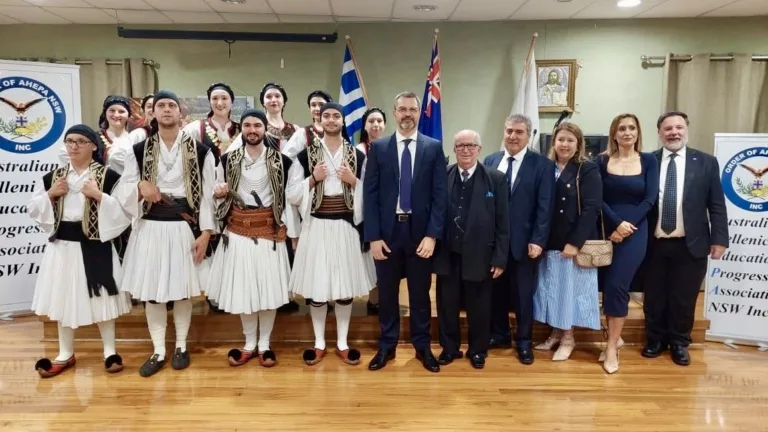
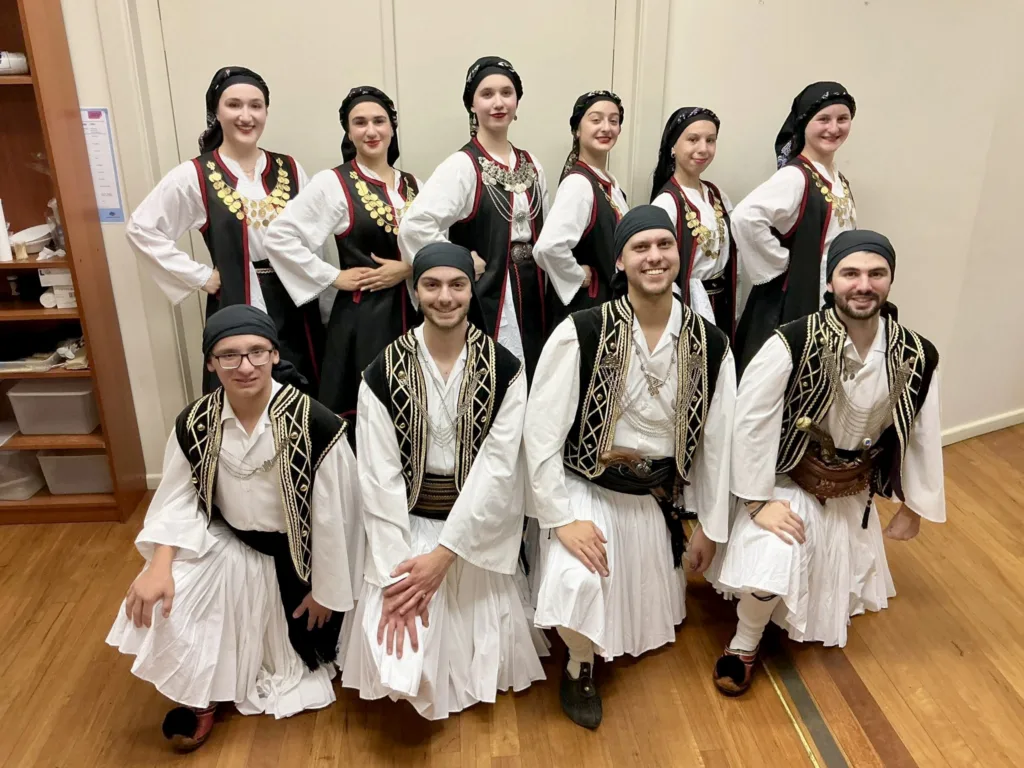
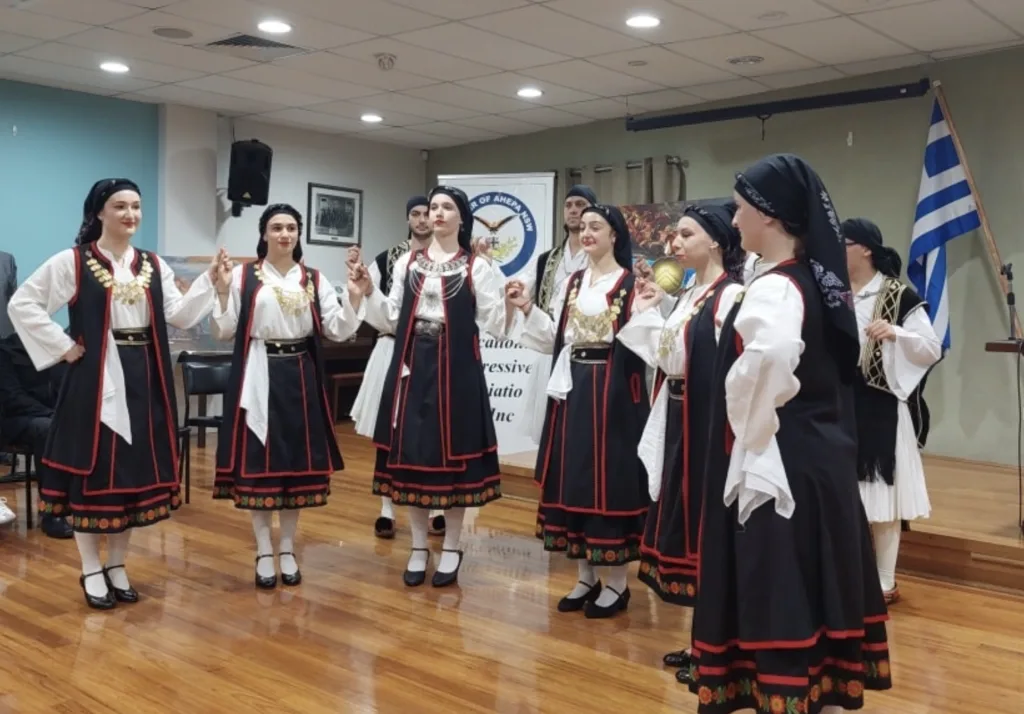
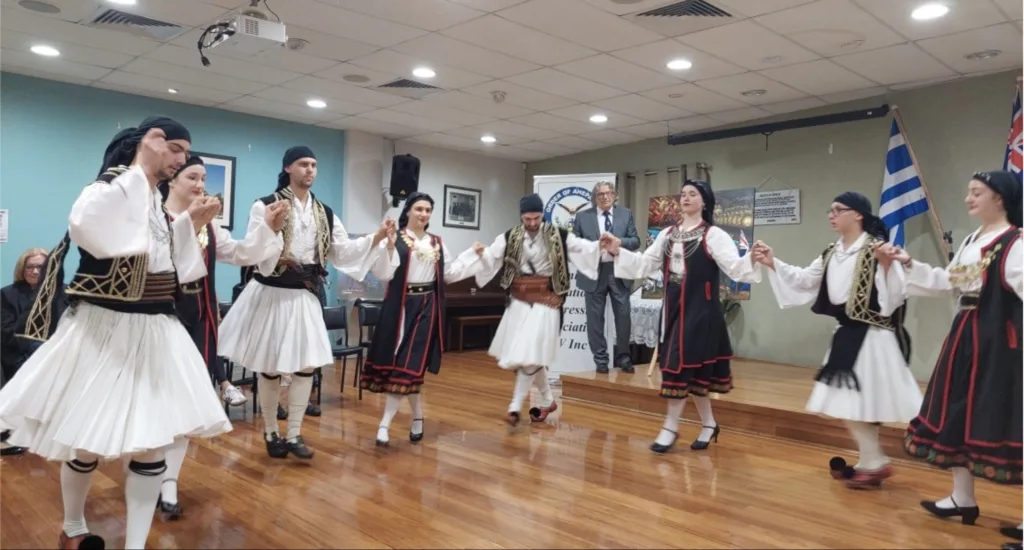
At the invitation of AHEPA Sydney & NSW Inc, the Kogarah School of Greek Dancing presented a special tribute to the heroic Hellenic Army’s VIII Division and the Women of the Pindus Mountains, who led the resistance to the fascist invasion of Hellas on 28 October 1940.
The talented dancers performed four dances from the Epiros region of north-west Hellas, where the heaviest fighting occurred between October 1940 and May 1941. They performed Kophtos (“to cut”)—named for the periodic interruptions in its rhythm; Sti Kentimeni sou Podia (“About your embroidered apron”); Zagorisios from the Zagori district of Epiros; and Nerantzia (“Bitter Orange”).
Formed only six months ago, the Kogarah School of Greek Dancing is an activity of the Orthodox Parish of the Resurrection of the Saviour, Kogarah, and welcomes everyone interested in learning about traditional Hellenic culture. Rehearsals are held Monday evenings in the Hermes Lounge.
AHEPA Sydney & NSW Inc extends its gratitude to all participants and attendees for making this event a memorable tribute to courage, freedom, and cultural pride.
Today marks 50 years since the passage of the Racial Discrimination Act 1975 (RDA) – the landmark legislation that made racial discrimination unlawful in Australia and laid the foundation for a more inclusive and equitable nation.
Introduced under the Whitlam Government, the Act transformed Australia’s moral and legal landscape, giving legislative force to the principle that equality must be both protected and lived.
For many, including Greek Australian lawyer Dean Kalymniou, the anniversary is deeply personal. A lifelong admirer of Gough Whitlam, Kalymniou views the Act not only as a cornerstone of modern Australian justice, but as an enduring reflection of Whitlam’s belief that multiculturalism is central to democracy.
Speaking to The Greek Herald, he reflects on his encounters with Whitlam, the influence of Hellenic thought on Whitlam’s vision, and the ongoing challenge of turning legal equality into lived reality.
You have spoken before about your admiration and personal connection to Gough Whitlam. How did that relationship shape your own understanding of justice, equality, and Australia’s multicultural identity?
My association with Gough Whitlam shaped my understanding of justice as a living discipline rather than an abstract ideal. Through his example I learned that equality demands participation, dialogue, and the courage to enlarge the moral boundaries of a nation. Whitlam dared to regard migrant Australians as partners in a shared enterprise, and in that recognition lay a quiet revolution.
For Greek Australians, his leadership was an affirmation of belonging. His government broadened access to education and welfare and created structures that treated cultural identity as an integral part of citizenship. Translation services, community language programs and migrant resource centres expressed a philosophy of inclusion. When the Racial Discrimination Act of 1975 became law, equality was no longer an aspiration but a right.
Whitlam’s bond with Hellenic civilisation deepened this vision. He had studied ancient Greek and retained a lifelong affection for its clarity and balance. When speaking at Greek community events, he often used phrases in our language and spoke with ease about our poets and philosophers. Those gestures affirmed that our heritage had entered the national story, that we were participants, not guests. Through him I came to see that justice depends on mutual recognition, and that a nation’s greatness is measured by the dignity it extends to all its citizens, not just a privileged few.
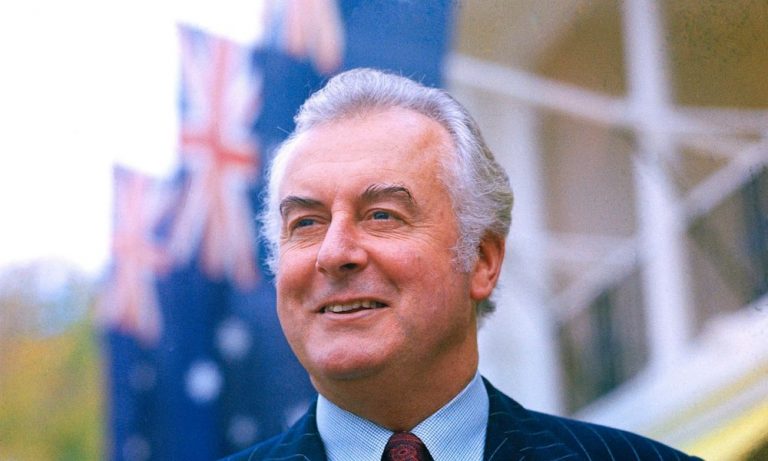
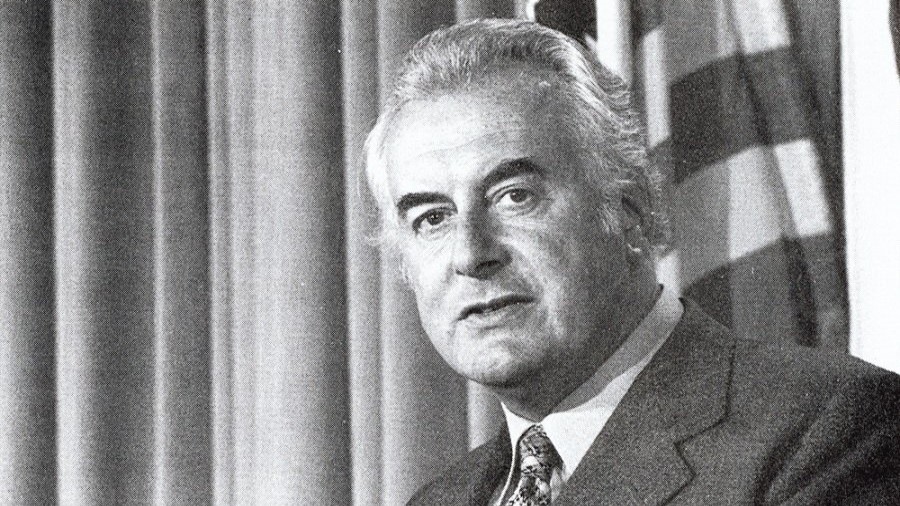
Gough Whitlam.
Can you share how your friendship or encounters with Gough Whitlam began? What impression did he leave on you personally and professionally?
I first met Gough Whitlam when I was 18, decades after his time as Prime Minister, at a Greek community function in Melbourne. Although he no longer held office, the admiration surrounding him remained palpable. People crowded around, eager to greet him, yet when I approached and told him that I considered him a great Australian, he took me aside at me and asked, with characteristic composure, “What do YOU think constitutes a GREAT Australian?”
That exchange began a friendship grounded in conversation and curiosity. What struck me was his attentiveness. Even amid noise and bustle, he listened as if that moment alone mattered. In later meetings he retained the same calm interest, asking questions that provoked deep reflection.
In our exchanges over the years, he taught me that public life is an ethical vocation for all, that policy and law are instruments of moral imagination. Personally, I was moved by his civility and his capacity to draw wisdom from anyone willing to engage in honest thought. His influence endured because it was founded on respect, the rare quality that makes leadership humane.
Is there a particular moment or conversation with Whitlam that has stayed with you — something that encapsulates his character or his vision for an inclusive Australia?
A moment that remains vivid is a conversation about the return of Gurindji land at Daguragu. As he recalled placing a handful of soil into Vincent Lingiari’s hand, his voice carried pride and solemnity. He described it as the reconciliation of law and conscience, a gesture that restored balance to the nation’s history. It was the embodiment of his conviction that justice must be anchored in the earth from which a people draws its life. I remember thinking that in that gesture there was something of the ancient rituals in which land and law were bound together. In that instant, Whitlam restored the moral grammar of a nation.
That account resonated deeply with me. The modern Greek story is one of dispossession and endurance, of lands lost and regained through faith and perseverance. As descendants of those who have known exile, we are instinctively attuned to those who work to heal injustice. In Whitlam’s act toward the Gurindji people, I recognised a truth that transcended politics: that moral restoration is the highest form of leadership.
Gough Whitlam had a long standing affection for Australia’s Greek community, recognising its contribution to multicultural Australia. How did he express that connection, and what did it mean to you personally as a proud Greek Australian?
Whitlam’s relationship with the Greek community was marked by warmth and genuine understanding. He saw Greek Australians as integral to the national story, a people whose experience enriched the moral fabric of the country. Having studied ancient Greek, he spoke of Hellenic culture with knowledge and admiration, and often addressed gatherings in Modern Greek. Such gestures carried quiet power. To hear the nation’s leader speak our language was to feel our identity affirmed.
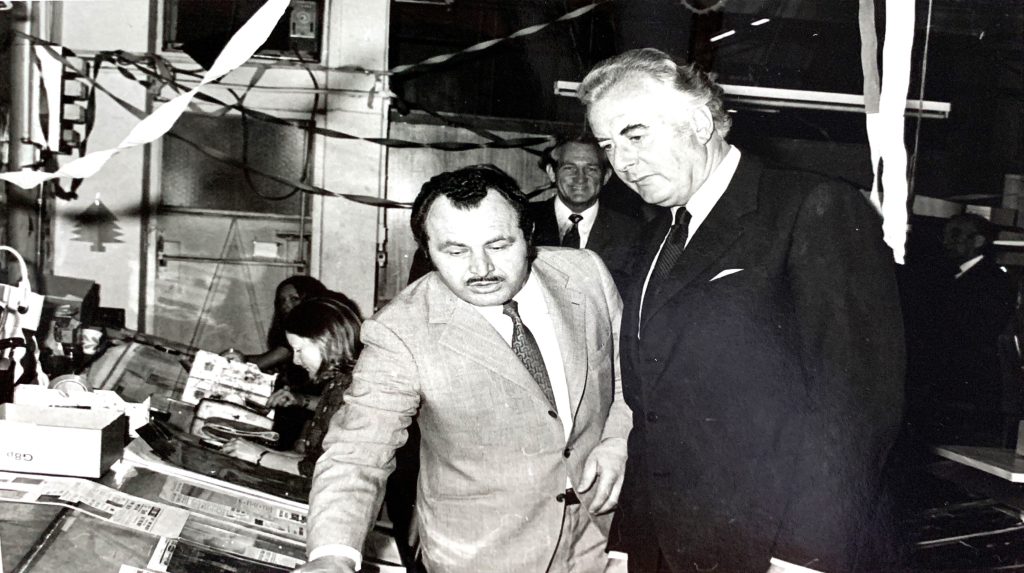
Gough Whitlam was a proud supporter of Greek Australians. Pictured here with the late Theo Skalkos at the Greek Herald presses.
He also championed the study of Modern Greek at Australian universities, arguing that education should reflect the society it serves. Through his advocacy, Greek language programs gained institutional standing and respect. He believed that the intellectual life of the nation should mirror its diversity, that every citizen’s heritage contributes to the whole. His engagement, however, extended beyond language.
When I once told him about the Pontian Genocide, he listened with characteristic attentiveness, and later wrote to me having undertaken his own research. He told me how profoundly moved he had been to discover that Dr H. V. Evatt, the great Labor statesman and jurist, had played a decisive role in formulating the legal concept of genocide in international law through his work at the United Nations. Whitlam’s curiosity was always ethical in nature. He was drawn to moral questions of memory and justice, to the ways in which history can be redeemed through understanding and acknowledgment.
He also spoke of his visit to the Acropolis and of his conviction that the Parthenon Marbles should one day return to Greece, for he believed that heritage belongs to the conscience of its people. Through gestures such as these, he joined the moral with the cultural, recognising that justice and beauty arise from the same source.
It was evident to me that he recognised in Greek Australians a people who had preserved dignity through hardship and who understood the meaning of democracy because they had inherited its ancient vocabulary. His attentiveness reinforced in me the conviction that Australian identity is a dialogue, and that our voice within it carries equal authority.
Whitlam often spoke about democracy, philosophy and civic duty — values deeply rooted in Hellenic thought. Do you think his admiration for Greek culture influenced his political vision, and how has that shaped your own outlook as a member of the diaspora?
Whitlam’s political imagination drew upon a serious engagement with Greek thought. He saw in classical philosophy a mirror through which a society might examine its conscience. The Athenian experiment inspired his belief that democracy is a discipline of mind, sustained by reasoning citizens rather than passive subjects.
He often reflected that the worth of a state lies in the moral intelligence of its people, a view that echoes the Greek conviction that politics is an extension of ethics. This spirit gave his reform program its depth. His pursuit of educational access, cultural pluralism, and social justice flowed from the belief that a nation prospers when all its people are empowered to contribute. In this, he resembled the philosopher statesmen of the classical age: he wanted to govern through the persuasion of ideas rather than the manipulation of interests.
When we spoke about Greek history, his curiosity was boundless. I once told him of Eumenes’ reforms in Heliopolis, that remarkable Hellenistic experiment in civic equality, and he was fascinated by its attempt to reconcile idealism with administration. Years later, I described to him the revolt of the Zealots in Byzantine Thessaloniki and their vision of a society free from hierarchy. He listened with delight and wonder. Both episodes appealed to his sense of justice and his faith in human perfectibility. He recognised in those distant moments of Greek history the same moral energy that animated his own life, the conviction that governance must mirror ethical order. Accordingly, Whitlam invited us, the descendants of migrants, to see our heritage as contributing to a continuing conversation between justice and statecraft.
This year marks fifty years since the Racial Discrimination Act became law under Gough Whitlam’s government. As both a lawyer and someone with a personal connection to Whitlam, what does this milestone represent to you?
The 50th anniversary of the Racial Discrimination Act invites reflection on how far we have travelled in our pursuit of formal as well as substantive equality. Passed in June 1975 and coming into force that October, the Act gave legislative form to Whitlam’s conviction that equality must be protected by law if it is to flourish in society. It was an act of moral clarity and political courage.
As a lawyer, I regard the Act as one of the most lucid expressions of justice in our statute book. It translated moral principle into enforceable language, providing redress to those whose dignity had been denied. It required the nation to see discrimination as an affront to its conscience. The Act has endured because it was built on conviction rather than expedience. It stands as his testament, a reminder that equality must be renewed through vigilance and the quiet labour of justice.
From a legal perspective, how transformative has the Racial Discrimination Act been in shaping Australia’s human rights landscape? Are there any landmark cases or reforms that, in your view, best demonstrate its enduring importance?
The Racial Discrimination Act reshaped Australian law by giving equality a legal and moral foundation. It affirmed that the protection of human dignity is a duty of the state.
In Koowarta v Bjelke Petersen, the High Court upheld the Act against constitutional challenge, confirming that the Commonwealth could legislate for human rights under the external affairs power. This decision anchored fairness within the constitutional order and made the defence of equality a federal responsibility.
In Gerhardy v Brown, the Court deepened the meaning of equality, recognising that laws designed to assist disadvantaged communities may advance justice rather than compromise it. Later, in Jones v Scully and Toben v Jones, the courts extended the Act to the realm of public speech, condemning anti-Semitic vilification both in print and online. These cases established that the dignity of ethnic minorities is integral to civic peace and that free expression carries with it an ethical duty of respect.
Together, these judgments revealed the quiet strength of the Act. Through them, the law became a custodian of civility, binding the many strands of the nation into a single moral fabric. It endures because it reflects a truth at the heart of Australian life, that dignity shared among many does not divide a nation, it completes it.
Despite half a century of progress, systemic racism still exists in many parts of Australian society. Where do you see the biggest gaps between the Racial Discrimination Act’s intent and the reality people experience today?
Half a century on, the Racial Discrimination Act remains a guide to conscience, yet its vision is fulfilled only through constant effort. The law forbids discrimination, yet inequality still shadows education, employment, housing, and justice. These are the unseen domains where unfairness survives through habit and neglect.
Those most in need of protection often lack the means to claim it. Legal redress can seem remote or daunting, and justice must be made accessible before it can be effective. Equality is achieved when fairness becomes a habit of life, not merely a right of appeal.
We must commit to these laws with renewed resolve. The world around us shows how swiftly societies can fracture and how easily fear can turn neighbour against neighbour. Australia has known such moments, from the Cronulla riots to the recent wave of anti-Semitic violence, yet we have also shown resilience. The instinct for decency still outweighs the impulse to divide. We remain a country capable of strong disagreement conducted with respect.
The Racial Discrimination Act continues to remind us that unity is sustained through civility and that a nation’s worth lies in how it hears its most vulnerable voices. To live by that principle is to keep faith with Whitlam’s vision of a society where freedom and respect walk together.
Gough Whitlam once said, “The real test of any government is not how popular it is, but how it treats those in need.” In that spirit, how can today’s leaders and the legal community uphold and extend the vision that inspired the Racial Discrimination Act fifty years ago? What part can the Greek community play in this?
Whitlam’s words still define the measure of leadership. The test of government is compassion translated into policy, and the test of law is the protection it affords to those who stand at the margins. The Racial Discrimination Act was conceived in that spirit and remains a living covenant between the state and its citizens.
Leaders today must recover the moral courage that animated Whitlam’s reforms. The legal profession must continue to preserve the integrity of justice, ensuring that it remains accessible and relevant to new generations. True equality requires vigilance and the capacity to calm division before it becomes resentment.
Whitlam believed that language was the breath of identity, and through the establishment of multicultural broadcasting he ensured that the many voices of Australia could be heard in their own tongues. In doing so, he gave form to the principle that cultural recognition is inseparable from democratic freedom. We must preserve it.
The Greek community has a distinct part in this continuing work. Our history, both ancient and modern, has taught us the meaning of exile and renewal. As heirs to a civilisation that gave the world the language of democracy and as migrants who once stood at the periphery of Australian life, we understand both privilege and vulnerability. This dual inheritance enables us to foster dialogue and empathy in an age that sorely needs both. Our own journey, from the uncertainty of arrival to full participation, mirrors the nation’s passage from exclusion to recognition.
We honour Whitlam’s legacy when we champion education that celebrates diversity, build bridges across communities, and stand beside those who face exclusion. Our presence here played a large role in constructing Australia’s broader generosity at a time when it could have chosen to embrace insularity instead. It falls to us now to extend that generosity to others. In doing so, we sustain Whitlam’s faith that the greatness of a nation is seen in the breadth of its humanity and in the embrace it extends.