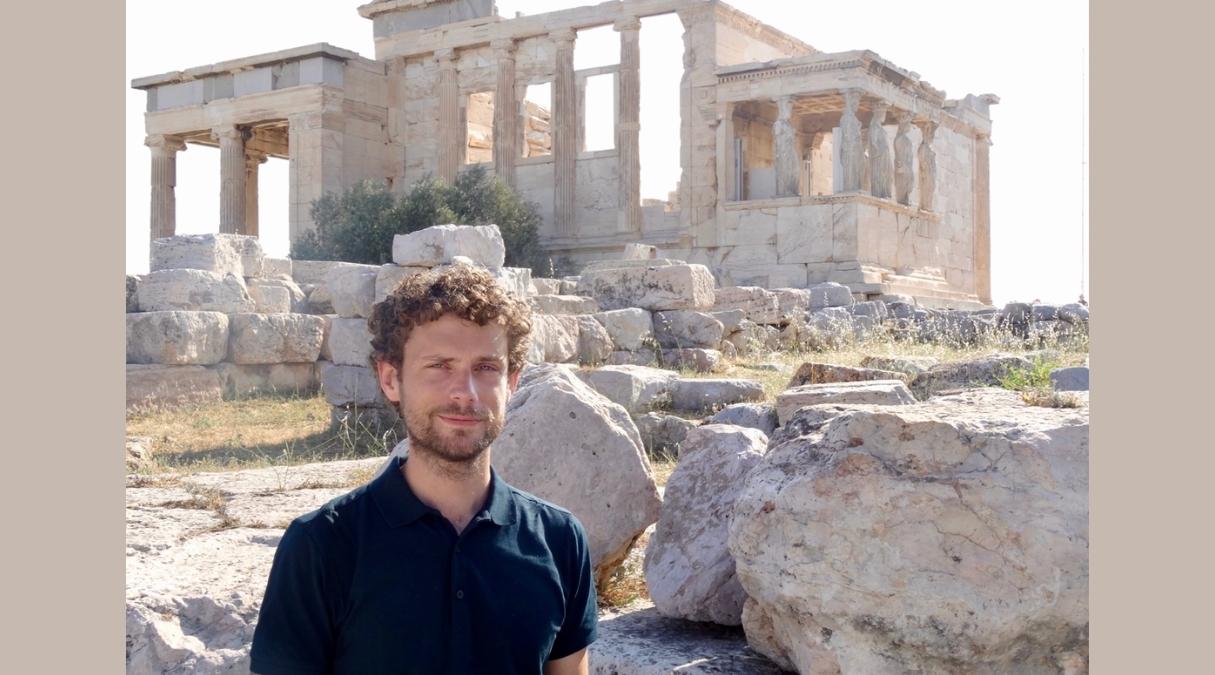
The Acropolis of Athens is the best-known archaeological site of Greece. But that does not necessarily mean that it is well understood. Among the scholars who try to uncover its ancient secrets is Dr. Janric van Rookhuijzen, researcher at Utrecht University in the Netherlands.
In 2019, he published an article concluding that the name “Parthenon” (an ancient Greek term meaning ‘room of the virgins’) originally belonged not with the great temple of Athena on the Acropolis, but rather with an entirely different temple of the goddess nearby: the one whose roof is supported by iconic virgin statues called caryatids. The theory caused quite a stir among archaeologists and the wider public.
Though many welcomed the new theory, not everyone is entirely convinced yet. Van Rookhuijzen is nevertheless pleased to have renewed the debate. “We have to keep an open mind about the Acropolis buildings rather than take for granted what we thought we knew. The traditional views are often centuries old, based on unconfirmed assumptions, and do not explain all the data from inscriptions and historical texts.”
Van Rookhuijzen is now ready to share a new provocative insight on the temple of the caryatids. The building is today commonly known as the Erechtheion – the sanctuary of the mythical Athenian king Erechtheus. The ancient Athenians believed that Erechtheus was an alter ego of Poseidon. “However, many archaeologists are not happy with the traditional idea that the caryatid temple was the Erechtheion. They think that the Erechtheion needs to be sought elsewhere.”
In his new study in the academic journal Kernos, van Rookhuijzen analyzed all historical sources for the Erechtheion, to confirm that the Erechtheion cannot be identified with the temple of the caryatids. Ancient authors, such as the playwright Euripides, rather describe the Erechtheion as a destroyed, yet sacred site in the middle of the Acropolis.
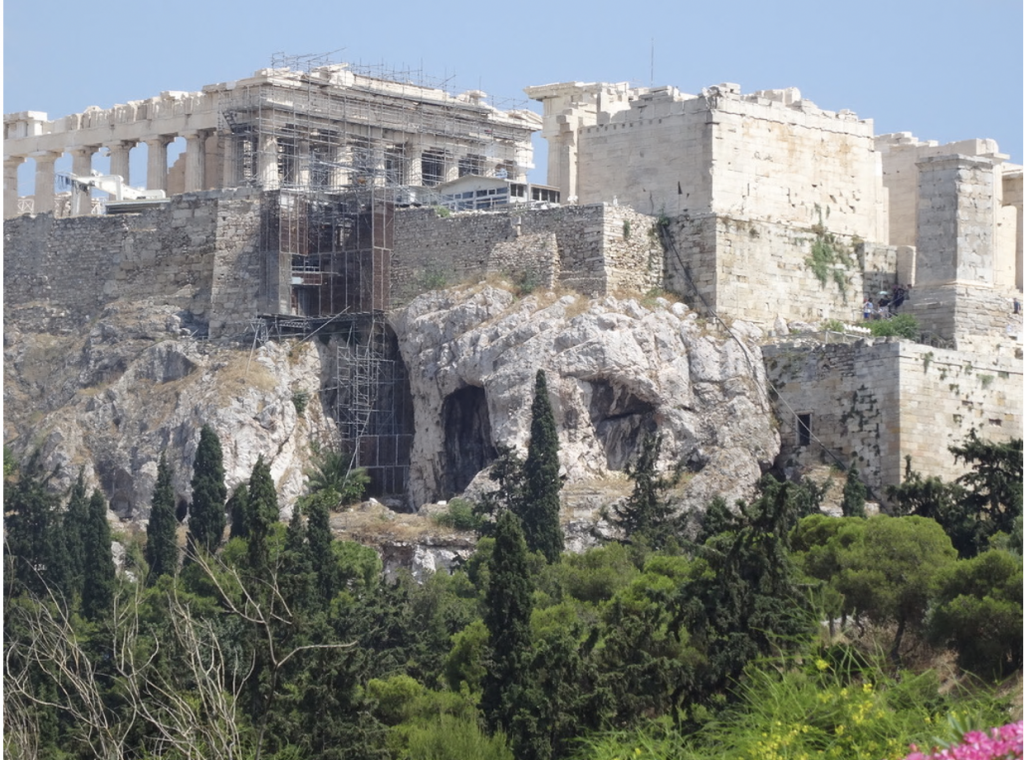
As it happens, the middle of the Acropolis sports a mysterious structure: the massive foundation of an ancient temple. The temple itself has long vanished after it fell victim to the invading Persians in 480 BCE. Nevertheless, the Athenians continued to venerate the sacred site itself for centuries. After antiquity, the structure was forgotten and rediscovered as late as 1885 by the renowned German archaeologist Wilhelm Dörpfeld. Van Rookhuijzen believes that the foundation could just be the elusive sanctuary of Erechtheus: “This sacred structure ticks all the boxes of the Erechtheion.”
The long-held, but probably erroneous belief that the temple of the caryatids was the Erechtheion is partially based on the idea that a mark of Poseidon’s trident was visible in a gap of the caryatid temple’s pavement. However, the ancient sources point in a different direction for that trident mark.
Van Rookhuijzen explains: “An ancient visitor to Athens wrote that the enormous trident mark was to be seen from a distance in the north face of the Acropolis. As it happens, three caves here seem to form the impression of a trident. Ancient Athenians apparently believed that Poseidon had thrusted his mighty weapon into the rock and created the caves. I was rather surprised that no-one before me has come up with this idea. If I’m correct, Poseidon’s trident mark was all this time hidden in plain sight.”
The Acropolis is not only a contested place for scholars. In one of the world’s most prominent cases of disputed heritage, many of the temple sculptures (including one of the caryatids) were taken to the United Kingdom in the early nineteenth century by Lord Elgin. They currently reside in the British Museum in London. Since the 1980s, calls for the return of the artworks to Athens have been numerous and loud, particularly from Greeks all around the world.
“The calls for restitution show how the Acropolis is in the hearts and souls of the Greeks, and many other people as well” notes van Rookhuijzen. From his position as a scholar, he remarks that it is undesirable that one of the most important legacies of Greek antiquity is divided over different places. “Leaving aside the extremely complicated legal considerations and understandable emotions on both sides, the current situation just doesn’t make sense. How can we fully appreciate and understand these artworks if they continue to be divided?”
Change is in the air as a piece of the great frieze of the Parthenon (the great temple, to be precise) was recently returned from Palermo’s Antonio Salinas Archaeological Museum to Athens in a loan arrangement. Thousands of years after their creation, new chapters continue to be opened for the ancient temples: “The Acropolis of Athens is among the most fascinating archaeological sites of the European continent. It deserves careful preservation, study, and contemplation. Its story is far from told.”

