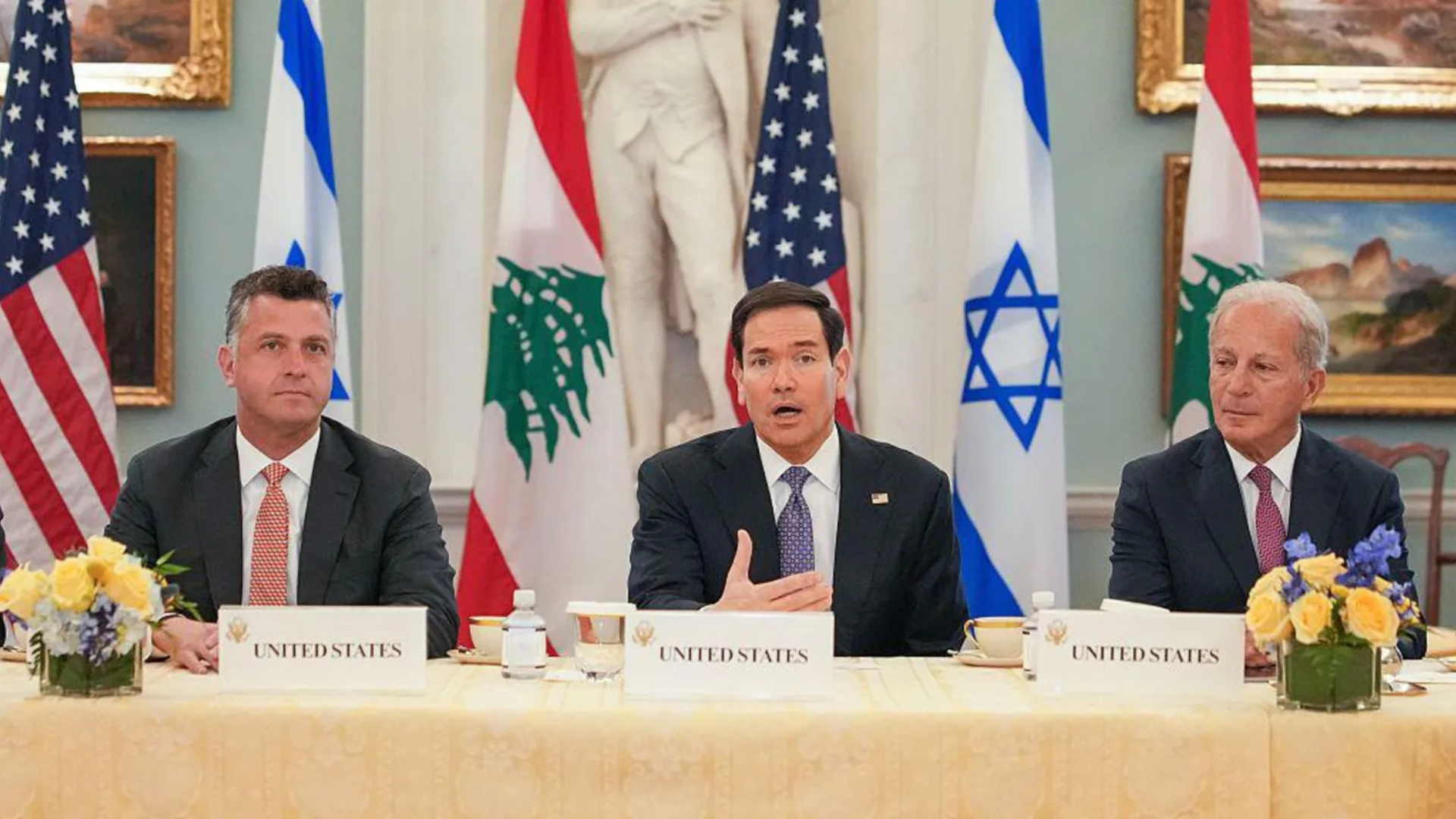
Israel and Lebanon have held their first direct diplomatic talks since 1993, in a rare meeting aimed at ending hostilities linked to Hezbollah, as international pressure mounts for a broader regional de-escalation.
The talks, mediated by Marco Rubio in Washington, were described as a “historic opportunity” to curb Hezbollah’s influence. A US statement said both sides agreed to launch direct negotiations at a time and place to be determined.
Israel reiterated its goal of disarming “all non-state terror groups,” referring to Hezbollah, while Lebanon called for a ceasefire and measures to address its humanitarian crisis.
A US official added both sides had agreed to work towards reducing Hezbollah’s influence, while Washington reaffirmed “its support for Israel’s right to defend itself.”
Speaking ahead of the meeting, Rubio said the process would take time but was worthwhile, calling it “a historic gathering that we hope to build on.”
Lebanese President Joseph Aoun said he hoped the talks would “mark the beginning of the end of the suffering of the Lebanese people in general, and those in the south in particular,” stressing the “only solution” was for the Lebanese armed forces to be “solely responsible for the security of the area.”
However, Hezbollah signalled it would not be bound by any agreement. Senior official Wafiq Safa said: “We are not bound by what they agreed to.”
The meeting comes amid escalating violence, with more than 2,000 people killed and around one million displaced since fighting began on March 2. While talks were underway, Hezbollah claimed at least 24 attacks on Israel, with air raid alerts sounding across northern Israeli communities.
International Foreign Ministers call for Lebanon’s inclusion in de-escalation efforts
The talks come as 18 European foreign ministers, including Greece’s George Gerapetritis and Australia’s Penny Wong, issued a joint statement urging Lebanon’s inclusion in regional de-escalation efforts.
The ministers called on all parties to pursue a lasting political solution and welcomed President Aoun’s initiative to open direct talks with Israel, as well as Israel’s acceptance of US mediation.
“We, Ministers of Foreign Affairs… call for the inclusion of Lebanon in the regional de-escalation efforts and urge all parties to work toward a lasting political solution,” the statement read.
They warned the ongoing conflict risked undermining broader regional stability, adding: “Direct negotiations can pave the way to bring lasting security for Lebanon and Israel as well as the region. We stand ready to support them.”
The group strongly condemned Hezbollah’s attacks on Israel and Israeli strikes on Lebanon on April 8, which reportedly killed more than 350 people and injured over 1,000, stressing that “civilians and civilian infrastructure must be protected in accordance with international humanitarian law.”
They also condemned attacks on UN peacekeepers and reaffirmed support for Lebanon’s sovereignty, calling for full implementation of UN Security Council Resolution 1701.
The ministers pledged readiness to provide emergency assistance to more than one million displaced people in Lebanon, urging all sides to urgently de-escalate and seize the opportunity presented by the current ceasefire efforts.
