By Ilektra Takuridu.
The burning of the Ottoman flagship took place on the night from the 6th to 7th of June 1822 just off the Greek island of Chios.
The episode, which happened during the Greek War of Independence, was a retaliation for the massacre of Greeks living in Chios, that occurred two months earlier. In the burning of the flagship, 2,000 Ottoman sailors were slain, including the famous Nasuhzade Ali Pasha.
Torching the Turkish flagship:
The Greek War of Independence against the Ottoman Empire began in March 1821. It was an 8 year battle often referred to as ‘agonas‘ – “the struggle.” The revolution would result in Greece’s independence from the Ottomans after over 400 years of oppression.
In 1822, a year after the beginning of the war, Ottoman armies landed on and attacked the Greek island of Chios, killing around 30,000 locals and around 50,000 Greeks were kidnapped and sold as slaves in Izmir and Istanbul.
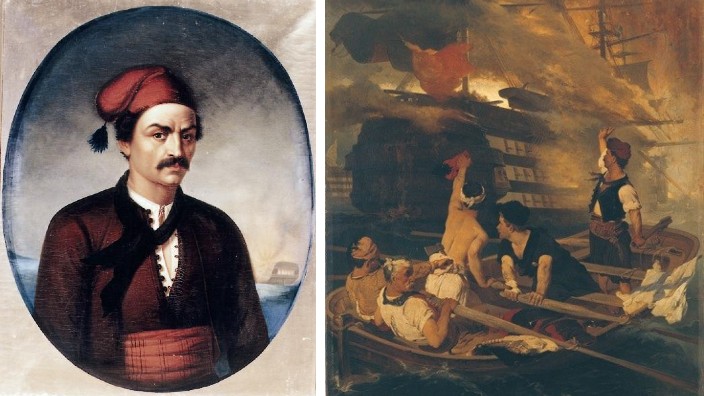
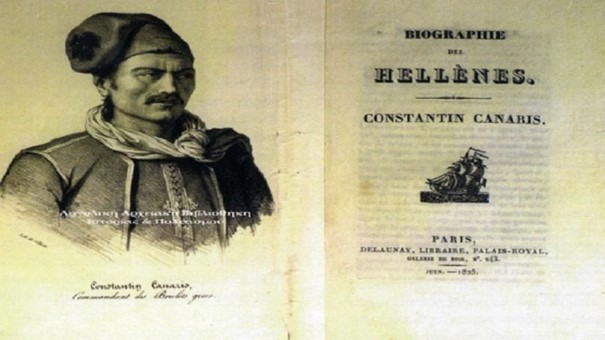
Konstantinos Kanaris was a Greek admiral, Prime Minister, and Greek War of Independence hero. He came to popularity and obtained hero status after the burning of the Ottoman ship.
Unlike most other major personalities of the War, Kanaris had never been inducted into the Filiki Eteria (Society of Friends), which played an important part in the uprising against the Ottoman Empire. The society was crucial in the uprising, mainly due to the secret recruitment of followers against Turkish authority, so it was even more impressive that Kanaris acted independently.
Kanaris himself planned to avenge those lost in the Chios massacre and organised 64 ships from Hydra, Psara, and Spetses to meet at Psara at the end of April and wait for an opportunity to strike the Ottoman forces.
Kanaris and Andreas Pipinos took control of the operation and after several failed attempts, an opportunity arose on the night of June 6 to June 7, 1822.
Turkish officers gathered on the flagship of the Turkish armada to celebrate the end of Ramadan. Pipinos attempted to burn the flagship’s rear, but despite significant damage it did not sink because the crew quickly saw the fireboat.
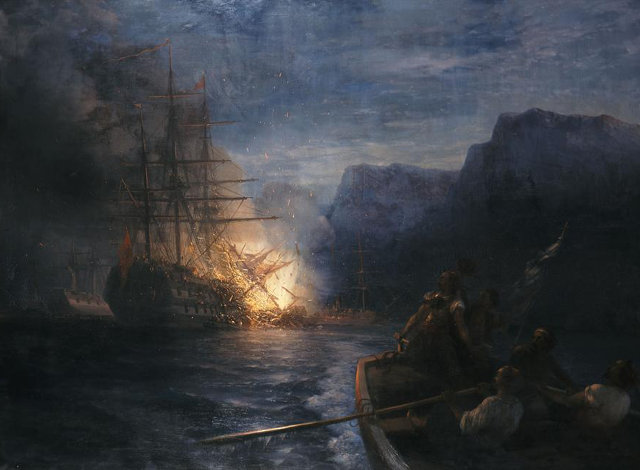
On the other hand, Kanaris managed to attach a ship he set alight to the Ottoman flagship. The Ottoman flagship ‘Mansue al-liwa’ was an 84 gun ship and was full of gunpowder storage.
The flames from Kanaris’ fire-boat reached the gunpowder storage, causing an explosion and sinking the ship. Approximately 2,000 men on board were killed, including Kara Ali, the perpetrator of the Chios massacre.
Kanaris’ victory was quickly spread around Europe. His action inspired famous European artists like Eugene Delacroix, Victor Hugo and Von Hess. A British historian wrote that he is the most outstanding and important representation of Greece’s courageousness and bravery.

