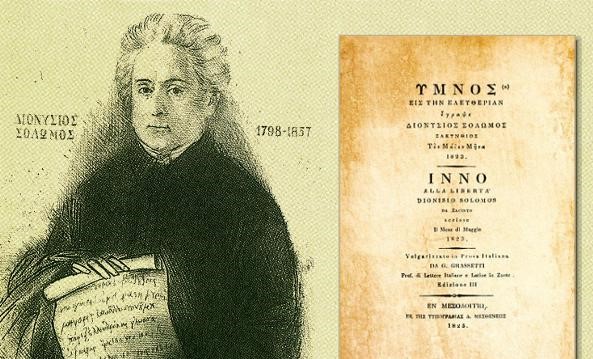
When you think of Greek national pride, the things that come to mind are both the Greek flag and the national anthem. Rich in symbolism and reminders of what the Greek people had to go through to gain their freedom, this anthem represents what modern-day Greece is all about.
Officially titled “Ýmnos is tin Eleftherían“ in Greek and the “Hymn to Liberty” or the “Hymn to Freedom” in English, this song is a reminder of not only how far Greece has come since the Ottoman Empire was officially defeated, but also of the journey that people took which ultimately led to their freedom.
Here’s a look at the history and biographical details of the iconic Greek national anthem.
Writing the ‘Hymn to Liberty’:
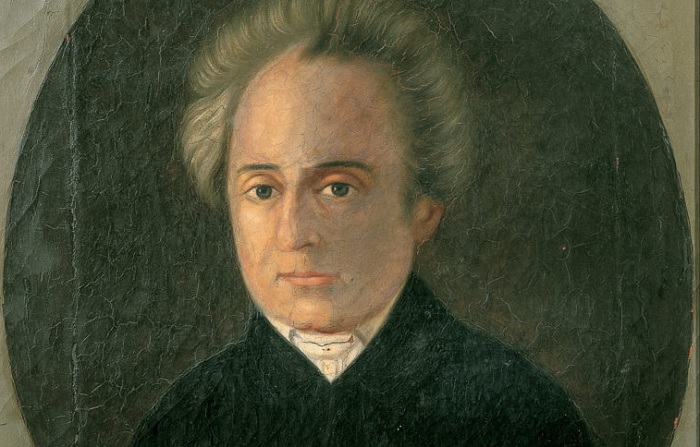
The Hymn to Liberty was written by 25-year-old Dionysios Solomos in Zakynthos in May 1823, at a time of great upheaval for the Greek Revolution.
His poem consists of 158 quatrains. The measure is trochaic with alternations of seven-syllable and eight-syllable verses. It is written in the Heptanese Style of poetry that originated from the Heptanese School of Literature, or literally the Literature School of the Seven Islands.
Here are some of the lyrics:
Σε γνωρίζω από την κόψη.
Του σπαθιού την τρομερή,
Σε γνωρίζω από την όψη,
Που με βιά μετράει τη γη.
Απ’ τα κόκκαλα βγαλμένη.
Των Ελλήνων τα ιερά,
Και σαν πρώτα ανδρειωμένη,
Χαίρε, ω χαίρε, ελευθεριά!
The National Anthem of Greece:
Between 1828 and 1830, the Hymn to Liberty was set to music by the famous composer Nikolaos Mantzaros and was heard with enthusiasm at national holidays in the Ionian Islands.
In December 1844, Mantzaros presented a new composition of the poem and submitted it to King Otto, hoping for it to become the “national song” of the country. The work was accepted only as a composition and awarded the Silver Cross of the Order of the Saviour.
But in 1865, during his visit to Corfu, King George I heard a version of Mantzaros’ composition by the band of the Corfu Philharmonic Society and it made an impression on him. This was followed by the Royal Decree of August 4, 1865, which characterised the poem as an “official national anthem” and was to be performed “by all the naval units of the Royal Navy.”
Since then, the Hymn to Liberty by Dionysios Solomos, set to music by Nikolaos Mantzaros, has been considered the national anthem of Greece.
From November 18, 1966 with the decision 6133 of the Council of Ministers, it was established as the national anthem of the Republic of Cyprus as well.

