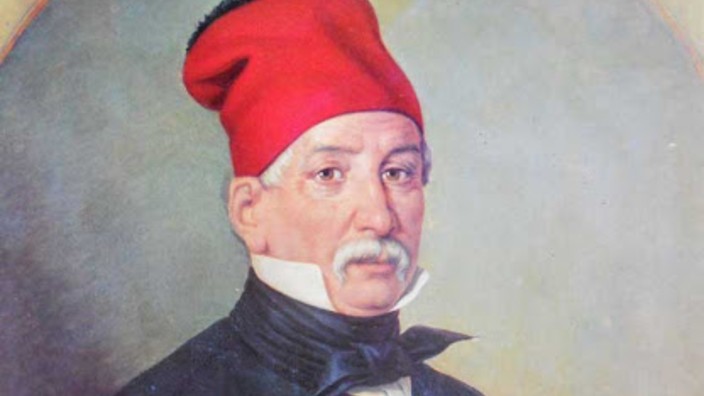
Georgios Kountouriotis was a well-known Greek ship-owner and politician during the 1821 Greek Revolution and the reign of Otto.
On this day in 1858, he passed away and to mark the day we take a look back at his incredible life achievements.
Early Life:
Georgios Kountouriotis was born in Hydra in 1782 and was the son of the merchant Andreas Kountouriotis and Maria Kokkini, daughter of the rich merchant Lazaros Kokkini.
The real surname of his family, which was of Albanian origin, was Zervas. “Kountouriotis” was a nickname which eventually prevailed as a family surname.
After the assassination of his father in 1799, Georgios, together with his older brother Lazarus, engaged in trade and shipping. Leading up to the Greek Revolution of 1821, their family owned half of the merchant ships of Hydra and he was considered the richest Greek of his time.
Support of the Greek Revolution:
Like most Hydra shipowners, Georgios considered the outbreak of the Greek Revolution premature and dangerous. However, when the people of the island revolted on March 27, 1821, he was forced to join the short-lived power established by Captain Antonis Oikonomou and to allocate large sums and his ships for the needs of the Struggle.
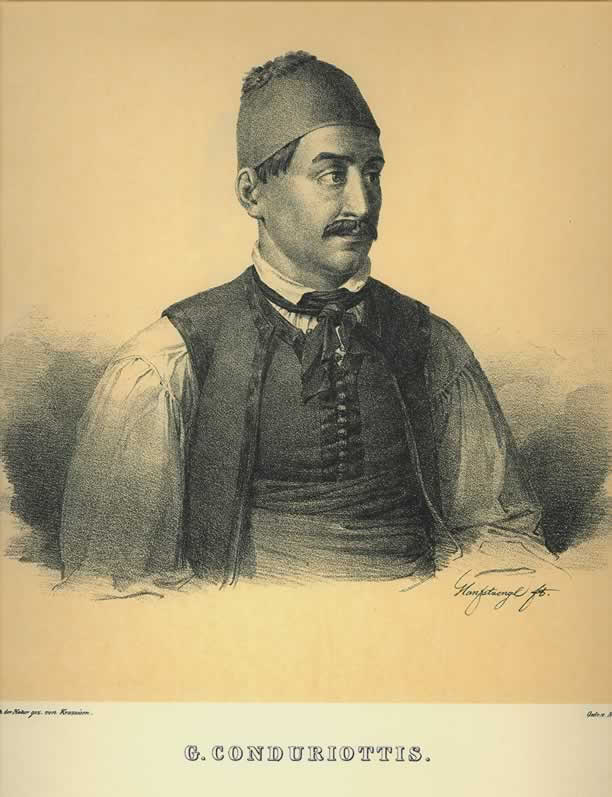
Georgios, although lagging behind in leadership skills over his brother Lazarus, excelled in politics. He participated as a proxy of Hydra in the 2nd National Assembly of Astros (1823), in the 3rd National Assembly of Troizina (1827) and in the 4th National Assembly of Argos (1829).
He appeared on the political scene at the end of 1823, when civil wars broke out between the Greek revolutionaries. At the urging of Alexandros Mavrokordatos, Georgios became a member of the new Executive (government) on December 19 and on January 6, 1824, he officially assumed the presidency.
Using his money, Georgios gained substantial superiority over his rivals. On June 12, 1824, after bloody fratricidal conflicts, his government settled in Nafplio. Much of the money from the loans was wasted in the civil strife, in meeting the demands of his political friends, as well as members of his family.
During his presidency, few measures were taken to strengthen the rebel areas. On the contrary, in 1824 the revolution in Crete was neutralised by the Turkish-Egyptian troops, while in the same year Kasos and Psara were destroyed.
After Ibrahim landed in Methoni (February 26, 1825), instead of appointing an experienced soldier (Karaiskakis, Kolokotronis, etc.) as commander of the army that had been sent to Egypt, Georgios named one of his naval compatriots, Captain Kyriakos Skourtis, instead.
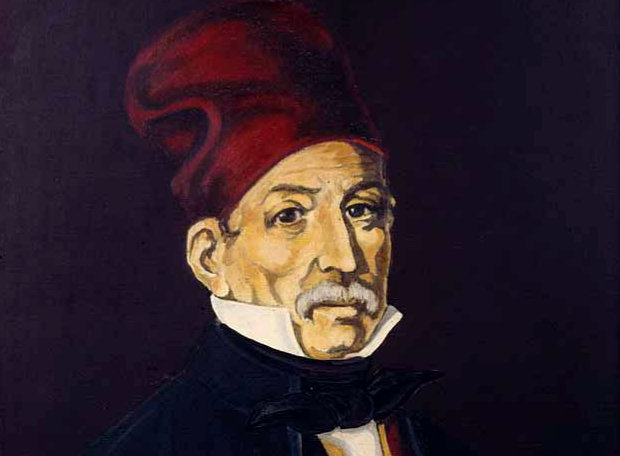
Georgios himself, with a ridiculous procession and oriental rhythm, set out for Messinia to be close to the chiefs and to coordinate their actions.
After the catastrophic defeat of the Greeks by Ibrahim at Kremmidi (April 7, 1825), Georgios returned to Nafplio and faced general outcry. After Papaflessas’ sacrifice in Maniaki (May 20, 1825), he was forced to release Kolokotronis, who was the only one able to face Ibrahim.
Georgios was also particularly criticised for the inaction of his government during the last siege of Messolonghi and its inability to supply even the most basic guard of the city. Georgios was forced to resign on April 12, 1826 and to withdraw to Hydra dissatisfied.
During the Third National Assembly in Troizina (March 19 – May 5, 1827), Georgios opposed the election of Ioannis Kapodistrias. However, after the arrival of the Governor in Greece on January 23, 1828, he was appointed adviser of the Economy of the Panhellenic. It was a position he did not hold for long because he soon joined the opposition.
After the Liberation and Death:
On August 14, 1829, Georgios was appointed by Kapodistrias a member of the newly formed 27-member Senate but did not accept his new position. He took an active part in the opposition actions against Kapodistrias in 1831 and led the apostasy of Hydra.
After the assassination of the Governor (September 27, 1831), he was appointed by the Senate a member of the Administrative Committee, which consisted of representatives of all political parties, but resigned in August 1832.

In the years of Otto, Georgios was appointed vice-president of the Council of State and followed a more moderate policy.
On March 8, 1848, he was appointed by Otto as chairman of the cabinet (Prime Minister) and took over the Ministry of the Navy. His government, which was essentially a coalition of the French and Russian parties, had to deal with a series of internal uprisings and strained relations with the Ottoman Empire.
Georgios remained in power until October 15, 1848, when he resigned, accusing the court environment of interfering in his work.
Bitter, he retired to Hydra, where he died on March 13, 1858, at the age of 76. Georgios belonged to the politicians who had entered the revolutionary struggle of the Greeks rich and came out poorer.
After his death, an honorary pension had to be given to his needy family.
Source: San Simera.
