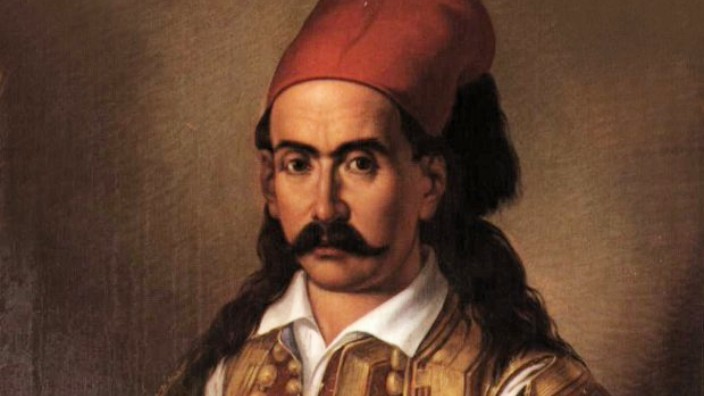
Markos Botsaris is known as a Greek General and hero of the Greek Revolution from Souli.
Early and Personal Life:
Markos Botsaris was born in Souli in 1790 and was the second son of Kitsos Botsaris (1754-1813), a leading figure of the Botsara lighthouse.
After the occupation of Souli by Ali Pasha in 1803 and the persecutions of the Souliotes that followed, he took refuge with his father and other compatriots first in Parga and then in Corfu. There he joined the ‘Albanian Regiment,’ formed by the French, and became one the regiment’s officers.
Despite his limited education, in 1809 he wrote a Greek-Albanian dictionary, the original of which is in the Library of Paris.
In 1810, he divorced his first wife due to infidelity and married for the second time, Chrysoula Kalogirou, daughter of the boatman of Preveza, Christakis Kalogirou, who gave him two children, Dimitrios Botsaris (1814-1871) and Katerina-Roza Botsari (1820-1872).
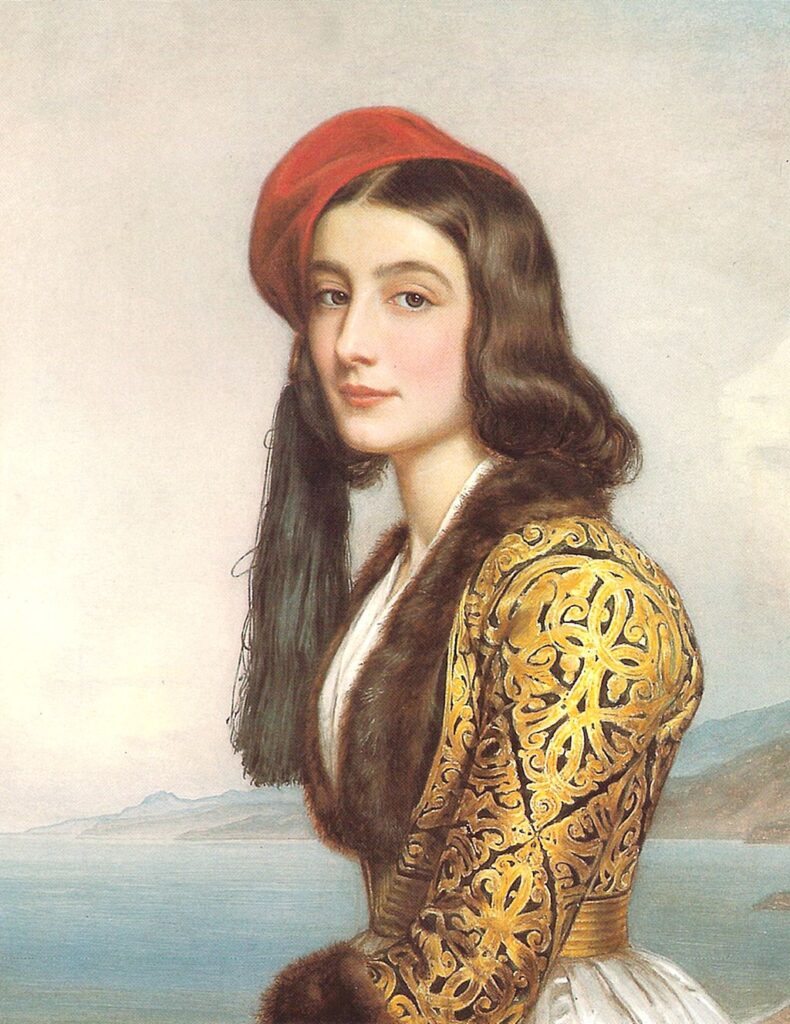
In 1813, Botsaris returned to Epirus and after the assassination of his father by the gunsmith, Gogos Bacolas, he settled with his family in Kakkolakos Pogoniou, where he was appointed leader of the region by Ali Pasha.
The same year, Botsaris became a member of the ‘Filiki Etaireia.’ In 1820, together with his uncle Notis and other Souliotes, he fought on the side of the sultan forces, which besieged the disobedient Ali Pasha in Ioannina, having received the promise that they would return to their homeland.
Seeing that the Turks were breaking their promise, Botsaris came to an agreement with Ali Pasha and asked him to repatriate the Souliotes, in exchange for their help in his fight against the Sultan’s troops. The relevant agreement was signed on January 15, 1821. His first success was the victory at Kampsades and Pente Pigadia and the occupation of the fortresses of Rigiasa and Riniassa.
Actions during the Greek Revolution:
After the outbreak of the Greek Revolution, Botsaris took part in the victorious battles in Kompoti Arta (3 July, 1821), Plaka (September 1821) and Dervizana (12 October, 1822). On November 12, 1821 he participated in the siege and the fall of Arta (November 17, 1821).
In the meantime, the Ottomans had captured his family, who remained in Kakkolakos. In March 1822, when Botsaris went with other Souli chiefs to the Peloponnese to ask for help from the provisional government, he succeeded in freeing his family, exchanging them with the harems of Khurshid Pasha who had been captured during the fall of Tripoli.
He sent the family to Ancona, Italy and he himself remained in the Peloponnese with Alexandros Mavrokordatos, whom he followed to Western Central Greece.
In May 1822, Botsaris persuaded Mavrokordatos to undertake a campaign in Epirus, with the aim of helping the people of Souli. At the end of June, with 1200 fighters, he headed from Kompoti to Souli.
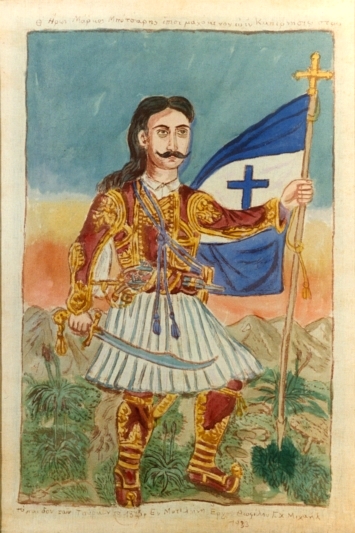
On June 29, near Plaka, they confronted the superior forces of Kioutachis and fled. On July 4, with 32 companions, he took part in the devastating battle of Peta, which marked the final surrender of Souli to the Ottomans.
On October 12, 1822, with the help of Alexandros Mavrokordatos, Botsaris was promoted to General, provoking the reaction of the other chiefs. Their attitude infuriated him and he tore the paper of his appointment in front of them, saying: “Whoever is worthy gets the diploma the day after tomorrow in front of the enemy.” This majestic act proves his selflessness and love for his homeland.
Botsaris then made a decisive contribution to the successful outcome of the first siege of Messolonghi (October 25 – December 31, 1822). With his ingenuity and cunning he lured the Turks into fake talks, giving the besieged time to strengthen their fortifications.
Death and Legacy:
In the summer of 1823, Markos Botsaris tried to block the way for the Turkish troops that were attacking from Trikala to the western mainland.
On the night of August 8-9, a group of 350 Souliotes attacked the 4,000 Turks of Mustai Pasha, who had encamped at Karpenisi. The surprise succeeded and Botsaris, although slightly wounded in the abdomen, proceeded towards Mustai Pasha, in order to capture him. But a bullet from an African pasha servant hit him in the eye and seriously injured him.
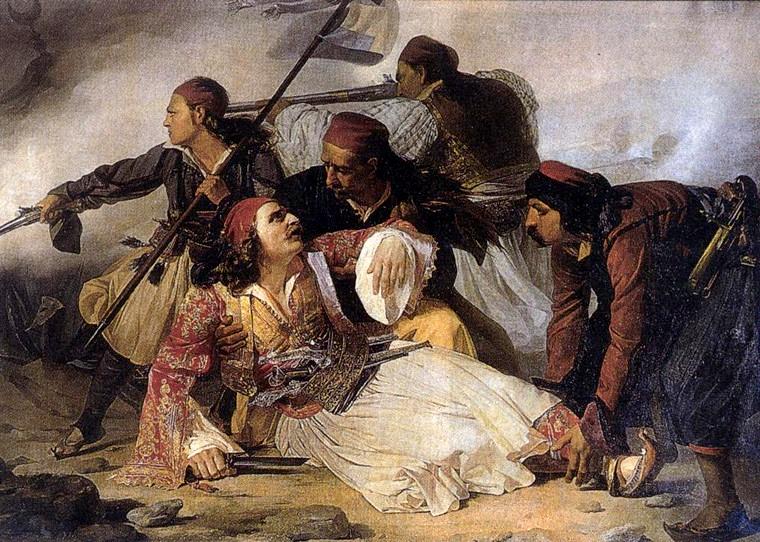
Botsaris passed away a few hours later. Then, his men, although victorious, stopped the battle to receive the body of their leader and the spoils.
Botsaris’ body was transported to Messolonghi on August 10, 1823 in a triumphant procession. His coffin was covered with a blue cloak. This was followed by the loot which were animals, weapons, tents, ammunition and the treasury of the enemies. The funeral ceremony took place in the church of Agios Nikolaos of the bastions.
The death of Markos Botsaris was praised by all. Dionysios Solomos wrote the poem “In Markos Botsari,” which likens the large influx of Greeks at the funeral of the hero with the influx of the Trojans in the burial of Hector.
Poems dedicated to Botsaris were written by the American poet Fitzgreen Halek, the Swiss poet and journalist Zist Olivier, and the French author Victor Hugo.
Source: San Simera.

