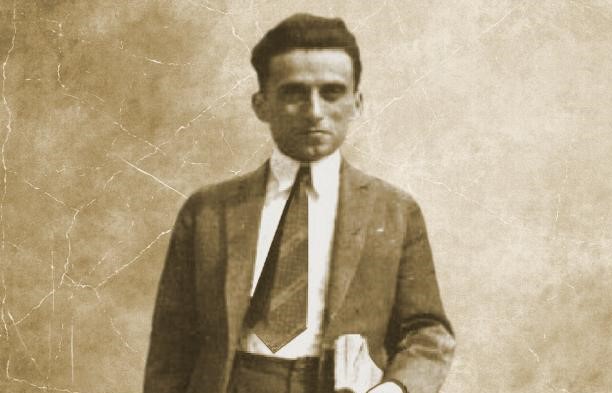
Poet and novelist, Costas Karyotakis, emerged in the generation of the 1920’s and is one of the first to introduce elements of modernism in Greek poetry. His work also influenced many of the later poets including Seferis, Ritsos and Vrettakos.
Early Life:
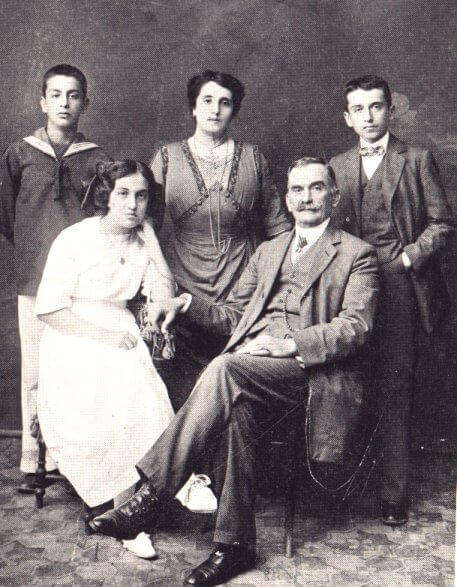
Karyotakis was born in Tripoli on October 30, 1896 and was the son of law engineer Georgios Karyotakis from Sykia, Corinth and Katigos Skagiannis from Tripoli. He was the second child of the family. He had a sister one year his senior, Nitsa, and a younger brother, Thanos, who was born in 1899 and worked as a bank clerk.
Due to his father’s job, his family had to move frequently. They lived in Lefkada, Patras, Larissa, Kalamata, Argostoli, Athens (1909-1911) and Chania, where they stayed until 1913.
His writing skills started to appear from an early age. At 16-years-old, Karyotakis published poems in children’s magazines and participated in literary contests, such as the short story contest of the children’s magazine “Edification of Children.”
In 1917, he graduated from Law School of the University of Athens with honors. At first he tried to practice law, but the lack of clientele pushed him to seek a civil servant position.
He was appointed to the Prefecture of Thessaloniki. After his final discharge from the Greek Army for health reasons, he was placed in various public services, including the prefectures of Syros, Arta and Athens. He enjoyed none.
Poetry:

His first poetry collection, “The Pain of People and Things,” was published in February 1919 and did not receive very positive reviews. In the same year, he published the satirical magazine “I Gamba,” but its circulation was banned after six issues. His second collection, entitled “Nipenthi,” was published in 1921.
In 1927, he published his last poetry collection “Elegy and Satyres.”
The poetry has no trace of philology, sentimentality and coquettishness which exists in abundance in the older poets. It exudes the feeling of futility, of being lost, its attitude is anti-heroic. Karyotakis wrote poems about the ignorant, the insignificant, even the ridiculous, as a protest which reaches sarcasm.
In addition to his poetic work, Karyotakis also wrote translations of foreign scholars such as Francois Villon, Charle Baptiel, Paul Verlaine, Tristan Corbier, Zan Morea and Heinrich Heine.
Death:
In February 1928, Karyotakis was seconded to Patras and a little later to Preveza. His correspondence with relatives during this period highlights his despair about provincial life and the small size of the local community.
On July 20, he went to Monolithi and tried for ten hours to commit suicide, trying in vain to drown. The next day on July 21, he bought a revolver and visited a cafe in Preveza. After spending a few hours alone smoking, he went to a nearby beach, Agios Spyridon, and ended his life under an eucalyptus tree.
Police found a note in his pocket explaining the reasons for his suicide (edited version): “… I am ready for an honorable death. I feel sorry for my unhappy parents, I feel sorry for my siblings. But I leave with my forehead up. I was sick.”

