By Dean Kalimniou
There are moments in the liturgical year when the Church, in the economy of her hymnography, speaks with a voice at once ancient and startlingly immediate, a voice that does not merely instruct but unsettles.
The Bridegroom Service of Holy Monday evening, that threshold vigil which ushers the faithful into the austere interiority of Great Week, belongs emphatically to this category.
Its central proclamation, “Behold, the Bridegroom comes in the midst of the night,” is neither ornamental metaphor nor poetic embellishment but rather an ontological summons, calling into being a mode of existence predicated upon vigilance, receptivity, and expectation. And yet, within this summons, there lies an underexplored dimension, one that bears profound implications for feminist theological reflection.
For the Bridegroom imagery, far from reinscribing hierarchies of domination, invites a reconfiguration of power, agency, and spiritual subjectivity. It does so by situating the faithful, not as passive recipients of divine initiative, but as watchful participants in a drama of encounter whose grammar is profoundly relational.
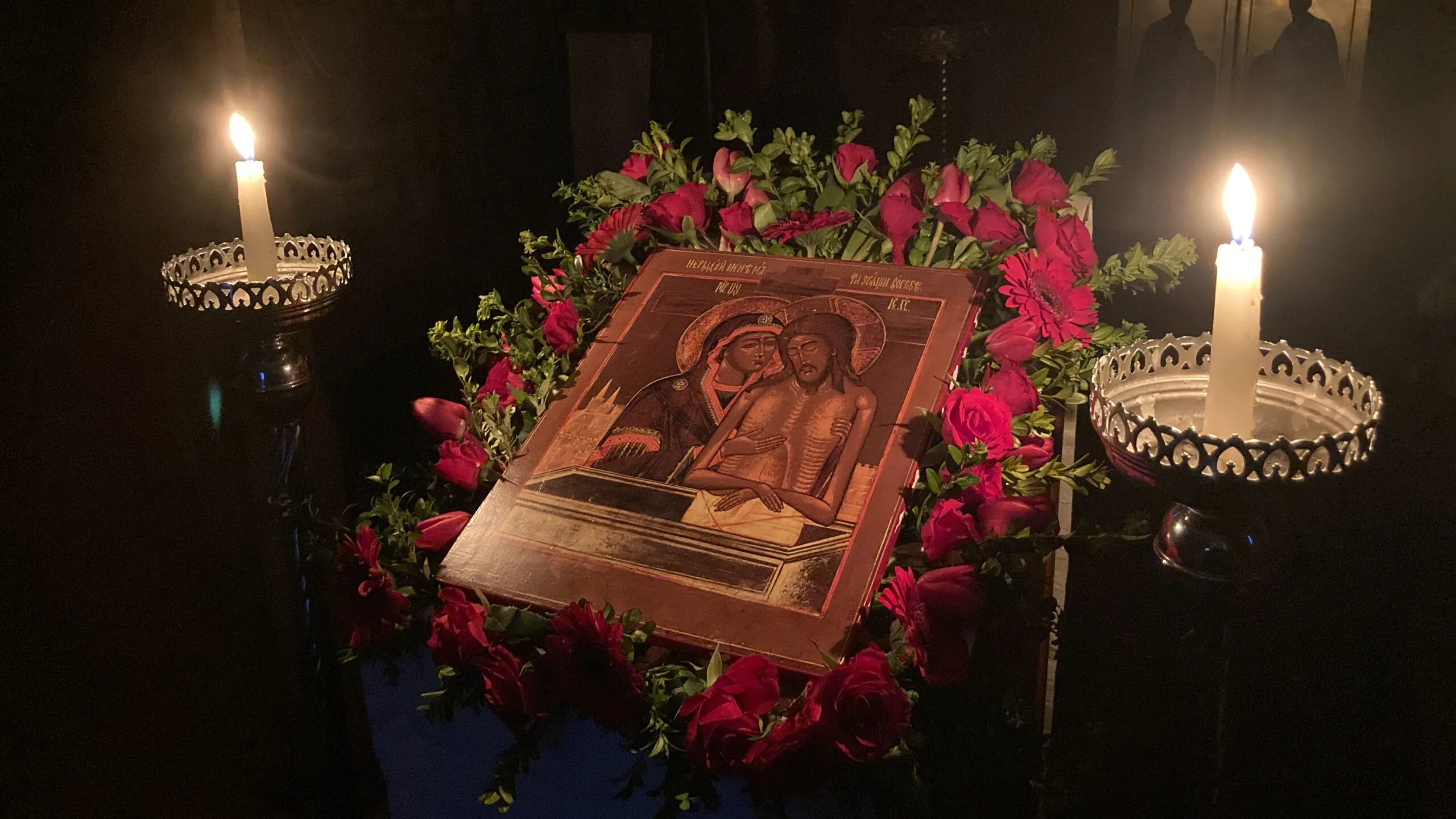
The service itself, as the liturgical text attests, derives its name from the parable of the ten virgins, whose preparedness or negligence determines their participation in the nuptial feast. The image is intimate, even disarmingly so. The Kingdom is not likened to a tribunal, nor to a battlefield, but to a wedding chamber. The Christ who approaches is not a distant sovereign but a Bridegroom, one whose arrival is anticipated not through fear but through longing.
Such imagery resists reduction to juridical categories, gesturing instead toward a theology of desire, one in which the soul is construed as capable of response, of readiness, of love. This nuptial grammar participates in a wider patristic tradition in which desire is not extinguished but intensified.
In Gregory of Nyssa, the soul’s movement toward God is one of unending ascent, an epektasis in which fulfilment does not terminate longing but deepens it. Likewise, in Maximus the Confessor, eros is transfigured into the dynamic orientation of the human person toward communion. The Bridegroom, therefore, does not resolve desire into stasis, but draws it into ever greater depth.
It is precisely here that a feminist reading begins to take shape. For in the patristic and liturgical tradition, the soul, irrespective of the biological sex of the believer, is consistently feminised. This is not incidental. It is constitutive. The human person, in relation to God, is figured as receptive, as awaiting, as capable of being filled with divine presence. In a world where receptivity has often been coded as weakness, the liturgy reclaims it as strength. The vigilant virgin is not inert. She is discerning, guarding the oil of her lamp with care. Thus she embodies a form of agency that is neither aggressive nor coercive, yet is no less decisive.
Such a reconfiguration of agency cannot be understood apart from a deeper ontological shift. What is at stake is not merely the rehabilitation of neglected virtues, but the dismantling of a paradigm in which power is equated with domination. Against this, the liturgical imagination advances a non-dominative ontology of power, one in which authority is disclosed through self-restraint, attentiveness, and the capacity to remain present without coercion. Within such a framework, receptivity ceases to signify weakness and instead becomes the condition for relational depth.
To understand the radicality of this inversion, one must consider the broader symbolic economy of Holy Monday. The commemoration of Joseph the Patriarch introduces a figure whose life is marked by betrayal, endurance, and ultimate vindication. Innocent, chaste, and righteous, Joseph is presented as a τύπος Χριστοῦ, a prefiguration of Christ Himself. Sold by his brothers, falsely accused, imprisoned, and yet elevated to a position of authority, Joseph embodies a paradoxical power, one that does not annihilate opposition but transforms it. “You meant evil against me,” he tells his brothers, “but God meant it for good” (Genesis 50:20).
Within a feminist hermeneutic, Joseph’s narrative acquires additional resonance. His refusal of the advances of Potiphar’s wife is not merely an assertion of moral rectitude. Instead, it constitutes a rejection of a form of desire predicated upon possession. He resists not because he is devoid of agency, but because his agency is oriented toward fidelity. In this sense, Joseph’s chastity is not negation but affirmation, affirming a relational ethic grounded in integrity rather than domination. It anticipates, in shadow, the kenotic love of Christ, who conquers not by force but by self offering.
Such a reading complicates simplistic binaries, resisting the temptation to align masculinity with activity and femininity with passivity. Joseph, though male, embodies virtues traditionally coded as feminine, patience, endurance, the capacity to suffer without relinquishing hope.
Conversely, the vigilant virgins of the parable are anything but passive. Their watchfulness is active, disciplined, and intentional. They prepare and anticipate. At the appropriate moment, they act. The cursing of the fig tree, commemorated alongside Joseph, sharpens this ethical horizon. The barren tree, lush in appearance yet devoid of fruit, becomes an image of spiritual sterility. Here, it is not mere unbelief that is condemned, but a form of religiosity that is performative without being transformative, creating a stark warning. Nominal faith, devoid of lived consequence, is not merely insufficient, it is unworthy.
From a feminist perspective, this critique resonates with particular force. For throughout history, structures of power have often privileged appearance over substance, conformity over authenticity. The fig tree becomes, in this light, a symbol not only of Israel’s failure to recognise Christ, but of any system, ecclesial or otherwise, that substitutes external compliance for genuine transformation. The call to fruitfulness, articulated in the language of the Spirit, love, joy, peace, patience, kindness, goodness, faithfulness, gentleness, self control, is not gendered. It is universal. Yet its realisation requires a reorientation of values, a willingness to privilege relationality over hierarchy, interiority over display.
The Bridegroom Service, with its nocturnal setting, intensifies this demand. Night, in the biblical imagination, is a time of vulnerability. It is the hour when defences are lowered, when the illusions of control are stripped away. The Bridegroom comes precisely at this moment, when the soul is exposed. The question posed, rather than being one of doctrinal correctness, is one of readiness. Are the lamps lit. Is there oil sufficient for the encounter. Here again, the feminist implications are profound. The emphasis upon vigilance and preparedness relocates spiritual authority. It is not the prerogative of institutional power, nor the monopoly of clerical office. Instead, it resides in the cultivated interiority of the believer. The wise virgins are not distinguished by status but by attentiveness. They have done the quiet work of preparation. They have resisted the temptation to assume that proximity is equivalent to participation.
In this sense, the Bridegroom Service may be read as a critique of complacency in all its forms. It challenges any structure that equates belonging with entitlement, insisting that the Kingdom is not inherited by default but entered through watchfulness. Such an insistence carries particular significance for those whose voices have historically been marginalised, serving to affirm that spiritual authority is not contingent upon recognition by external systems, being constituted instead through fidelity, through the disciplined cultivation of the inner life.
The nuptial imagery itself warrants further reflection. In a contemporary context, the language of bride and bridegroom may appear fraught, burdened by associations of hierarchy and possession. Yet within the liturgical framework, it is precisely these associations that are subverted. The Bridegroom who comes is not a figure of domination. He is the one who will be betrayed, humiliated, crucified. His approach is marked by vulnerability rather than coercion. The union he seeks is not imposed, but rather, is invited. The soul, grammatically feminine in Greek, is neither objectified nor marginalised within this economy. She is addressed as subject, summoned into encounter, and recognised as capable of response.
The language of femininity here does not denote subordination but relational capacity, the ability to receive without surrendering agency. The entire drama is thus predicated upon mutuality, albeit within the asymmetry of Creator and creation. It is a mutuality grounded in love, one that respects the freedom of the beloved even as it calls her into deeper communion. This relational dynamic opens space for a reimagining of gendered symbolism. The feminine, as it appears within the liturgy, is not a marker of subordination. Rather, it is a sign of capacity, capacity to receive, to nurture, to respond.
In a cultural milieu that often equates agency with assertion, the liturgy proposes an alternative, suggesting that true agency may be found in attentiveness, in the willingness to remain awake, to resist the anaesthetic of indifference. Such a proposal carries undeniable challenges. A revaluation of historically undervalued virtues becomes necessary, unsettling the entrenched assumption that power must declare itself through control. A deeper reconsideration of action itself is thereby demanded. The wise virgins do indeed act, though nothing in their conduct courts spectacle. Their mode is quiet persistence, sustained and disciplined, an action grounded in preparation.
The troparion itself encapsulates this ethos, “Beware, therefore, O my soul, lest you be borne down with sleep.” The admonition is addressed not to an abstract collective but to the individual soul. It is intimate, urgent, acknowledging the ever present temptation to lapse into inertia, to relinquish vigilance. The danger is not overt rebellion but subtle negligence. The insistent repetition of the troparion, “Behold, the Bridegroom comes in the midst of the night,” does not merely ornament the service but disciplines perception. Through repetition, expectation is rendered habitual, binding the gathered community into a shared ascetic posture in which vigilance is no longer episodic but sustained.
Within a feminist theological framework, this emphasis upon vigilance acquires an additional dimension. It may be read as a call to resist not only personal complacency but systemic injustice. To remain awake is to perceive, to discern, to refuse the numbing effect of normalised inequity. The oil in the lamps may thus be understood not only as personal virtue but as ethical awareness, a readiness to respond to the demands of justice. The Bridegroom’s arrival in the night becomes, in this reading, a moment of unveiling. It reveals the true state of the soul. It exposes the disparity between appearance and reality, confronting the believer with the consequences of her choices. Yet it does so within the horizon of love. The purpose of the revelation is not condemnation but invitation. Joseph’s final words to his brothers, “Do not fear; I will provide for you and your little ones,” echo within this horizon. They articulate a theology of providence in which suffering is not denied but transfigured. The betrayal that led to Joseph’s descent becomes the means of salvation for many.
This pattern, fulfilled in Christ, undergirds the entire narrative of Holy Week. It affirms that what is intended for evil may be reoriented toward good. For feminist theology, this affirmation carries both consolation and challenge. The reality of injustice, betrayal, and suffering is acknowledged without diminution. No attempt is made to soften or obscure these experiences. At the same time, any conclusion that they are definitive is firmly resisted. The possibility of transformation and redemption is upheld, and the struggle for justice is placed within the broader narrative of divine faithfulness.
The Bridegroom Service thus stands as a liturgical locus for the articulation of a nuanced, deeply relational anthropology. The human person is revealed as capable of vigilance, of response, of love, with power reconfigured as attentiveness and authority as readiness. Participation is neither passive nor coercive, but freely embraced. Within the stillness of that nocturnal vigil, as the troparion is intoned and the faithful stand in expectation, a different vision of human flourishing comes into view. The soul, irrespective of gender, is summoned to a watchfulness that is at once receptive and active. The encounter with the divine Bridegroom is not experienced as imposition, but as the fulfilment of desire.
Within this convergence of longing and readiness, the feminist implications of the service attain their fullest clarity. The Bridegroom who comes in the night does not seek domination, but communion. A response is summoned that rests upon freedom, while the agency of the beloved is fully honoured. To remain awake, then, is to honour that agency. Refusal of the sleep of indifference becomes imperative. Quiet and persistent preparation shapes the anticipation of encounter. Preparation is no longer deferred to some future moment but enacted in the present through disciplined attentiveness. Vigilance, in this sense, does not anticipate love from afar. It constitutes its first and most faithful expression.
