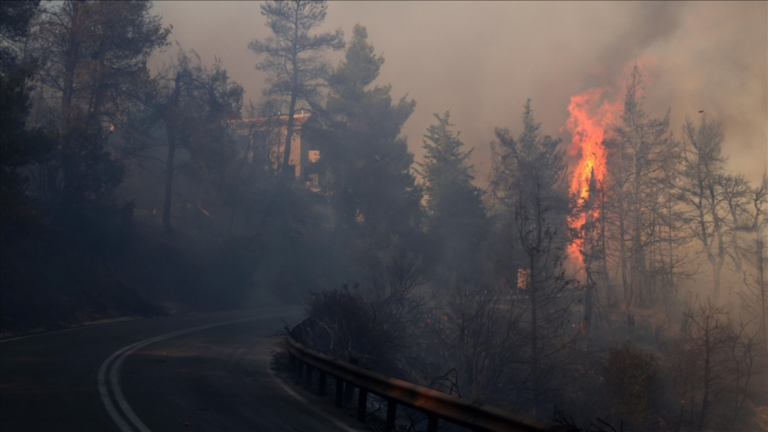
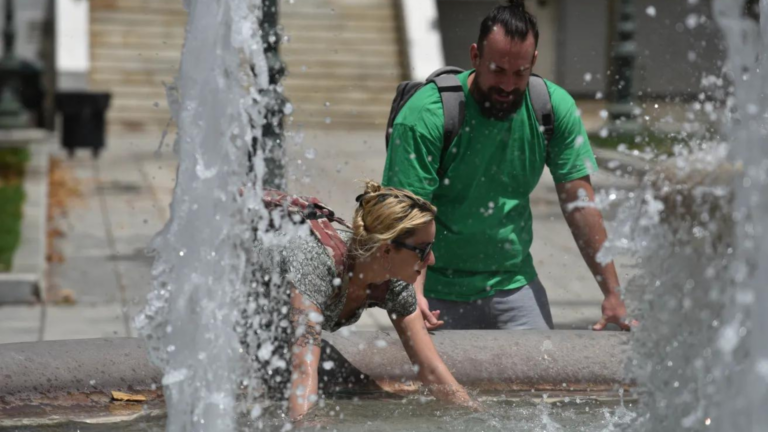
Greek officials have warned people to limit their movements and stay indoors with their “windows closed” as poor air quality across the Attic basin has seen at least eight people rushed to hospital with respiratory problems amid wildfires on the outskirts of Athens.
“Forces are being continually reinforced but they face flames that in many cases exceed 25 metres [in height],” fire brigade spokesperson Vassileios Vathrakogiannis said.
While one fire in western Attica had been controlled, another north-east of Athens was still not contained. At least 10 communities around Varnavas, Attica had been evacuated and firefighters were expected to continue throughout the night.
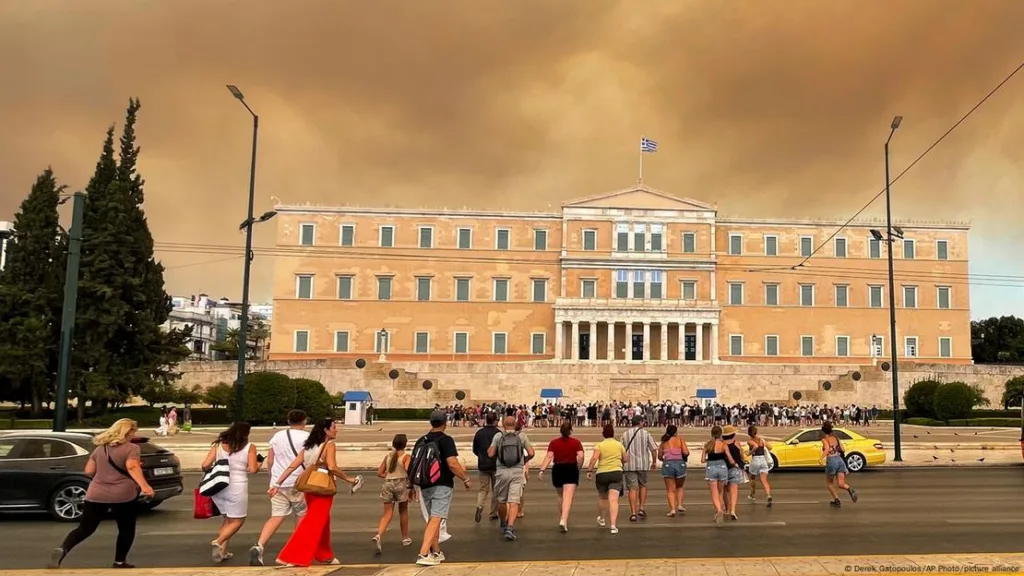
Smoke blankets Athens as strong winds persist. Photo: Derek Gatopoulos / AP Photo.
Facing strong winds, 315 fire fighters with 10 teams of forest commandos, 98 vehicles, 15 fire-fighting airplanes and 11 helicopters as well as a large number of volunteers participated in the operation.
Their efforts were being assisted by digging machinery and water trucks from the Attica Region and the Armed Forces.
An outbreak of wildfires follows Greece’s record-breaking week-long heatwave before mid-June.
With strong winds persisting, at least half of Greece is expected to enter “red alert” conditions.
The Paris Olympic Games came to an end on Monday, August 12 with a star-studded closing ceremony in front of around 71,500 spectators at the Stade de France.
Around 270 artists and performers performed in the packed arena for an estimated 9000 athletes, who marched into the venue as the festivities got into full swing.
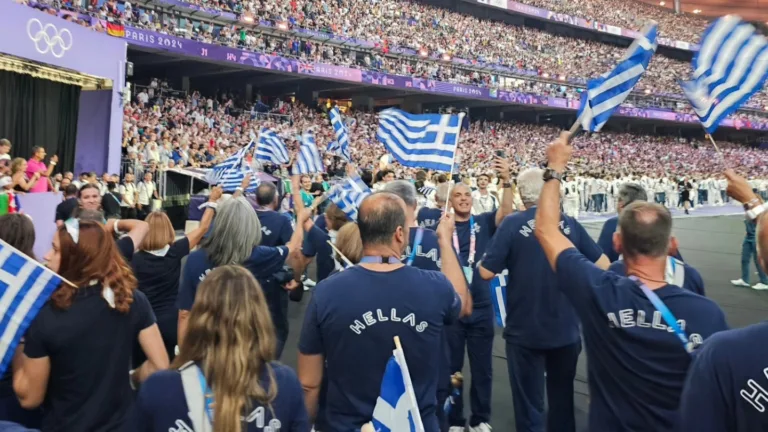
Team Hellas’ delegation was led by pole vaulter Emmanouil Karalis and artistic swimmer Evangelia Platanioti. Karalis won a bronze medal in the pole vault, while Platanioti, competing in her fourth Olympics, finished sixth.
— Ηellenic Olympic Committee (@HellenicOlympic) August 11, 2024
Australian flag-bearers Kaylee McKeown and Matt Wearn, who both won gold in the French capital, led their teammates into the venue, while canoe slalom champion Jess Fox was inducted as a new member of the IOC Athletes’ Commission.
The opening segment of the ceremony festivities began with French swimmer Leon Marchand – winner of four gold medals at the Games – gathering the Olympic flame from the cauldron in the centre of Paris to begin its journey to Stade de France.
French rugby hero Antoine Dupont – who led the host nation to a rugby sevens gold medal in one of the early highlights of the Games – carried a tricolored flag into the Stade de France as partying athletes swarmed the field.
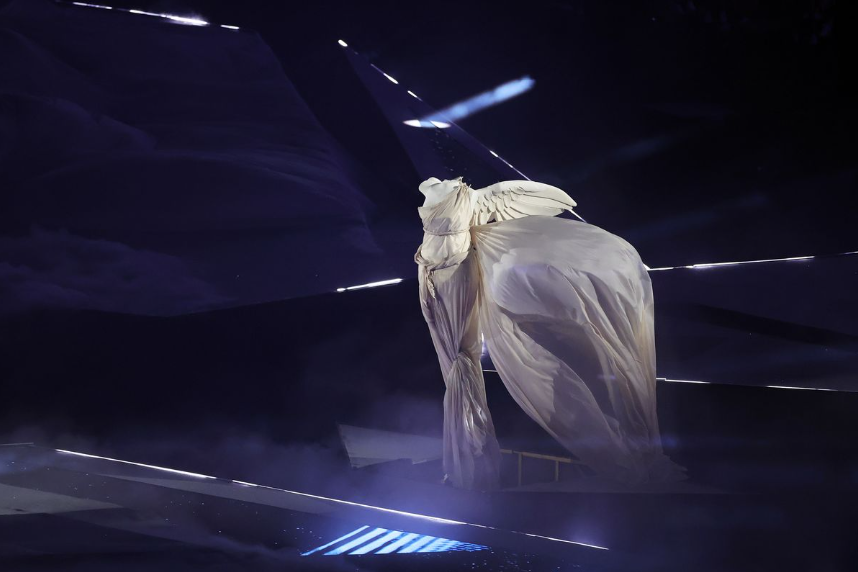
The ceremony also brought the Winged Victory of Samothrace in the stadium. The statue is one of few surviving from the ancient Hellenistic period. Representing the Greek goddess Nike (Victory), Winged Victory has been exhibited at the top of the central staircase of the Louvre Museum in Paris since 1884, when it was discovered on the island of Samothrace in the Aegean Sea.
The Winged Victory of Samothrace in the stadium. Photo: Getty Images.
Paris 2024 president Tony Eugene and IOC president Thomas Bach paid tribute to volunteers and spectators.
Following the official Olympic handover to Los Angeles, which will host the next edition of the Games in 2028, American musician H.E.R. performed the national anthem of the United States.
Next up, Hollywood superstar Tom Cruise appeared on a flying fox, riding off with the Olympic flag on a motorbike as Red Hot Chili Peppers anthem ‘By The Way’ resonated in the background.
The Chili Peppers performed hit song ‘Can’t Stop’ from Venice Beach before pop sensation Billie Eilish whispered the chorus of ‘Birds of a Feather’.
The Closing Ceremony wrapped up with performance from hip-hop royalty Snoop Dogg and Dr. Dre.
The ceremony follows 17 days of frequently breathtaking sporting action set against the backdrop of iconic Parisian landmarks from the Eiffel Tower to the Chateau de Versailles. Team Hellas won a total eight medals at the Paris Games, including one gold medal, one silver and six bronze.
As the anniversary of the second invasion of Cyprus approaches, Christakis Stylianou – former Prisoner Of War (POW) in the Turkish invasion of Cyprus in 1974 – speaks for the first time about his traumatic experiences of captivity.
By Andrea Garivaldis
Each year when July and August come around, it is a solemn time for Christakis Stylianou when Cypriots around the world commemorate the horrific events of 1974.
Fifty years have now passed since the Turkish troops marched through Cypriot towns with their tanks, but the personal horrors of the second Turkish invasion are just as raw and vivid as they were the day they occurred for Mr Stylianou.
“The Turkish military were advancing and were triggering the second invasion in mid-August and the people received no warning,” he said.
“There were sounds of gunfire, heavy bombings, Turkish planes in the sky, and machine gun fire. Army reservists had to go to their training base, except for those who owned a petrol station.
“They had to remain at their petrol station and fuel emergency and military vehicles. The word was spread that anyone found with military uniforms, or any ammunition, would be executed. A lot of our own people turned into traitors and were revealing information to the Turkish military.”
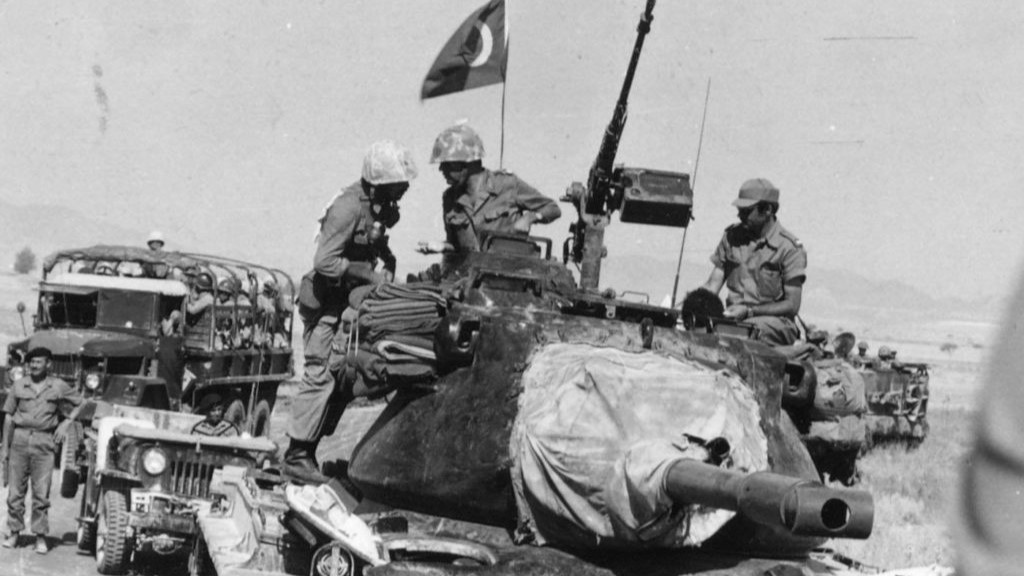
Turkey invaded Cyprus in 1974.
Mr Stylianou was on the front lines fighting alongside Major General Tasos Markou, who is highly regarded as one of Cyprus’ national heroes. Markou remains a Missing Person from the 1974 Turkish invasion to this day.
“I was in his unit and directly under Major General Tasos Markou and followed his orders. I was one of his right-hand men, driving him here and there in the car to visit camps, where he needed to take care of the transportation needs of soldiers exposed under the olive groves around Kythrea. I supported his movements, the army and the Cyprus police with transportation and refuelling vehicles,” he said.
“I saw a hero fight like a lion defending our homeland with a simple Martini rifle. Without weapons, he was defenceless in the heat of the war, while the Turkish troops were coming down the Pentadaktylos mountains and occupying the outposts.
“Tasos Markou protected us and kept us away from danger at times. He was responsible for the army in the area and ensured we felt safe under him. I am certain that his skilful management saved my life.”
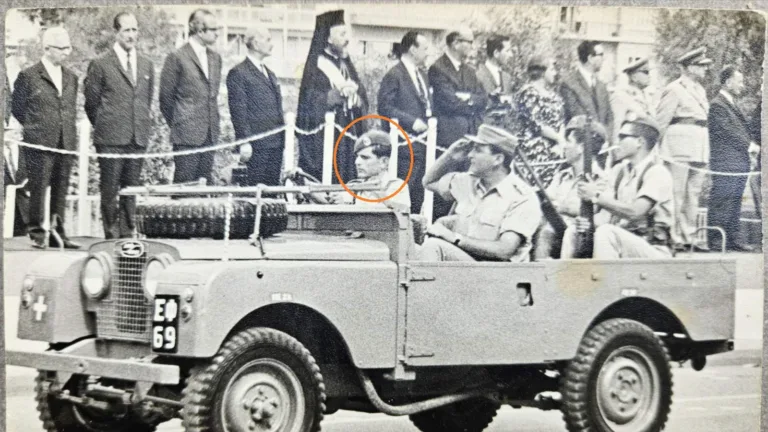
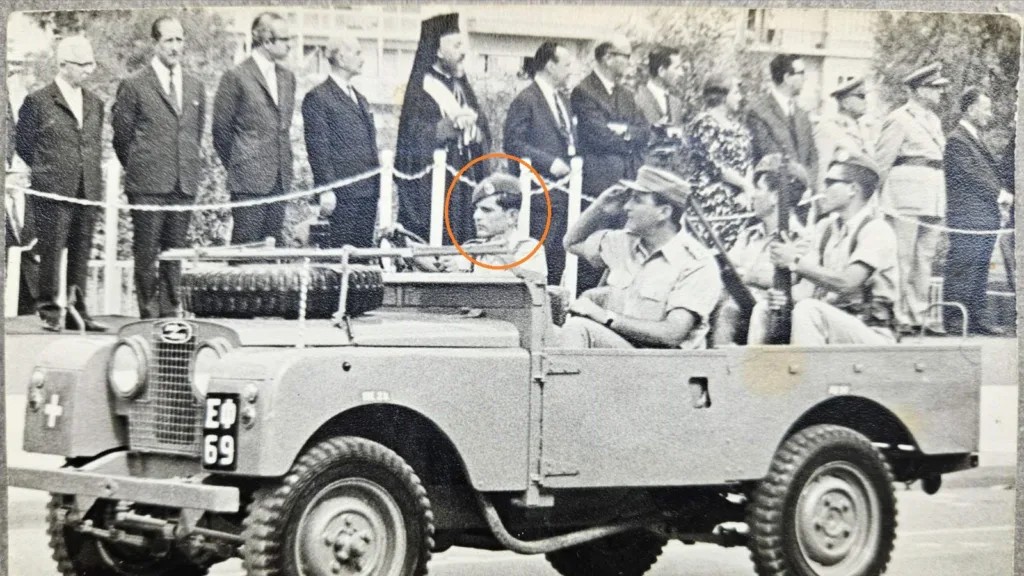
Christakis Stylianou (circled) drives past Former President of Cyprus Archbishop Makarios III.
The night before Mr Stylianou was captured, he went home, while leaving others to look after the petrol station.
“I had changed into civilian clothes from my military reservist uniform and the next day, on Wednesday 14 August 1974, I was driving to Nicosia to escape the fighting,” he said.
“I did this after ensuring that none of the soldiers were left behind in the village. Our family was split up among thousands of other Cypriots who were displaced in the conflict while escaping to safety. I drove my car to a location we were told we would find our soldiers to assist us, but we only found Turkish army where Greek military were known to be stationed.
“I was forced to leave my car in the town of Mia Milia, not too far from where the free areas are now. The Turkish military found my driver’s licence in my car, which was under my name Christakis Stylianou. At the time they did not have photo ID. Later, when I was captured while on foot with a group of others, a last-minute decision to use my grandfather’s name, Takis Mina, saved me from being executed. At the time I did not realise that I had saved myself from execution as the Turkish troops found military clothing in my car and were to execute the owner Christakis Stylianou.”
Mr Stylianou was then detained by Turkish armed forces and spent almost three months in Turkish concentration camps as a POW.
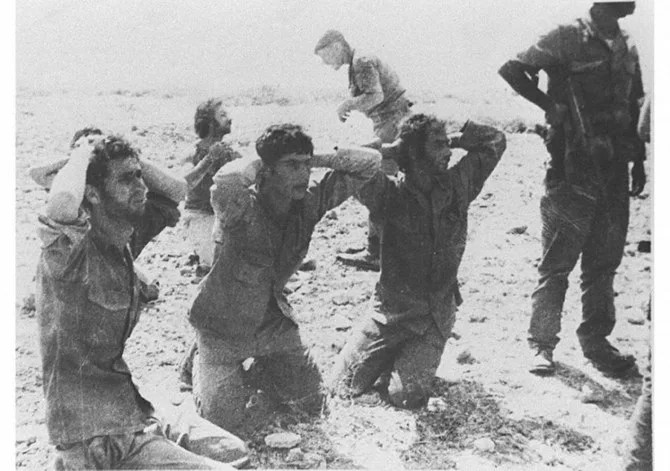
A dated file photo in 1974 shows Greek Cypriot soldiers taken prisoners of war by Turkish soldiers who invaded Cyprus following an ethnic bloodshed that erupted in the Mediterranean island. Photo: AFP/File Photo.
“The Turkish armed forces moved all the captured men by ship to Mersina, then we were put on trucks and transported to Adana, where we were kept for some days in the prisons under horrible conditions,” he said.
“We were blindfolded with our hands tied behind our backs most of the time. They then put us on buses and took us to Amasya. I think over 2,000 POWs had been illegally transferred from Cyprus and held in Turkish prisons.
“Those who were captured as POWs and kept in prison camps had to deal with harsh living conditions, enduring physical torture and maltreatment.
“Many of us were malnourished, severely wounded from regularly being beaten if we did not obey the most inhumane requests from the prison guards. We had to do physically demanding work and live in tough conditions and given little food. Just a small piece of bread and an olive was our average meal. The bread was usually half eaten by rats.
“Prisoners who attempted to escape from captivity were often executed. In Adana itself, the abuse was indescribable, and it was a test for human survival.
“The Turkish guards would kill rats and place them in our daily meal of legume soup and expect us captive prisoners to eat the same food for days. If we refused to eat it, the Turkish soldiers would strip us and beat us with a bat in front of everyone.”
Mr Stylianou recalls the daily bashings and whipping and how best friends would fight over a piece of bread.
“I remember how some men would distract each other so they can steal one another’s allocated meals, but we did rely on each other for support and survival,” he said.
In the 1974 BBC news footage inside Adana prison camp, where Mr Stylianou is also seen, the captive prisoners all said they were treated well by the Turkish army although it was not the case.
“What can I tell you, what else could we say? We were forced to say something positive under the fear of not being released and the risk of not returning to Cyprus. So, we declared that we were satisfied to avoid the dire consequences,” he said.
“We developed friendships as we had a common life experience of seeing the evil side of humans.
“After several days in Adana, they put us on buses and took us to Amasya, many hours away. With our eyes tied, we didn’t know where we were going. At Amasya, one of the guards, who we learned was from Trabzon, once took pity on me and gave me a candy. He tried to help me. He knew very little Greek. He told us that some ancestor of his was Greek. From such interpreters who knew some Greek, we were able to find out what was happening around us. The conditions in the prisons were again terrible, with beatings and hunger.
“Many of us POWs were exchanged by Cyprus and Turkey in late 1974, assisted by the International Committee of the Red Cross.
“From the point where we were released at the checkpoint, we were transported by bus to the Filoxenia Hotel in Nicosia, where they gave us some clothes to wear and a meal. They also gave us an injection for the protection of others in case we brought any disease, and I was given one Cyprus pound.
“I was released on 28 October 1974 – after 75 days in captivity. I considered myself lucky to be in the last group of people to be released and eventually reached safety. I was out alive, but sadly some of those I befriended were escorted out and never seen again, as they had been executed. Those who were not fortunate to get out were either confirmed dead or listed as Missing In Action, and hundreds of others remained unaccounted for. The next task was to reunite with our displaced families who we had no contact with for months.
“The summer of 1974 brought a lot of emotional upheaval to many families including mine who were forced to leave our home, business and possessions and having to start a new life all over again as a refugee.
“After losing so many friends and comrades, I feel that it is a duty for me to honour the memory of all those who were captured and imprisoned along with myself and to remember those who were killed or still missing and did not make it back home to reunite with their displaced family.”
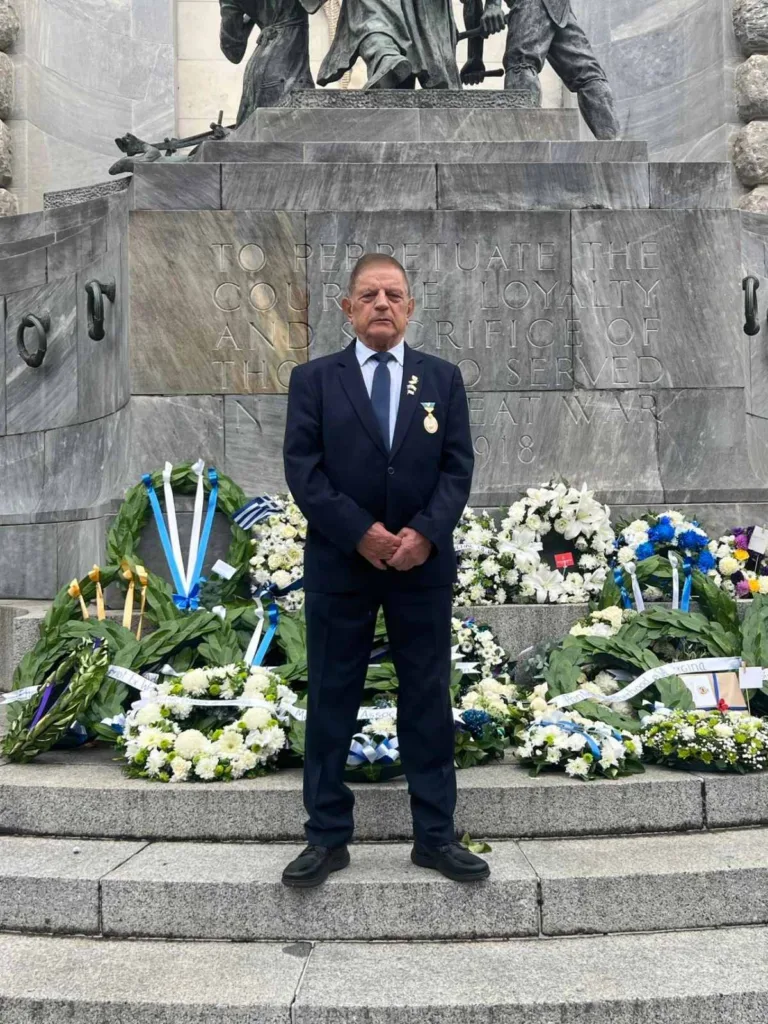
Although 50 years have passed, Mr Stylianou honours the memory of all the POWs who were captive with him and he lays a wreath here in Australia – on behalf of the Prisoners of War Association of Cyprus from the Turkish invasion of 1974 – at various Hellenic events, on ANZAC Day and Remembrance Day.
Although 50 years have passed, Mr Stylianou honours the memory of all the POWs who were captive with him and he lays a wreath here in Australia.
Mr Stylianou strives to ensure that his children and grandchildren have a passion for Cyprus and do not forget the service and sacrifice of those who fought for freedom. His daughter, Dr Andrea Stylianou, academic and journalist, has written a research thesis with a European Union “Research Excellence Scholarship” on the topic of the Missing Persons of Cyprus and the Diaspora of Cypriots in Australia affected by the Turkish invasion of 1974.
“These commemorations are an emotional moment where I pay tribute to those who endured the gruelling conditions in the hands of the enemies and to the many who never returned. The dream of a free Cyprus will never die,” he said.
The Greek Orthodox Community of NSW’s (GOCNSW) Petersham Childcare Centre received crucial donations at their successful Vivid Night Fundraiser, which will strongly boost the centre’s operations.
The annual fundraiser event saw the centre showcase their own version of a vivid light display at their premises on Friday, August 2, with the children and their families and friends in attendance.
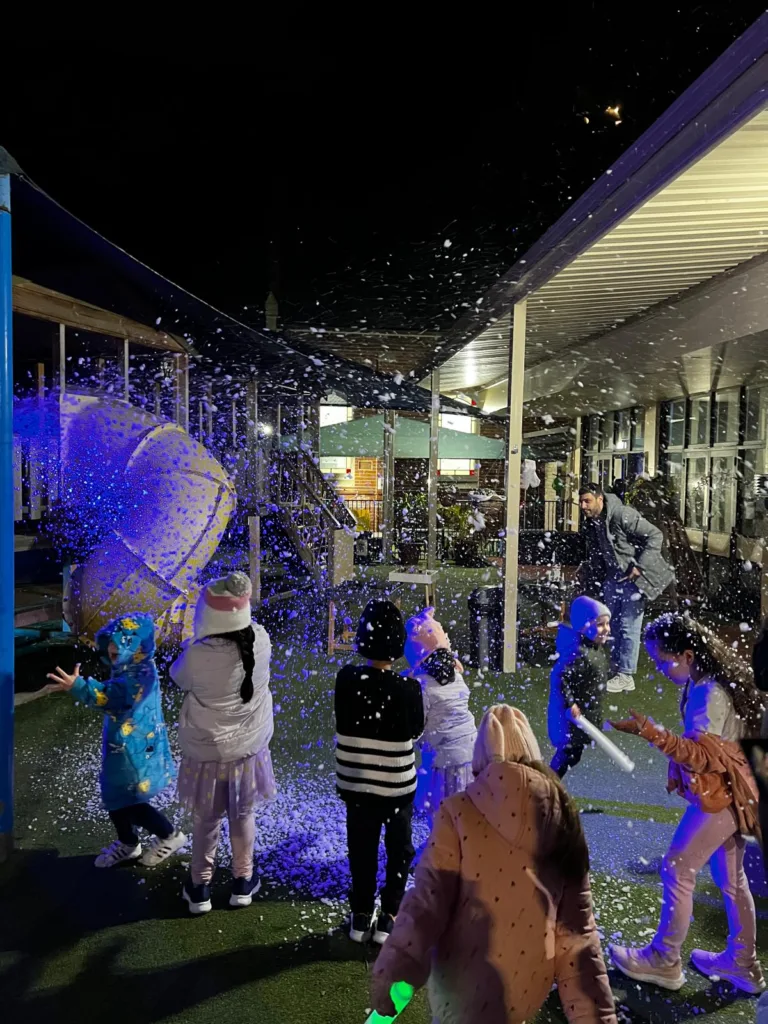
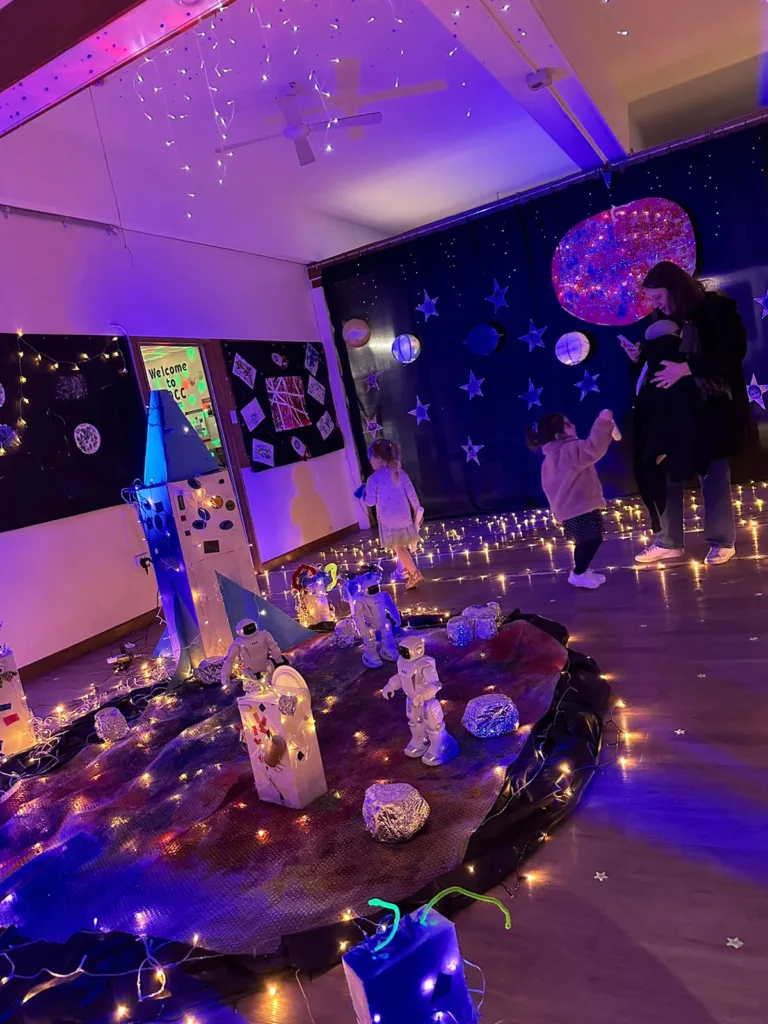
The event was helped greatly by CR Lighting and Audio in Kingsgrove with the centre borrowing lights and a snow machine from there to create the display which featured different themes, such as Winter Wonderland in the playground of the 2–5-year-olds and a space theme in the Nemo (toddler) room.
The annual fundraiser event saw the centre showcase their own version of a vivid light display at their premises on Friday, August 2.
In addition to the light display, there was also artwork shown off that the children and educators worked together on in the Marlin (preschool) room with their various works also accompanied by a summary with a voiceover by the children themselves.
Some light entertainment was organised for the event in the hall, including a performance by a member of the new dance fitness group, Happy Feet, which will commence at the centre in August for all age groups.
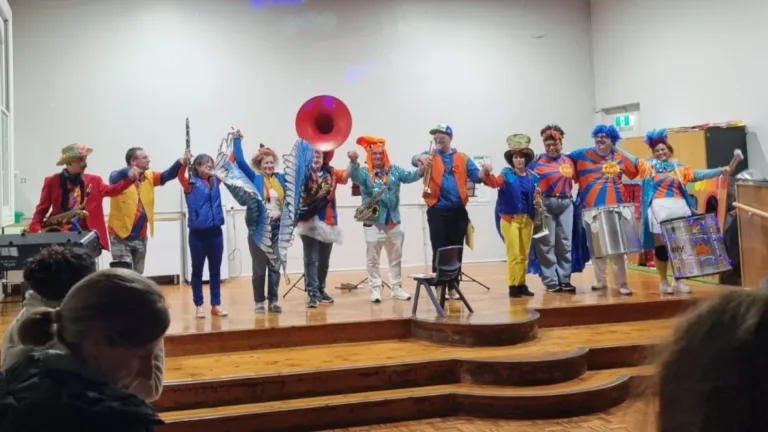
The event featured a performance by brass band Bateria Brass 61, a group which one of the centre’s educators is part of.
The fundraiser also saw two major prizes raffled off with 1st Prize valued at $1,400 and 2nd Prize valued at $640, which were won by Anna Healey (1st) and Jo Cao (2nd).
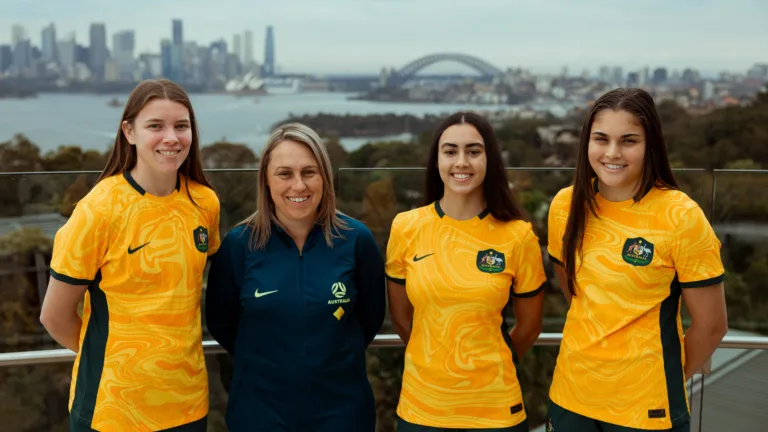
CommBank Young Matildas Head Coach Leah Blayney today announced the 21 players selected to represent Australia at the FIFA U-20 Women’s World Cup Colombia 2024™ (U-20 WWC).
The squad will be captained by Jessika Nash and supported by Alexia Apostolakis and Naomi Chinnama in the 24-team global showpiece running from 31 August – 22 September 2024.
For the second consecutive tournament, Australia will begin their U-20 WWC campaign against the host nation, facing Colombia at the Estadio El Campín in Bogotá on Saturday, 31 August (local).
Their Group A schedule – all played at the Estadio El Campín – will see the CommBank Young Matildas tackle their second opponents, Mexico, on Tuesday, 3 September (local) before ending the group phase against Cameroon on Friday, 6 September (local).
CommBank Young Matildas Head Coach Leah Blayney today announced the 21 players selected to represent Australia at the FIFA U-20 Women’s World Cup Colombia 2024™
Blayney has settled on three goalkeepers, six defenders, five midfielders and seven forwards following two years of domestic camps, Talent Development Scheme matches, international friendlies, qualifiers, and AFC tournament activities. The squad features 19 players who participated in the recent 2023/24 Liberty A-League Women’s season.
While the cohesion and chemistry of the team has been maintained through the inclusion of 15 members of the AFC U20 Women’s Asian Cup 2024™ roster, it also includes new faces in Ella Buchanan, Amber Luchtmeijer, Tanaye Morris, Emilia Murray, Ella O’Grady, Peta Trimis and Alicia Woods, who have earned their positions through extensive scouting efforts.
The Class of 2024 includes six players with previous youth World Cup experience: Apostolakis, Chinnama, Nash, Jynaya Dos Santos, Kahli Johnson, and Chloe Lincoln. Notably, Shellharbour’s Jynaya and Indiana Dos Santos will become the first sisters to compete together in a FIFA World Cup™ tournament.
Leah Blayney commented on the challenging selection process that resulted in a talented final squad that will take on the world’s best youth players.
“This cycle has taken the team to the Kyrgyz Republic, Vietnam, China, Uzbekistan, New Zealand and now we will complete this two-year journey in Colombia where the players have a golden chance to display their abilities and represent Australia with pride on the world stage,” Blayney said.
“Over this cycle we have seen over 60 players across all Member Federations participate in the process, and every single one of them has contributed to the quality of this team as they showed up to test and challenge each other to keep evolving. I would like to thank all the players, Member Federations, NPL clubs and Liberty A-League Women clubs for their contribution to the final squad.
“We’ve selected a roster that has exhibited strong current form, combined with an important balance across the lines of defence, midfield and attack. The collective of players across those three lines provides us with plenty of variety as they all have different types of playing profiles and attributes.
“Ultimately our team will strive to maintain our attacking playing style with a focus exciting and entertaining football which we hope will capture the Australian public and gain their support. The test that this group craves, is now to pull it all together under tournament conditions.”
With the tournament falling outside of a FIFA Women’s International Window, Liberty A-League Women 2023/24 Young Player of the Year, Daniela Galic, will be unavailable following a recent overseas club move. Excitingly, eight members of the Australian squad will remain eligible for the 2026 cycle.
The U-20 WWC will also provide a preview into the future of the game. Over the past decade the U-20 Women’s National Team and Future Matildas Program nurturing and developing the talents of Ellie Carpenter, Mary Fowler, Kyra Cooney-Cross, Clare Hunt, Clare Wheeler, Kaitlyn Torpey, Cortnee Vine, Amy Sayer, Charli Grant, Courtney Nevin, Holly McNamara, Remy Siemsen and Alex Chidiac who progressed to not only make their senior debuts but to also represent Australia at AFC Women’s Asian Cups, FIFA Women’s World Cups and Olympic Games.
The Young Matildas will have some existing and new faces.
The CommBank Young Matildas qualified for their fifth appearance at the FIFA U-20 Women’s World Cup Colombia 2024™ by virtue of a bronze medal finish at the AFC U20 Women’s Asian Cup™ in March 2024. They will represent Asia alongside former U-20 winners DPR Korea, reigning U-20 silver medallists Japan, and Korea Republic.
The top two nations from each group, and the two best third-place finishers following the completion of group play will progress to the knockout phase. The knockout phase starts with the Round of 16 (11 and 12 September), followed by the semi-finals (Wednesday, 18 September) and the final on Sunday, 22 September 2024.
The team will begin assembling in Sydney next week, ahead of their departure for an acclimatisation pre-camp at the altitude of Bogotá, before the FIFA U-20 Women’s World Cup campaign commences.
In retrospect, I wish I had paid more attention to Greek cinema while growing up in Australia. With my parents and godparents, we kids – my godsisters, my godbrother and myself – would often go to various local cinemas in Melbourne in the early 1970s to see Greek films. It was a great outing into the fantasy world of film, an experience we made sure we enhanced with our own touches, as then mischievous 8-10 year olds.
We would try to sit quietly and watch the Greek, predominantly black-and-white movie on the big screen. Yet we found it more pleasurable to giggle and poke one another before heading off quietly, into the aisles and conspiratorially sneak out of the doors into the foyer.
We’d check out the toilets, then head for the canteen, gazing excitedly at the snacks we’d soon be having during intermission, like ice cream and little chocolate balls with whole almonds in them. Our cheeky escapades from our cinema seats would occur once we assured each other via sneaky looks, that our parents were so engrossed in the film that they wouldn’t notice us.
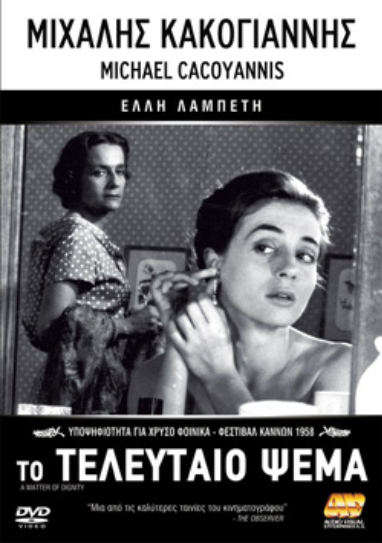
Fifty years have passed since then and it is now that I’m catching up on those days of my literally childish disregard of Greek cinema. I seek out and regularly watch old Greek films; having discovered gems like, ‘I Kalpiki Lira’ (‘The Counterfeit Coin’), a 1955 film with the beautiful and talented Elli Lambeti, as well as ‘To Teleftaio Psema’ (‘A Matter of Dignity’), another of the films she so wonderfully stars in. And there’s also another of the more ‘serious’ Greek films, ‘O Drakos’ (‘The Ogre’) 1956, starring Dinos Illiopoulos. I’ve even discovered some other favourites to rival any old Hollywood or European movie of substance from that era; socially aware, gut wrenching movies relating to the struggle of life in Athens in the 1950s, such as ‘Magiki Polis’ (‘The Magic City’) 1954 with Giorgos Foundas.
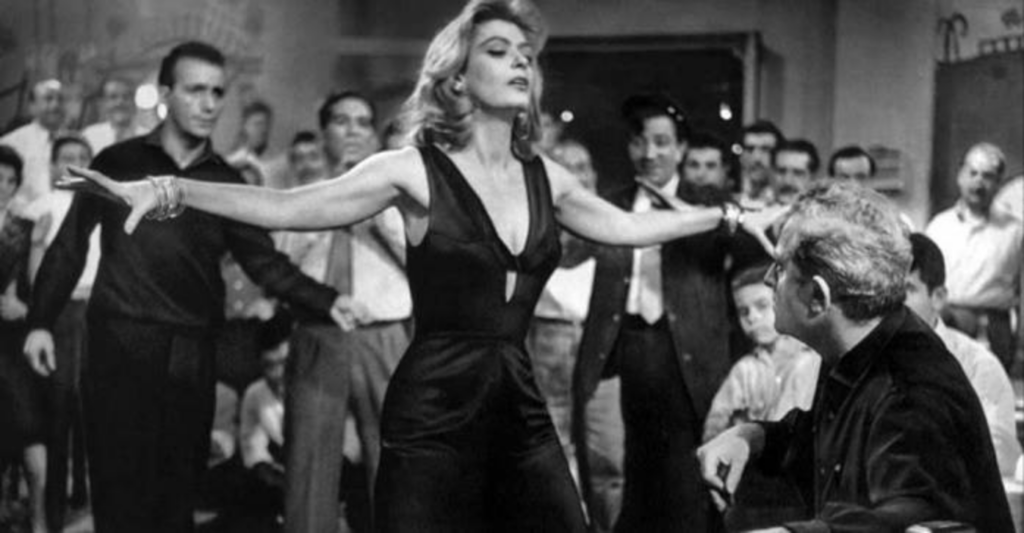
Greek films.
Living in Greece now, I also get to see quite a few old Greek films screening on TV. To me, these old Greek movies stand out as treasures amongst the glaring colour Greek TV series and other modern day, predominantly American films.
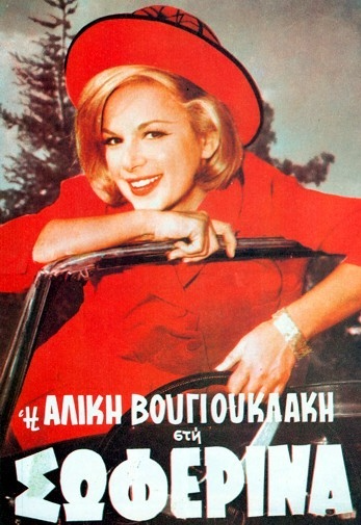
I’ve rediscovered many of the most popular Greek films too, ranging from comedy classics to melodramas that were shown at our Australian cinemas back then in the 60s and 70s. Their superstars included Tzeni Karezi, Aliki Vouyiouklaki and Dimitri Papamichail, Lambros Konstantaras and Rena Vlahopoulou for example, with titles that bring a smile to many a Greek cinemagoer’s face, such as ‘I Thia ap’ to Sikago’ (‘The Aunt from Chicago’).
I decided to speak with a few fellow 2nd generation Greek Australians living in Greece about their memories of watching old Greek films in cinemas in Australia back then. George, in his late 50’s, became very animated and excited, immediately spouting out film titles: ‘Papaflessas,’ ‘Anamesa Se Dio Gynaikes’ (‘Amongst two women’) with Papamichail, and ‘Katigorimeni Apologisou’ (‘Accused, Plea’).
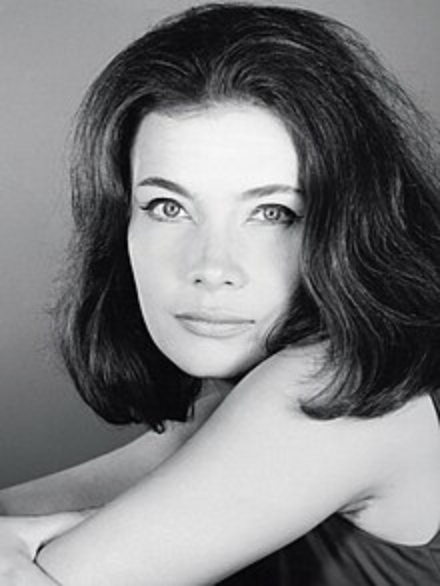
Tzeni Karezi.
George then went on to tell me, “I remember that the atmosphere at the Greek cinemas in Australia was totally Greek. If someone got killed in the film, the audience would do that Greek sound, tsk, tsk, tsk, you know?”
George suddenly adds: “I came to Greece due to being influenced by these films!”
I guess it familiarised us, even on a fictional level, with our Greek parents’ world – that became our world too, with different nuances now.
Tina, also a 2nd generation Greek Australian living in Greece, aged 60, says that being exposed to old Greek films didn’t influence her decision to come to Greece (and eventually settle here ten years ago).
“Though it was a great bonding experience back then in the 70s with cousins and aunts and koumbaroi. I remember being mesmerised by Tzeni Karezi and by all the romantic stuff. But it was particularly heart-warming to see my parents and relatives, hardworking Greeks, let loose a bit on weekends and laugh and sigh at the Greek films, plus have an excuse to dress up for an outing every week,” Tina says.
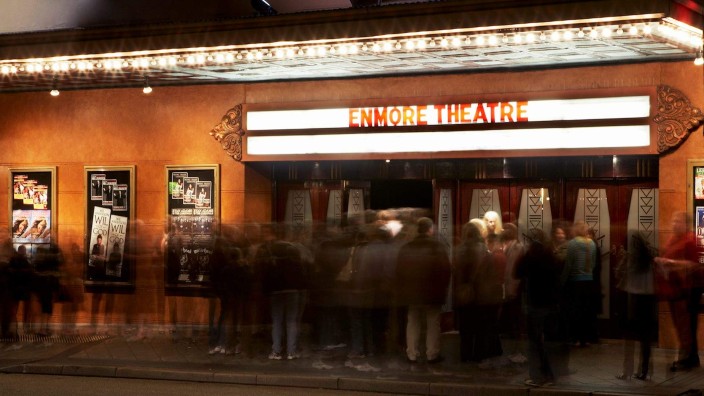
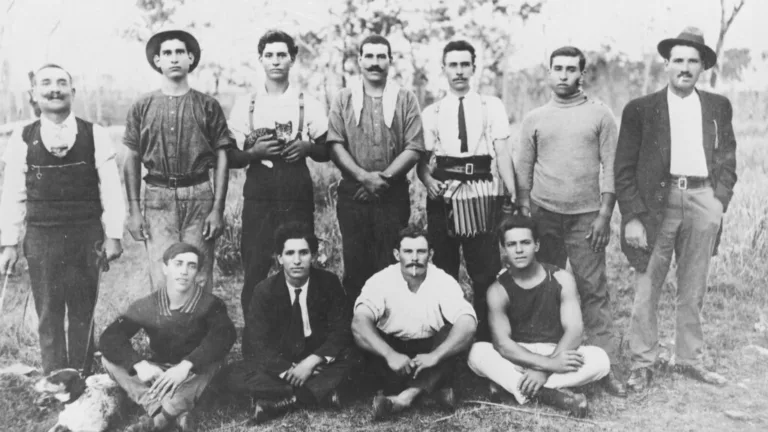
Greek cinema was popular in Australia.
Audience membership aside, the Greek film industry in Australia in the 50s, 60s and 70s was huge. A few sassy, Greek Australian business men, brought the world of Greek cinema into our faraway and homesick, diaspora community eager to keep in touch with the homeland.
Initially staging piecemeal screenings all around Australia where there were Greeks, these businessmen, to name a few, such as Sydney’s Camilla brothers, Melbourne’s Raftopoulos and the prominent film importer Peter Yiannoudes, did us a community service with their work in bringing these movies into our lives in Australian suburban cinemas, many of which they later bought outright.
Peter Yiannoudes claims that he’s now in the process of facilitating a museum of Greek film in Australia, just behind the Westgarth Cinema in Melbourne, one of the many he eventually came to own.
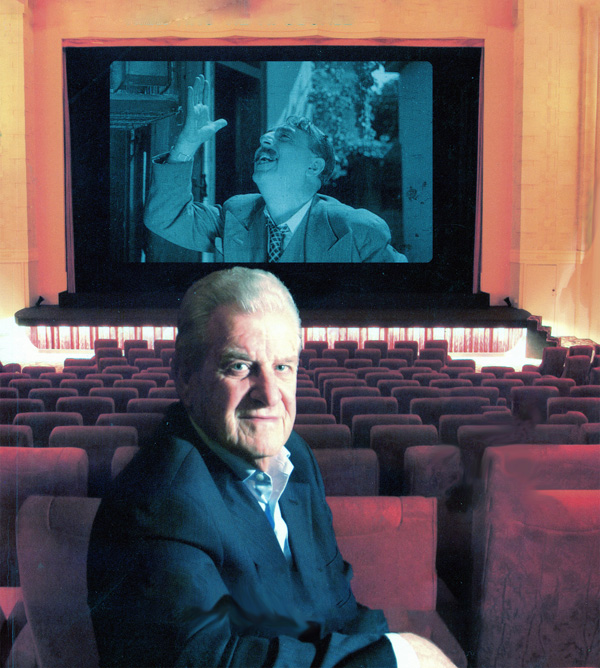
Peter Yiannoudes.
Furthermore, at Australia’s annual Greek Film Festivals, and other Greek Australian movie showcasing events such as The Setting Sun Film Festival last year, old Greek movies have featured – and will hopefully continue to do so. And who knows, perhaps screening of old Greek films at cinemas could be a regular occurrence again.
Speaking recently to my godmother about the old days of Greek cinema in Australia, she recalled what one of us kids had said during a Greek film: “Look they have cars in Greece and restaurants too!” She adds, “I got so angry thinking about the sort of propaganda you kids got back then about Greece at your English schools!”
I assured her that we didn’t get anything of the sort; that Greece wasn’t of much interest to the Australian, primary school education system in which we were brought up. She was silent; a testament perhaps to the generation gap of Greeks in Australia. It might not have mattered to our schools, but Greece mattered and matters to us. Greek films after all, larger than life that they were, did play a major part in keeping us connected to our Greek identity; something solid and innate and large: Often larger than our Australian assimilation.
The Greek Community of Melbourne (GCM) has announced a special lecture by Dr Andonis Piperoglou, the Hellenic Senior Lecturer in Global Diasporas at the University of Melbourne.
The lecture, titled “Envisioning a Mediterranean Pacific: Photography and Sugar Cane Migrants,” will be delivered on Thursday, 15 August 2024, at 7pm at the Greek Centre. This lecture is part of the ongoing Greek History and Culture Seminars series.
Dr Piperoglou’s lecture will delve into the intertwined histories of Mediterranean and Pacific migrant labor in Queensland’s sugar industry.
While much of the early twentieth-century narrative focuses on Mediterranean migrants who labored in the region’s sugar refineries and bush-clearance efforts, this presentation will expand the discussion to include the pre-existing system of forced migration from the South Pacific that was also vital to Queensland’s sugar industry.
The Greek Community of Melbourne (GCM) has announced a special lecture by Dr Andonis Piperoglou.
By examining visual culture—through photographs, cartoons, and sculpture—Dr Piperoglou aims to reveal the often overlooked connections between these two migrant labor groups. His work challenges the conventional narratives of assimilation and highlights how Mediterranean and Pacific diasporas have been represented and perceived within the context of Australian settler colonialism.
As the inaugural Hellenic Senior Lecturer of Global Diasporas, Dr Piperoglou brings a wealth of expertise in migration and ethnic history, with extensive publications on Greek migration to Australia. His research explores historical links between colonialism, racism, and migration, focusing on the movements between the Mediterranean and Pacific regions. In addition to his academic role, he is the Vice President of the International Australian Studies Association.
This lecture promises to offer a fresh perspective on the history of migration and labor in Queensland, encouraging attendees to reconsider established narratives and explore comparative histories of diaspora.
Event Details:
Title: Envisioning a Mediterranean Pacific: Photography and Sugar Cane Migrants
Date: Thursday, 15 August 2024
Time: 7:00 pm
Venue: Greek Centre, (Mezzanine, 168 Lonsdale Street, Melbourne)
July 2024 has been declared the hottest July on record in Greece, according to meteorological data analysed by the National Observatory of Athens’ Meteorological Service.
Scientists reported that temperatures throughout July 2024 significantly surpassed the typical levels for this time of year across Greece.
Temperatures exceeded the 1991-2020 average by +2.9°C and surpassed the previous record set in July 2012 by +0.3°C.
Notably, three of the four hottest Julys in Greece have occurred within the past four years. Looking at the trend from 1960 to 2024, average July temperatures in Greece have risen by +2.5°C.
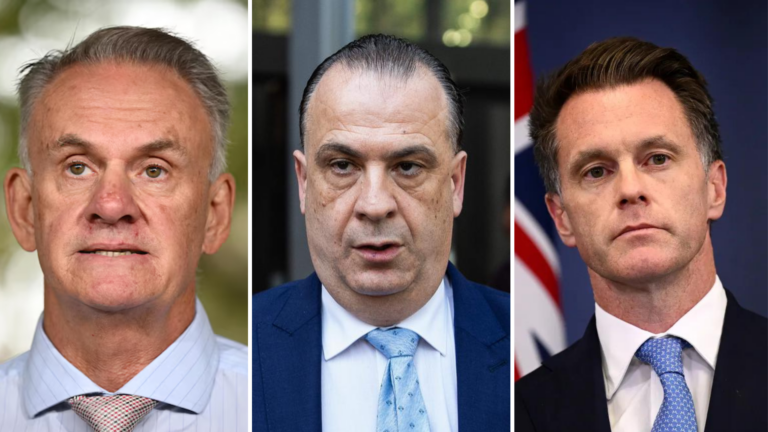
NSW Premier Chris Minns has condemned “disgraceful” attacks made by independent MP Mark Latham on Racing NSW chief executive Peter V’landys.
Delivering a private member’s statement in the upper house on Wednesday, August 7, Latham accused V’landys of impropriety, “dictatorial behaviour” and a “constant pattern of regulatory abuse.” Latham also called on the powerbroker to resign.
“Megalomania is a dreadful thing, and it’s really ruining the NSW racing industry. For the sake of a sport I dearly love, I believe V’landys should resign and hand over to someone with the best interests of racing in mind, rather than the relentless pursuit of a toxic power,” he said.
Latham’s accusations come in the face of an ongoing parliamentary inquiry into the proposed development of Rosehill Racecourse. V’landys’ is scheduled to appear at the Rosehill inquiry hearing today to give evidence on the sale of the racecourse.
Racing NSW chief executive Peter V’landys.
In a statement to The Sydney Morning Herald, V’landys called on Latham to repeat the allegations outside of parliament, insisting he had always remained at arm’s length during steward inquiries and there was zero evidence for his baseless attacks.
“There is no doubt Mr Latham is running an agenda for some very wealthy breeders who don’t wish to be held to account for animal welfare,” V’landys said.
“…everything he is saying is completely and utterly rubbish.”
The NSW Premier also weighed in on Friday morning and said Latham’s accusations were “disgraceful.”
“Mark Latham is currently being sued for defamation for things he said outside of Parliament, so he’s taken his attacks inside Parliament, where he can’t be sued,” Mr Minns said. “It is the definition of the ‘Coward’s Castle’.”
“We are ready, we have activated a specific plan, ESTIA, which has been tried and tested,” Cyprus’ deputy government spokesperson Yiannis Antoniou said.
“In the event we are asked to assist other countries who may be moving their nationals from the crisis area home, we are in a position to host them for a few days until they are repatriated.”
The Joint Rescue Coordination Centre (JRCC) in Larnaca will serve as a hub for coordinating and controlling any rescue operations and evacuations. On Thursday, August 8, tents were erected in the compound, with cots to be used to process any arrivals.
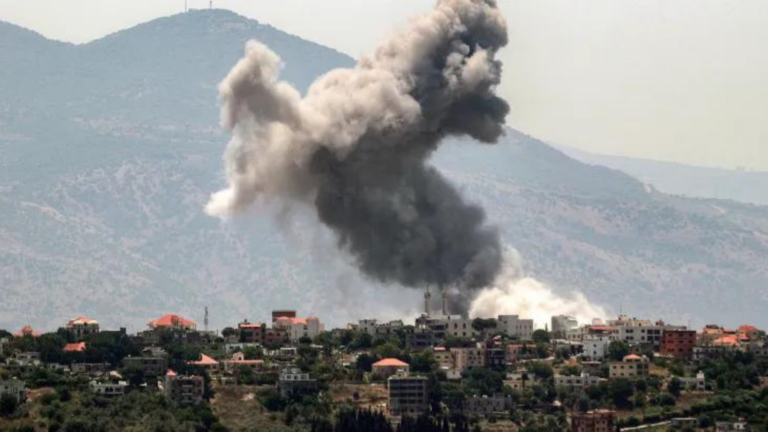
Israel’s antagonism with Iran and the Lebanese Hezbollah movement have fanned fears of a broader conflict in the Middle East.
In 2006, Cyprus was a sanctuary for about 30,000 people who left Lebanon during a flare-up in hostilities between Israel and Hezbollah in 2006.