Greek Orthodox Christians across Australia filled churches on Sunday, 13 April, to mark Palm Sunday, a significant feast day that signals the beginning of Holy Week in the Orthodox calendar.
Known as the Triumphal Entry, Palm Sunday commemorates Jesus Christ’s entry into Jerusalem before His crucifixion and resurrection.
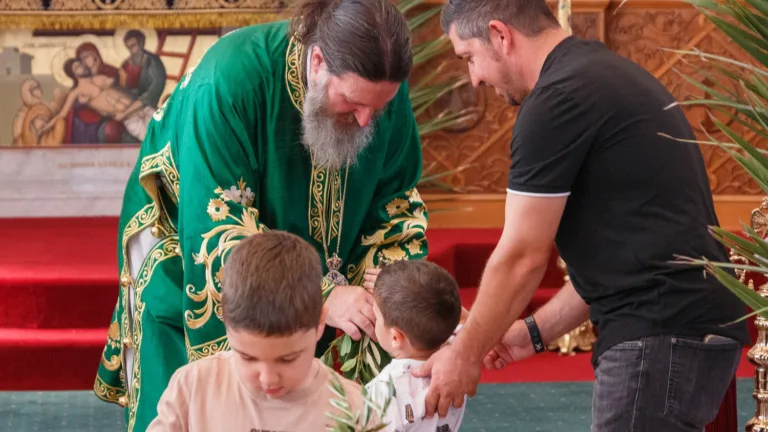
In churches from Melbourne to Perth, the faithful gathered in large numbers for Matins and Divine Liturgy, where they received the Sacrament of Holy Communion and took home blessed palm crosses as symbols of Christ’s victory over death.
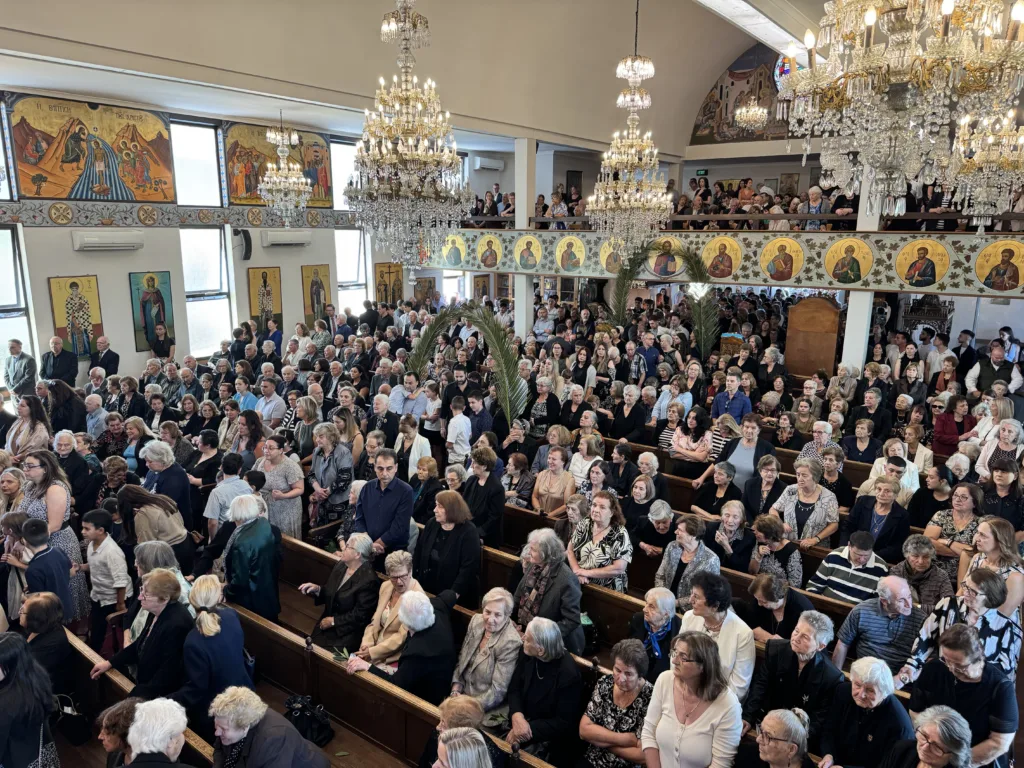
In Melbourne, over 1,100 parishioners attended services at the Greek Orthodox Church of Saints Anargiri in Oakleigh.
In Melbourne, over 1,100 parishioners attended services at the Greek Orthodox Church of Saints Anargiri in Oakleigh, presided over by His Grace Bishop Kyriakos of Melbourne and parish priest Rev. Fr. Stavros Kakavas. Attendees included students from Oakleigh Grammar and local MP Steve Dimopoulos. Following the service, a traditional luncheon was held at the school hall, further strengthening the sense of community.
At the Archdiocesan Church of Our Lady “Axion Esti” in Northcote, His Grace Bishop Evmenios of Chora led services and reflected on the Resurrection of Lazarus as a prelude to Christ’s own Resurrection. He called upon the faithful to participate actively in the upcoming Holy Week services, “not as spectators, but as participants in the Divine Drama,” and encouraged them to rise spiritually from sin and indifference.
His Grace Bishop Evmenios of Chora led services in Northcote.
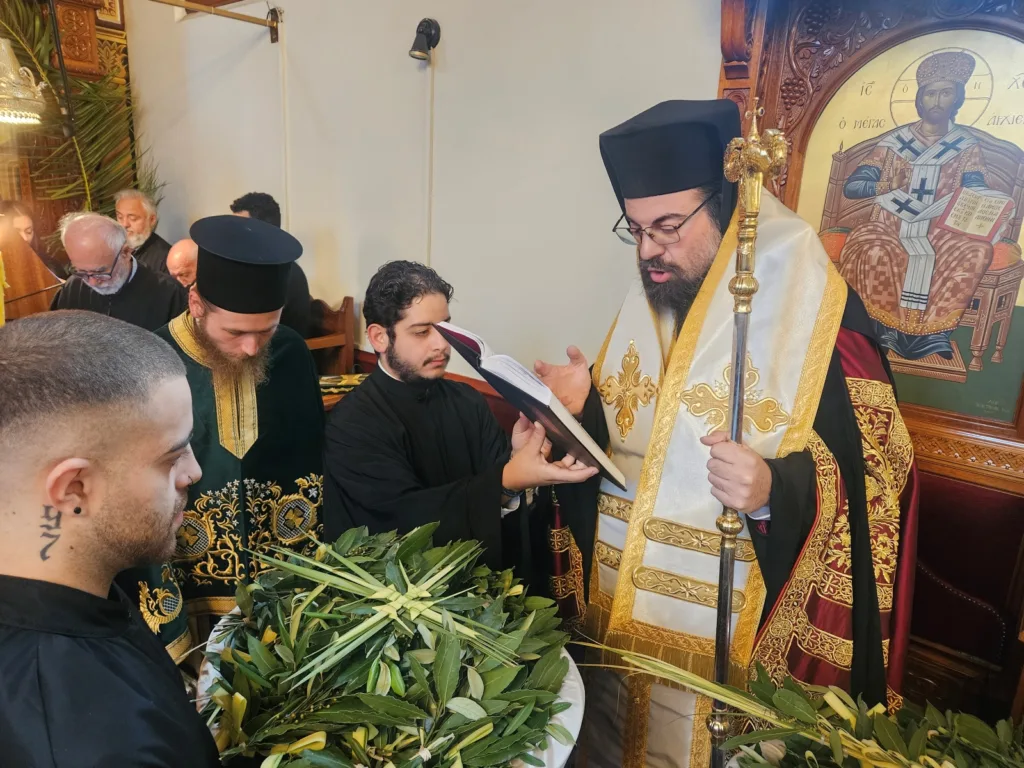
In Sydney, His Grace Bishop Christodoulos of Magnesia presided over the Palm Sunday service at the Greek Orthodox Parish and Community of the Resurrection of Christ in Kogarah. The church was filled with worshippers who gathered in reverence for the Divine Liturgy and the Blessing of the Palms. Bishop Christodoulos delivered a heartfelt homily, encouraging the faithful to approach Holy Week with prayer, humility, and spiritual focus.
In Western Australia, Palm Sunday was celebrated at St Nectarios Greek Orthodox Church in Dianella, Perth, where His Grace Bishop Elpidios of Perth presided. During his sermon, he spoke of Christ’s threefold role as King, Teacher, and High Priest, and encouraged the faithful to allow Christ to reign in their hearts and homes.
Across all services, palm crosses were blessed and distributed, and the faithful took part in a day of reflection, community, and spiritual preparation for the solemn days to come.
Despite being a fasting period, the day offered a joyful reprieve with the traditional Palm Sunday dish of bakaliaros me skordalia—fried cod with garlic mash—being enjoyed by many in line with Orthodox tradition.
As Holy Week continues, Greek Orthodox Australians now enter a more solemn phase of the liturgical calendar, culminating in the Resurrection of Christ on Pascha.
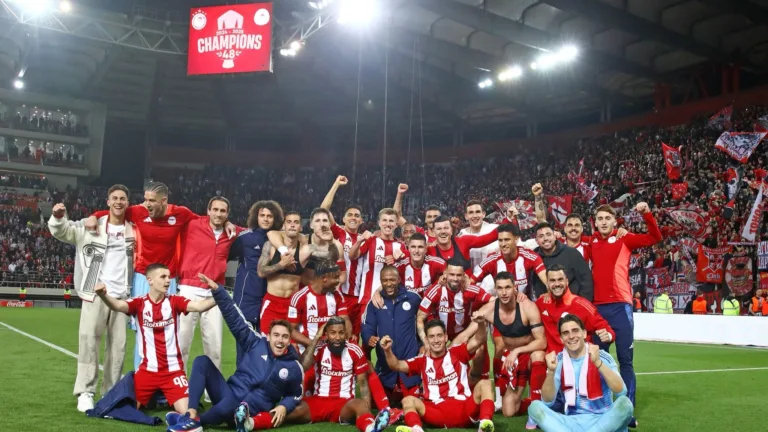
Olympiacos FC has reclaimed the Greek Super League title after a two-year hiatus, following a 1-0 home victory over AEK on Sunday, April 13.
Ayoub El Kaabi’s goal in the 55th minute sealed the win and sparked jubilant celebrations in Piraeus.
With three matches remaining, Olympiacos holds an unassailable lead at the top of the table with 66 points, and eyes a domestic double ahead of the Greek Cup Final against OFI on 17 May.
The title crowns an exceptional period for the club, which also won the Europa Conference League and is celebrating its 100th anniversary.
Panathinaikos boosted their hopes of Champions League qualification with a 3-1 win over PAOK, moving up to second place. Meanwhile, Aris all but secured fifth place in the 5–8 playoffs, and Volos climbed out of the relegation zone with a key win in the play-outs. In Super League 2, Larissa and Kifissia are set for promotion to the top division.
We all have wants and desires that feel just out of reach. Not because we can’t achieve them, but because of that little voice in our head that gets louder and louder, telling us that “Life isn’t a holiday,” and “It’s not like the movies.”
Paired with the societal pressure of what growing upis supposed to look like, it’s the perfect storm for anyone who’s even slightly considering taking a big leap to retreat back into their comfort zone – where their favourite coffee shop is around the corner, and their friends and family within arm’s reach.
I urge anyone standing at the precipice to ask themselves this: If you could will your dream life into existence, what would it be?
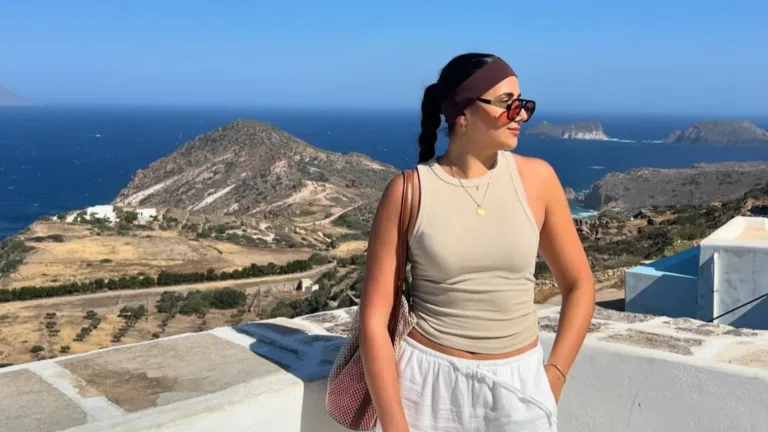
While the Eat, Pray, Love phenomenon is probably not lost on you, with a wild-haired Julia Roberts roaming around Italy undoubtedly springing to mind, the essence of this journey comes in many forms. For some, the pull for adventure is loud and urgent. For others, it’s more subtle, creeping in at the fresh-faced age of 25, in a suburban home somewhere in Sydney. For Anthi Preketes, it was the latter.
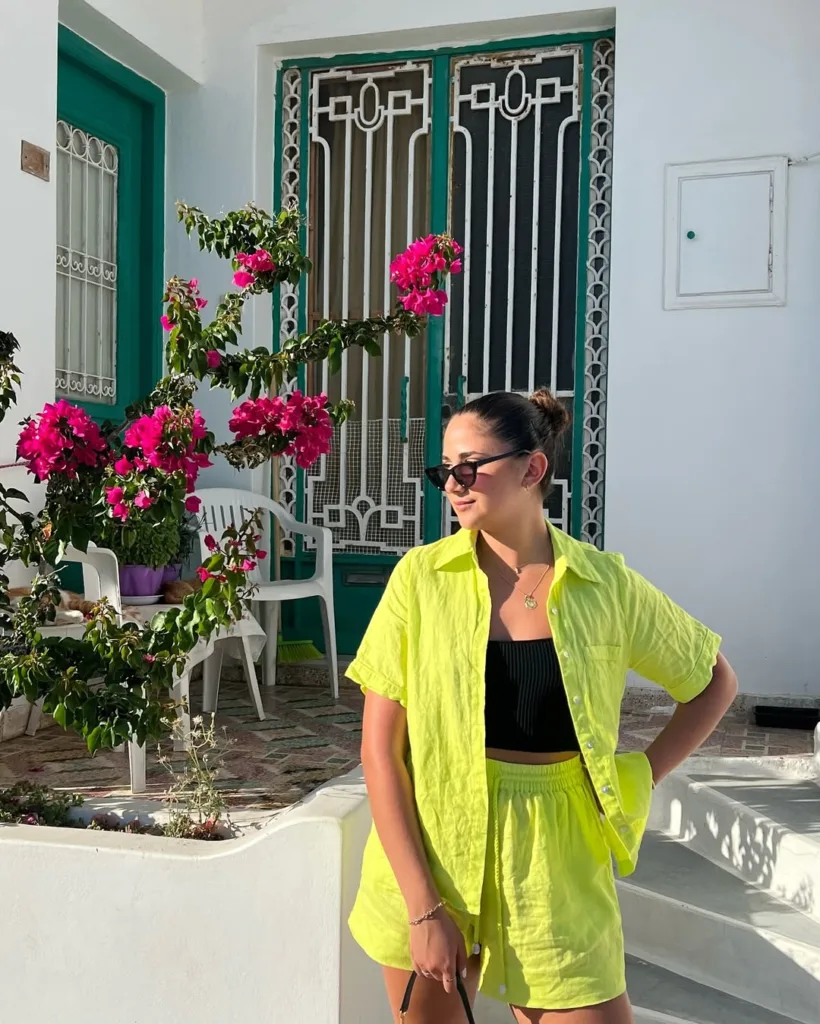
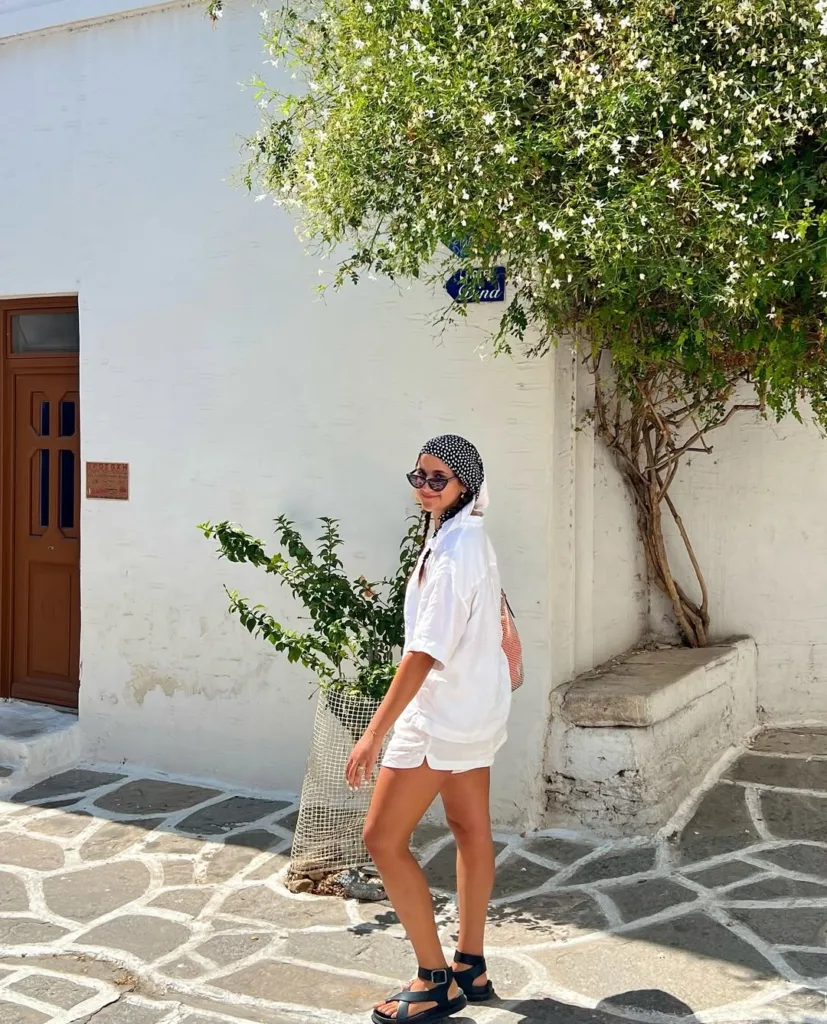
Now calling Greece home for just over a year, Anthi is living her best life yet. She packed her life into a single suitcase (weighing just 25kg), grabbed a one-way ticket, and set off with her hopes and dreams in front of her – her return date, TBC (to be confirmed).
“In my head when I left, I didn’t really think of it as moving to Greece. I had no idea what to expect,” she says.
While Julia’s ah-ha moment came through a turbulent divorce from her husband of 10 years, Anthi’s was a bit less dramatic.
“There wasn’t a specific moment that led to my decision… something was pulling me towards Greece. As I’ve matured, I’ve become more interested in discovering more about my heritage and my culture,” she explains.
Contrary to my 20-year-old self’s own experience – landing in London eight years ago and thinking, “What the hell have I done?” – Anthi’s touchdown on Greek soil felt nothing short of a match made in heaven (literally).
“It was a crazy feeling, but when I first arrived in Athens, I felt I belonged. I think this has become a self-discovery journey without that being my intention,” she says.
Anthi only validated my assumptions that if there are two certainties about Greeks, it’s this: they cannot hide their emotions, (even if they try really, really hard), they’re always late – even when they’re early – and they will never let life get in the way of having a good time.
“Something I learned when moving to Greece is that the lifestyle and mindset here are so different. In Australia, you live to work. In Greece? You only work so you can live,” Anthi says.
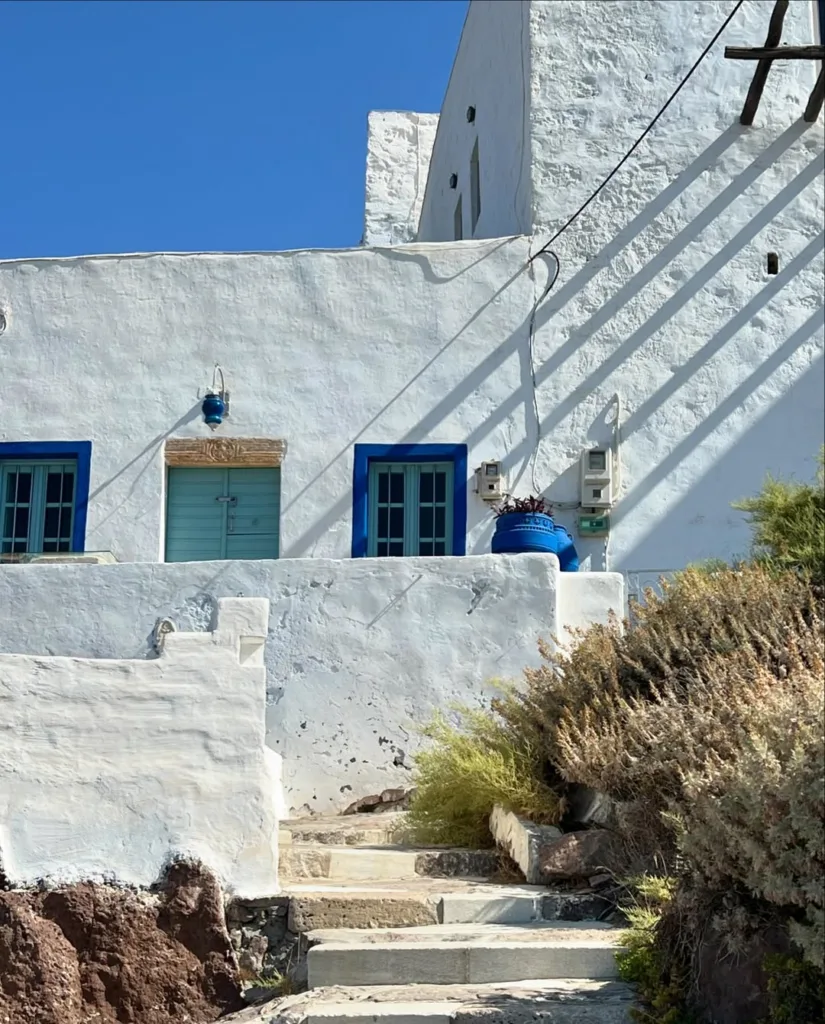
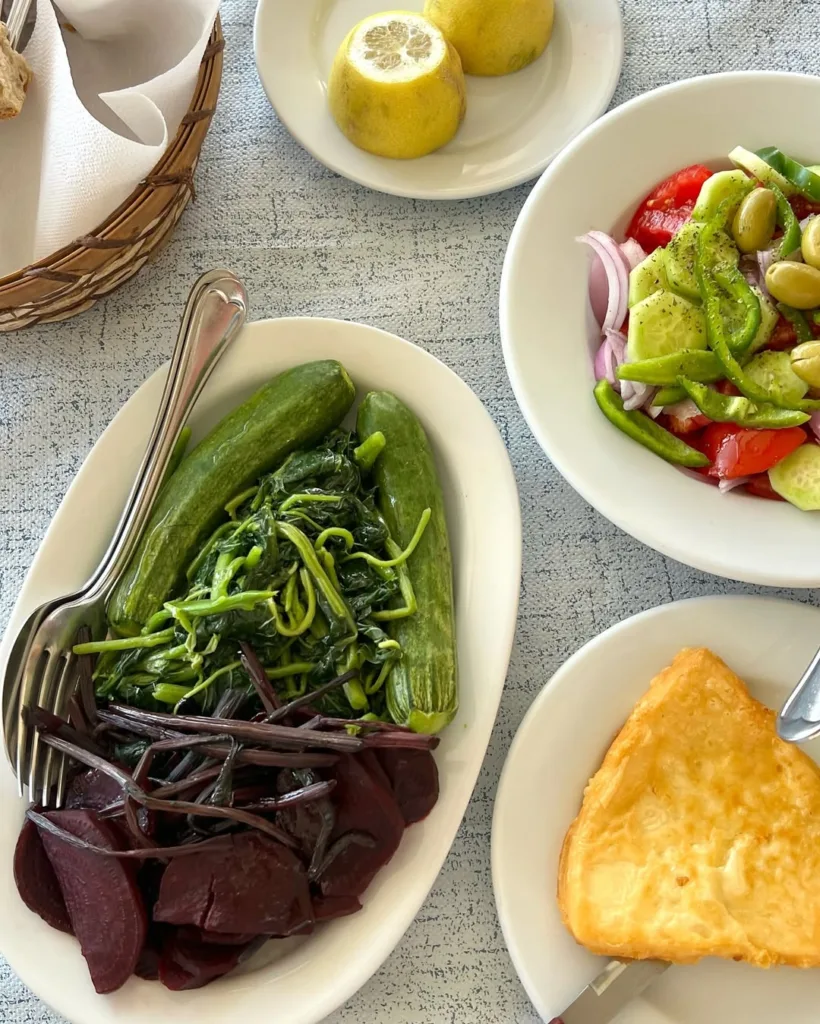
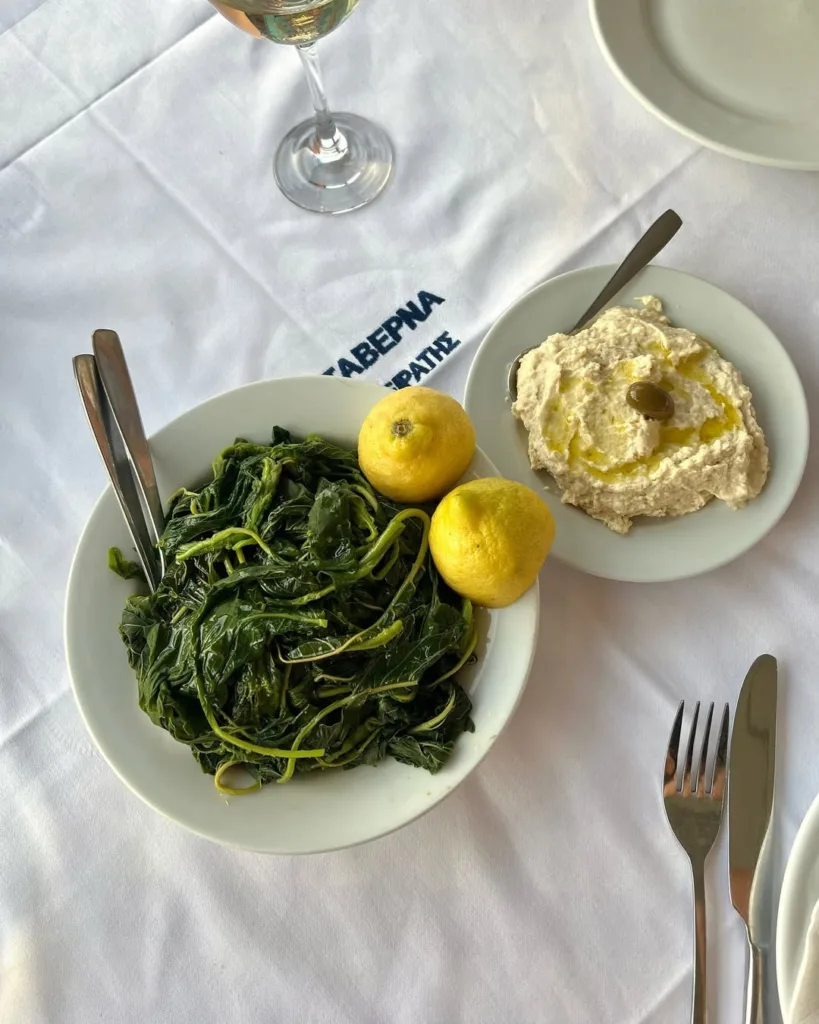
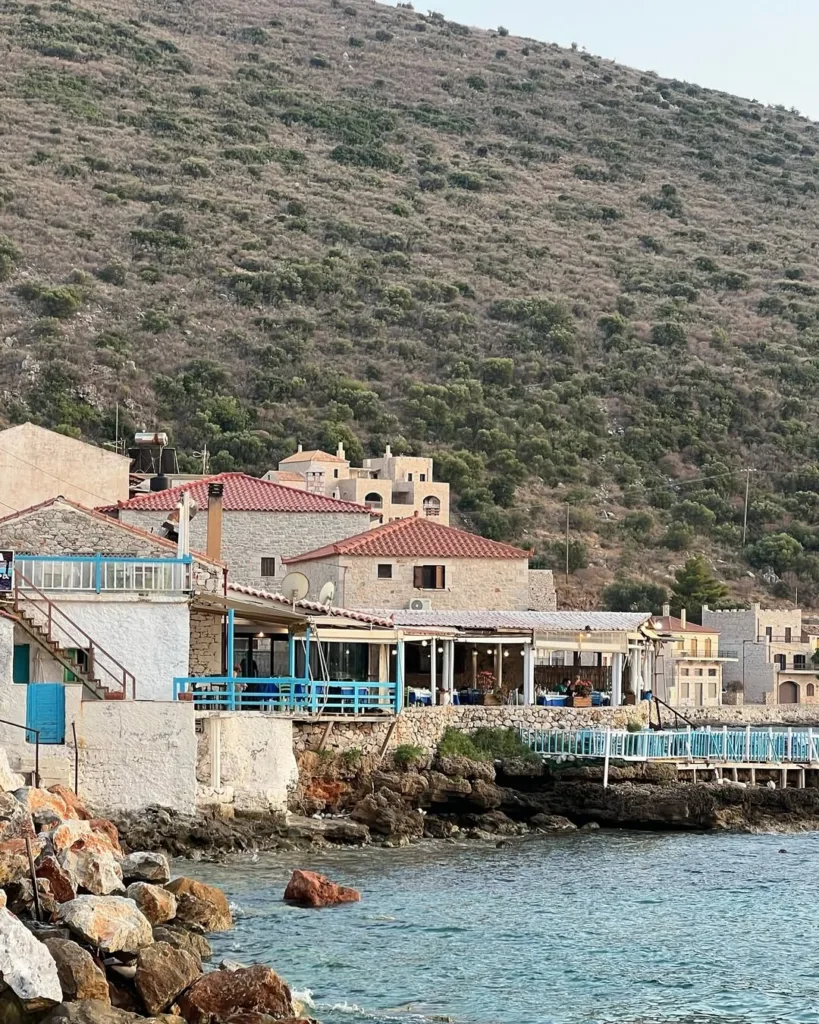
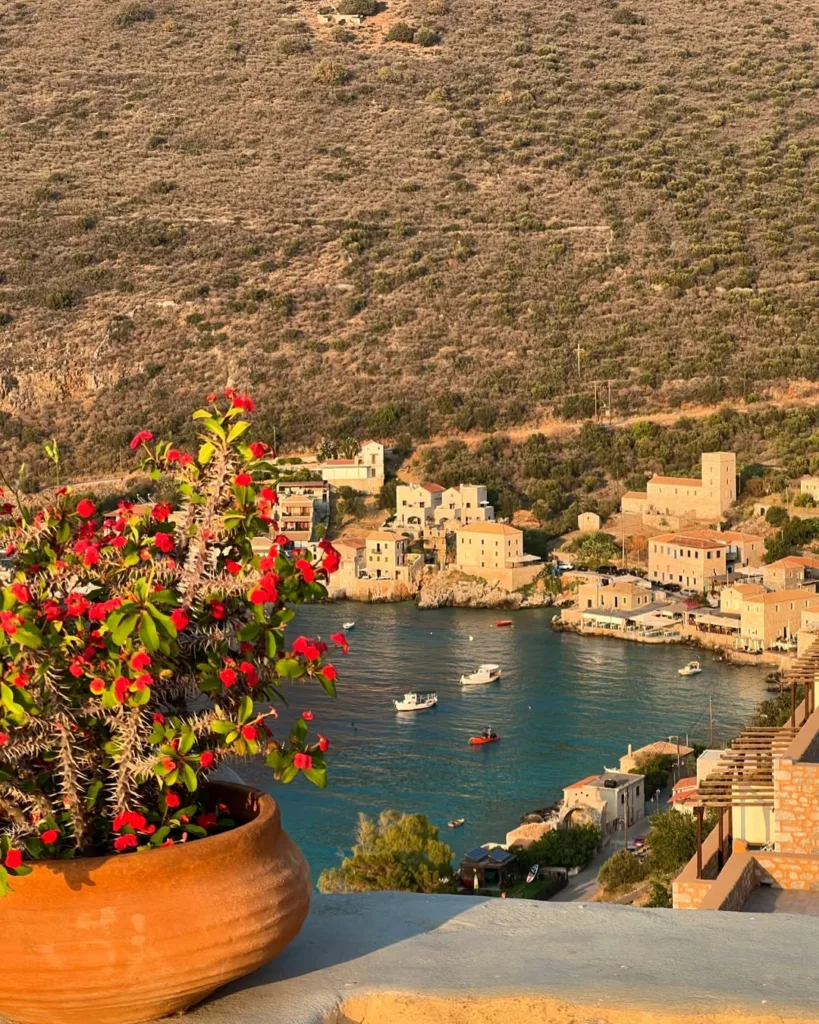
Where Egypt has its pyramids and Paris has the Eiffel Tower, in Greece it’s all about the freddo espresso, island hopping, and filling woven bags with fresh market produce.
If you haven’t yet scrolled Anthi’s TikTok – AKA, her “visual diary” – let me give you a peek into an average weekend. It starts with an ice-cold freddo espresso and a koulouri, followed by a stroll through the market. Then it’s off to a nearby island by ferry, and bouzoukia night to finish.
To wrap things up, I asked Anthi for her top tips on moving abroad.
“Patience is very important, sometimes you have to put yourself in uncomfortable situations to connect with people, and Bumble BFF is a lifesaver when it comes to finding new friends,” she says.
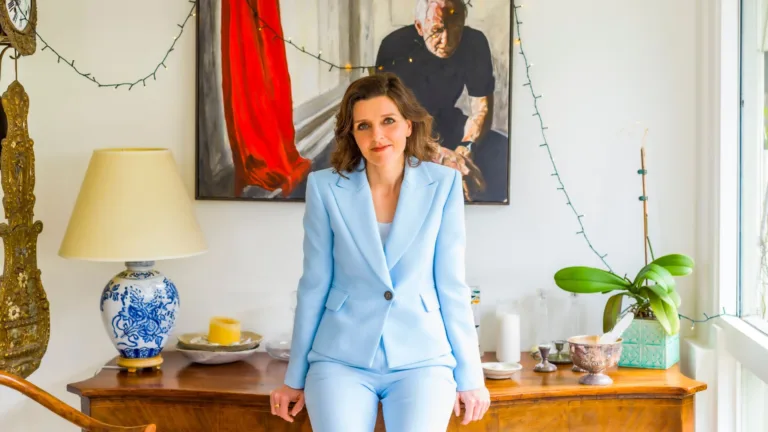
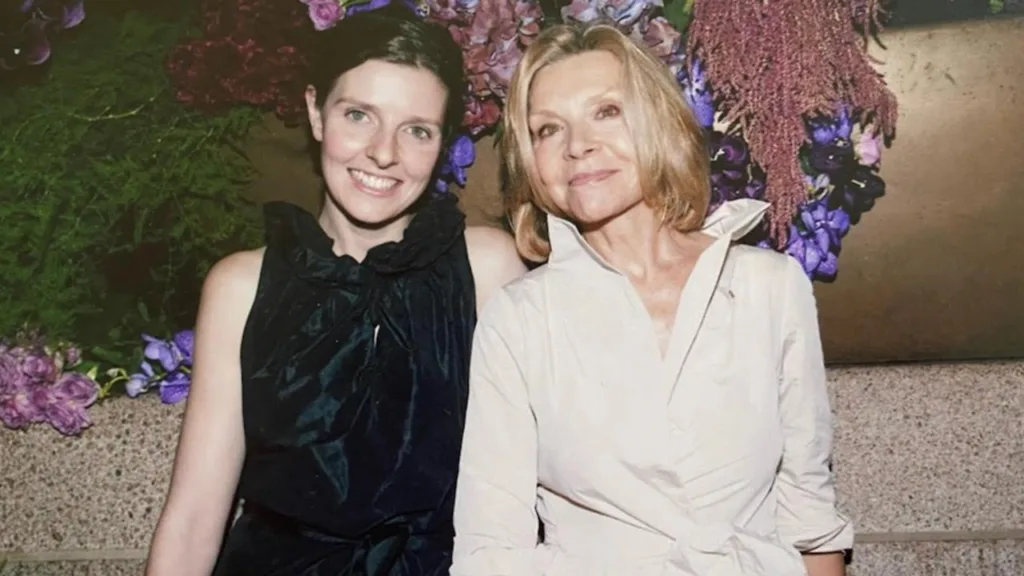
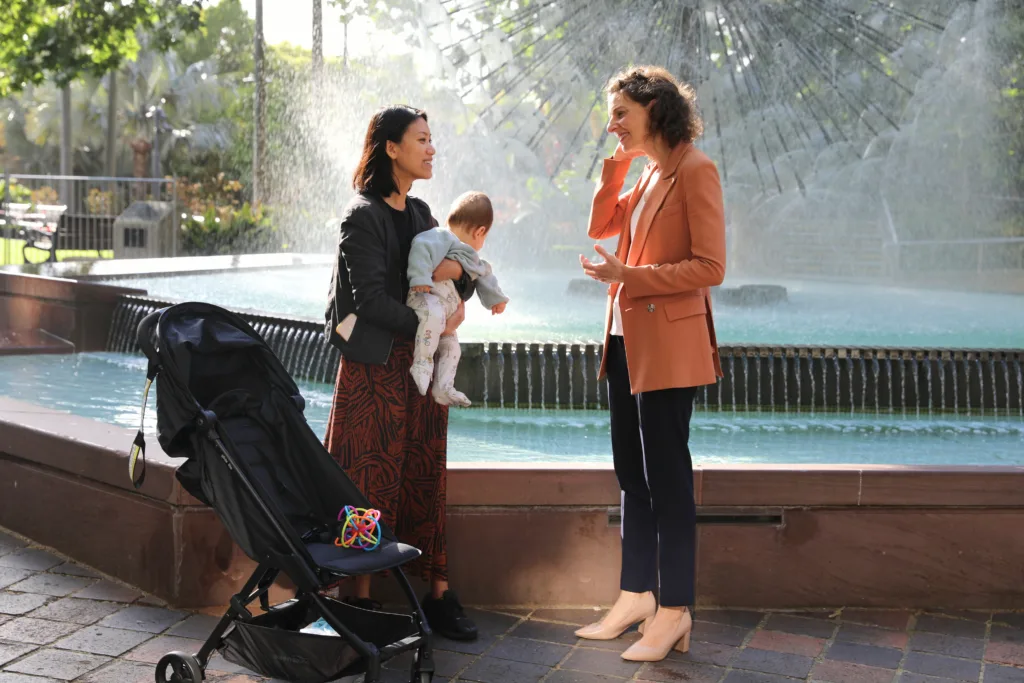
My mum arrived in Australia with nothing. No money and no English – but with the determination to build a better life in a country that allowed her to thrive.
To me, Carla Zampatti was one of a kind, but her story echoes that of many migrant families – especially Greek Australians who rolled up their sleeves and built businesses from the ground up in the Eastern Suburbs.
Mum wanted us to understand the value of hard work. So from the age of 10, I spent every school holiday working in her fashion business. It taught me resilience, respect and the importance of community. These are values I see reflected in so many Greek Australian families who have turned ambition into success.
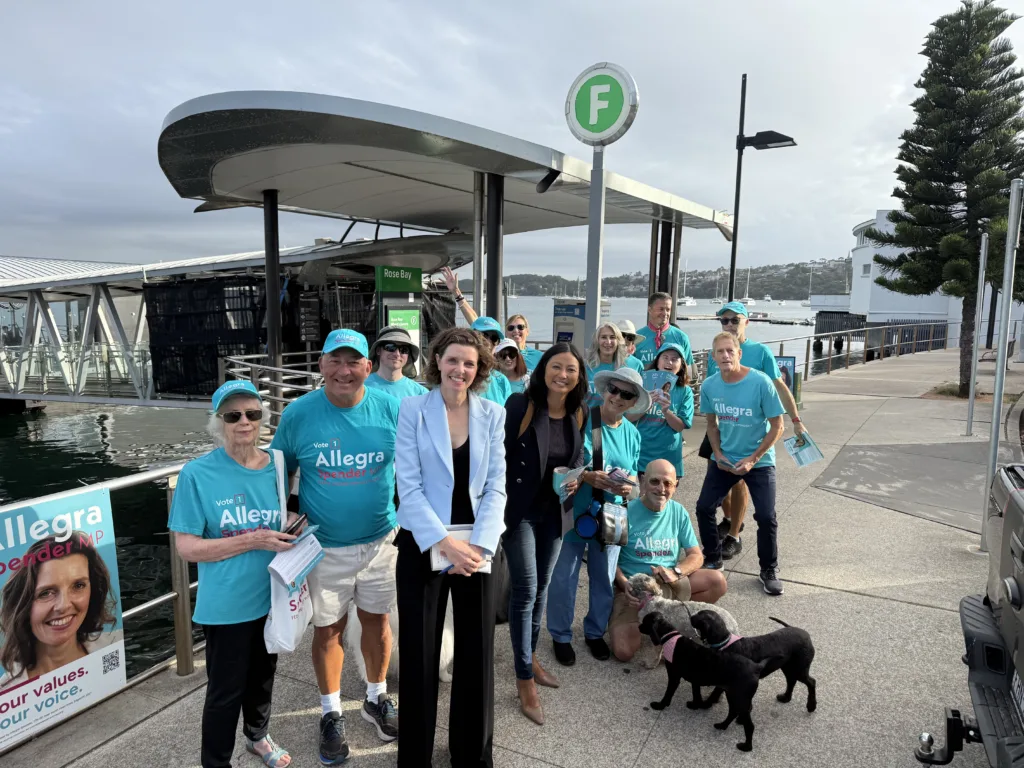
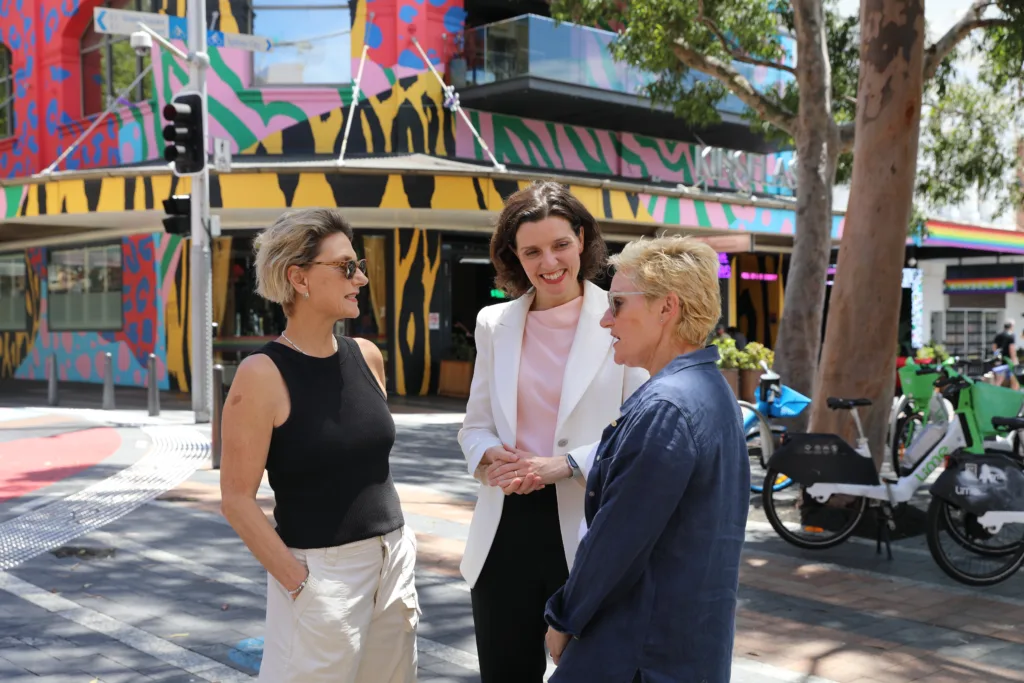
These values shaped who I am and why I put my hand up to represent Wentworth.
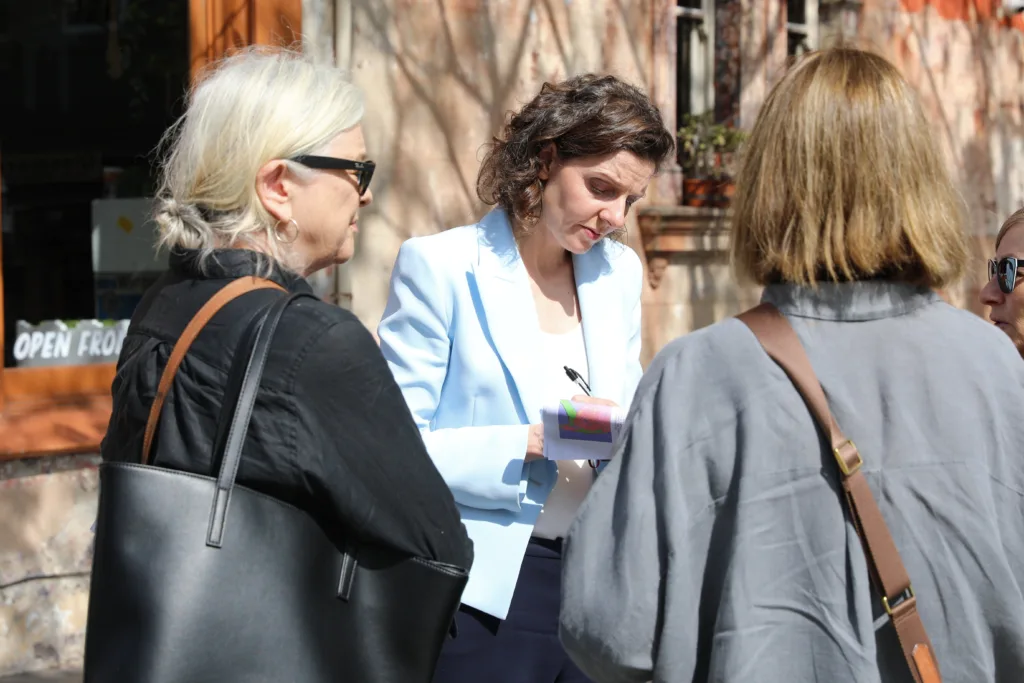
In 2022, I left my career in business and stepped into politics because our community wanted change. They wanted action on climate, integrity in politics, economic reform, and a more inclusive society. But more than anything, they wanted someone who would stand up for their values.
Standing up for businesses
Small businesses are the beating heart of our community. But too often, these businesses are drowning in regulations that make life harder. Add the current cost of living pressures and it’s little wonder many small businesses go under.
Having run multiple businesses, I understand this frustration, which is why I’m determined to back policy that reduces red tape and helps business thrive.
When the government proposed new industrial relations laws, I fought to protect small businesses, securing important safeguards against some of the worst impacts. I also led a push from eight Independent MPs to raise the “small business” threshold from 15 to at least 25 employees – a move that would simplify regulation for over 46,000 businesses.
When the government tried to pass a tax hike on superannuation balances over $3 million, I fought hard to stop them – and succeeded. Taxing paper profits discourages investment and threatens innovation and economic growth.
When I was concerned the extension of the small business instant asset write-off would not pass Parliament, I worked across both houses to get it through in a single day—because local businesses told me how much this change would mean to them.
My dad was a federal Liberal frontbencher, as his father was before him. That meant much of my childhood was spent in Liberal Party t-shirts, handing out flyers. He encouraged me to listen to evidence, engage with people and most importantly – to remain open minded.
That value of independent thinking was key to my decision to run for Parliament as an independent.
I wanted to stand for a different kind of politics – one that puts the community first, listens to the evidence, and delivers real solutions rather than party politics. Too often, our political system focuses on division rather than progress, and I believed we needed a new approach that prioritises integrity, accountability, and action on the issues that matter most.
I am proud of what we have achieved together.
We’ve turned the ship around on climate, with tougher laws on big polluters, record renewable investment, and new standards to deliver cleaner cars. We’re on track to meet our 43% emissions reduction target by 2030, up from 26-28% under the previous government.
Parliament now looks more like modern Australia, with a record number of women and diversity on the crossbench.
I’ve helped deliver a new ombudsman to tackle sexual assault on university campuses, a Special Envoy to combat the rise in antisemitism, and our LGBTQ community will finally be counted in the census. And while the major party’s squabble, I’ve led the debate on economic reform.
My Tax Green Paper was the first ever released by a non-government MP, setting out the urgent need for long-term reform – including lowering income taxes to help young people get ahead.
But beyond any single policy achievement, we’ve proven that politics can be done differently – and that progress is possible.
Looking forward, there is much more to do.
Reducing the costs of renting and home ownership. Reforming our tax system so young people can get ahead. Building a smarter economy that works better for business. Accelerating climate action. Creating a kinder community.
These are big challenges that require bold solutions. Politics as usual won’t do it.
As an independent, I’ll continue to stand up on the tough issues that the major parties are too scared to tackle. I’ll continue to listen to our community and to the experts. I’ll continue to vote every single time based on the values of the community I represent.
And I’ll hold to the values that made Australia a wonderful place for my family to thrive.
Sorting through boxes, Nik Loukas finds rolls of old film containing frames upon frames of happy holiday memories.
He didn’t remember it at the time, but his father Chris loved taking their video camera on their trips overseas, capturing moments with his family.
“My first trip was in the 80s. We took Singapore Airlines from Melbourne to Frankfurt. My parents took us out of school for six months. I was about four or five years old and I vaguely remember the trip. I just remember losing my boarding pass on a stopover in the Middle East somewhere,” Mr Loukas tells The Greek Herald.
“The following year we went to Hawaii for a week and I specifically remember my kid’s meal on Continental Airlines from Melbourne to Hawaii. We regularly went to Greece flying Olympic Airlines which no longer fly long haul.
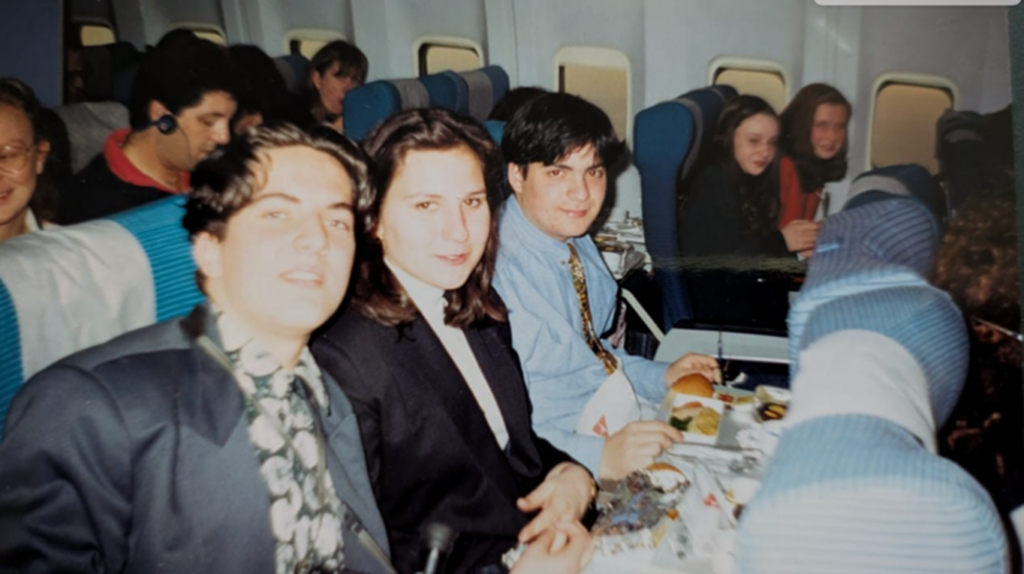
Melbourne to Sydney Qantas 1994 school communication project.
“Having the memories because he [dad] videoed these holidays is so special and getting exposed to travel so young made me fall in love with it. I don’t think I would’ve if it wasn’t for him.”
While you might not know Mr Loukas by name, you may know him from his website or Instagram, Inflight Feed, where he shares reviews of airline catering from across the world.
Thousands of visitors flock to the website every month; from civilians who want to know what they’re getting into, to airline head honchos looking to see what their competition is up to.
“I got the idea to start Inflight Feed when I was working at Tiger Airways in Melbourne. Back then we had changed the service on the flights and stopped accepting cash which was a big thing in the 2010s. I thought, ‘why doesn’t someone have a website that tells people what is offered on board’,” Mr Loukas said.
“A friend of mine said you’re flying around so much ‘why aren’t you doing reviews as well?’ So I added in legacy airlines, I started flying in business class and throwing in airline reviews. It’s morphed into a wealth of information, including how to order special meals and people want to read about it.”
Air travel has drastically changed since the inception of the first airline back in 1914. For starters, it’s become far more accessible to everyone.
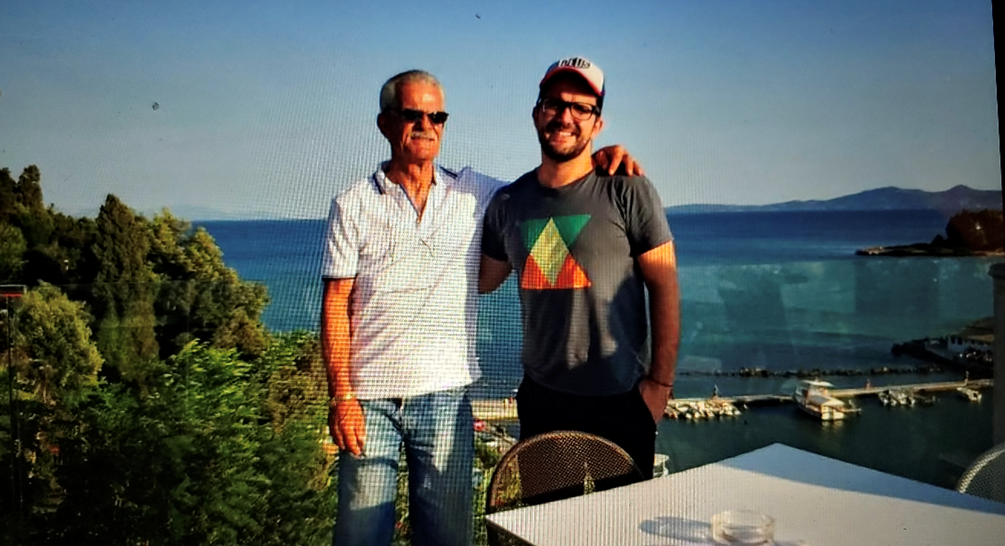
Loukas’ favourite place in Corfu, watching the planes land in Kanoni.
“A lot of people complain today about airline food but air travel has become more common for everyone today. It’s really easy to jump on an airplane with a 100-dollar ticket within Australia. When I was travelling with my parents in the 80s, flying was a privilege,” Mr Loukas said.
“And so airlines are now making mass amounts of food. It’s not going to be delicately prepared the way it was over 40 years ago; being carved in front of you in business class.”
In their efforts to make flying more economical, airlines have cut back on inflight service amenities and even squeezed in more seats by reducing the size of the galleys.
“Airlines have used post-COVID as an excuse to cut back on service and to reduce the size of meals. Some airlines like Lufthansa, Swiss and Austrian Airlines have removed complimentary food from all short haul and medium haul flights and you’ve got to pay for it now,” he said.
“Toilets in the galleys mean passengers are using the space that was once dedicated to preparing meals. Airlines are finding it difficult to fly for six to seven hours and back. They would have to do ‘double catering’ which means having your flight catered for both trips. People are given a box of food because it’s easier and occupies less space. You’ll find that everything is getting smaller including the cutlery; there’s no more glassware in economy. These items are heavy and airlines want to save fuel. I understand and I respect that but how much is too much?”
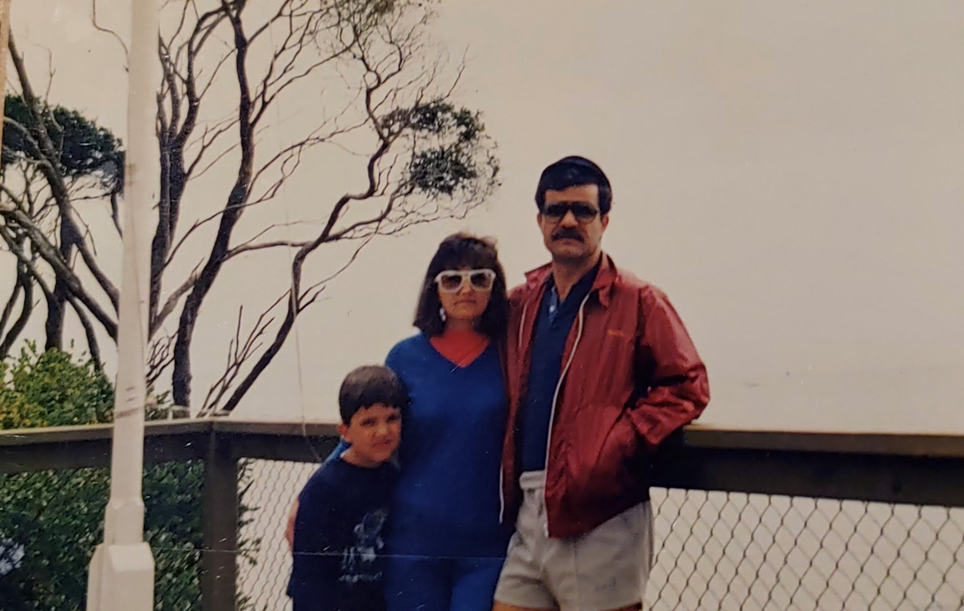
1987 Hawaii trip with the Family
While the days of a full buffet service have long gone, not all hope is lost on board.
“Airlines are focusing more on profit rather than experience but at the same time I think we’re going to see more airlines investing in their food. Qatar introduced a caviar service in business class on some routes. JetBlue is really focusing on offering fresh, local food in conjunction with local restaurants and collaborating with local brands and I think we might see more of that. But I think it will take a long time for the big airlines to catch up,” Mr Loukas said.
Over a decade later, Inflight Feed has become a beacon of knowledge. With his wealth of experience, Mr Loukas has also been called on to consult airlines, advising them on how they can make this experience better.
“Some of the best experiences I’ve had is meeting people and we talk about travel and food. I held an event in New York in conjunction with China Southern Airlines and we invited people that came from all over the world to taste test two meals that they were thinking of serving in economy class,” he said.
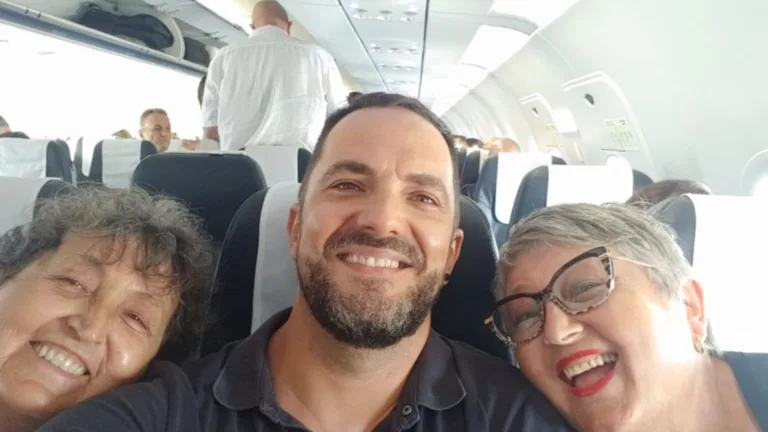
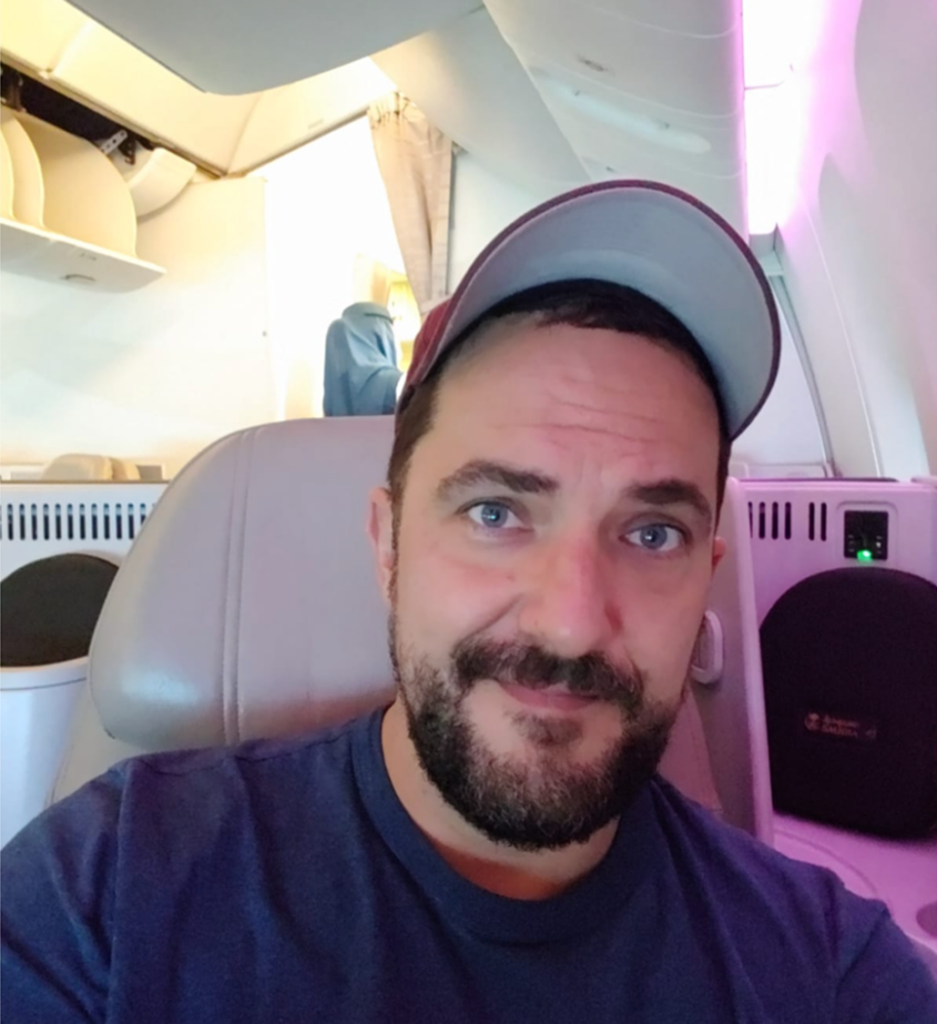
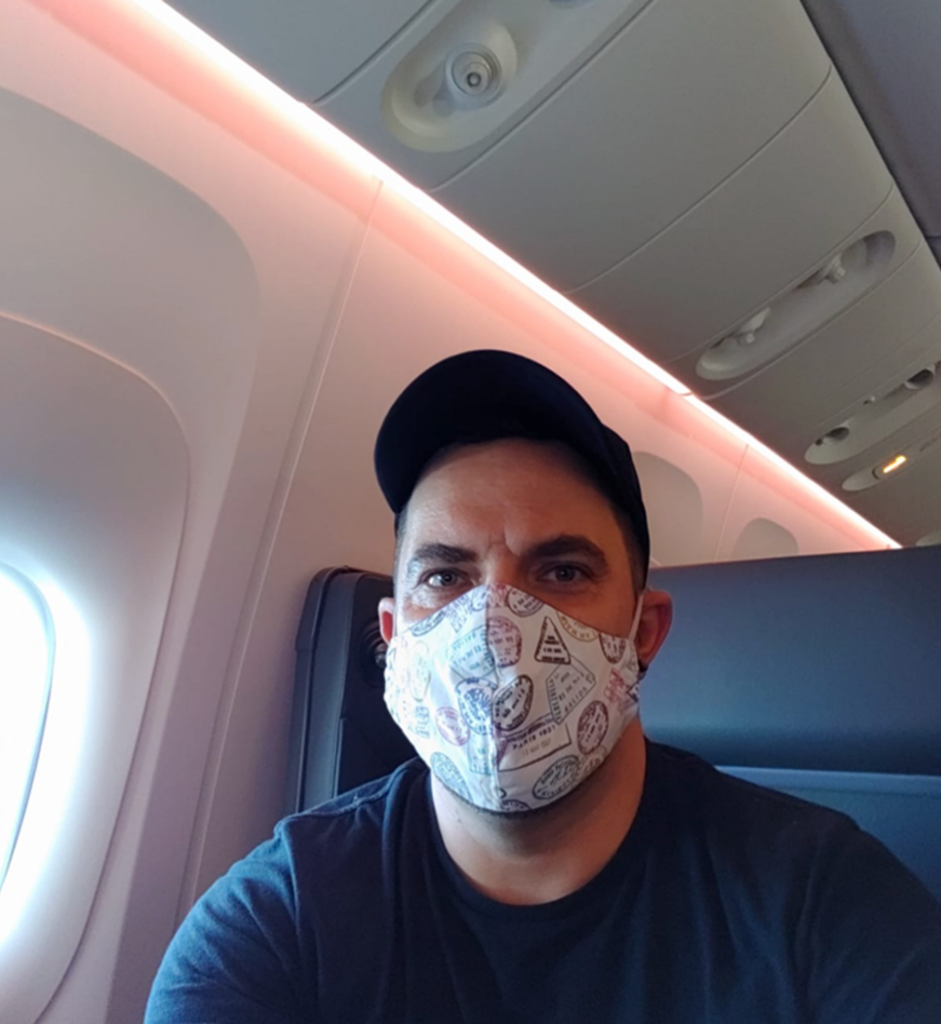
Selfie 2022 travelling between Asia and Europe with SaudiaFirst trip in 2021 November once the borders were first opened after Covid. Went to Europe.
“It brought together a lot of people. Some of them worked in the industry, some of them just loved flying. Food, no matter where it’s served, brings people together. It’s always a bit of a common ground.”
Mr Loukas’ head isn’t always in the clouds. On the ground, he volunteers an hour of his time every week with Pronia.
“It’s such a simple way to give back to the community and it makes a world of difference to those you spend time with.”
This question has come in from a reader of The Greek Herald who struggled with Greek as a child and wonders now if it’s still possible to learn the language as an adult.
Kicking off
There are questions in language research that are ambiguous, difficult or complicated, and academics end up giving unhelpful advice to people. But this isn’t one of them. The research on age and language study is clear. You can learn a language at any age, and, although young people have some advantages over older people in some aspects of language study, there are many, and important, areas where, believe it or not, adults are better learners than young people. In general, adults and children, especially young children, learn languages differently, because they are cognitively different.
So, the simple answer is that no one is ever too old to learn a second language and you definitely can learn fluent Greek as an adult. Success in language study is closely tied to motivation, opportunity, desire, cognitive maturity, quality of teaching, and experience with language study, even if it wasn’t successful, should not hold you back.
I will unpack many of these points below but before I launch into that I should say: the best time to start learning Greek is ‘as soon as possible’.
Children and adults
Because there are individual differences, (and a small percentage of lucky people seem to have a special talent or aptitude for language that others don’t share), we must speak in averages or tendencies, rather than in absolutes. When it comes to second languages, we know that the first language, and the kind of facility we have with it, influences how we approach the second language and how well we learn it. This means that children and adults approach language study differently because children are still learning their main language, and adults, mostly, have achieved full knowledge of their main language.
When we look at how well children perform in language study and which kinds of programs are best, we find that children tend to shine in more naturalistic settings, where they ‘absorb’ the new language using their intuition. Many adults find this difficult or too slow and tend to benefit when language teaching is more strategic, or explicit. There are interesting reasons which make this the case, and I will mention some of them below. However, some people, both adults and children, like a mixture of the formal and the informal, the implicit and the explicit at any age, and each has advantages and disadvantages.
I will set these out for THE KIDS and THE GROWN UPS.
THE KIDS
Children’s brains tend to have more ‘neuroplasticity’, which means they adapt easily, and tend to be more flexible. Because of this they can learn ‘implicitly’ meaning they ‘pick up’ language while doing other things, such as team sport or art. In such activities Greek would be the language used to play the sport and follow the rules and strategies of the game. If you have to coordinate with others to win a game of soccer and you are only allowed to use Greek, then the need to communicate is high. This need to communicate, N2C, is maximised because you are trying to achieve another goal that you share with others and which is the focus of the activity, rather than the communication itself. In this way, implicit language learning reproduces first language learning, the learning of our mother tongue, in which our parents do not set out to instruct us in language, but to communicate with us in that language, adapted to our age, but focused on activity and practical needs.
Everyone learns their first language, their ‘mother tongue’, successfully. Unless there is a serious disability, no one fails their mother tongue. By contrast, many people who try to learn a second language are not so successful. A key difference is whether there is a N2C, and if the N2C is missing in the real world, whether the classroom, or home, can create a substitute N2C.
Children should still be taught explicit language: the sounds (phonics and phonetics) of Greek, the rules of its grammar, and of course Greek vocabulary, but this should not dominate the curriculum for small children, and should always be done in a way that is linked to meaning and communication. Many adults (not all) prefer to have explicit teaching, they want to know the rules and sounds and words of Greek so they can speak accurately. When you learn in an immersion setting, you are learning to become fluent, and you may not always be accurate. Language teaching should try to achieve both fluency and accuracy, but how we go about it will vary.
Another way to talk about these differences, which I repeat are broad and not every young child and every adult neatly fits into one or other group, is to distinguish between implicit learning (unconsciously picking up language through exposure to it in activities and interactions with people using only Greek to them), and explicit teaching (direct instruction through rules, memorisation, practice, etc).
I have expressed this difference in a very general way, but I hope the point is clear that listening, imitating, participating, with small amounts or none of formal instruction is a way to learn that young children accept more readily than adults. There is an important psychological reason for this, which I will call ego-permeability, and this can be different between boys and girls, men and women. Perhaps we can talk about gender on another occasion, because like age it is an important issue in language study.
A high ego permeability allows younger learners to not stress too much about making mistakes, to adopt new roles and sounds and not feel too embarrassed when doing so. I am sure we all know shy young children for whom the opposite is true, but it remains true that this is a key difference between children and adults in language learning outcomes. Many adults have trouble adopting the new personality and perspectives that you need to learn a new language. If you get too attached to your self-image as it is now, then you might find it hard to adopt a new identity that will come from speaking and participating in a new language community. This is one of the explanations for why children do better than adults with ‘native like accents’ (intonation and pronunciation), where children’s superiority over adults seems to be clearest. Teachers find that children are more open to activities where it is ok to make mistakes or to hear yourself sound ‘funny’ as you try to master the new sounds of the language you are studying, while many adults aren’t so open to this.
Other reasons why children do better than adults are more pragmatic. The most important one is that they are, obviously, younger. They have more time than us.
THE GROWN UPS
The advantages we adults have over children in second language study tend to be the mirror image of the advantages children have over us. We have stronger cognitive abilities (we know more), and we can work out strategies for learning that suit us better and focus on specific parts of language learning that interest us or which we know we need or desire.
Allied to this is that we are likely to have a specific goal or aim in our language study, and usually children don’t get consulted about why they are learning the language and what they want to get out of it (something I recommend we do with children learning Greek whether in the home or at school).
Adults have more awareness of language (metalinguistic awareness), and this sharper awareness of language and how it works allows adults to analyse the rules of language, the parts of speech and writing and work out complex expression, vocabulary and grammar. It is easy to see how language awareness helps the learner because it can personalise the program of study and assist in language tasks that are based on writing rather than speech, or in which complex topics are being discussed.
This also means that adults are less dependent on the teacher for language input, and this greater autonomy can help in supplementing the program they are enrolled in or making it more attuned to the specific goals the individual learner has. So, we grown-ups can learn second languages perfectly well.
So, back to the question: I failed Greek as a kid, can I learn Greek as an adult?
Yes, you certainly can.
There are many providers offering Greek courses at different levels of proficiency. You can extend and enrich these with the myriads of online courses and apps, software and aids to personalise the learning you do in class. You can engage in immersion (I will do a ‘tips’ article on immersion soon). There are practice opportunities like the one Pharos supports at present during Speak Greek in March (though we think you should extend well beyond March), the conversation café.
What I recommend you do is to write down a personal learning plan. It is useful to define your purpose (WHY do I want to learn Greek?), list all the reasons, situations and people you would like to use Greek with and in and what you would like to accomplish in these settings.
Set out a time goal for each week in addition to the total lesson time. If you are doing a weekly 90-minute class, for the first month you triple the hours per week in personalised listen/read time. Call this Greek beyond class time, then try to increase it steadily each month after that.
Build a network of friends/family that you call on to assist you. Call them your team or your support base, a Greek Ginger Group (support group). It is useful to help them to understand what you need from them. It would be helpful if some of them are more fluent than you. Starting small, with clear aims, in a program that you discuss with the teacher and your Ginger Group, what your goals are rather than an ‘off the shelf’ course, you can take control of your learning and write your own learning plan.
As in all language study it is important to interact with Greek frequently, and regularly, to mix formal study with actual communication, to be consistent and to set realistic goals. These can be vocab gains (X number of new words each week) or topics you want to specialise in. You might say, “next month I want to become more confident discussing ideas about Greek politics”. An aim such as this is very practical and immediately tells us what kind of language you need to achieve this aim and the activities you need to follow to access this language. So, once you have the aim set out you need to research as follows: 1) what are the main political parties? (their names, slogans), 2) who are their key leaders, heroes, significant ideas? 3) what policies do they have? 4) what alliances and differences are there between them all? 5) what is their representation in the «Ελληνικό Κοινοβούλιο»? etc. Once this map is outlined you could record online discussions of a sitting of parliament, or a radio/tv/newspaper debate, and work with your teacher to help you make sense of complicated language, listing all the difficult or problematic areas. A similar exercise could be around transport around Greece, or Greece’s membership of the EU, sports facilities or cooking or Greek folk music, whatever topic will push you beyond ordinary or comfort zone language. Your Ginger Group comes in handy in doing this task together, depending on people’s interest.
In this way you can immerse yourself in specific contemporary Greek language, including idioms and colloquial expression, and this leads to opportunities for practice and utilising diverse learning methods. These methods extend you beyond the lessons and classes; to include the vast array of apps and aids we have access to these days, including local media. In all of this the aim is to build an N2C, a need to communicate.
Some small things tips that you can do right away and can help are:
Make Greek your phone and computer language
It’s something we do with children, but you can adopt an ‘ego permeable’ attitude and label your house with Greek names. Names might be too simple so, move from single words (vase, vacuum cleaner) to expressions (put flowers in the vase, change the water in the vase, check the battery is charged on the vacuum cleaner).
Make sure you listen to Greek news every day or at least a few times per week. Have a notebook near the TV or radio for writing down words, expressions, topics or grammar that you find confusing or opaque and label these “learning challenges”. Select these to support the topic I mentioned above.
Every week summarise these learning challenges and talk to a teacher/tutor/friend who can help you work through these, or the Group.
If a group is too difficult you could limit the support to a Greek buddy, and arrange a weekly meal or coffee get together for exclusive Greek conversation practice.
Build a positive attitude, pre-warn anyone who you think might be judgmental or negative about mistakes. The best attitude is to see mistakes as information for new learning, fodder for growth or something like that, turning problems into possibilities in a systematic way.
In the activities it is important to include all the ‘macro skills’ of language: speaking, listening, reading and writing.
With a plan and with routine your knowledge of the language will grow. All language success is worth celebrating, so make sure that is part of your learning journey. If your child is learning Greek then join your efforts and turn your home into a Greek language immersion environment. We had an article with tips on this recently.
In these ways language study, building Greek back into ordinary life, helps build community, identity and connection.
*Joseph Lo Bianco is Professor of Language and Literacy Education at the Melbourne Graduate School of Education. He is also the President of Pharos Alliance, dedicated to preserving Greek language in Australia.
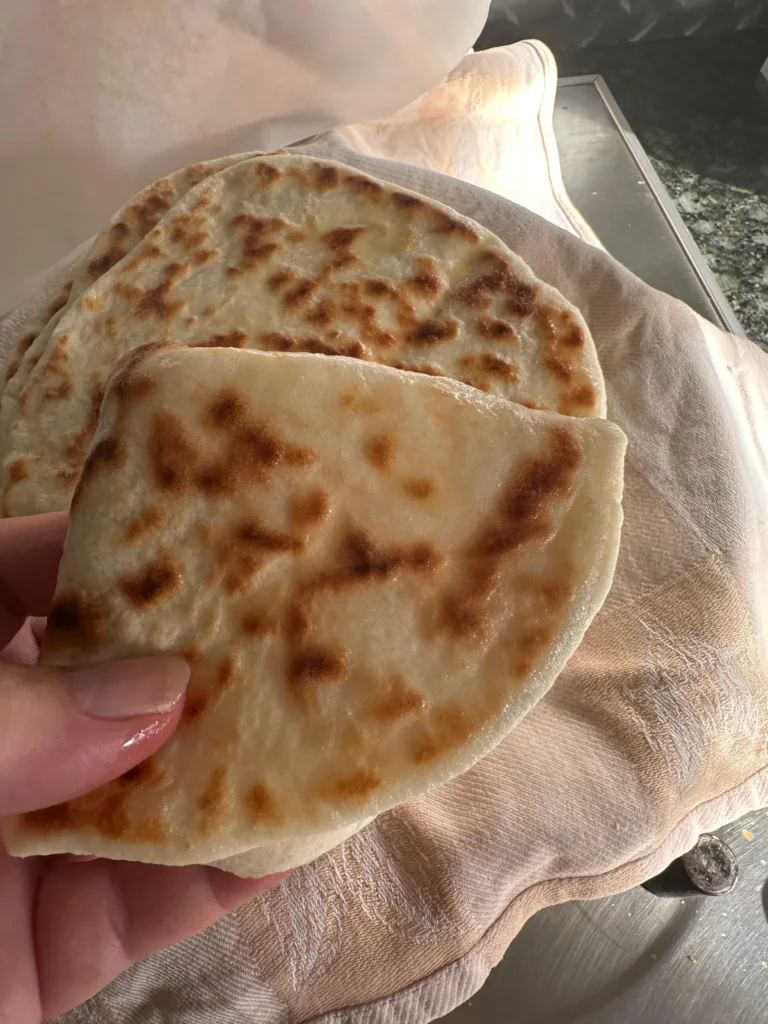
Niki Louca from My Greek Kitchen shares her favourite recipe for pita bread with The Greek Herald. You can follow her on Instagram @mygreekkitchen for more!
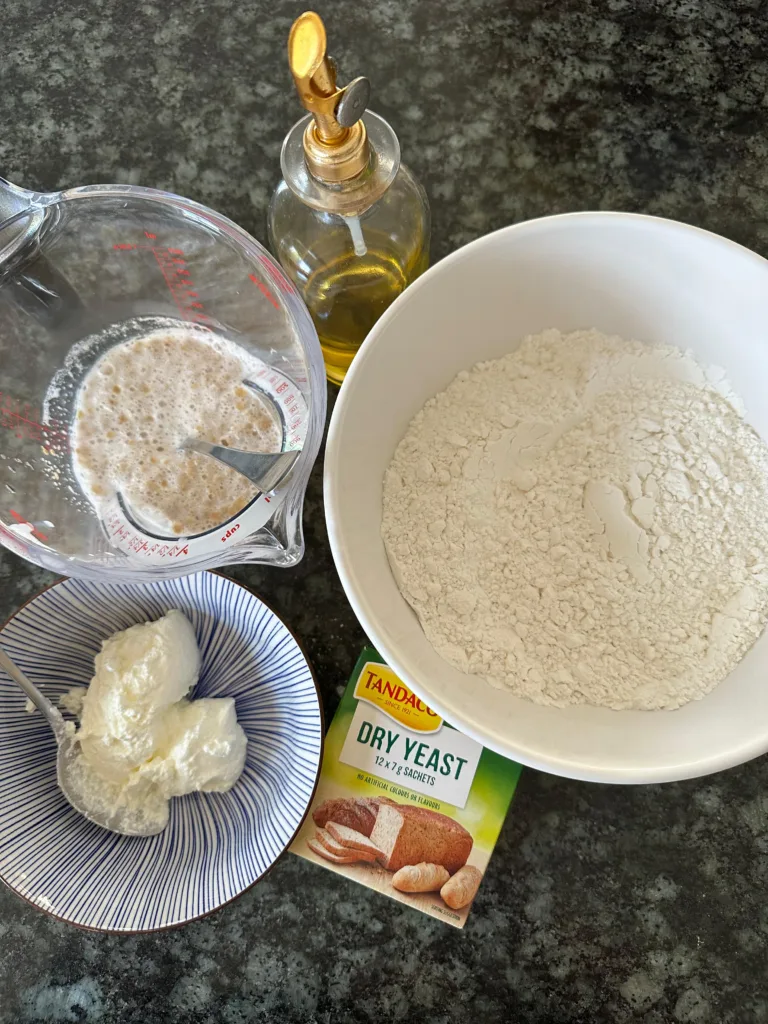
Ingredients:
500 – 550 gm strong bread flour
1 sachet dry yeast (7 grams)
100 gm Greek yoghurt – if you don’t have any you can substitute with an extra 100ml water
100 ml warm milk
120-140 ml lukewarm water
1 tsp sugar
½ tsp salt
Method:
In a small bowl add 100 ml of lukewarm water, warm milk, sugar and yeast together. Stir to combine well and set aside for 5-10 minutes.
In a large bowl add your flour and salt – stir it through. Add the yoghurt and the yeast mixture. Knead together, adding the remainder of water as needed. Dough should be smooth and soft but not sticky.
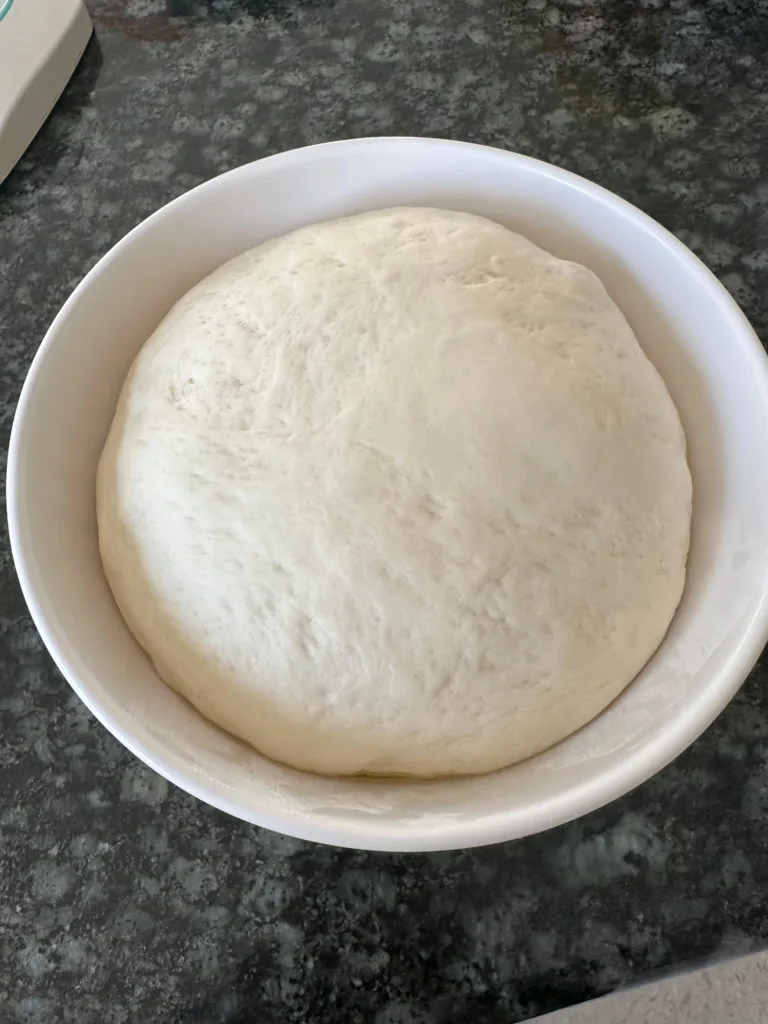
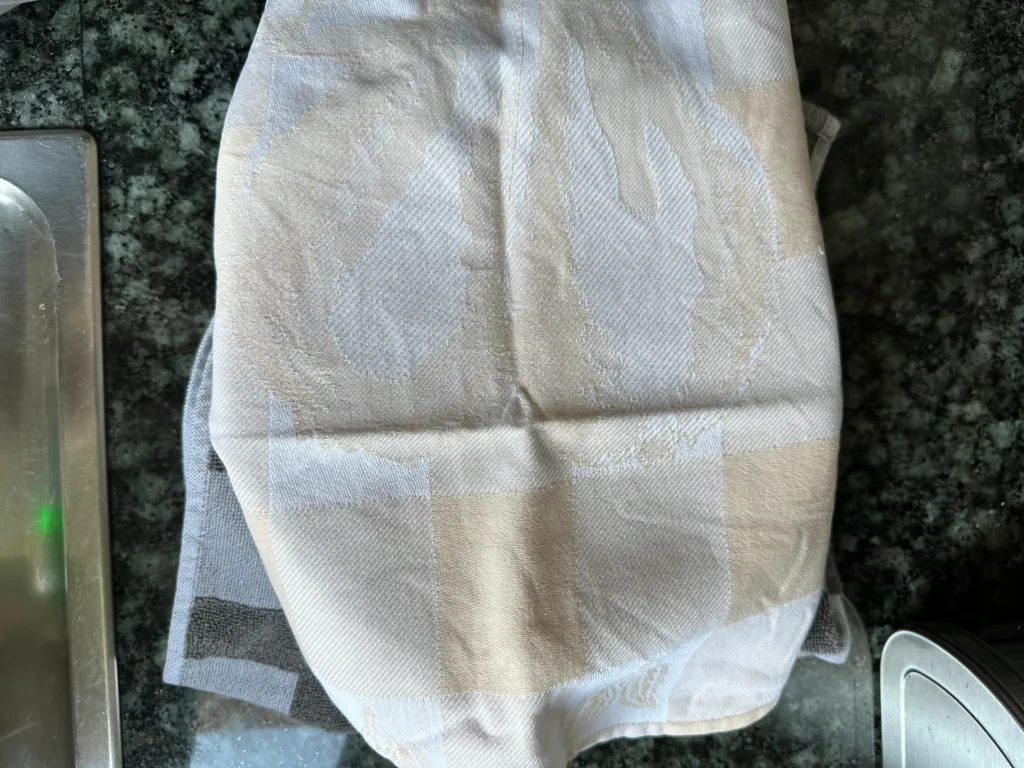
Keep kneading the dough for about 10 minutes till it all comes together – you may use a mixer if you prefer. Once ready, pour a little olive oil in your hands and rub it all over your ball of dough. Let it rest in an oiled bowl and cover with a clean tea towel for about an hour till its doubled in size.
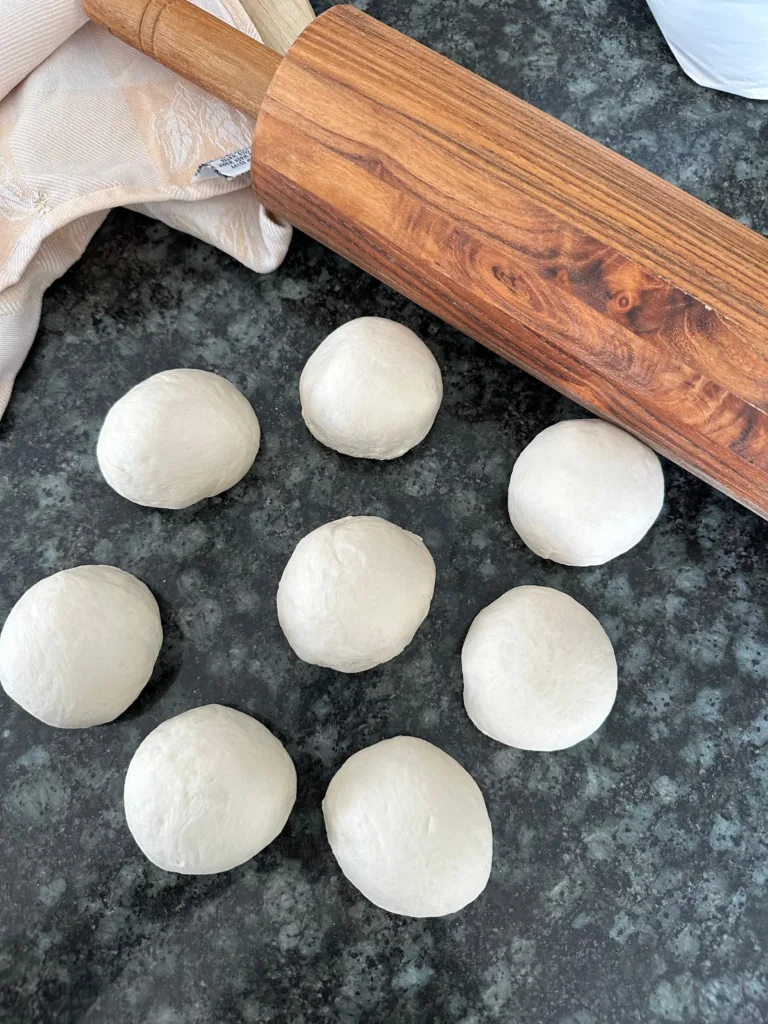
Divide dough into 8 equal portions and form little balls. Let them rest/proof again for 20-30 minutes. Make sure you cover them with a tea towel.
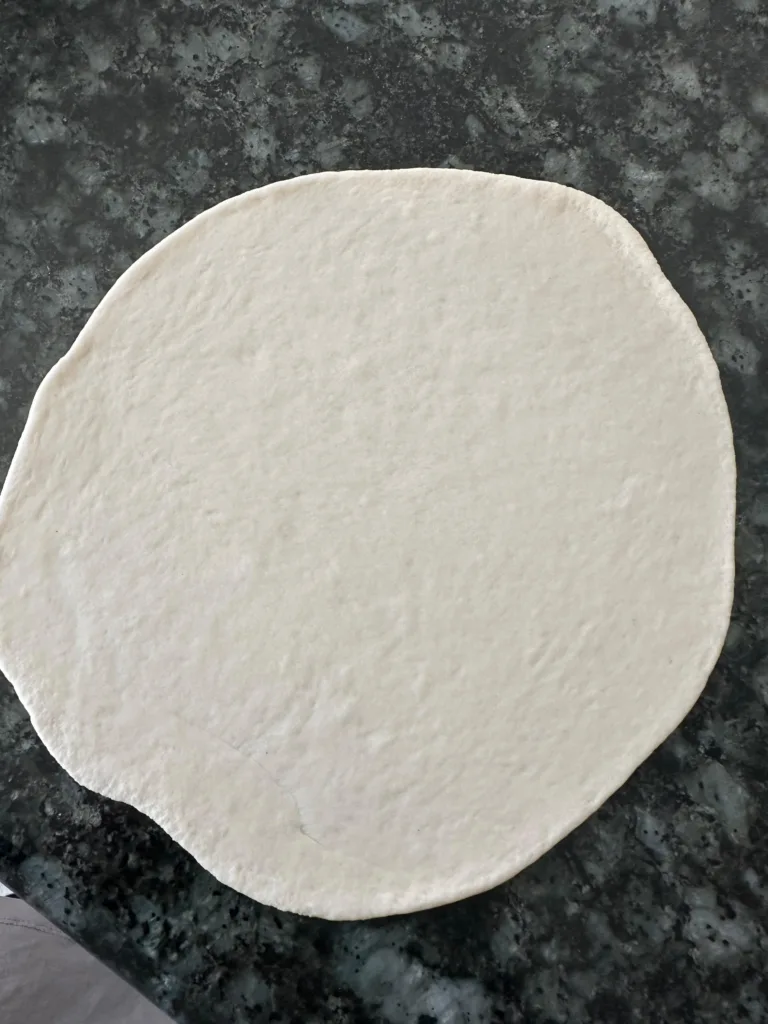
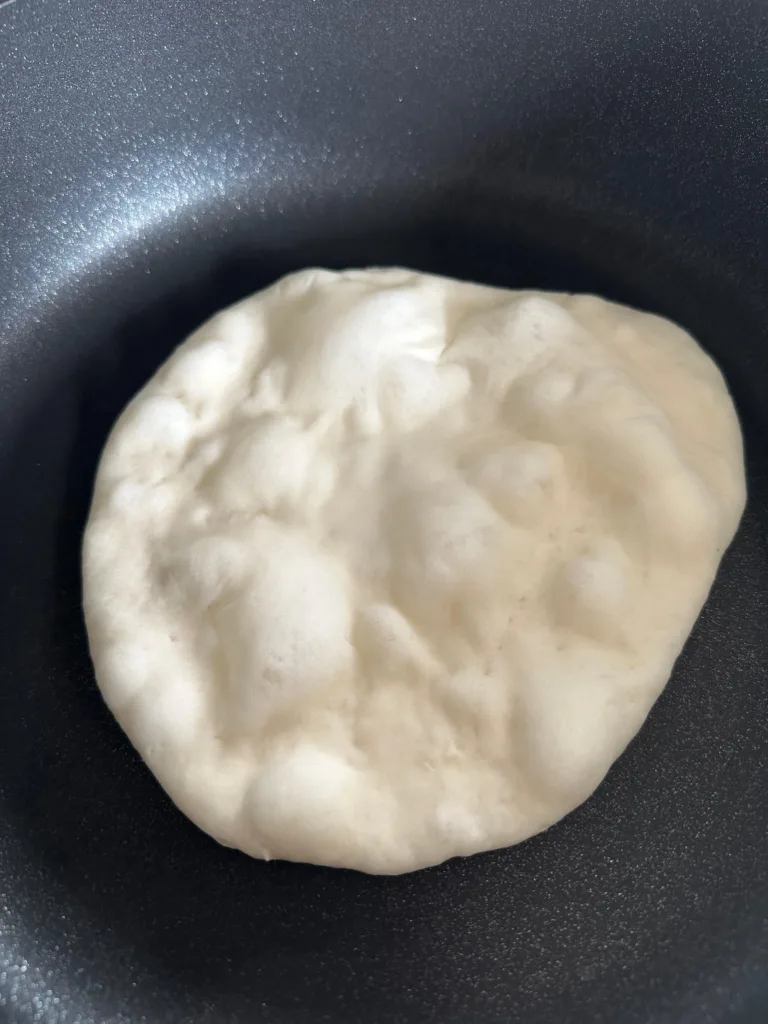
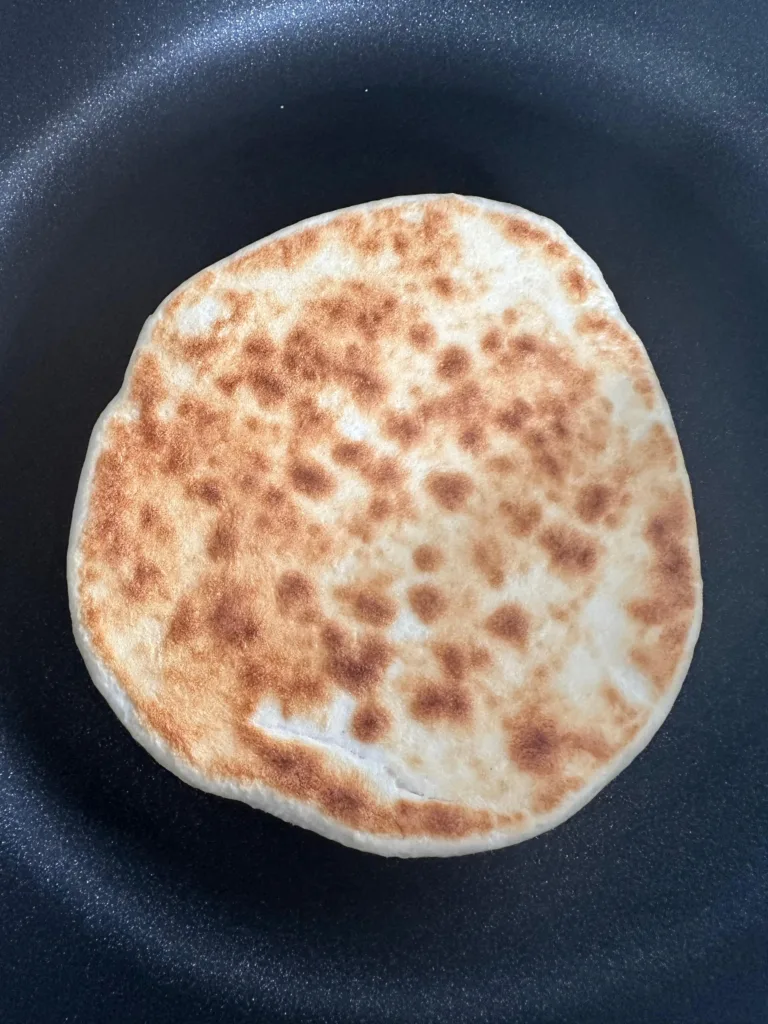
Using a rolling pin, roll out each ball into approx.. 20 cm round disk, and about 1-2mm thick. Yes, that’s pretty thin but once they heat up they will puff up and be thicker. In the meantime, heat your skillet or thick based pan, and put one pita in pan at a time. When you see bubbles emerge, flip the pita onto the other side. You should have a light golden colour on each pita. I like to put a bit of butter on mine once cooked.
Cover pites with a tea towel once cooked to keep them warm and soft. Spread a little butter if you want. Serve immediately.
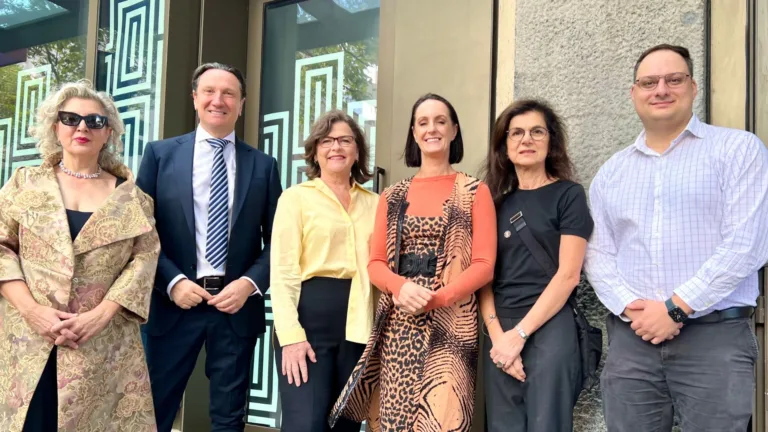
Labor has committed $310,000 to the fit out of the Greek Community of Melbourne’s (GCM) cultural programs spaces at 272 and 274 Russell Street, if re-elected.
The Greek Centre HUB (272 Russell St) and the new Multi Arts Community (MAC) Space at 274 Russell Street, will provide much needed technical capacity for use by the extensive GCM cultural program.
The GCM is delighted to announce that it was successful in securing a long-term lease for a token $1 per year at the 274 Russell Street Iglu development from which to deliver a public programs cultural space, that is located next to its 272 Russell Street Greek Centre HUB.
Housing programs that range from spoken word presentations and comedy, immersive multimedia programs, exhibitions and community events, the MAC is designed to celebrate emerging multicultural artists and to support community programs and events.
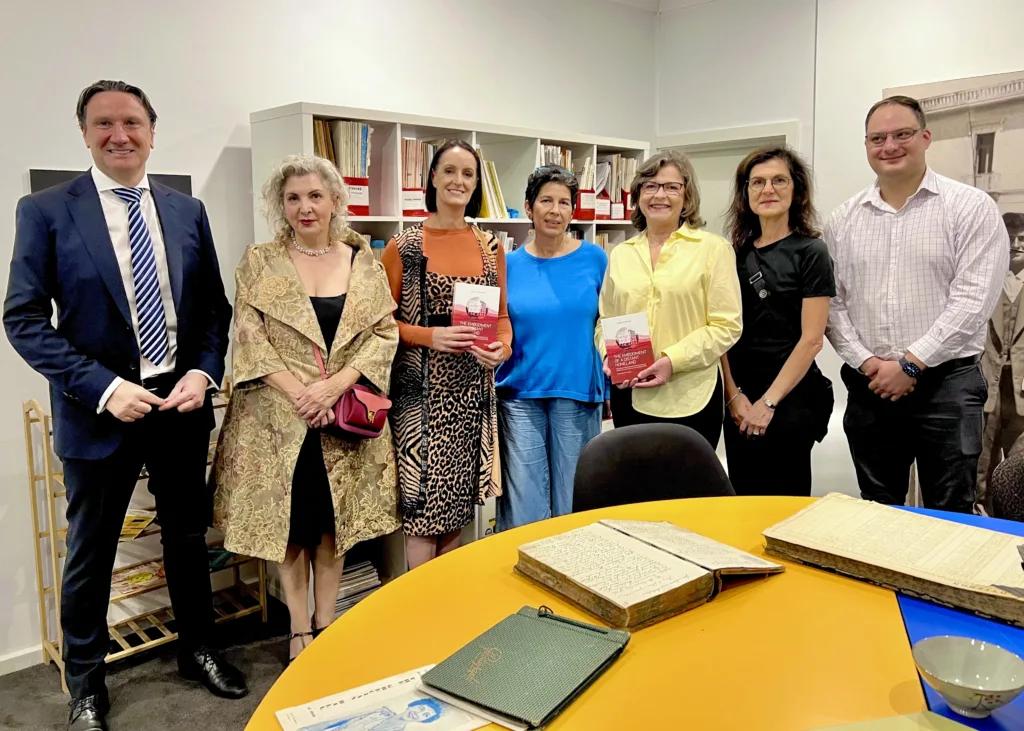
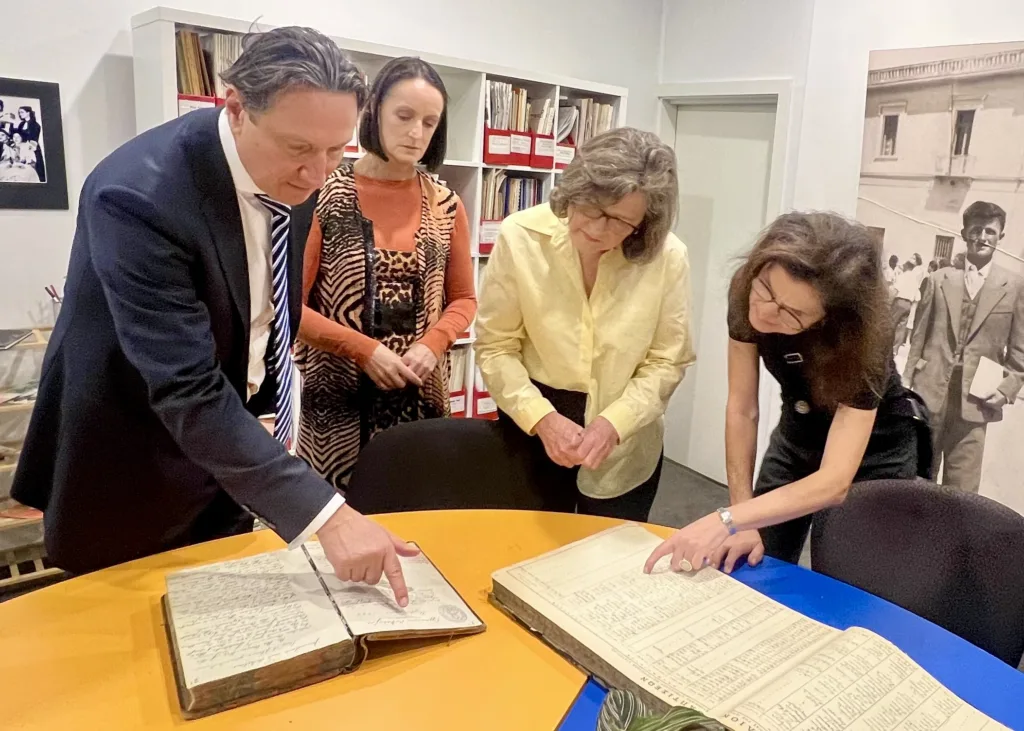
The HUB at 272 Russell, houses the GCM’s Archive and Historical Centre, and a ground level meeting, workshop and performance space as is currently underway as part of the Melbourne International Comedy Festival.
President of the GCM Bill Papastergiadis OAM said, “expanding our cultural and educational footprint is ongoing. In particular, with the fully leased 15 storey cultural centre which acts as a vertical Hellenic precinct in the heart of the city, we are delighted to announce that our Hellenic presence has now expanded onto Russell Street with the successful tender for the space at 274 Russell.”
Mr Papastergiadis added, “this effectively represents three shop fronts along Russell St that have a Hellenic focus, and which the GCM has control of. Recognising and supporting the historical significance of Lonsdale St is part of the aims of the GCM. With the recognition by Government of our Antipodes Festival as a tier 1 event and the continuous educational and cultural programs offered at our 15-storey cultural centre, we are excited by this announcement by the Labor Party to support the GCM’s further city projects.”
Mr Papastergiadis said, “These grants are investments in the infrastructure of our community and last beyond the tenure of any board. We are building on the work of past boards by adding to the GCM’s construction program footprint. We thank the Albanese Labor Government and welcome Ged Kearney and Sarah Witty here today to deliver the good news.”
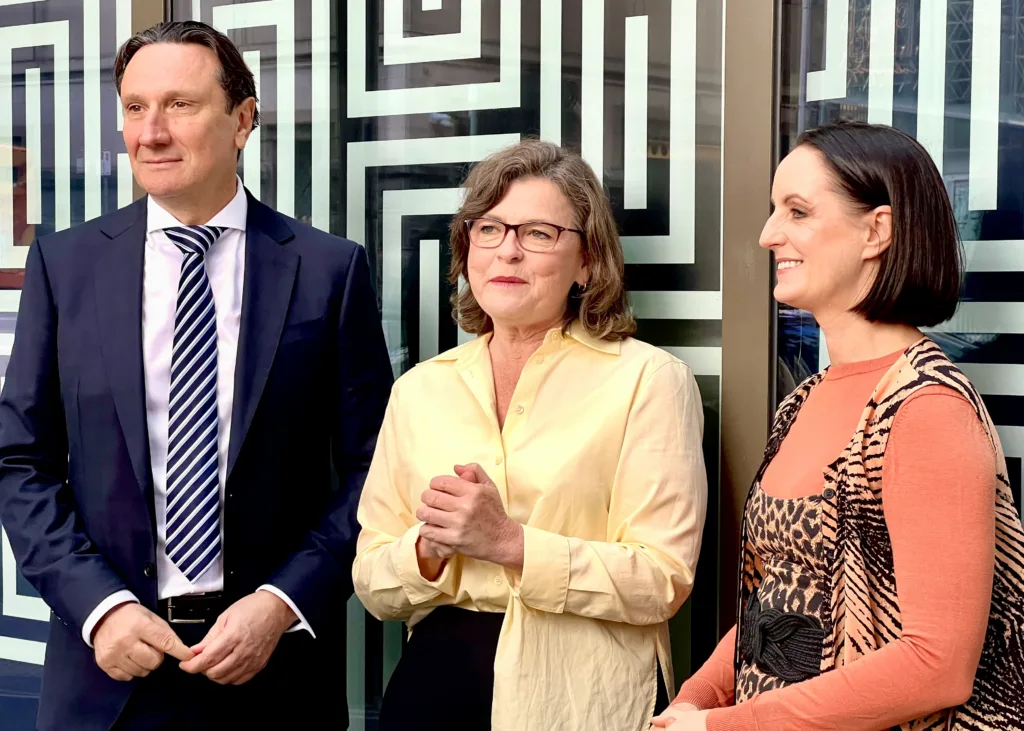
Speaking at the announcement, the Hon Ged Kearney, Assistant Minister for Health and Aged Care and Assistant Minister for Indigenous Health in the Albanese Government said: “Melbourne’s identity, culture and history is intimately intertwined with Greece, with many Greek Australians living in my electorate of Cooper. I’m proud the Albanese Labor Government is honouring this community with this investment. Visiting the Greek Centre HUB and the Multi Arts Community Space was just great. You can feel how alive the culture is and literally see the impact on our community – it’s inspiring!”
Labor’s candidate for the seat of Melbourne Sarah Witty, who also attended the announcement, said: “Melbourne’s Greek Community are an important part of the fabric of this great city, and I am proud that a returned Albanese Government would help to enhance their cultural footprint on our city.”
Joining Ms Kearney and Ms Witty at the announcement was Mr Papastergiadis, GCM Cultural Committee members Dr Spiz Demetriou, Tass Sgardelis, Jeana Vithoulkas and Greek Centre Director Jorge Menidis who led their guests through the MAC and Hub, including a visit to the GCM’s Archive Centre where GCM historian Juliana Charpandithou talked about some of the GCM’s most precious archives including its first minute book and baptism register.
GCM Cultural Committee member Mr Sgardelis reflected on the announcement: “I am immensely proud to be part of an organisation that is able to strengthen and support Greek community cultural activities in the heart of Melbourne. Ongoing government support is absolutely vital in enabling grassroots multiculturalism to flourish to build more vibrant communities.”
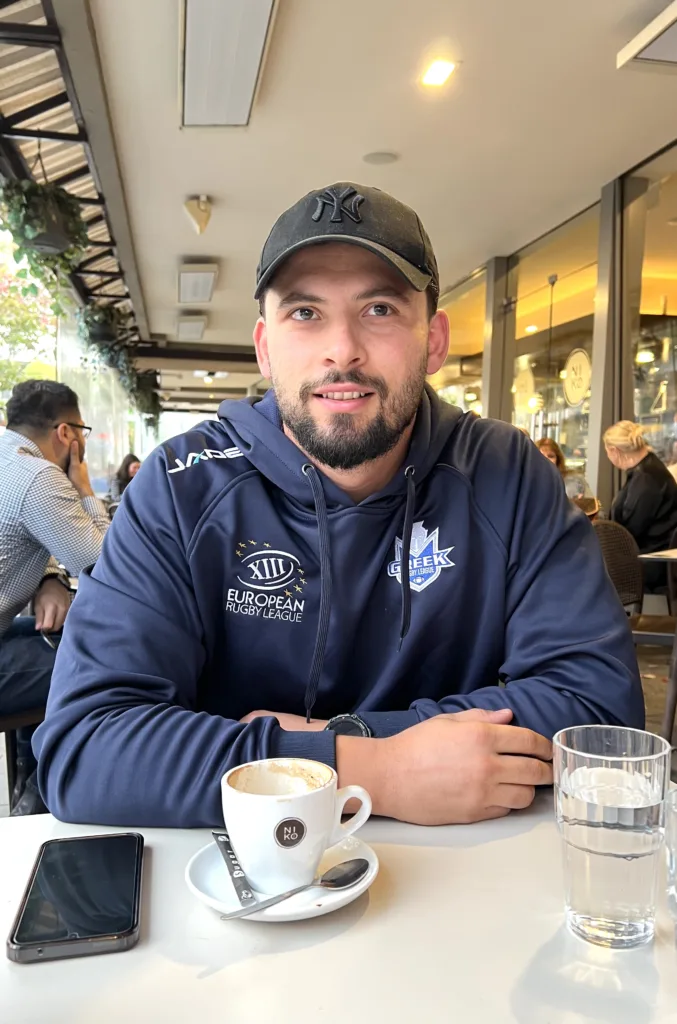
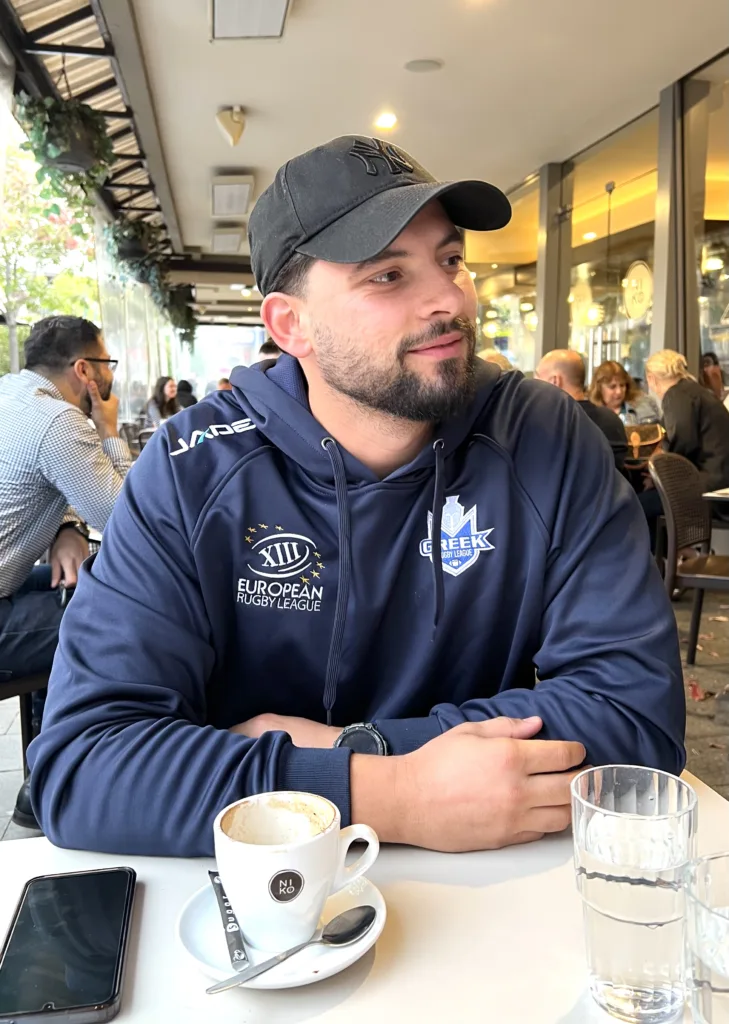
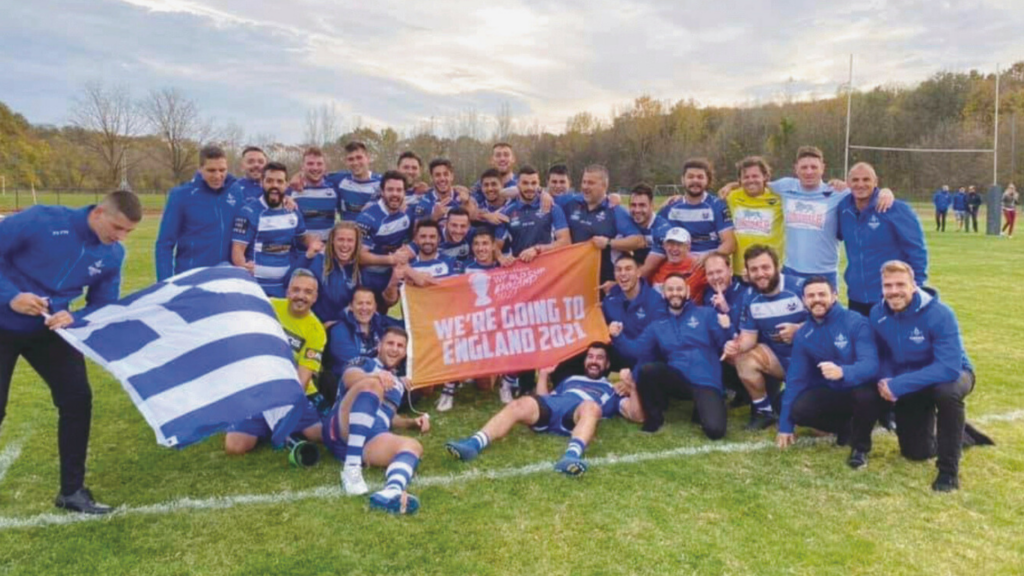
It is with great pleasure that The Greek Herald introduces you to the international Greek Rugby Player Theodoros Nianiakas, who has been in Melbourne for the last three years, while he recently played with the Greek national team in Las Vegas, USA.
“My name is Theodoros and I come from Mikrokastro, Kozani, I had nothing to do with Rugby League. I got to know it and got involved when I moved to Athens as a professional in the Armed Forces, where I served for about six years,” Theodoros tells us.
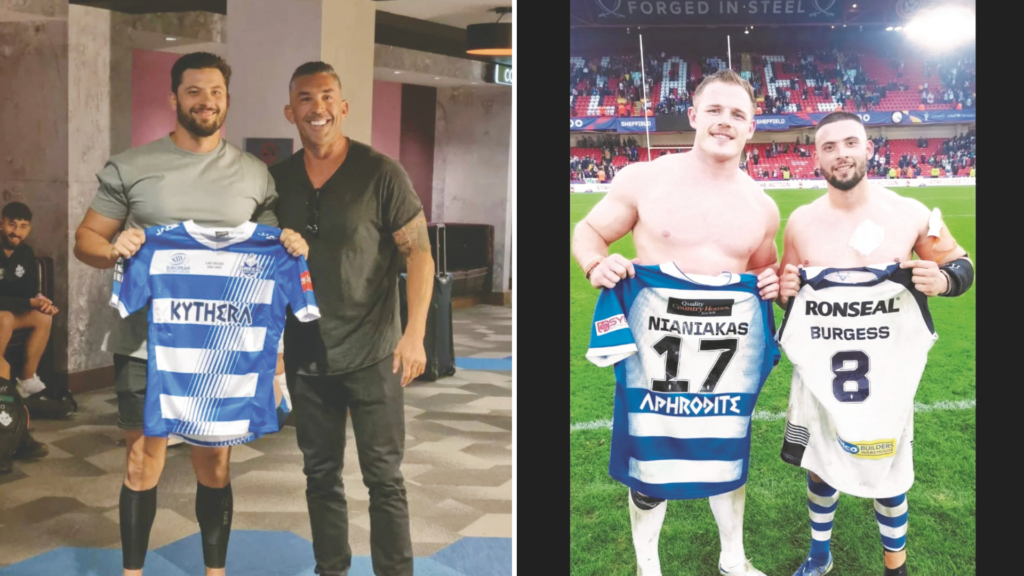
“Some military colleagues were involved in the sport of Rugby League, they motivated me to get to know it and so I took my first steps in Rugby. I saw that it suited me and I started participating in training, trials and then as a registered Rugby athlete. I have 12 appearances with the Greek National Team and I feel great pride when I play with the national emblem.”
Tell us about your sports resume:
My first team was Aris Petroupolis which was later renamed Aris Eagles as an expatriate from Australia, a fan of the Manly Eagles, donated the uniforms. With Aris I played in the league, while I played friendly games with mixed teams against strong English teams. There I was spotted by the selectors of the Greek national Rugby League team and I received the call to try and play.
I made my debut in 2019 in England in a game against Norway for the 2019 World Cup qualifiers. After the end of my six-year military career, I moved to England, firstly to better prepare for the World Cup and secondly to play in a stronger league and signed for the semi-professional club of Woolston Rovers. Since my participation in the semi-professional league in England, I have learned a lot of things, I have improved significantly and my call to the national team for the World Cup has come.
Tell us about the World Cup:
At the World Cup, which England hosted, we had a tremendous experience as not only did we play for the first time in the final phase of the World Cup, but we faced Rugby behemoths, such as England and then Samoa and France and all these three countries, all of their players were full-time professionals. It was a huge challenge for most of us who were amateurs, especially when in the World Cup qualifiers we faced national teams of our own measure, such as Norway, Serbia and Scotland and then we faced high-level national professional teams – it was something shocking. And I say this because we were not afraid of them at all, we looked them in the eye, we gave everything and treated them with dignity. It was an unforgettable experience for all of us.
A few weeks ago you faced the USA in Las Vegas:
Indeed, my last participation with the Greek National Team was a few weeks ago in the USA, which we won 46-10. It was a pleasant game, against a USA team. Rugby develops at a fast pace, in the first half the Americans made it difficult for us, but in the second half we found our rhythm and achieved an easy victory.
A very good job is now being done for the Greek national team, especially from here in Australia as there are people who are looking for second and third generation expatriates to play with the Greek national team. These guys, wearing the blue and whites, feel 100% Greek like us and are proud to represent the Greek national team.
This also happened in the international matches for the qualifiers and the World Cup final. Second and third generation expatriates were anxious and proud to wear the jersey with the coat of arms, most of them were accompanied by their parents who were also doubly proud. We bonded with the Greek athletes very quickly and we, the locals, helped them get into the atmosphere of our national team and they helped us with their talent and experiences from the NRL.
I say it again, the expatriates felt proud to have played for the Greek national team and showed it in the stadium where they bled for the jersey with the coat of arms.
Financially, did the Greek government support you?
Unfortunately, Greece did not help us at all, it was absent, and this is our big complaint. The expenses were borne by us players personally. We searched and are looking for sponsors and the greatest help was given to us by Nick Politis, president of the Roosters. We had a lot of help from Mr Politis. He still helps us and he helped us on our recent trip to Las Vegas, USA. Not only for the national team, but for the Greek league and for the creation of Rugby Academies, because without academies there will be no development.
How did you find yourself in Australia?
I came to Australia for two months to visit my uncle and cousins. I liked it very much and I want to live here permanently. I also play rugby and play with the Waverly Oakley Panthers team, where I found a fantastic, friendly and family atmosphere. I’m the only Greek to play for the Panthers, but I feel very good and this year I’m going to play for the third year in a row. Basically, I’m very happy with life in Australia.
What is your next goal?
My next goal is to play in October with Greece against Italy and Ukraine. They are two matches that we have to win to get points to move up to a higher European category, where we will face stronger national teams and then it is the next World Cup. All the players try to be in good physical condition, to play as many matches as possible with our teams and when we are called up to the national team to be ready. At the moment there are 17 expatriates from Australia, members of the Greek national team, but in the European games only seven players have the right to play and two substitutes. The rest of the players must be from the Greek league.
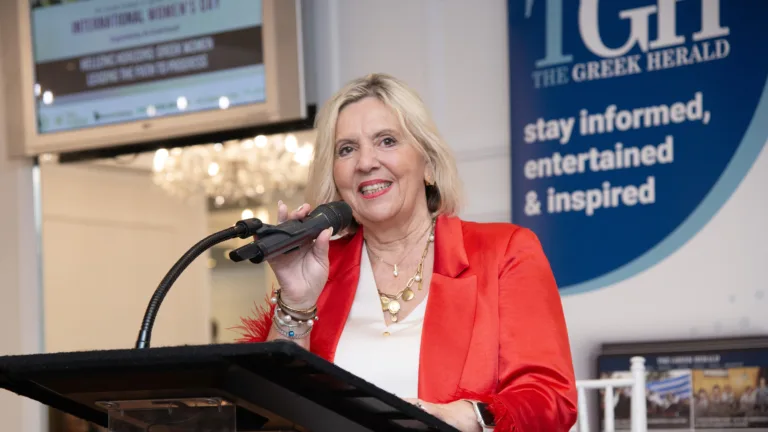
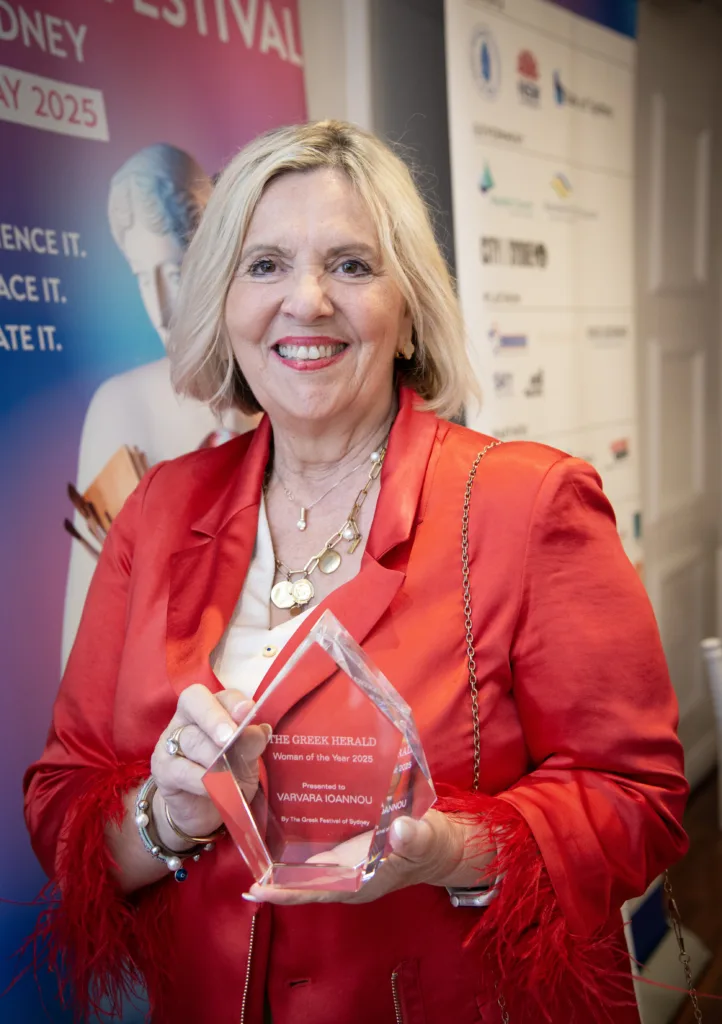
In a moment of well-deserved recognition, The Greek Herald named Varvara Athanasiou-Ioannou AM as the 2025 Woman of the Year — an honour that reflects her decades of tireless work in education, human resources, diversity and inclusion, and community leadership.
Migrating to Australia from Epirus at 19 without speaking a word of English, Varvara transformed personal adversity into purpose. From founding the Food for Thought Network Inc over two decades ago to spearheading the landmark Global Women and Hellenism Conference in Greece, her work has reached thousands.
In this exclusive interview, Varvara reflects on her journey, her vision for the future, and what this latest accolade means not just for her, but for every woman.
Tell us a bit about yourself.
My journey began when I migrated to Australia from Epirus at the age of 19, arriving in a country where I did not speak the language. That experience shaped my resilience and fuelled my passion for lifelong learning, leading to a fulfilling career spanning education, curriculum writing, consultancy, human resources, and university lecturing in diversity and inclusion.
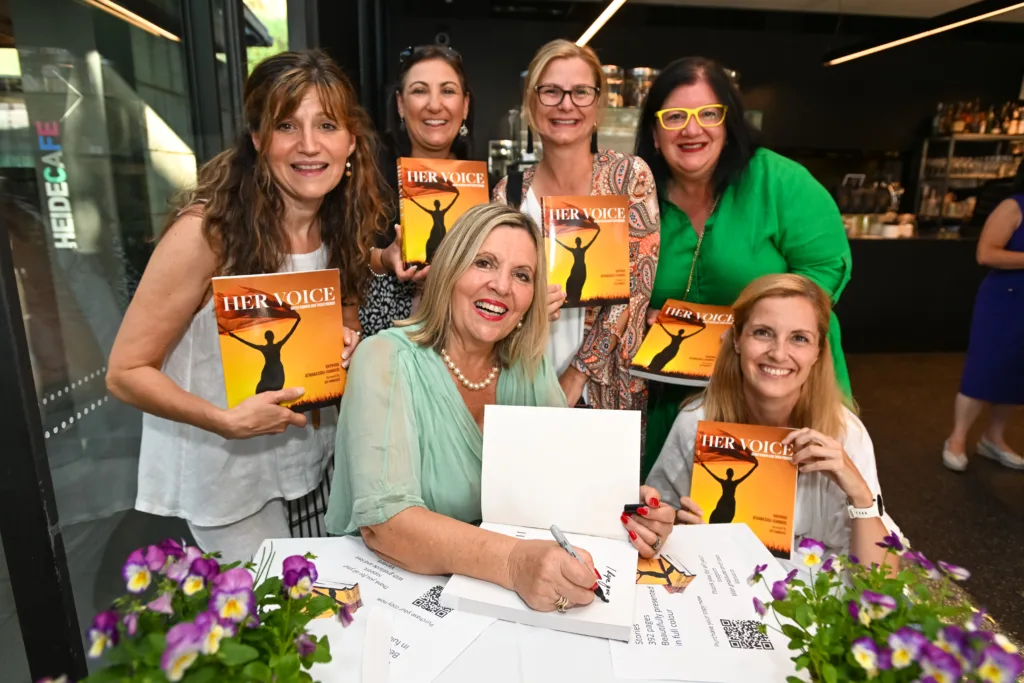
Beyond my professional roles, my true passion has been empowering women and fostering connections. Over 24 years ago, I founded the Food for Thought Network Inc (FFTN), a community organisation run completely by volunteers, whom I want to thank and acknowledge. FFTN has provided a safety net, given voice to thousands of women, particularly those who have lost theirs. I have led 150+ events, established a Philosophy Café, provided empowerment awards for young women, and created an online platform fostering dialogue, mentorship, and knowledge-sharing among Greek women globally. My book, Her Voice: Greek Women and Their Friends, profiles 42 women’s diverse stories, showcasing the best of intersectionality, resilience and leadership.
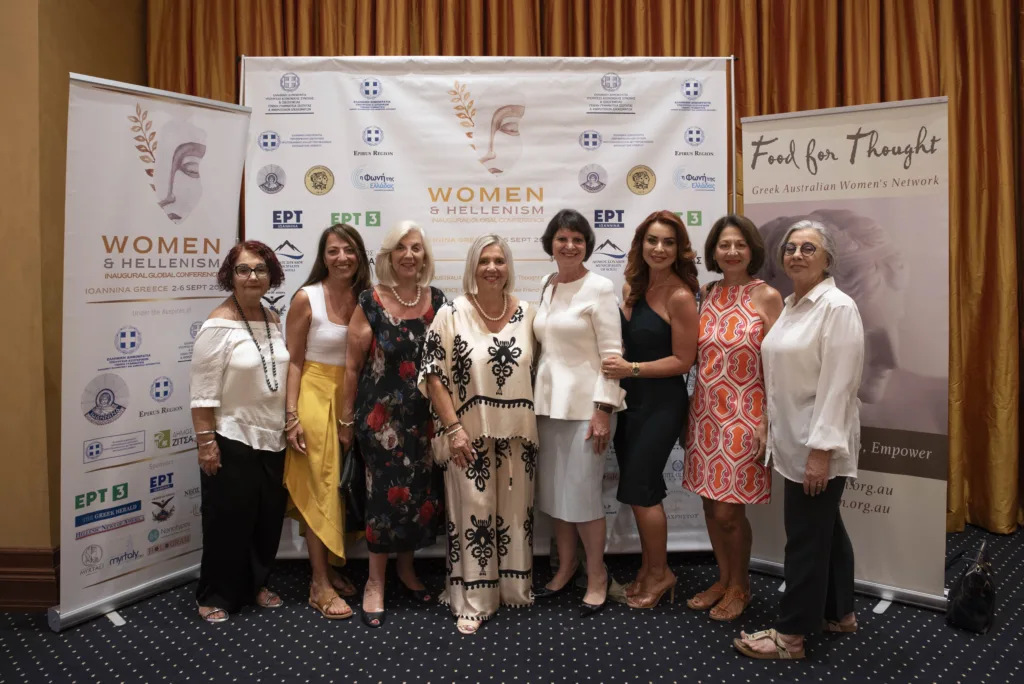
During COVID, I launched the Greek Women and Friends Global Forum, which, together with Her Voice, became the catalyst for organising the Inaugural Global Women and Hellenism Conference in Greece 2-6 Sept 2024. This landmark event united thought leaders, scholars, and professionals from across the world to celebrate and elevate the contributions of Hellenic women. With media coverage in 50+ international publications, it inspired strategic initiatives, leading me to engage with Greek politicians and international diplomats to institutionalise women’s leadership in Hellenic affairs.
I have also contributed extensively to education, co-authoring the Greek Curriculum Project and over 60 children’s books for the Education Departments of Victoria and South Australia and designing and teaching University Courses relating to Diversity and Inclusion.
A cancer survivor, I share my time between Greece and Australia, leveraging online teaching technologies since 2013. My contributions have been widely recognised, including Greek Herald Woman of the Year Award (2025); Appointed Member of the Order of Australia (AM) (2024); GIWA Finalist, Social Responsibility (2023); Manningham Volunteer of the Year Award (2022); Swinburne University Vice-Chancellor’s Teaching Excellence Award (2018); Victorian Honour Roll for Women and HACCI Award (2003); and International Teaching Fellowship (1993).
Through my work, I have shaped policies, empowered emerging leaders, and built global networks that transcend borders. My mission remains clear: to be a voice for the voiceless and to continue inspiring the next generation of women.
You migrated from Epirus, Greece, to Australia in 1972. How has your Greek heritage influenced your journey, both personally and professionally, and how do you see it shaping the next generation of Hellenic women in Australia?
Migrating to Australia at the age of 19 was both a challenging and transformative experience. Arriving in a country where I did not speak the language, I carried with me a strong and deeply rooted Greek identity. The unfamiliarity of my new surroundings only strengthened my determination to succeed. I immersed myself in learning English, attending every class I could find, with a dictionary as my constant companion.
Varvara as a baby with her mum and dad.
I was fortunate that my parents had migrated to Australia two years earlier, building a foundation within the community. Their unwavering support and belief in education provided me with a home filled with love, encouragement, and a deep appreciation for learning. This journey of resilience and perseverance has shaped not only my personal and professional path but also my vision for the next generation of Hellenic women in Australia which I promote through everything that I do. I hope they continue to embrace their heritage while forging new opportunities, carrying forward the rich legacy of strength, adaptability, and ambition that defines our Greek spirit.
You’ve dedicated your career to education, human resources, and community leadership. What inspired you to focus on empowering women, and what have been some of the most rewarding moments in your journey?
Arriving in a new country at 19, without knowing the language or understanding the system, was a profound challenge. When you cannot communicate, you lose your voice. You make mistakes, you feel invisible, and in my case, I also faced bullying, bias, and discrimination. I nearly had a breakdown in 2000. But rather than let those experiences define me, I chose to transform them into something meaningful. After a year of research, I founded the Food for Thought Network (FFTN), a space where I not only found my true voice but also created a platform for hundreds of women to find theirs. This on a probono basis on top of a career, a husband and two kids.
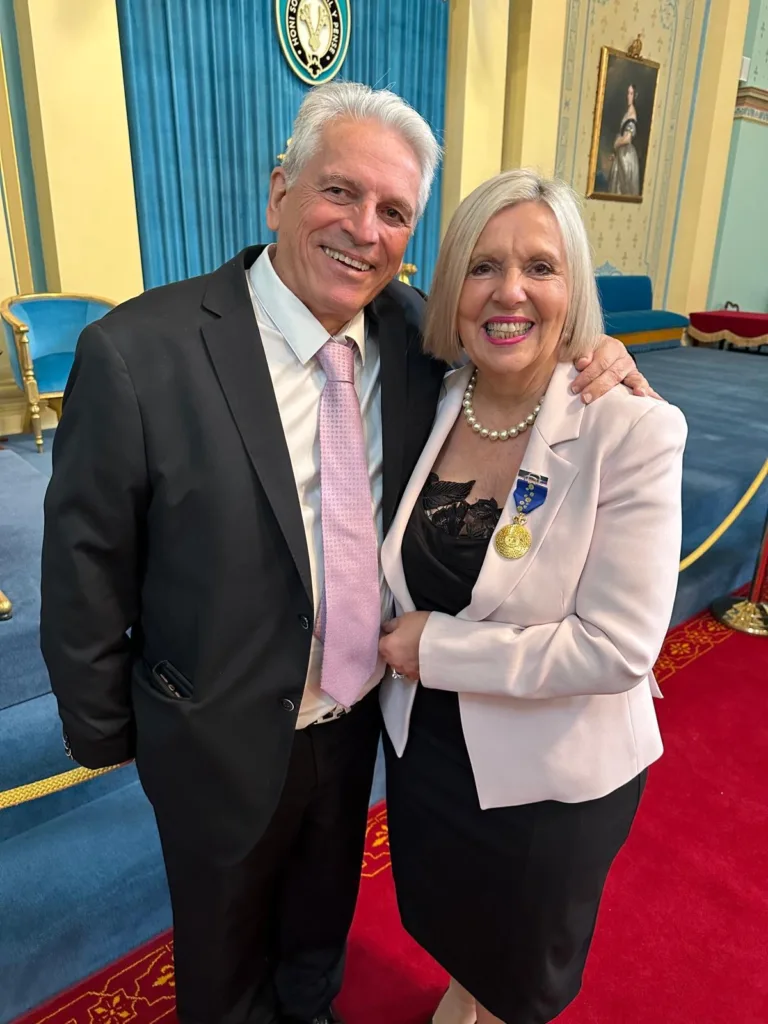
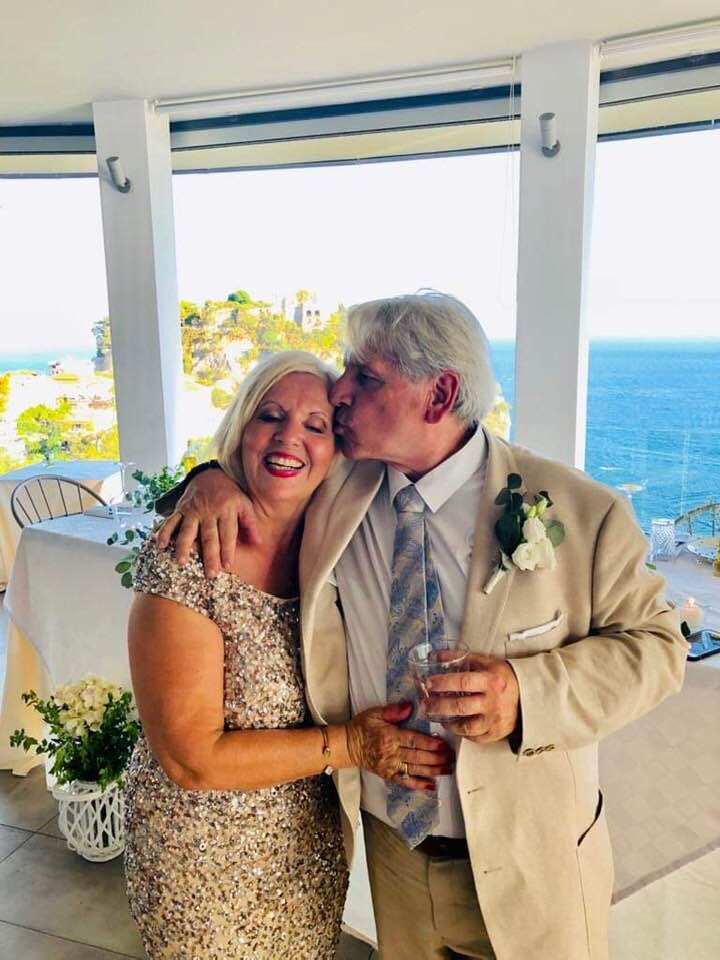
Varvara with her husband.
Despite the obstacles, I embraced every opportunity that came my way. One of the defining moments early in my career was writing as part of a team the curriculum for the teaching of Greek in the state education system, inspired by real-life experiences. This led to the publication of curriculum guides for teachers from prep – year 8 and 60 illustrated books—one of my first proud milestones. Later, retraining in Human Resources and stepping into leadership roles allowed me to work toward removing and breaking down barriers for others. Designing and Teaching units relating to diversity and inclusion at Swinburne University, training managers and academics on how to build truly inclusive workplaces/classrooms, was both a privilege and a responsibility that I embraced with passion.
Through my university sessional lecturing, I found my wings. Through Food for Thought Network, I found my voice. And through every challenge, I discovered the power of resilience, gratitude, and the deep fulfillment of empowering others. My book HER VOICE: Greek Women and Their Friends entered uncharted waters giving voice to 42 women sharing their personal and professional stories in their own words, a blue print of showcasing the best of diversity and intersectionality, leadership and resilience.
Being named The Greek Herald’s Woman of the Year is a tremendous honour. What does this recognition mean to you, and how do you hope it will further your mission of gender equality and empowerment?
Being named The Greek Herald’s Woman of the Year is both a profound honour and a great responsibility. While awards serve as a recognition of one’s work, they also serve as a powerful reminder of the ongoing commitment required to drive meaningful change. For me, this award is not just a personal achievement—it is a tribute to the countless women and men whose voices, stories, and struggles have shaped my mission since I arrived in Australia half a century ago.
It strengthens my resolve to continue the work I began through Food for Thought Network and long before that, through forums such as the Modern Greek Teachers Association and other community groups. This recognition amplifies the message that gender equality and empowerment are not just ideals to strive for but urgent imperatives that require action, collaboration, and unwavering dedication. My hope is that it inspires others—especially the next generation of women—to step forward with confidence, knowing that their voices matter and their contributions can shape a more just and inclusive future.
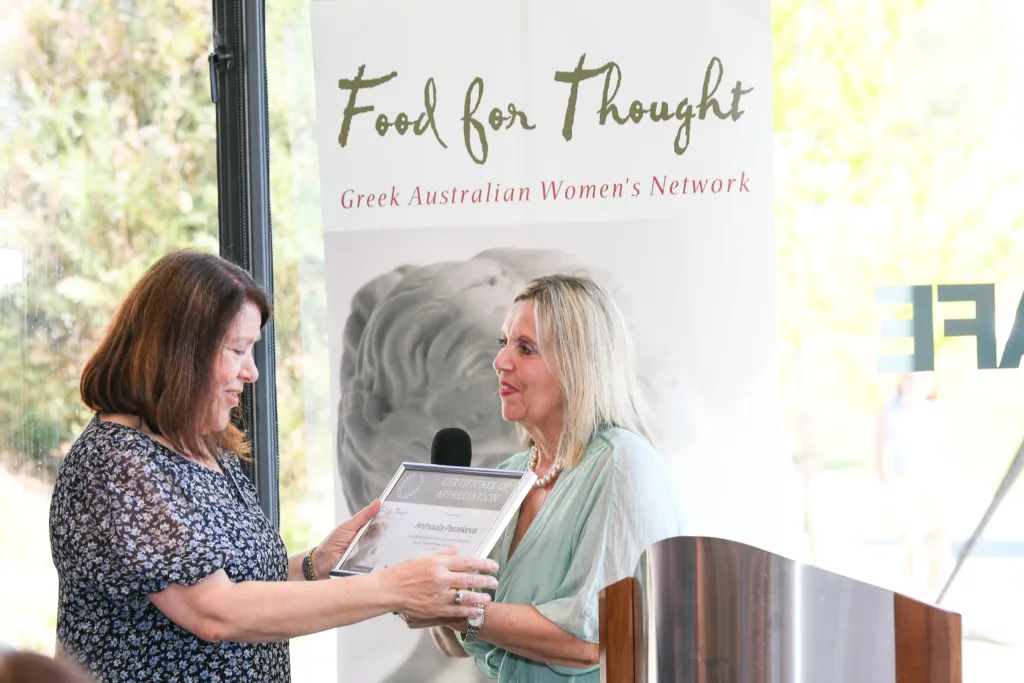
Varvara was named The Greek Herald Woman of the Year 2025.
You’ve said that true equality could take five generations to achieve. What key changes do you think need to happen in the coming years to accelerate progress for women, both within the Greek and Cypriot community and globally?
Achieving true equality is a long and complex journey—one that cannot be accomplished through legislation and policies alone. While these are important foundations, real change requires a profound cultural shift. This transformation must be driven by education, resources, and targeted programs designed for men, women, boys, and girls alike. One size does not fit all.
We cannot view gender equality as solely a women’s issue—it is a societal issue, a human right’s issue that demands collective action. Joining forces is essential. Each of us has a role to play in building a more inclusive world, whether through advocacy, leadership, or everyday actions that challenge bias and create opportunities and raising children to value difference.
Within the Greek and Cypriot communities and globally, we need to actively foster environments where both women and men can thrive. There are some encouraging examples of young 3rd generation women are playing a key role in reshaping the old organisations and or creating their own. By working together—across generations, communities, and sectors—we can accelerate progress and ensure that the next generations inherit a world that values equality not as an aspiration but as a reality.
What’s next for you, and what legacy do you hope to leave for the future?
Building Food for Thought Network and launching the Global Women and Hellenism Conference have been incredible milestones, but for true impact to last beyond my lifetime, we need to create a sustainable structure. Without serious funding, the progress we’ve made risks being temporary. My vision is to establish a structure and a fund that will provide grants, scholarships and empowerment awards—supporting both brilliant minds and underprivileged women who need opportunities to further their education, careers, and networks.
Photo by Paterousis
The challenge ahead is to secure the resources and governance structures needed to ensure that this work continues to grow and evolve. I want to leave behind more than just initiatives—I want to build a lasting legacy of empowerment, one that will continue to open doors for generations of women to come. My hope is that future leaders will take this mission even further, ensuring that Greek and Hellenic women worldwide have the support, connections, and recognition they deserve.
My mission is to continue building sustainable structures that will support, uplift, and inspire future generations of women, ensuring that our voices are heard and our contributions recognized on a global scale. I have had discussions with relevant politicians and international diplomats and it was heartening for the current Secretary General for Greeks Abroad, Mrs Maira Myrogianni to mention FFTN when launching the Greek government’s Strategic Plan for Greeks Abroad as a collaborator in implementation.
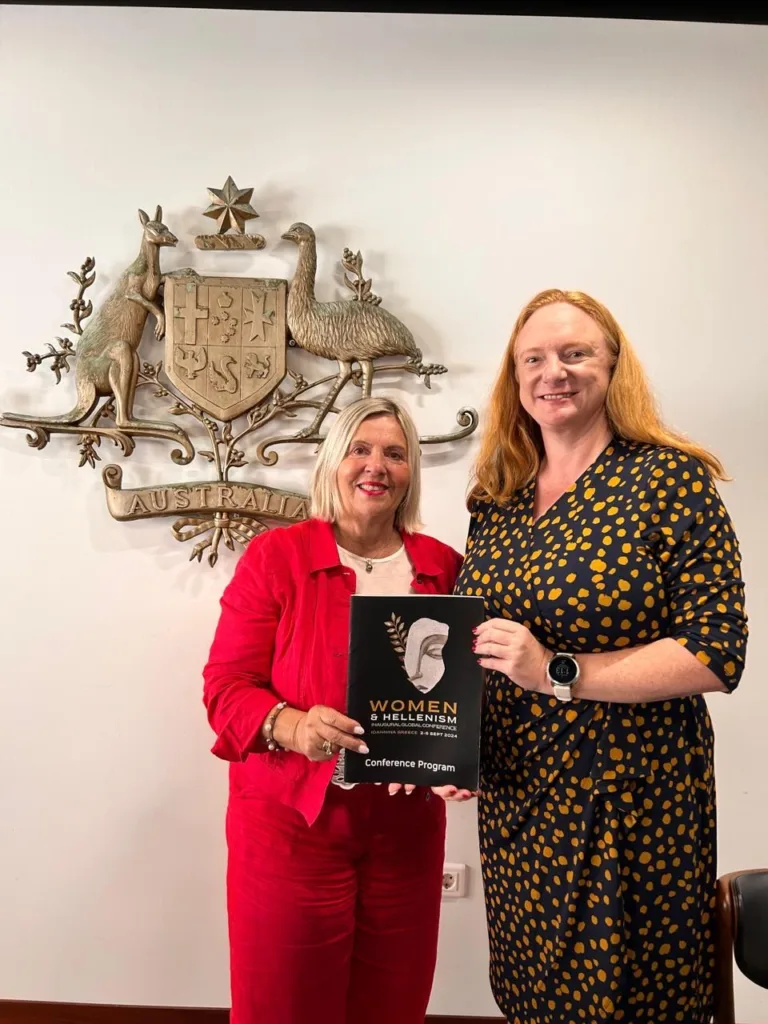
Varvara with Australia’s Ambassador to Greece Alison Duncan.
Is there anything else you’d like to say?
Driving cultural change requires an unwavering work ethic, passion, and determination. It demands resilience—especially when faced with resistance or criticism. One of the greatest lessons I’ve learned in leadership is the 80/20 rule. I also learned that the future belongs to those who dare, and who have their hearts in the right place and that collaboration is the key. Together, we can create a world where every woman has the opportunity to thrive, knowing that the power of support and solidarity will propel us all toward a brighter future.
I choose to live with gratitude, passion, and a deep sense of urgency to do good. Change does not happen overnight, nor does it come without challenges. But what truly matters is our commitment to progress and lifting others along the way. My commitment through The Food for Thought Network has always been about impact, empowerment, and connection—and now with a renewed committee we are looking ahead to the future.
We are seeking sponsors, benefactors, and visionary partners who share our mission and want to help shape the next chapter. Your support will enable us to expand our reach, amplify women’s voices, and create lasting change.
As I said in my acceptance speechof the TGH Woman of the Year award, “This recognition is not just mine—it belongs to every woman who was told she couldn’t but did, to every man who has championed equality, and to every person who dares to challenge the status quo.”
If you believe in the power of women’s empowerment, community, mentorship, and preserving Hellenic identity, I invite you to stand with us. Let’s build something extraordinary—together.