Home Blog Page 405

The Tymbakion Shorts: How a heirloom uncovered a hidden chapter of ANZAC history

When Dr Andrew Holyoake, Postgraduate Research Director at Lincoln University, stumbled upon a box of wartime memorabilia during family history research in 2021, he had no idea it would lead him to a long-forgotten chapter of World War II history.

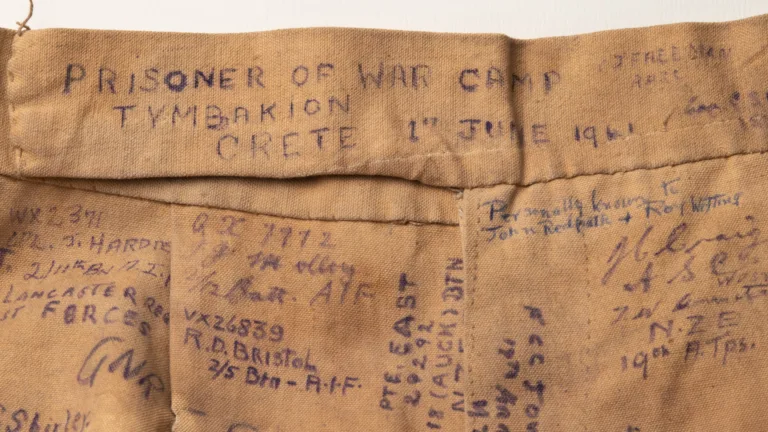
Inside the box was a pair of hand-stitched shorts, covered in signatures and bearing the name “Tymbakion POW camp.” What began as a curious investigation into their authenticity quickly evolved into The Tymbakion Shorts Project — a deep dive into the hidden story of Allied prisoners of war, including many Australians and New Zealanders, who were forced into labour on the island of Crete in late 1941.

In this interview, Dr Holyoake shares how his personal connection through his wife’s grandfather, a POW at Tymbaki, shaped his research; why the September–December 1941 period remains so poorly understood; and how the courage of the Cretan people, who secretly sustained Allied POWs under German occupation, forms the heart of what he describes as a profoundly “ANZAC-Greek story.”

Andrew_Holyoake_Welcoming_Large----
Andrew Holyoake.

What inspired you to start researching and documenting the story of the Tymbakion Airfield and its connection to Allied POWs and local Cretans?

I was doing family history research in 2021 and my mother-in-law mentioned that she had a chocolate box of war memorabilia from my wife’s grandfather (who died in 1973). Amongst the items in the box was a pair of shorts that were signed by over 120 men and referenced ‘Tymbakion POW camp’.  I googled it, and at that stage there were no ‘hits’.  I’ve always been a researcher, so thought I’d find out if the shorts were fake, or if there was actually a camp at Tymbakion. I was quite quickly able to link the names of a couple of the people on the shorts with Tymbakion so realised that there was an untold story here. Up until then I knew very little about the Battle of Crete and the POWs.

Your wife’s grandfather was one of the POWs involved in the forced labour at Tymbaki. How has his personal story influenced your work on this project?

Other than the pair of shorts, and a few other things, Bert Chamberlain left no record of his war experiences, but it’s clear that, like many other POWs, he was deeply affected by what he went through. Part of this research is to try to understand Bert’s, and other POW’s, experiences, to help contextualise their lives post war.
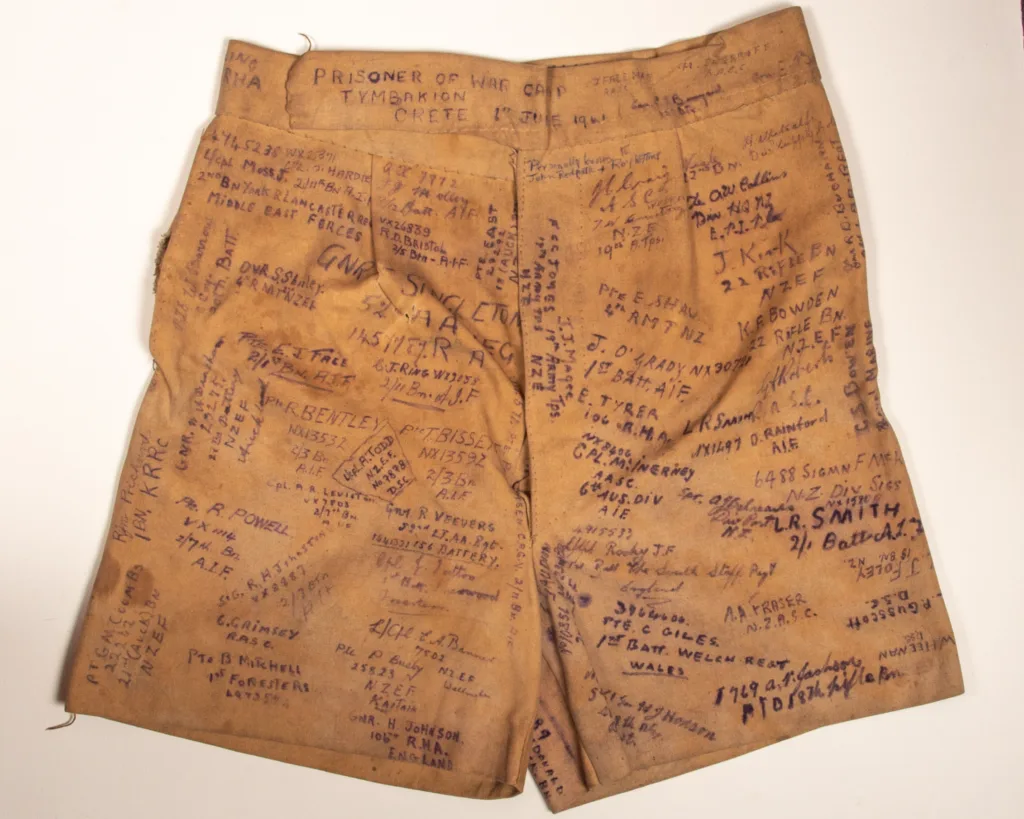
The Tymbakion Shorts. Photo: Mitch Adair

The period between September and December 1941 seems pivotal in your research. Why did you choose to focus on this timeframe specifically?

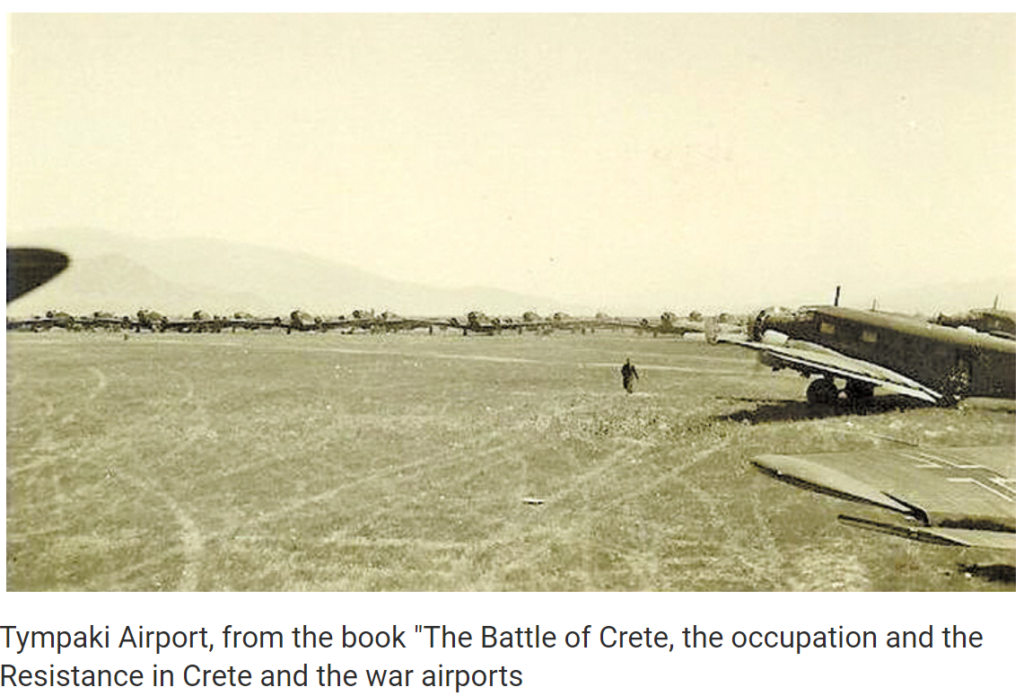
The common narrative is of Allied surrender around 1 June 1941, bringing together POWs to camps on the north coast soon after and then the shipping off of POWs until early September 1941 for processing elsewhere. However, through my research, I’ve discovered there were still around 800 UK and Dominion POWs on Crete at Christmas 1941. These men were processed as POWs on Crete from September 1941, and were in a number of POW camps across Crete, including Tymbakion. They were mostly shipped off in early January 1942. The period from September until December 1941 seems to be little understood, but was actually very active. It seems as though the first group of POWs were shipped/trucked to Tymbakion in mid-September 1941, and did not leave until December 28th 1941.
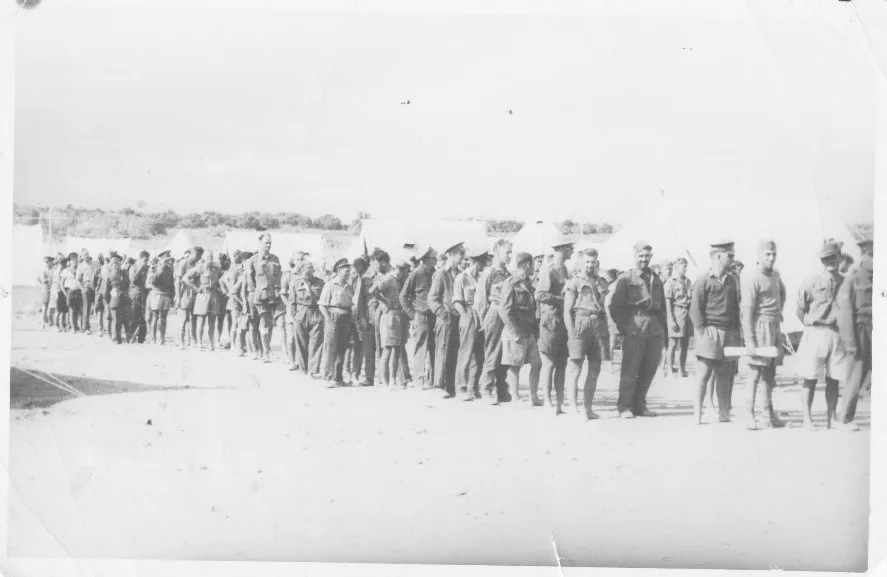
Allied POWs (Crete) CO Angela Holmes
Allied POWs (Crete). Copyright: Angela Holmes

What has been the most surprising or impactful discovery you’ve made about the interactions between the Allied POWs and the local Cretans?

Quite a lot has been written about the experiences of escapers and evaders on Crete, the support they got from locals, and the frequent, tragic, consequences of this support. 

At the Tymbakion camp, the men were doing forced labour, cutting down very old olive trees that were the backbone of the local economy, to prepare land for the airport. When the men came back the next day, they talk of finding food left in the bowls of the trees by the locals. Additionally food was frequently being brought into the camp, essentially sustaining these men, who were on very meagre rations supplied by their German captors. When I talk to Cretans about this, they just shrug their shoulders, seeing it as a long-held tradition of helping others, whereas, from my perspective, they kept these men alive.

Tymbaki holds martyr village status, yet its history remains largely undocumented. Why do you think these stories have remained untold for so long?

After the POWs left in late December 1941, shortly after, the Germans made a decree that locals had to leave the village and that their houses were to be destroyed to provide resources to surface the airfield runways. The locals (and up to as many as 7000 other Cretans from surrounding villages) were then put to forced labour working on the airfield and surrounding fortifications in the early part of 1942.  This had a massive impact on Tymbaki that still resonates today.  Whilst they rebuilt in the postwar period, a lot of people remained displaced and the POW camp story seems to have been largely forgotten.
You describe the project as an “Aussie-Greek story.” How do you see this narrative resonating with both Australian and Greek communities today?

I think this is an ANZAC-Greek story.  Of the close to 800 men who were still in POW camps on Crete at Christmas 1941, about 75% of them were Aussies and Kiwis.  It’s clear that they held the Cretans in very high regard, commenting in later diaries about the support they got, and their love for the Cretans.  Likewise, I hear that the reception that Aussies and Kiwis get when visiting Crete indicates that the mutual respect is still there today, in later generations.

Many of the POWs forced to work at Tymbaki were Australian, and their experiences intertwine with the sacrifices of the Cretan people. Can you share some anecdotes from that time?

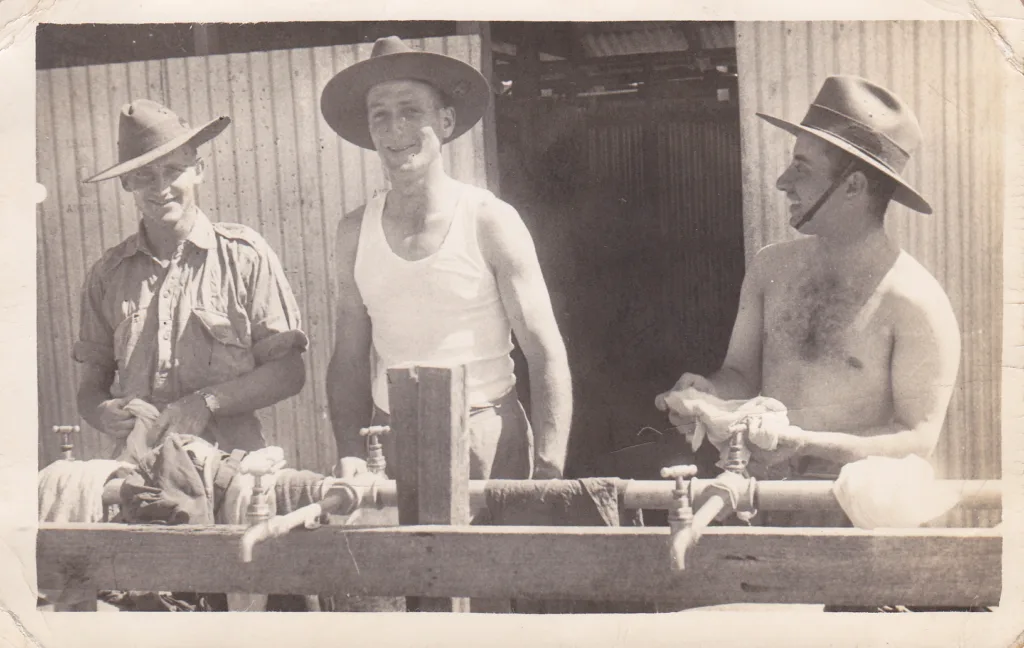
There were Aussie POWs from Queensland, NSW, Victoria, and WA at Tymbakion. In addition to UK and Dominion POWs, there were a number of Greek POWs there as well. Overall, my research has identified about 200 UK and Dominion POWs who were there, making it one of the larger Cretan POW camps in the later part of 1941. 

A digger from WA wrote an unpublished diary, detailing his experiences at Tymbakion. In it, he tells of the forced labour they endured, and the harsh conditions that they lived under, but equally he talks about the locals bringing food into camp, especially on religious holidays. The POW camp seems to be organised with an AIF Doctor being the senior officer. The men were told that they were clearing land to make way for a vineyard, but knew all along what was going on, with the first planes landing at the new airfield in mid-October 1941. Others talk of trying to escape and being helped by a family from the village.

The destruction of Tymbaki, including the uprooting of ancient olive trees, must have had a profound impact on local livelihoods. How do you think this legacy is remembered by the current residents?

The impact on Tymbaki, with the forced labour, destruction of the village, post-war maiming by uncleared mines, and the loss of income/heritage, still seems very raw.  There is a sense that Tymbaki was set back by decades, and is only now starting to reclaim its identity, and economy.  I find it fascinating that the airfield has been in almost continuous use since construction was started by POWs in September 1941, and it is a very dominant part of the Tymbaki townscape; a constant reminder of its past.
What are your long-term goals for the Tymbakion Shorts project? Are you planning a book, documentary, or any other medium to share this important story?

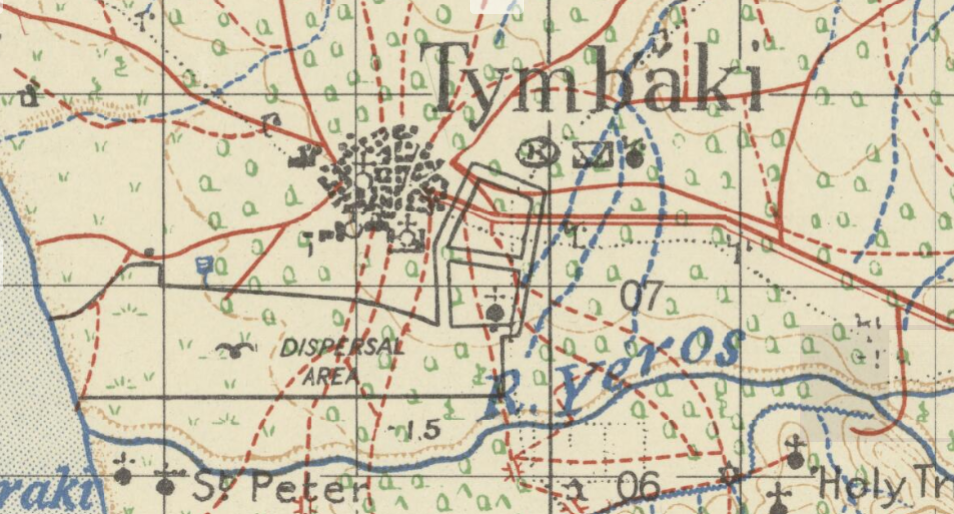
I’m still in the research phase, but think that there is a story here worth telling.  I’m working with John Irwin (a Kiwi filmmaker who does a lot on Crete), and will likely try to put together a book.  One of the unknowns is exactly where the POW camp was, so a trip to Tymbaki in May 2026 is on the cards, as I’ve never been.  Ideally it would be great if Tymbaki was recognised as a significant place in the Battle of Crete/Fortress Crete story, with a connection to a lot of families worldwide.
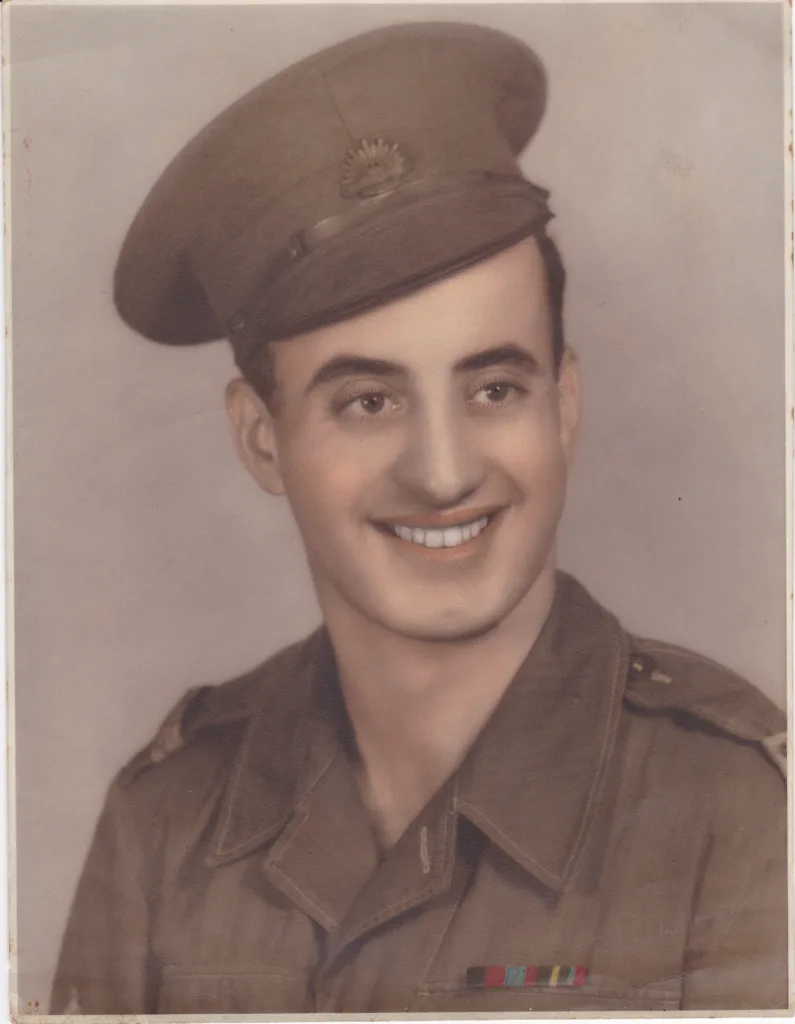
A Kytherian ANZAC: The wartime legacy of Nicholas Theodore Georgeopoulos

By Rene N Panagiotelis (Poulos)

Service No: N168040 & NX128588 Rank on Demobilisation: Corporal

Continuous Full Time Service (CMF/AMF): 01 Oct 1941 – 17 Jan 1946 (1570 days)

Special Service Areas:

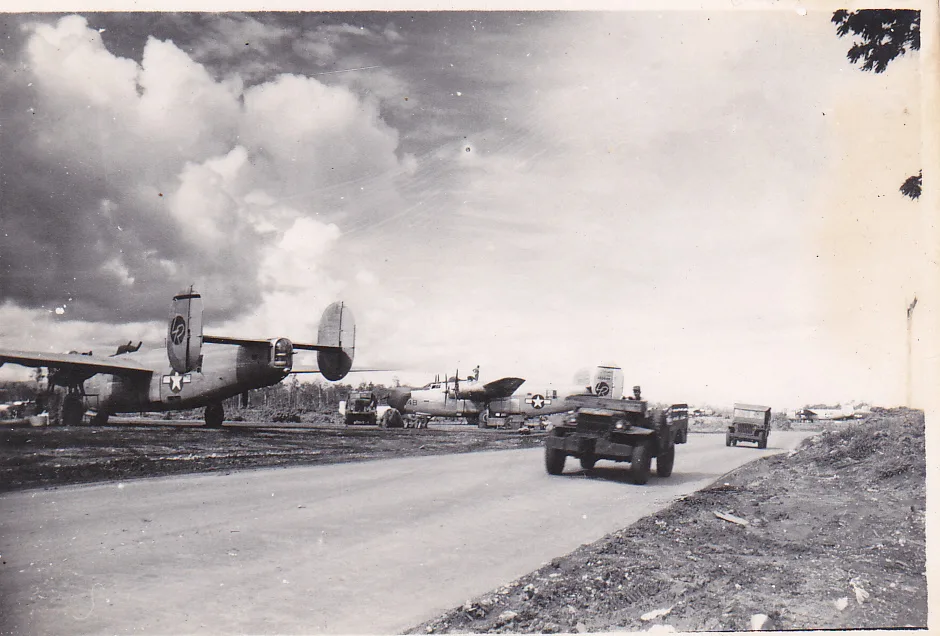
  • Dutch New Guinea, 24 Sept 1943 – 27 March 1944
  • South West Pacific Area (SWPA), Netherlands East Indies (NEI), Merauke, Morotai 19 Jun 1945 – 4 Jan 1946

Other Areas:

  • Australia: Newcastle, Blackalls, Darwin, Brisbane, Cairns

Posting at Discharge: 13 Aust Advance Workshops

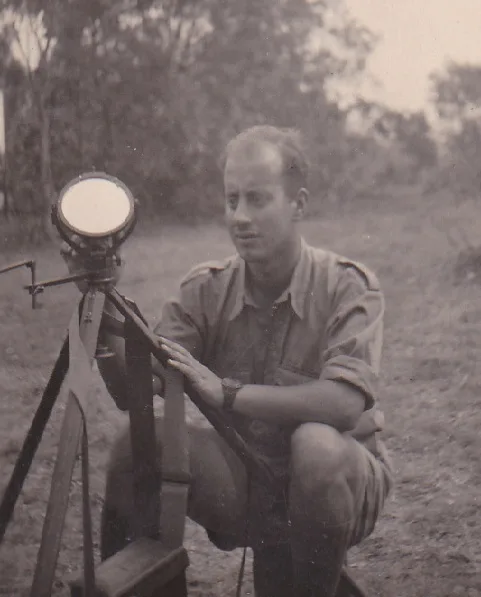
Trade Group: Telecom Mechanic (Radar)

Medals:

  • 1939/45 Star (Operational Service)
  • Pacific Star (Operational Service in the Pacific theatre)
  • War Medal 1939/45 + Mention in Despatches (Bronze Oak Leaf Emblem)
  • Australia Service Medal (Service Qualification – Dip. In Radio Engineering)

Postings 1941-1946:

  • 2/33 Infantry Battalion
  • 42 Fortress Signals Fixed Defence
  • 2 Australian Electrical and Mechanical Engineers (AEME) – Australian Radio Maintenance Section (Northern Territory Forces)
  • Heavy Artillery Newcastle, Fixed Defence (Coastal Artillery)
  • 56 Australian Anti-Aircraft Company RAE (Royal Australian Engineers)
  • 52 Australian Anti-Aircraft Regiment, New Guinea
  • 38 Australian Anti-Aircraft Battery
  • 13 Australian Advanced Workshops

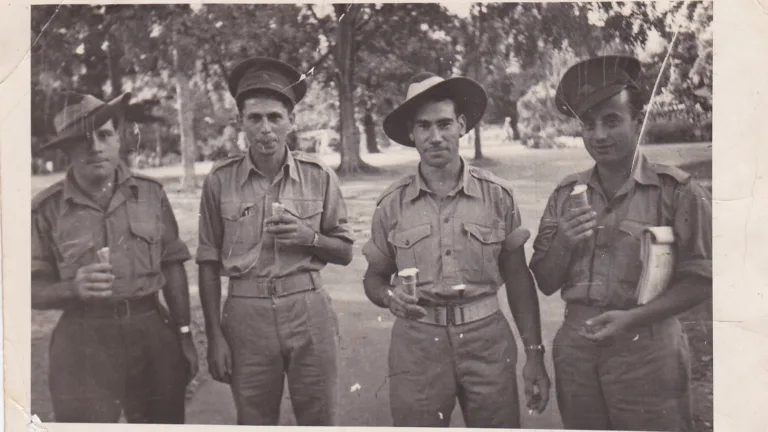
Nicholas, the first child of Theodore N and Eirini Tzortzopoulos, was born in Sydney, Australia in 1917. In 1922 his family moved to Crookwell where his parents established and ran the Niagara Café. This was a very successful enterprise and in 1929, some seven years later, the entire family, now with four children, relocated to Kythera and Athens. Eight years later, in 1937, with war clouds looming, the family returned to Australia.

Nicholas was educated in Greece between the ages of 12 and 20 yrs of age and completed four years of secondary education at Anastasias Evangelinidou High School in Kallithea, Athens. He returned to Australia with an excellent command of both spoken and written English and Greek. Nicholas hoped this skill would take him back to his beloved Greece as an interpreter with the Australian Army, but upon enlistment in 1941, other factors took hold.

On arrival back in Australia in 1937, Nicholas enrolled at the Australian Radio College and received a Diploma in Radio Engineering. This qualification served him and the Army well and he continued with his telecommunications training throughout the war years, eventually specialising in telephone, radio and more importantly radar. His record shows that both in Australia and during active service in the Pacific theatre of war, his duties were, signals, defence and radar.

After the war, Nicholas married Mary Louise Caling (Kallinikos), and together they had three children, Theodore, John and Rene. Nicholas remained employed in the technical world of radio, TV, video and computers. He was a firm believer in the value of education and was, himself, a lifelong learner, gaining a TAFE Diploma in Fine Arts during his retirement. He never lost his love for Kythera and Athens, and he proudly served on the Board of the Kytherian Brotherhood for some years including the 50th Anniversary year in 1972, where he was MC at the Anniversary Ball.

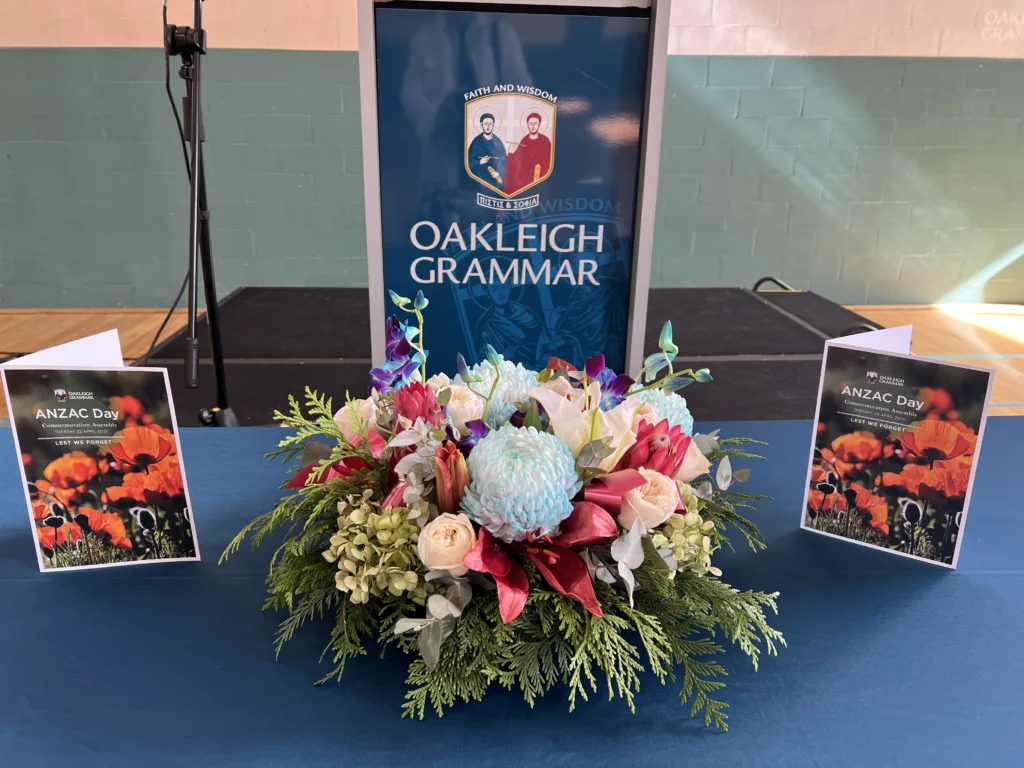
Oakleigh Grammar commemorates ANZAC Day at special assembly

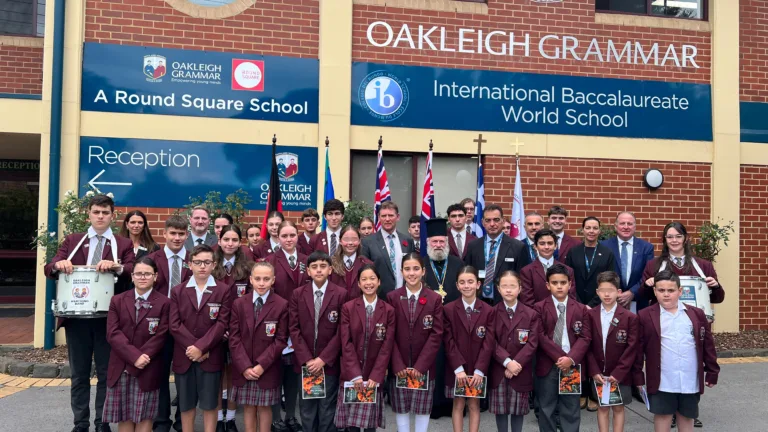
Oakleigh Grammar has honoured ANZAC Day with a moving whole school assembly to commence Term Two of 2025.

Attended by students, staff and members of the School Executive and School Board, the assembly reflected on the enduring legacy of the brave soldiers who landed at Gallipoli on 25 April 1915, and the values of courage, sacrifice, and mateship that continue to define the ANZAC spirit.

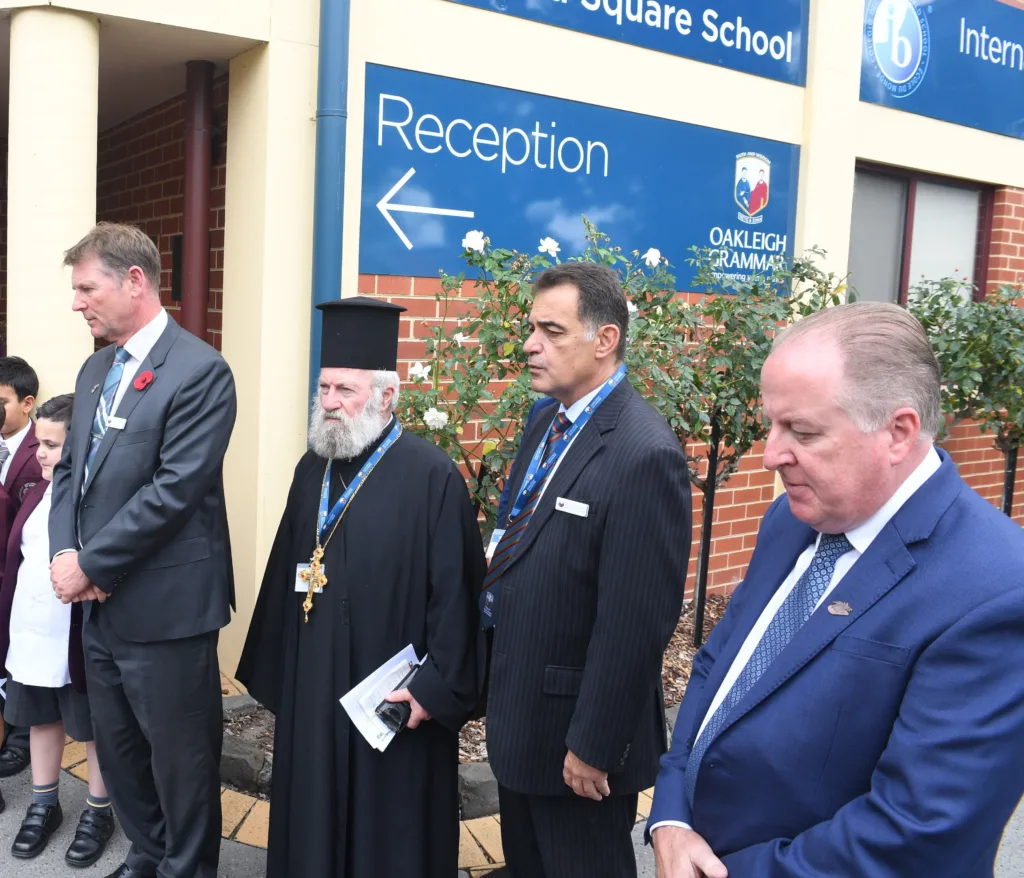
School leaders
School leaders.

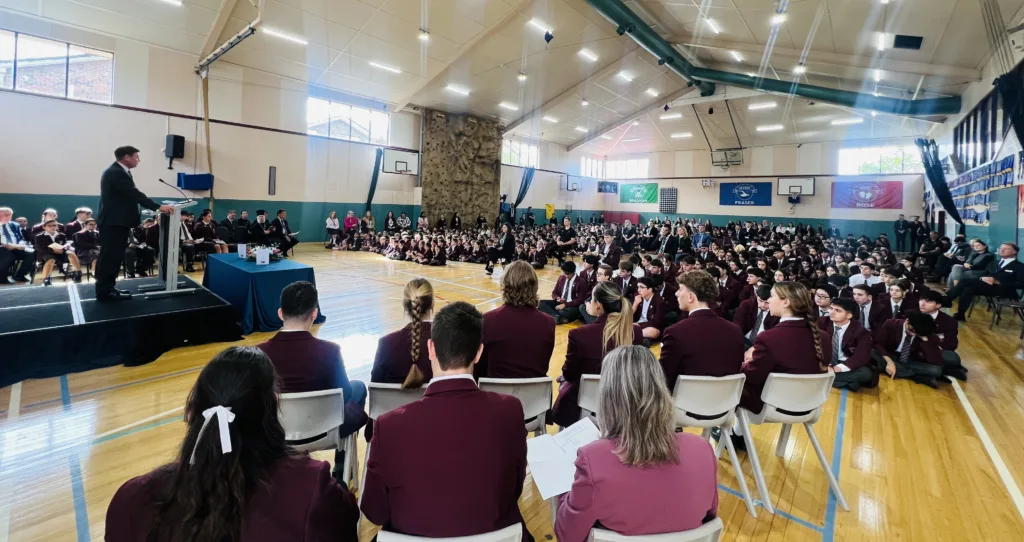
Both the Australian and New Zealand national anthem were sung, before Principal Mark Robertson delivered a solemn address on the continued relevance of the courage and sacrifice of the ANZACs to our modern-day world.

He reminded students of the importance of remembering the past to shape a more peaceful future and encouraged all present to carry forward the values of respect and kindness in their everyday lives.

ANZAC assembly
ANZAC assembly.

Following the Principal’s speech there were several reflections on ANZAC Day by students in Year 4 and Year 8, followed by a playing of The Last Post and a minute of silence.

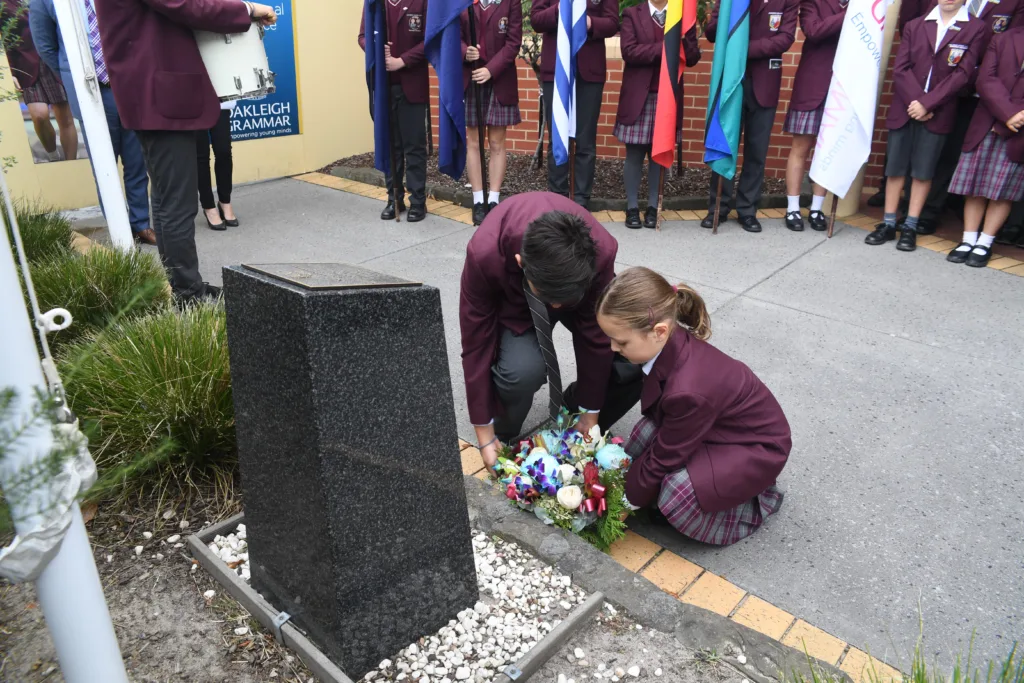
The official party then departed and lay a wreath at the ANZAC memorial at the front of the school.

‘ANZAC Bread’: How Australian flour fed the survivors of Genocide

By Dr Panayiotis Diamadis, Vice-President, Australian Institute for Holocaust and Genocide Studies

This day, every day, it is our duty to honour the ANZACs who sacrificed so much. ANZAC Day was born on the shores of the Kallipole Peninsula, named for its largest settlement, Kallipole (Gallipoli), the ‘Beautiful City’. Their sacrifice went far beyond the battlefield, inspiring Australians and New Zealanders to give generously to the survivors of the Genocides of the indigenous Hellenes, Armenians and Assyrians of the Turkish-ruled Ottoman Empire.

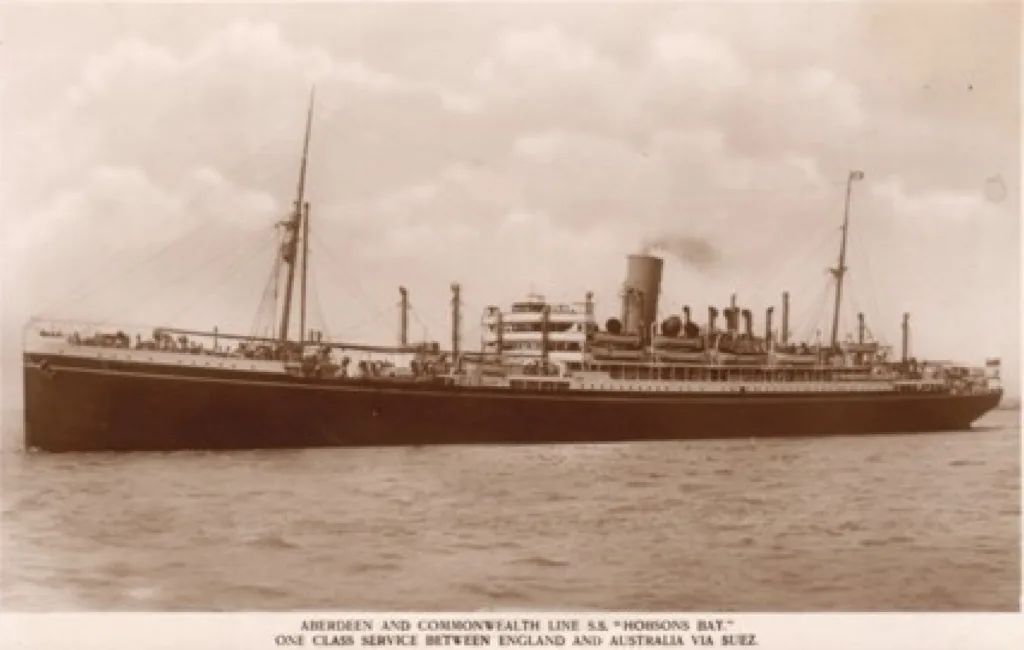
It was in October 1922 that the Australian vessel Hobson’s Bay ‘passed tragic Gallipoli, where many brave ANZACs from Australia and New Zealand had laid down their young lives, face to the foe. And now the unhappy victims of this same foe were to be fed with bread from their homeland, as if to complete the work for which they died. ANZAC bread!’

This is how Rev. Dr. Loyal Lincoln Wirt, an American Congregational minister and the International Commissioner of the Near East Relief organisation, described the shipment of Australian flour in his memoir The world is my parish.

The Hobson’s Bay had sailed from Melbourne the previous month with thousands sacks of flour donated by Victorian farmers. Having left part of its cargo at Beirut, for the Australasian Orphanage at nearby Antelias, proceeded to Constantinople.

Wirt recalled being met by the local Near East Relief Director, Dr Jacquith.

the Hobson's Bay
The Hobson’s Bay.

‘Do you remember St. Paul’s vision and the cry from Macedonia, ‘Come over and help us’? You are no saint and probably do not resemble St. Paul in the least – except perhaps in stature – but here is a message for you. It came in the same way St. Paul’s did – by wireless’.

Jacquith handed Wirt a radiogram from a Near East Relief post at Alexandroupolis in western Thrace: ‘It was indeed the same cry.’ The message read: ‘Ten thousand people driven from Eastern Thrace are here, starving to death. They have been overlooked in the food distribution. Some are dead, many are dying. Can you send flour?’

The Hobson’s Bay still had 4,000 bags of Australian flour stowed away, according to Wirt, ‘given for the express purpose of meeting some such emergency.’ As he later recorded: ‘Time was precious; moments meant lives.’ Within a few hours, the flour had been transferred to a steamer and was on its way.

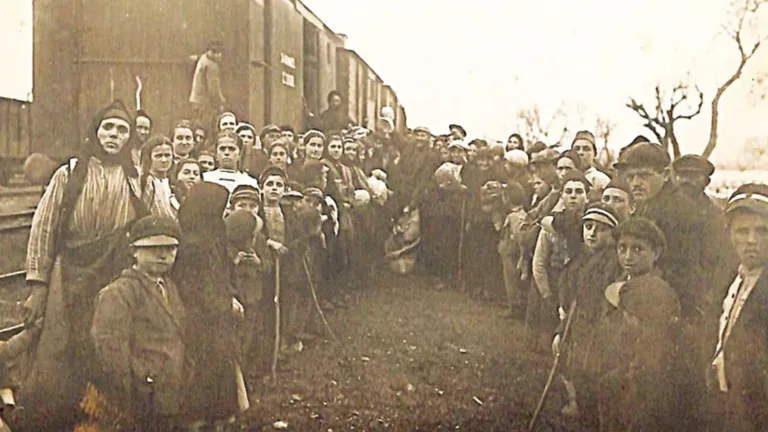
This flour – and the bread baked from it – was used by the League of Nations’ Commissioner for Refugees, Colonel George Devine Treloar and his colleagues to feed thousands of destitute survivors of the state-orchestrated plan to exterminate the indigenous Christian presence in eastern Thrace and Anatolia.

The final part of the ANZAC legacy is for the next Parliament of the Commonwealth of Australia to acknowledge the efforts of those ANZACs, those Australians and New Zealanders who fought against genocide and did their utmost to assist the survivors from the other side of the world.

We will remember them. Lest we forget.

Exclusive sold-out premiere of ‘Stelios’ shines at Melbourne’s Astor Theatre

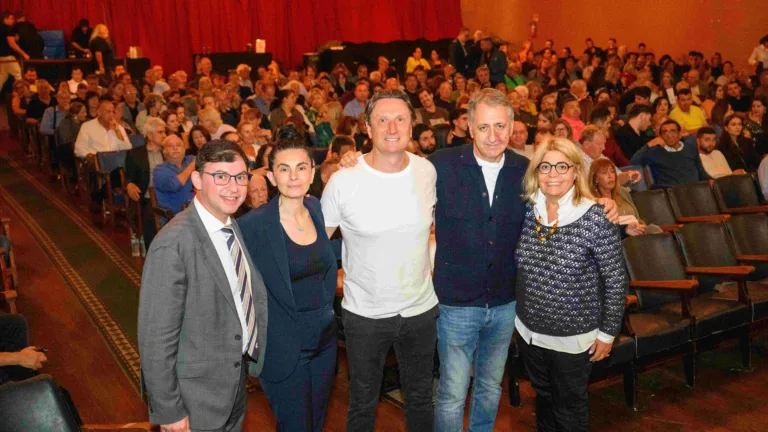
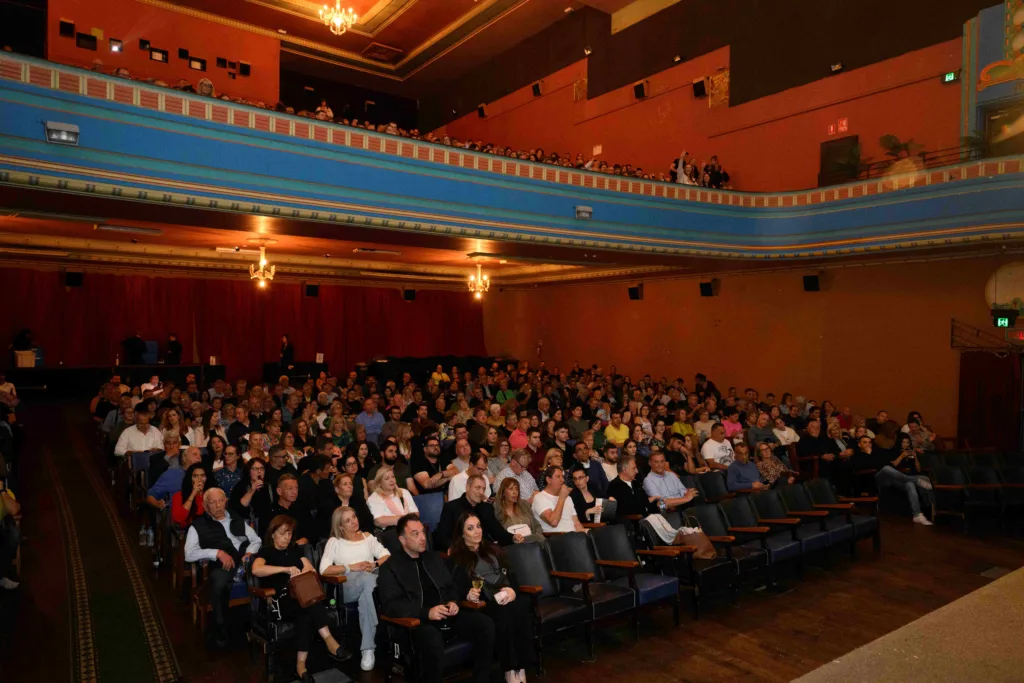
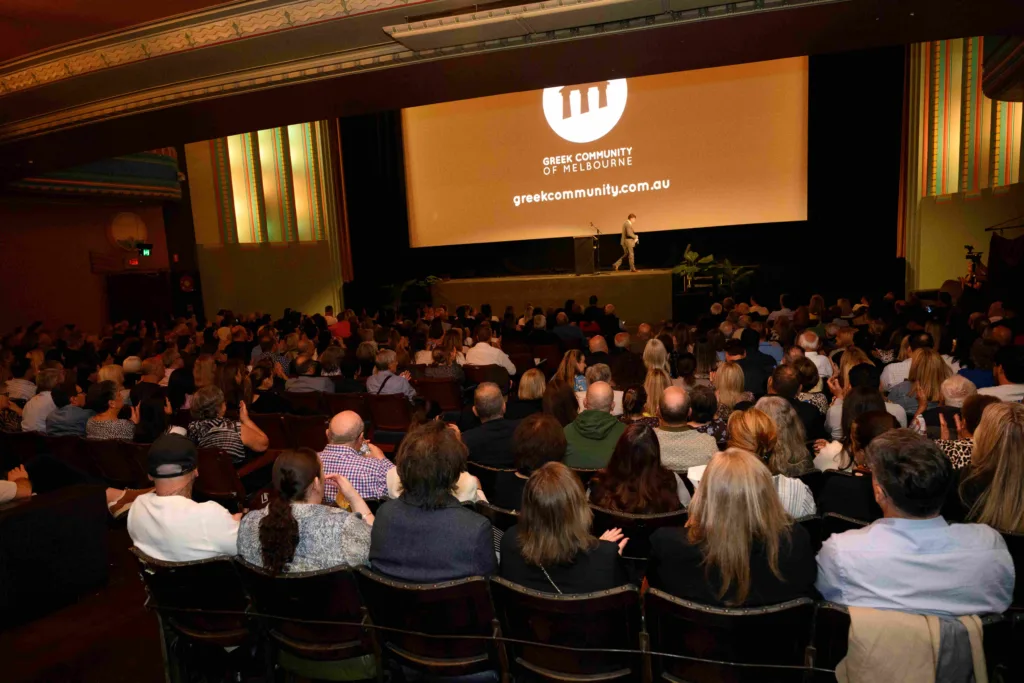
The biopic ‘Stelios’ premiered exclusively on Wednesday night at the Astor Theatre, with the screening completely sold out. The event attracted a strong turnout from Melbourne’s Greek Australian community.

Among those in attendance was the Consul General of Greece in Melbourne, Dimitra Georgantzoglou, as well as members of the media and community representatives. Guests gathered to view the story of Stelios Kazantzidis – a well-known Greek singer whose life and music resonated with generations of Greeks both in Greece and abroad.

Directed with care and attention to detail, ‘Stelios’ traces Kazantzidis’ life, from his early struggles to his rise as a cultural figure. The film combines archival footage and performances to explore themes of migration, hardship, and the role of music in expressing collective experience.

Bill Papastergiadis OAM, President of the Greek Community of Melbourne (GCM), remarked: “’Stelios’ reminds us of the stories that shaped many in our community. It’s a timely and respectful portrayal of an artist whose music meant a great deal to so many, particularly migrants who found a sense of connection in his lyrics.”

Leonidas Vlahakis, Chairman of the GCM Cultural Committee, added: “This film gives voice to a part of our cultural identity that is often difficult to express. It’s important that we continue to support projects like this that reflect our heritage and experiences.”

Due to high demand, another screening will be held at the Astor Theatre on Sunday 27 April, ahead of the film’s general release across cinemas in Australia.

Professor Anastasios Tamis: The Australian Government disgraced the Greek language

The decision of the Government of Australia, through its Permanent Representative to UNESCO, not to vote in favour of the Proposal for the Recognition of the International Day of the Greek Language, every year on 9 February, the day of the death of our National Poet Dionysios Solomos, at UNESCO (14 April 2024), is a historic HYBRIS to our ancestral and homeland Greece.

Moreover, it is a humiliation and trivialises the only language in the world, Greek, with a living duration of 3,500 years. The Proposal was ultimately voted in favour by the UNESCO Executive members countries, with the exception of the Australians, after our Australian Ambassador preferred to abstain from the vote.

Now, in retrospect and due to the election campaign and the uproar caused to the Greek Diaspora by the Formal Complaint, our Prime Minister and the Minister of Foreign Affairs enthusiastically declare that they will celebrate February 9, 2026, together with the Hellenism of Australia, congratulate them on the vote in favour and declare the amicable relations between the peoples of Greece and Australia.

However, the government authorities avoid stating that the initial approach to vote in favour of the Proposal for the Recognition of the Greek Language had begun in Australia by the Australian Institute of Macedonian Studies and the Australian Institute of Hellenic Research in May 2024 and dozens of consultations with academics, politicians, Ministers and Church leaders followed. Also, the Permanent Representative of Greece to UNESCO, Georgios Koumoutsakos, had approached his colleague, the Australian Ambassador in Paris, many months earlier and was trying to change her refusal to vote in favour of the Greek proposal, in vain.

This decision of the Australian Government from June 2024 (according to the letters we have from our own Foreign Minister, Penny Wong, who in the letters drafted by her assistant advisers, systematically and unswervingly) has been negative. The Australian Government has been refusing to support the Greek proposal for ten months. This negative predisposition and decision of the Australian political and diplomatic leadership offends and denigrates the 500,000 Australian citizens of Greek origin, whose Greek language is a key component of their cultural identity and betrays the feelings of friendship that distinguish the peoples of Greece and Australia.

I would like to remind that the Executive Council of UNESCO points out that the Greek language is the linguistic cradle of the basic concepts of world culture, science and philosophy. UNESCO also emphasises that the Greek language holds, according to historical and objective criteria, a special place among the languages of the world.

The Executive Board of UNESCO also emphasises that historically the Greek language occupies a key position in the intellectual, linguistic expression and formulation of fundamental concepts and words of the European and wider intellectuals, which are declared, perceived or reduced to words-concepts of the Greek language.

All those virtue and exclusive characteristics of the Greek language were not enough to influence the Australian decision in the affirmative. The Australian Ambassador to UNESCO and the leadership of Australian diplomacy preferred to humble the Greek language and Greeks and Australians who are linked by origin/ancestry or culture to Greece and the Greeks,  preferring that history should condemn them forever as deniers and critics of the language of Homer and the Gospels. The responsibility for the humiliation of our language lies with the Government of Australia. It was heard by party organs of the Labor Party and the Australian Foreign Ministry, that the government is supposedly acting as Caretaker Government and therefore could not take a position, it is ridiculous, provocative and unsubstantiated.

Since last June, our letters have been on the offices of both the Prime Minister and the Minister of Foreign Affairs, and we already had their negative response in July 2024, dressed in a decent style, claiming that “the Greek language is important, and Greeks should be proud to speak it”. But so far as for the request to vote in favour of the Proposal, they did not respond. They did not enter into the difficulty of expressing neither affirmation nor denial, the path of affirmative denial known to diplomats “I do not anticipate, and I do not exclude“!!

And how will the Greek pioneer immigrants, the settlers who made Australia economically and culturally stand out and their children, and how will their grandchildren and the unborn feel? And how will they wash away the shame they felt and feel when the country in which hundreds of thousands of Australians of Greek origin vote, stand humiliated by those we elect. We give them the power they have, we put them in positions of dignity and power to protect our culture, faith, customs and core values; we elected them Prime Minister and Minister of Foreign Affairs; the Australian Ambassador to UNESCO in Paris is paid with our taxes. So instead of them being held responsible and accountable for their actions and decisions, we will beg for their forgiveness in order to extract from those who were elected by us to serve us a ridiculous excuse, a political stunt about a supposedly caretaker government, a few days before the elections on May 3, which will determine their re-election.

The truth is one, as Aristotle said, and it does not allow for interpretations and diplomatic acrobatics. The Australian Government, from June 2024 until April 14, 2025, constantly humiliated the Greek language, humbled the language of Sophocles, the language of Pericles and Alexander the Great. They degraded our language, from which their own mother tongue language is constantly being enriched, because their negative decision to support the discrimination of the Greek language was not made out of ignorance, nor by electoral restrictions, and it is a shame to invoke them.

For a year now, Mr Koumoutsakos, our Ambassador to UNESCO and academics and intellectuals in Australia, Greece and France have been trying to convince the Australian Ambassador and her head of authority, the Australian Government, Ms Wong and our Prime Minister, in vain. The Archbishop of the Anglican Church, His Eminence Dr. Philip Freier and with him Australian Ministers of State, intellectuals, university professors sent letters of support for the Greek language to the Australian Government, in vain. The government was under siege, a year before the elections, and they consciously decided to humble us, humiliating the language of our ancestors, our mother tongue.

*Professor Anastasios M. Tamis taught at Universities in Australia and abroad, was the creator and founding director of the Dardalis Archives of the Hellenic Diaspora and is currently the President of the Australian Institute of Macedonian Studies (AIMS).

Direct from Greece: Elsa Mouratidou to enchant Australian audiences

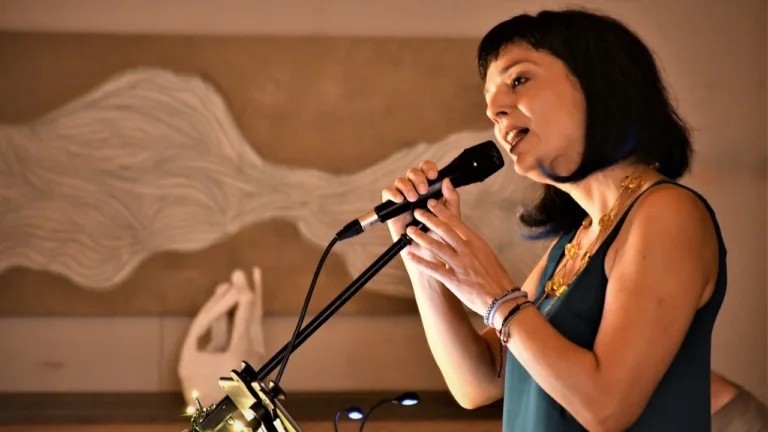
Direct from Greece, Elsa Mouratidou will be playing two intimate shows in Melbourne and Sydney this weekend.

Her musical journey began early, influenced by her involvement in the Ayia Triada Children’s Choir, before she pursued classical philology at Democritus University of Thrace. Elsa’s vocal training, which includes mentorship from Eleni Mihalopoulou and attendance at seminars with renowned artists such as Spyros Sakkas, Savina Yannatou and Michael Marmarinos, has helped shape her distinctive sound.

In addition to leading the Elsa Mouratidou Sextet and releasing the album Epsilon & Theta (Έρωτας & Θάνατος), Elsa actively participates in various musical projects. She is a member of Stringless (an a cappella group), Argatia Ensemble (specialising in Black Sea music), and Tir Fada (focused on Celtic music). Her recent contributions to projects like L’alma de Saloniko (Judeo-Spanish songs of Thessaloniki) and Plan C–Caucasus (songs from the Caucasus) further demonstrate her versatility.

Elsa’s impressive career has taken her across Greece and internationally, performing at prestigious festivals and venues in countries like Turkey, Bulgaria, Spain, France, Germany, Belgium, Switzerland and Morocco. She has collaborated with a wide array of Greek artists, including Giorgos Kazantzis, Doros Demosthenous, Maria Thoidou and many more.

Beyond her performances, Elsa has worked with the National Theatre of Northern Greece as both a performer and music director. She has spent 18 years as a vocal coach, nurturing the next generation of musicians and actors at music schools and the Drama School of the National Theatre of Northern Greece.

Event Details:

  • Saturday 26th April in Sydney: Butchers Brew 499 Marrickville Rd, Dulwich Hill – Matinee show with Taxim Trio. Tickets available via venue website here.
  • Sunday 27th April in Melbourne with Estudiantina of Melbourne at Church of All Nations, 180 Palmerston St, Carlton. Tickets via The Boite Website here.

What happens when the papacy becomes vacant? Key terms and traditions

The process of transitioning leadership in the Catholic Church—whether through the death or resignation of a pope—is steeped in centuries-old rituals and terminology. As the global Church prepares for such a moment, understanding the roles, Latin phrases, and traditions involved offers clarity.

At the heart of this transition is the camerlengo, or chamberlain, currently Irish-born American Cardinal Kevin Farrell. He is responsible for officially verifying the pope’s death and sealing his personal quarters. Until a new pope is elected, he administers the Vatican’s “goods and temporal rights.”

The College of Cardinals, comprising 252 members worldwide, assumes interim responsibility for Church affairs. Among them, 135 are under the age of 80 and thus eligible to vote for the next pope in a conclave. Most of these cardinal electors—108 to be precise—were appointed by Pope Francis, according to Vatican statistics.

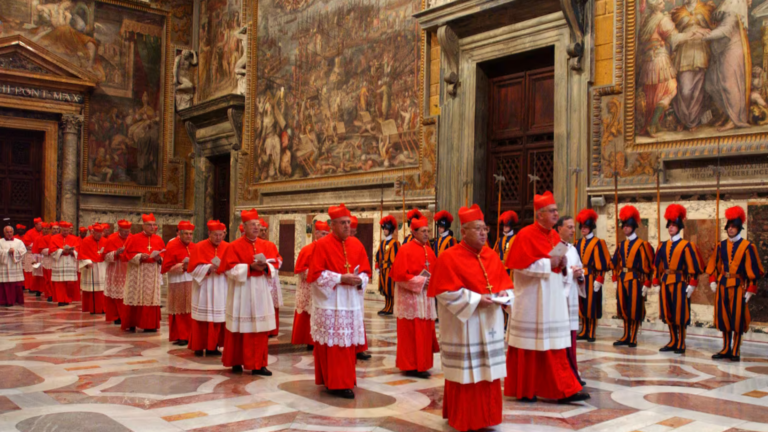
The conclave, literally meaning “with a key,” refers to the secretive gathering in the Sistine Chapel where electors choose the new pope. Instituted in the 13th century, the conclave begins no later than 20 days after a pope’s death or resignation.

Electors are completely sequestered during this process, which in recent times has concluded within days. When the conclave is ready to commence, the master of papal liturgical celebrations—currently Archbishop Diego Ravelli—declares “extra omnes,” Latin for “all out,” instructing all non-electors to leave the chapel so voting can begin.

Italian Cardinal Giovanni Battista Re, the current dean of the College of Cardinals, is tasked with notifying the Church and diplomatic corps of the pope’s death. He also convenes and presides over the conclave, asking the elected candidate if he accepts the role and what name he will take. If a pope is elected, the protodeacon of the College—currently French Cardinal Dominique Mamberti—steps onto the loggia of St. Peter’s Basilica and announces “Habemus Papam,” Latin for “We have a pope,” followed by the new pope’s chosen name.

Voting is a structured affair, overseen by three groups of cardinals selected by random draw: scrutineers who count and announce the votes, revisers who double-check them, and infirmarii who collect ballots from any sick electors. A two-thirds majority is required to elect a pope.

If the process is prolonged, the top two vote-getters may go to a runoff, but the two-thirds requirement still applies. This procedure is outlined in Universi Dominici Gregis, the constitution issued by St. John Paul II in 1996 and later amended by Pope Benedict XVI to maintain the two-thirds threshold throughout.

Each voting round concludes with the burning of ballots. If no pope is chosen, chemicals are added to produce black smoke; if a new pope is elected, white smoke signals the decision to the outside world, along with the ringing of bells. The elected pope receives the Fisherman’s Ring, symbolising his role as a “fisher of men.” While it was once destroyed upon a pope’s death, it is now “annulled” to prevent misuse.

The interregnum is referred to as sede vacante, Latin for “vacant seat.” During this time, all cardinals gather in the General Congregations, closed-door meetings to discuss major Church affairs and finalise preparations for the conclave. These discussions are secret and carried out under oath.

St. Peter’s Basilica plays a central role during this period. Built over the tomb of the apostle Peter, it is one of the largest and most significant Catholic churches. It becomes the site where the pope’s body lies in state, allowing the faithful to pay their final respects. The basilica is home to major artworks, including Michelangelo’s Pietà and Bernini’s bronze baldacchino.

Pope Francis, notably, has expressed his wish to break with tradition by being buried not in the Vatican but in Rome’s Basilica of St. Mary Major, near the icon of the Virgin Mary he holds dear—Salus Populi Romani. In his will, he requested a simple underground tomb inscribed only with “Franciscus.”

Francis also chose as his motto miserando atque eligendo, Latin for “having had mercy and choosing him,” a phrase drawn from the homilies of St. Bede the Venerable and referencing Jesus’ call to Matthew in the Gospel.

Another key Vatican site is the Domus Santa Marta, the guesthouse where the cardinals stay during the conclave. Pope Francis famously chose to live there after his election, opting for a modest suite over the traditional papal apartments.

Finally, the rogito—a Latin document detailing the pope’s life and papacy—is placed in his coffin, with a copy kept in the Vatican archives. It serves as a formal record of a papal legacy that, through tradition, ritual, and symbolism, passes solemnly into history.

Source: Ekathimerini.

ANZAC bravery at Kalamata: The last battle in mainland Greece

*Information provided by the Society of Kalamata ‘23 March’

In early 2016 the Society of Kalamata ‘23 March’ began commemorating the Battle of Kalamata with a commemorative service for the 75th Anniversary at the Australian Hellenic Memorial. The commemorative service which has been held every year since 2016 honours the Allies and Greeks who fought and died for the defence of Greece in World War II and the courage of the civilians who risked their lives to protect the Allied troops.

By honouring the sacrifices made the friendship between Greece and Australia has grown stronger as we continue to remember the bravery and determination of those who defended Greece against the Axis forces.

We note that there will be a memorial service undertaken by the Brotherhood of Veterans of the Greek Campaign 1940-41 which will be held on Tuesday 13th May 2025 at the WW2 memorial located at the entrance to the Municipal Railway Park in Kalamata, Greece. Also there will be a Memorial Service at the National Memorial Arboretum, Lichfield on Saturday 6th September 2025 at 11.30 am in the Greek Grove, or in the chapel if wet.

History of the Campaign in Mainland Greece

On 28 October 1940, Italy invaded Greece from Albania. The intention of the modern, mechanised Italian army was a lightning campaign which would lead to the domination of the Balkans and the Aegean Sea. The Italian invasion was a failure with the ill-equipped but high-spirited and brave Greek infantry, despite not having modern weapons or equipment, successfully fighting on familiar ground to defeat the more numerous and heavily armed Italian invaders, who were forced back deep into Albania.

Going back to 1941 we recount in summary the Allies movements in mainland Greece.

In March 1941, more than 60,000 Commonwealth troops (British, Australians, New Zealanders, Indians, Palestinians and Cypriots) were sent as part of a British Expeditionary Force to support Greece, comprising the 6th Australian Division, the New Zealand 2nd Division, and the British 1st Armoured Brigade to help defend Greece from the Axis invaders.

At approximately the same time period a major Italian counterattack failed, and Germany was forced to come to the aid of its ally. The Germans invaded on 6 April 1941 in order to secure their southern flank in preparation for Operation Barbarossa, the invasion of Russia, and consequently forced the surrender of the Greek army who had for almost 6 months since the 28th of October 1940, valiantly fought and  beaten  the Italian  invaders.  This was  a disaster for the retreating Commonwealth troops as they were exposed to bombing, strafing, a lack of food and shelter and constantly being pushed back with no rest.

Allied and Greek soldiers set up a defence line near the village of Vevi in central Macedonia in Northern Greece. However, they could not withstand the might of the highly modern and mechanised German army, and were soon forced to retreat to the southern ports of Greece, in the hope of evacuation by the Royal and Merchant Navy.

German fighter and bomber aircraft ruled the skies bombing and machine-gunning the Allied and Greek soldiers all the all the way, inflicting many casualties.

The Commonwealth troops fought at Vevi in central Macedonia, the Veria Pass, the Monastir valley, Servia pass, Mt Olympus, Corinth canal, Larisa, Domokos, the Pinios Gorge, Elasson, Haliacmon valley, the Vermion range, Brallos, Elatia, Thebes, Nafplion, Megara and Kalamata.

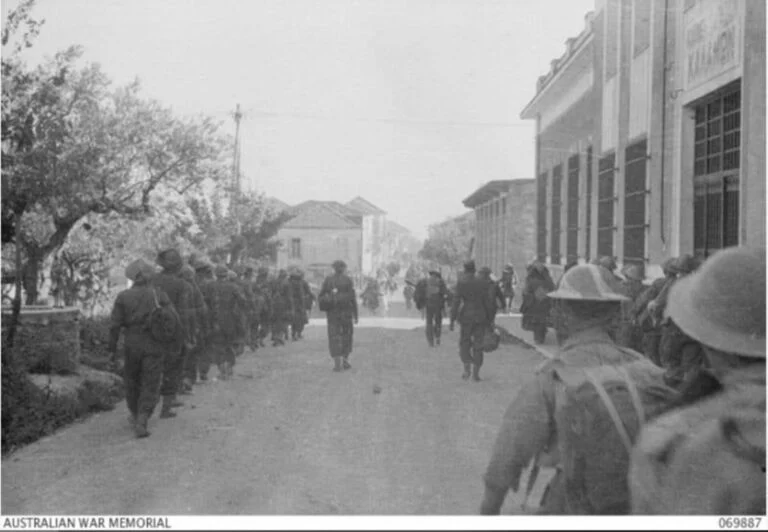
Allied troops arrive at Kalamata. Courtesy of Australian War Memorial
Allied troops arrive at Kalamata. Courtesy of Australian War Memorial.

On April 12 at the historic Thermopylae Pass the second ANZAC Corps was created by the Australian Commander Blamey as the Australian and New Zealand units fought side by side as a rear guard. Like King Leonidas and the 300 Spartans they were given the order to fight at all costs and were ordered that “it is essential to deny the enemy even if it meant extinction.”

There were further desperate rearguard actions to delay and defeat the advancing German forces invading Greece. The campaign in the Peloponnese had begun with the defence of the Corinth Canal on April 1941, where Australian, New Zealand and British troops stopped German paratroops from capturing the bridge across the canal.

This led to a successful evacuation of over 52,000 Commonwealth, Greek and Yugoslav troops by sea from Athens, Megara, Nafplion and Kalamata.

By the 26th April between 18,000 and 20,000 troops were assembled at Kalamata and hid in the massive olive groves to the east of the town, out of sight of German bombers that roamed the skies during daylight hours. These included Australia, New Zealand, British and Greek troops. Amongst the British troops were around 2,000 Palestinians, Indians and Cypriots. There were also some 2,000 Yugoslav soldiers and merchant seamen from sunken transport ships – all awaiting evacuation from the Kalamata waterfront. But sadly not all of these could be evacuated, as the Allied naval evacuation force was under constant air attack, with many ships and lives being lost in the effort.

By April 28 there were still 8,000 allied troops left in Kalamata. During the day, 300 men of the British 4th Hussars, of the British 1st Armoured Brigade, had been ordered north of the town to search for the advancing enemy. They were ambushed and either killed or captured to a man.

On the night of April 28 two companies of the German 5th Panzer Division, with artillery launched a fierce attack on the town and stormed into Kalamata and got as far as the quay on Navarino Street. The New Zealand and Australian troops fought the last battle in mainland Greece in Kalamata and counter attacked with fixed bayonets, even though they had not received orders before pitching in. Some 40 Germans were killed and 100 captured. It was during this action that the bravery of Sergeant Jack Hinton of the 20th New Zealand Battalion earned him the Victoria Cross whilst Captain Albert Gray of the Australian 2/6th Battalion was awarded the Military Cross for bravery. Both Hinton and Gray would eventually be captured.

On April 29 with the Navy being unable to return and the enemy’s superior strength, the Allied Commander decided to surrender his troops to avoid further massive bloodshed. Before dawn the allied troops were ordered to destroy all weapons, equipment and anything of value prior to surrender the next day, when it would be every man for himself. The Allied troops left from the Olive groves and marched in orderly rank and file down to the beach, where they formed up in smart parade order, before the Allied Commander surrendered his men as dawn broke over Kalamata, to a German high-ranking officer. And by April 30, most had surrendered. Others chose to escape into Laconia, Koroni and Mani. Over 300 Anzacs are resting in Messinia today.

The Greek campaign ended in a German victory with the fall of Kalamata in the Peloponnese. Nevertheless, both German and Allied officials expressed their admiration for the strong resistance of the Greek soldiers. Some historians regard the German campaign in Greece as decisive in determining the course of World War II, maintaining that it fatally delayed the Axis invasion of the Soviet Union.

Whilst we commemorate the last battle in mainland Greece at Kalamata, we note that the fighting did not stop there as most of the Allied and Greek troops that were evacuated from Kalamata and the other embarkation beaches across Greece went on to defend Crete against the Axis invasion in May 1941. The vast majority of Greek forces defending Crete were regiments raised from the towns and villages of the Peloponnese.

It is important that we all remember those who served in Greece in World War 11, including those who took part in the defence of Kalamata in 1941. The bravery of Captain Gray and Sergeant Hinton and their men in that brave charge on the Kalamata waterfront should never be forgotten.

Winston Churchill stated: “the world will no longer say that Greeks fight as heroes, but heroes fight as Greeks”.

And Adolf Hitler stated: “only the Greeks, of all the adversaries who confronted us, fought with bold courage and highest disregard of death”.

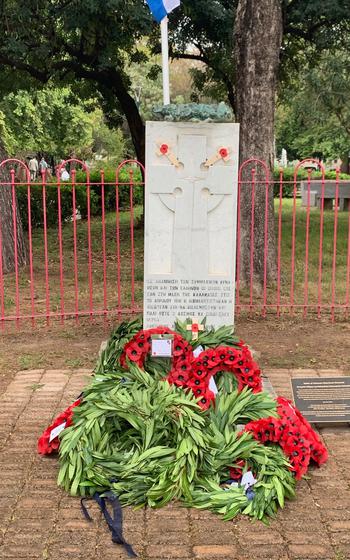
Kalamata ANZAC Memorial (Mic Fleming)
Kalamata ANZAC Memorial. Photo: Mic Fleming.

Descendants of those that fought in Greece in 1941

Over the years we have had many descendants attend our Commemorative Services. We would like to thank the children and descendants of those that fought in Greece in 1941.

Rosemary Hart daughter of Brigadier Alfred Bell, OBE of the 19th Brigade. The Australian 19th Brigade were to hold the Thermopylae Pass as long as possible, allowing the other units to withdraw. Brigadier Vasey said: “Here we bloody well are and here we bloody well stay.” This was interpreted by Vasey’s Brigade Major Alfred Bell, as meaning that the brigade would “hold its present defensive positions come what may”, until the withdrawal had been completed. The Germans attacked them with the two battle groups, the 6th Mountain Division and the 5th Panzer Division on 24 April, meeting fierce resistance. The Australians and New Zealanders held out for an entire day, destroyed 15 German tanks and inflicted considerable casualties. With the delaying action accomplished, the rearguard retreated towards another defensive position at Thebes.

Catherine Bell daughter of Private Syd Grant of the 2/8 Field Regiment. He had served though the battles of Greece, including Vevi in Macedonia. Escaping from the Germans after being captured at Kalamata, Syd was eventually evacuated from the village of Trachila, south of Kalamata, after being helped by villagers for a number of days. He never forgot the support of the Greek people and after the war named his Victorian soldier settlement farm Kalamata. And our understanding is that Catherine will be donating his large World War 2 photo collection to the State Library in November.

Mr Peter Ford whose father served with the 22nd Battalion of the New Zealand 2nd Division

Mr Aron Segal whose uncle Corporal Aron Weizman of the 608 Company of the Palestine Pioneer Corps who took part in the defence of Greece and was present at the Battle of Kalamata where over 1,300 of them were taken captive.

Mr Phil Cleary the grandson of Ted Dorian of the 2/6th Battalion and the other ‘Brunswick Boys’ who fought in Greece and Crete

Quote from Australian soldier about Kalamata

Undoubtedly what many Australian soldiers took away with them from Greece was the manner in which the Greek people, who had greeted them so warmly on their arrival, did not desert them in defeat. As a detachment of the 2/3rd Battalion acted as a rearguard near the evacuation beaches at Kalamata they passed the cottage of an elderly Greek lady who stood by her door ‘with a tray of sliced cake and glasses of Retsina, a local wine’:

She offered these to each of the soldiers as they passed by, an act which touched us deeply. We could not understand what she was saying as she tearfully proffered her gifts, but her meaning was clear and we all said things like, ‘Never mind, Ma; we’ll be back and make up for all of this’.

Conclusion

It is important that we all – as Australians and as Greeks – remember those who served in Greece in World War Two, including those who took part in the defence of Kalamata in 1941. On behalf of the Society of Kalamata ‘23 March’ we thank all who have assisted and participated in honouring the sacrifices made in Greece in 1941 by both the Allied and Greek service personnel and the civilians who risked their lives to protect the Allied troops. Through the continuing Battle of Kalamata Commemorative Services we look forward to strengthening and celebrating the lasting bonds that were forged between Australia and Greece during the Second World War in Greece in 1941.

The friendship between our two countries has grown stronger as we continue to remember the bravery and determination of those Allied and Greek troops who fought in Greece and courageous civilians who risked their lives to protect the Allied troops.

The poem below was written by Buster Doug Beckett, son of Private Doug (Joe) Beckett, Royal Army Ordnance Corps who is one of the Administrators of the Brotherhood of Veterans of the Greek Campaign 1940-41. The Brotherhood was formed in the UK over 30 years ago by Edwin Horlington MBE and aims to promote awareness of the Greek Campaigns and foster communications and information between veterans and their families across the UK, the Commonwealth and all nations that served in Greece during WW2.

It is in honour of the Allied soldiers that were evacuated from Kalamata, and in particular those who fought, and those who died during the ‘Battle of Kalamata’ on the 28 / 29 April 1941. Also, for the thousands of Allied soldiers who were taken prisoners of war. May their memory live on forever.

Kalamata 1941 – A poem

The olive groves are now deserted

Weary soldiers hide there no more

Waiting for night-time and the darkness

Praying that boats will reach the shore

Kalamata was their final destination

From here they could run no more

They were battle hardened and bloodied

Bearing the battle scars of war

If only the olive trees could speak

I wonder what they would say

Having listened to their conversations

And watched as they knelt to pray

The sun still warms the olive trees

The rain still touches every leaf

The breeze still stirs the branches

I wonder if the trees can still feel their grief

The Brotherhood of Veterans

Will never let others forget

The sacrifice they made for our freedom

With brave hearts and no regret

For the soldiers who never came home

Let us pray for them and shed a tear

And for those that escaped or were captured

Remember to “Tell Them We Were Here”

EY affidavit reveals explosive allegations over Cyprus Community of NSW Administration

An affidavit and supporting documentation, filed with the NSW Supreme Court on 10 April 2025 as part of Ernst & Young’s (EY) application to extend the administration period, outlines a series of concerning observations, claims and internal disputes surrounding the Cyprus Community of NSW Ltd.

Prepared by Morgan Kelly of EY, the 24-page affidavit and 260 page exhibit details the complex challenges facing the community organisation, including governance breakdowns, contested financial decisions and unresolved legal tensions — all of which have contributed to the administration now being extended to October 2025.

Among the material presented in the affidavit is a letter submitted to EY by a group of members (some of which are suspended or expelled). The letter raises allegations about past board conduct and EY’s oversight. A 6-page email response was issued by Mr Kelly addressing those matters.

Tensions reported at March meeting

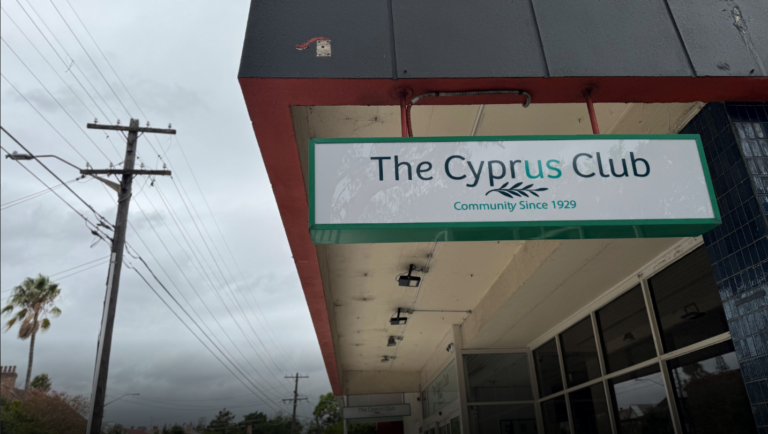
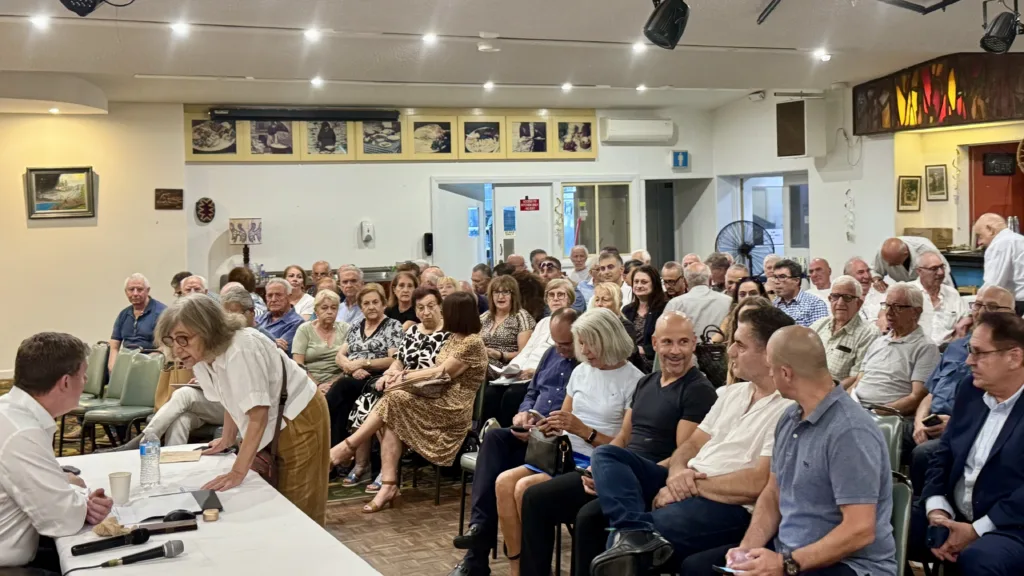
One of the more dramatic passages of the 6-page email refers to the member information session held at the Cyprus Club on 13 March 2025. Mr Kelly recounts an incident involving former president Spyros Constantinou, who attempted to attend the session despite his membership being cancelled. According to the affidavit, Mr Constantinou was asked to remain in the foyer but became agitated. An associate identifying as his bodyguard allegedly warned EY staff that “things could turn violent if necessary.”

Mr Kelly states that, to defuse the situation and ensure safety, all expelled and suspended individuals were allowed entry — a notable departure from the original policy of limiting the meeting to financial members only.

cyprus community of nsw
The March meeting. Photo copyright The Greek Herald.

A fractured membership base

The affidavit details prolonged delays stemming from legal disputes between member groups and creditors. A legal challenge brought by Cyprus Capital and its director Con Costa, which questioned the validity of EY’s appointment, is noted as having stalled progress for several months.

Mr Kelly also references internal divisions that predate the administration, with conflicting visions for the club’s future, unresolved property matters, and member dissatisfaction over previous board conduct.

Concerns over property deal and potential conflicts

The 6-page email reveals that Eric Costas and former president Mr Constantinou had supported a redevelopment proposal from a developer known as Platino. EY’s Real Estate Advisory Project Management team reviewed the proposal and raised concerns that certain individuals, including Mr Costas and “other certain Cyprus Club Members”, are entitled to financial gain and that the proposal “is favoured for self-interest rather than the benefit of the community”.

The administrators flagged that such interests may compromise members’ ability to vote impartially and confirmed that anyone with a financial interest would be excluded from the Property Steering Panel. While no misconduct is alleged, the concern over impartiality adds another layer of complexity to an already fractious situation.

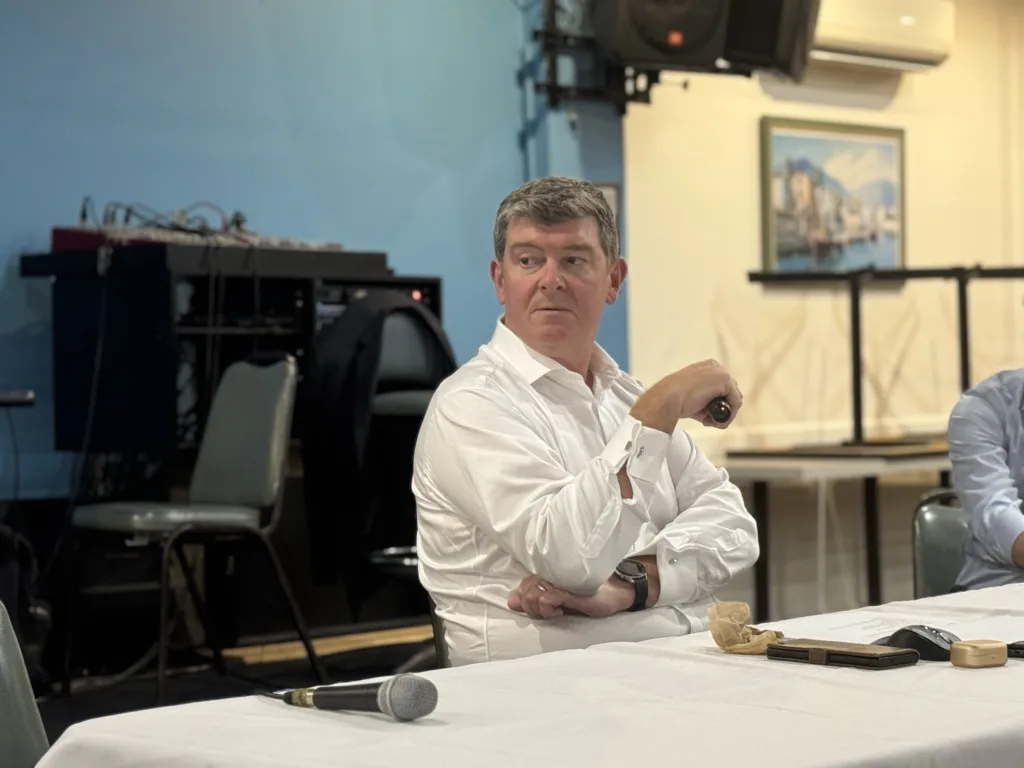
cyprus community of nsw
EY’s Morgan Kelly (above) issued a 6-page email response to allegations.

Allegations rebutted in Court filing

In his sworn response, Mr Kelly rejects accusations of bias or improper influence. He explains that the administration’s actions — including the controversial decision to admit expelled members to the March meeting — were taken to ensure safety and de-escalate tensions. Mr Kelly also disputes any personal or professional connection to individuals alleged to have influenced EY’s appointment.

He further notes that despite numerous invitations, the individuals who raised concerns have yet to provide further documentation to support their claims.

$1.1 million dispute and questions over Receivers’ role

The affidavit also sheds light on a simmering financial dispute involving a $1.092 million portion of the payout claimed by Cyprus Capital. That amount was withheld and paid into court, with its final allocation still to be determined. Mr Kelly states this figure includes fees claimed by the former Receivers and Managers, whose tenure ended in February 2025.

EY raises serious questions over the legitimacy of those receiver fees — reportedly nearing $1 million — and notes that the Receivers failed to progress a property sale strategy or meaningfully advance the community’s future while in office. Despite being in control of the club’s operations for several months, the Receivers reportedly did not obtain valuations, run tenders, or conduct an EOI process.

Mr Kelly also highlights how Cyprus Capital’s conduct — including its refusal to cooperate on refinancing matters — contributed to administrative delays and legal costs, ultimately reducing funds available to creditors.

Crucial decisions loom

While the administration has been extended to October, the real test lies ahead. A successful Deed of Company Arrangement (DOCA) — a proposal that would allow the organisation to continue operating while repaying creditors — remains under consideration but is not yet in a form that EY can recommend.

If a viable DOCA is not finalised and accepted by creditors, EY may be forced to advise winding up the community — a move that would result in liquidation, sale of assets, and the loss of member control. As stakeholders await the next round of creditor and member meetings, the affidavit offers a sobering glimpse into what’s at stake and just how far the road to recovery may still stretch.

The affidavit and accompanying exhibits offer rare insight into the behind-the-scenes pressures, financial disputes and leadership struggles that continue to grip one of Sydney’s most prominent Cypriot community organisations.

The Greek Herald will continue to follow this matter closely as administrators and stakeholders navigate the next critical phase of the Community’s future.