
Turkey’s top administrative court on Friday annulled the 1934 government decree that turned Hagia Sophia into museum.
The Council of State, Turkey’s highest administrative court, received the case July 1 and was expected to make a ruling by July 16. On Friday afternoon, the court annulled the 1934 government decree, paving the way for Hagia Sophia to become a mosque.
Only one hour after the decree was signed, Erdogan ordered the conversion of one of the world’s most treasured cultural sites into a Muslim house of worship.
READ MORE: Iconic Hagia Sophia to be turned back into a mosque
Hagia Sophia, a UNESCO World Heritage Site, is one of Turkey’s most visited monuments. Finished in the year 537 with futuristic building techniques in what was then Constantinople, it was the main cathedral in Christendom for 900 years before becoming an Ottoman mosque in 1453.
It was converted into a museum in 1934 under the secular founder of the modern Turkish republic, Kemal Ataturk, but the July 2 case before the court challenges the legality of this step.
READ MORE: Greece has no rights on Hagia Sophia, says Turkish Foreign Minister.
Since last year, Turkish President Recep Tayyip Erdogan has backed the idea of returning the building’s mosque status in several speeches, in an attempt to satisfy his conservative Muslim base, which has always seen Ataturk’s decision as catastrophic.
Following the court’s ruling, Erdogan’s government still needs to take the actual steps to make the necessary changes in the building to open it for public prayers.
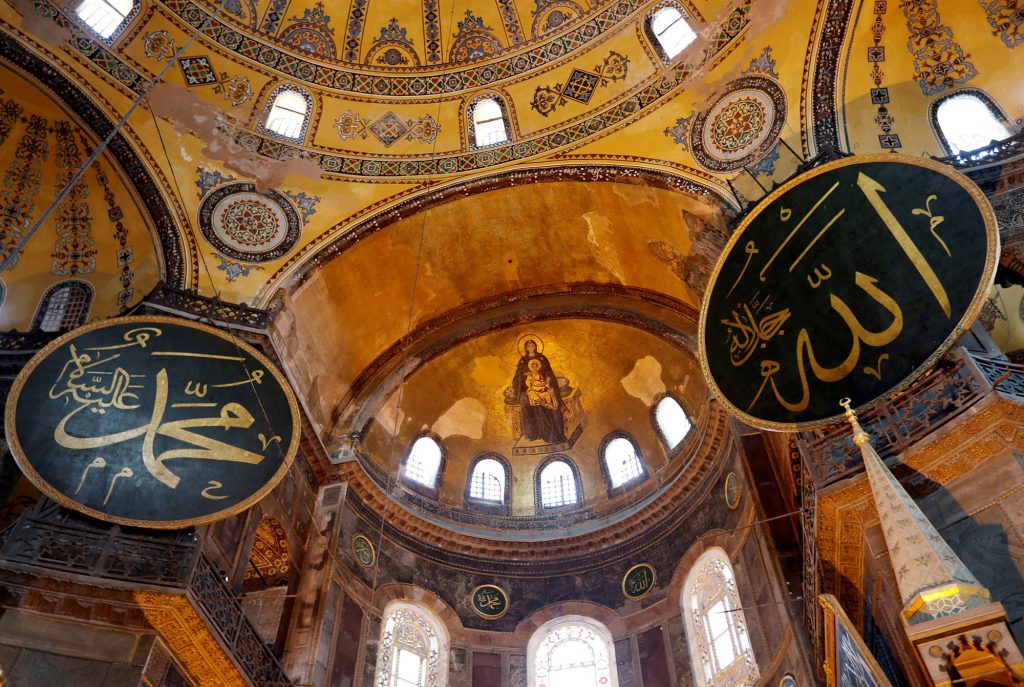
UNESCO warned that it must be notified of any change in the status of Istanbul’s sixth-century museum and the changes may have to be reviewed by its World Heritage committee, the United Nation’s cultural body told Reuters late on Thursday.
UNESCO told Reuters that the Hagia Sophia was on its list of World Heritage Sites as a museum, and as such had certain commitments and legal obligations.
“Thus, a state must make sure that no modification undermines the outstanding universal value of a site listed on its territory,” UNESCO said.
“Any modification must be notified beforehand by the state to UNESCO and be reviewed if need be by the World Heritage Committee,” it added.

UNESCO said it had expressed its concerns to Turkish authorities in several letters and conveyed the message to Turkey’s ambassador to the institution on Thursday.
“We urge Turkish authorities to start a dialog before any decision is taken that could undermine the universal value of the site,” UNESCO said.
Ecumenical Patriarch Vartholomaios, the spiritual head of some 300 million Orthodox Christians worldwide and based in Constantinople where the Orthodox church stands, said making it a mosque would disappoint Christians and “fracture” East and West, setting up a potential clash of religions.
“The potential conversion of Hagia Sophia into a mosque will turn millions of Christians around the world against Islam,” Vartholomaios warned prior to the court ruling.
More to come.
