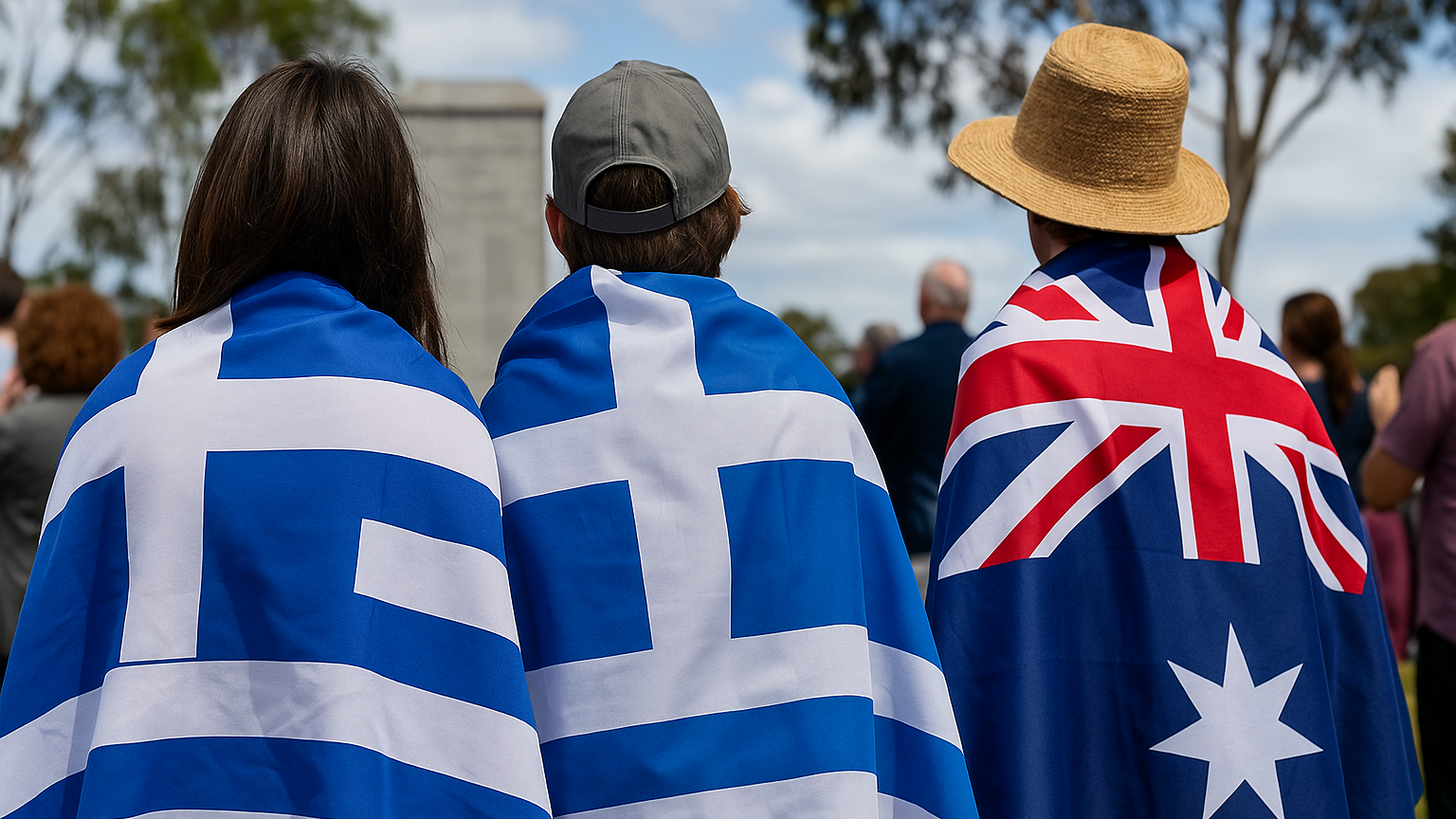
In today’s article and those two which will follow, we will refer again to the performance of the Greeks, their cultural integration, their contribution, in general, to the arts and letters, and the effort to preserve the cultural ethnic consciousness.
I would like to clarify that the preservation of the political, civil conscience of a people in its diaspora is “nationalism”. The preservation of its cultural identity, customs and traditions is “ethnicity”.
The Greek immigrants who settled in Australia from the end of the 19th century made constant and persistent efforts to preserve the ancestral language, to heal their spiritual needs and to organise collectively to claim equality in settlement and citizenship in Australia.
From 1898, the effort began to teach the Greek language sporadically in restaurant lofts and rooms behind fish shops and bakeries. The first systematic afternoon school of the Greek language, “Pittakos of Mytilene”, dedicated to the Lesvian political and military leader of the sixth century BC, was inaugurated in Perth in 1922 by Archimandrite Germanos Iliou, where teachers were paid equally to the priests’ salaries and teaching normally lasted nine months. Greek-language schools with school boards operated, without temporal consequence, in the historic Communities of Melbourne, Innisfail, Home Hill and Sydney from the mid-1920s and in Adelaide after 1934.
The mass emigration that began in 1946 for the Cypriots and in 1952 for the Greek settlers, led to the more systematic and consistent teaching of the Greek language in all urban settlement centers, and placed the issues of afternoon Greek language teaching and learning under the responsibility of the historical and regional communities in all states, except Victoria where almost 50 independent schools belonging to the private initiative operated. With the establishment of the policy of parochialisation by the Greek Orthodox Archdiocese of Australia, and the progressive decline and gradual leveling of the regional communities, after 1980, the Church also assumed an important role in the teaching of the Greek language.
With the end of immigration in 1975, and as we entered the fourth generation of Greek settlement, the future of the Greek language in Australia should also be evaluated in light of the institutional structure and organisation of the Greek community, the limitations and the potential of the Greek community to functionally evaluate and utilise the economic and professional opportunities generated by bilingualism and the ability of the Greek diaspora to break through its limited borders and to promote the Greek language and culture in the wider Australian society.
However, to enable this, it is absolutely necessary: (a) for Greek language to be offered in pre-school education centres and kindergartens, (b) for the Greek language to return as a compulsory subject in the country’s state schools, especially now with the recognition by UNESCO of the World Day of the Greek Language, which will be celebrated throughout the world annually on February 9, and (c) for the official Church, the Archdiocese, to return to the language that created and built it, in the language of the Creed, in the language in which the Gospels were written, and not to allow English to dominate at least the rituals and sacraments.
However, it is legitimate to argue with certainty that Greek language will continue to be widely used, within constraints, until 2040 as a collective, but also as an instrument of communication in Greek clubs and organisations, as well as a means of contact for cultural activities of the Greek diaspora.
The main linguistic (socio-economic) domain where Greek is used in Australia remains the family environment and functions as a collective, as an instrument of communication between Greek-born, as well as in cultural and community events.
In 2021, Greek and its dialects (mainly Pontic and Cypriot) were used as the language of theatre, musical compositions, opera and other creations, for example, discographies. Greek was also used, albeit partially, as the language of the Greek Churches (the Greek Orthodox Archdiocese, the Old Calendarists, the so-called Autocephalous Church, the Evangelicals, the Millennials, etc.), as a language in the press and other mass media, including television, tourism, commerce, nursing homes, kindergartens, pre-school education centers, Greek day schools, tertiary institutions, and less as the language of Health, Social Welfare and other social service centres.
The first Greeks in Australia from a very early age celebrated with enthusiasm Greece’s victories in the Balkan Wars and the liberation of Greece in 1945, establishing Greek National Day with parades and events in which Australians also participated. In these celebrations, in addition to parades and speeches, fundraisers were held in favour of Greece and relations of appreciation were cultivated with Australians.
After 1952, the Greeks celebrated Greece’s National Day with great splendour, with public parades and school events to which, after 1974, cultural events, musical and theatrical competitions were added, for example, the Greek Week, the Greek Festival, the Antipodes Festival and the Greek Feast. Special cultural celebrations, with pan-Hellenic participation, were the Dimitria Cultural Festival by the Pan-Macedonians, the commemoration events of the Battle of Crete and the commemoration events of the Pontian Genocide. Remarkable in terms of mass participation are the celebrations of the Epiphany, the Antipodes Festival in Melbourne, the Greek Festival in Sydney, as well as local traditional cult festivals.
It is worth noting that in all the religious and cultural assemblies of Hellenism, what certainly prevails is the customary element, the importance of celebrating a specific custom, even a devotional event, such as the Epitaph or the Resurrection, without paying due attention to the essence of the event or the remembrance. We participate almost solemnly to celebrate by custom, out of habit, out of sociability, without evaluating and respecting, perhaps, the messages and values that the specific events carry.
Cultural competitions (the mis-called festivals) aim to bring us closer to ancestral traditions, through song, dance and feasting, to recall ancestral roots, to live the unity of civilisation, to be reborn as heirs of civilisation. Unfortunately, however, few live such an experience, just as few are those who follow the Divine Epitaph and mourn and have in their minds the sacrifice of Christ at that moment.
In the next article we will continue the highly concise presentation, almost an assessment, of the other manifestations and expressions of the cultural presence of the Greeks in Australia.
*Professor Anastasios M. Tamis taught at Universities in Australia and abroad, was the creator and founding director of the Dardalis Archives of the Hellenic Diaspora and is currently the President of the Australian Institute of Macedonian Studies (AIMS).
