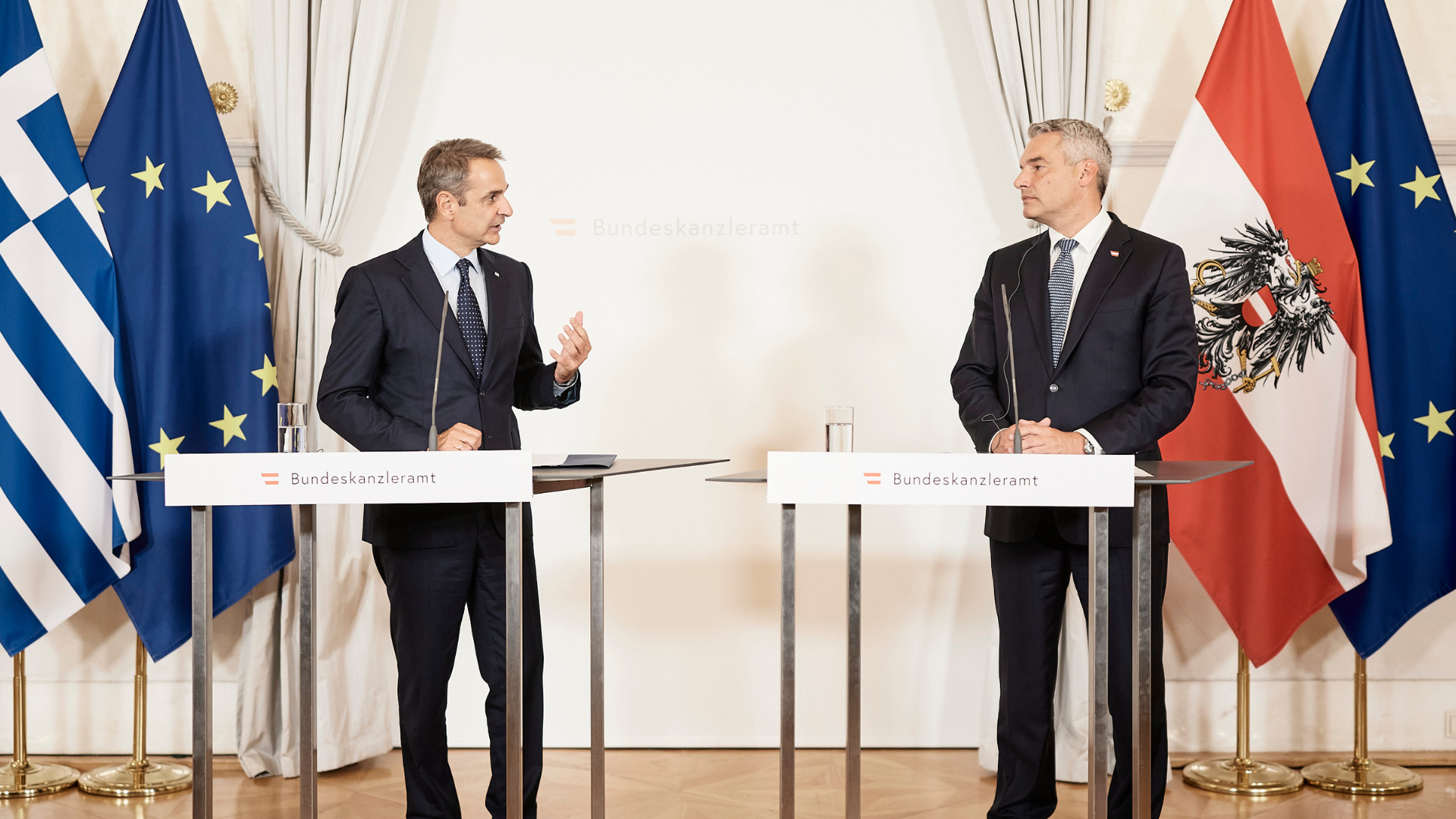
Greek Prime Minister Kyriakos Mitsotakis met with Austrian Chancellor Karl Nehammer in Vienna, Austria on Wednesday, September 11 to address several critical migration issues, emphasising the need for EU member states to control who enters the European Union.
Mitsotakis commended Austria’s support in March 2020, when Greece successfully defended its borders against a coordinated attempt to breach them.
He noted this as a turning point in Europe’s approach to migration, with a growing emphasis on protecting external borders, as reflected in the European Council’s conclusions and the Migration and Asylum Pact.
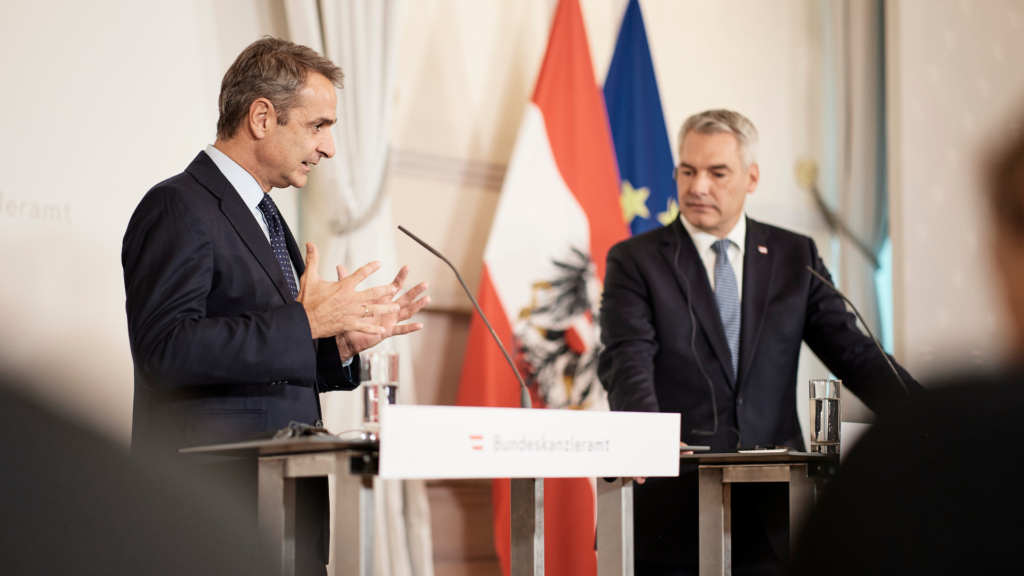
Reflecting on Greece’s progress over the last five years, Mitsotakis highlighted significant improvements in migration management. He indicated that reception facilities on the Aegean islands have been upgraded and the number of migrants from Turkish shores have significantly reduced.
Mitsotakis confirmed that the planned fence along the Evros River would be built, either through national resources or the favoured support from Europe.
Turning to legal migration, Mitsotakis spoke of agreements with countries such as Egypt and underscored the importance of adhering to the rule of law and existing agreements, particularly with respect to European integration prospects for the Western Balkans.
On broader regional issues, the Greek PM reaffirmed his country’s dedication to brokering a ceasefire in the Middle East, alleviating the humanitarian crisis and securing the release of hostages. He warned that further escalation in the region could have serious consequences for Europe.
Ευχαριστώ τον Καγκελάριο της Αυστρίας @karlnehammer για τη φιλοξενία του σήμερα στη Βιέννη. Η συνάντησή μας ήταν μία ευκαιρία να επανεπιβεβαιώσουμε τους εξαιρετικά στενούς δεσμούς μεταξύ των δύο κρατών μας. https://t.co/DfksTQCCrh pic.twitter.com/LKUKONWe18
— Prime Minister GR (@PrimeministerGR) September 11, 2024
Addressing the energy crisis, Mitsotakis acknowledged that energy costs in Europe remain high due to recent market distortions in the European energy sector, calling for greater investment in Europe’s infrastructure.
In his broader comments regarding migration, Mitsotakis stressed the urgent need to implement the Migration and Asylum Pact, emphasising that Greece should not be left to bear the brunt of managing migrant flows simply due to its geographic location. He called for ongoing European support, cautioning that current resources might not be sufficient.
Mitsotakis concluded with the rejection of an ad hoc approach to migration that undermines the Schengen Agreement. He argued that Greece should not be expected to provide better social protections for refugees than for its own citizens, especially in light of the country’s recent economic challenges.
Source: Ekathimerini.
