5 nations demand better EU sharing of migration load

·

The interior ministers of the five Mediterranean countries on the front line of mass migration to Europe want their EU partners to share the burden more equitably.

“We can no longer be punished for our geographical position,” Malta’s Byron Camilleri said Saturday, summing up his position and that of his colleagues from Cyprus, Greece, Italy and Spain after they met in Athens.

Greek Prime Minister Kyriakos Mitsotakis and European Commission Vice President Margaritis Schinas joined part of the meeting, Schinas is coordinating the commission’s work to revise the European Union’s pact on migration and asylum.

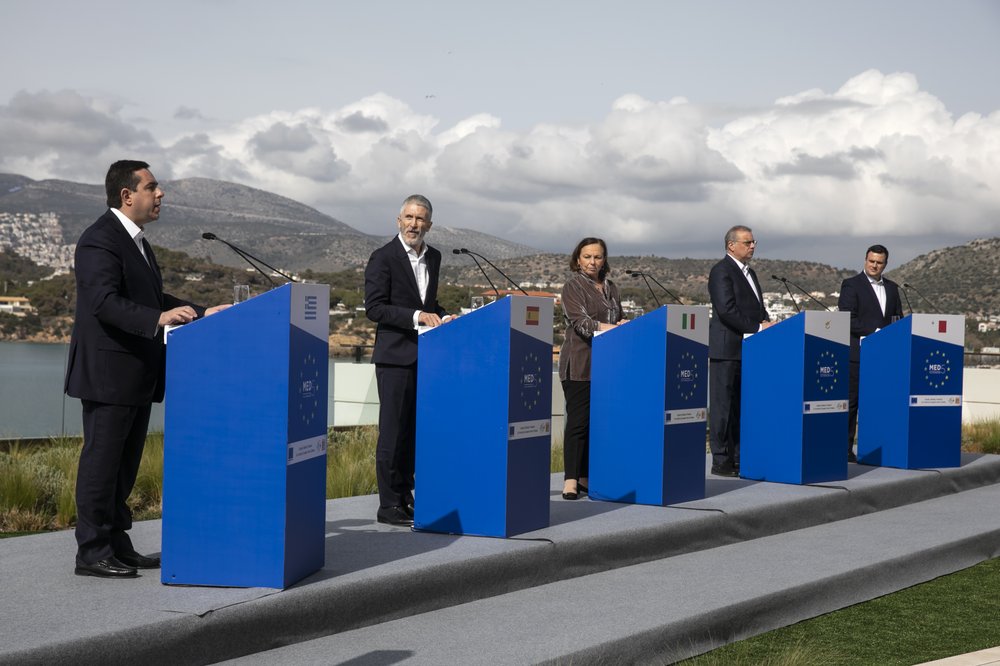
Greece’s Minister of Migration and Asylum Notis Mitarachi makes a statement following a ministerial meeting in Athens, Saturday, March 20, 2021. (AP Photo/Yorgos Karahalis)

Ministers from Cyprus, Greece, Italy, Malta and Spain created a “MED 5” group last year in an effort to present united front and influence the new EU pact.

Their demands are threefold: better cooperation with the countries in Africa, the Middle East and South Asia where most Europe-bound migrants and asylum-seekers come from; greater willingness by other EU member nations to accept newly arrived migrants; and a centralized European repatriation mechanism overseen by the EU’s executive commission.

More than a thousand people protested in solidarity with migrants and refugees in the center of Athens on Saturday. The timing was intended to coincide with the officials’ meeting.
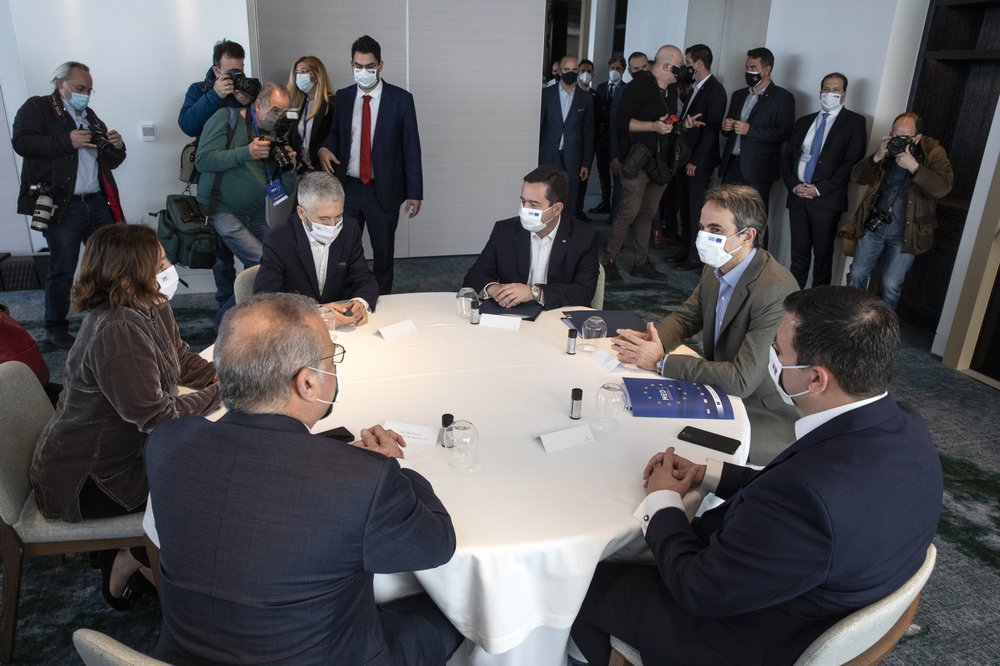
Greece’s Prime Minister Kyriakos Mitsotakis, right, attends a ministerial meeting in Athens, Saturday, March 20, 2021. (AP Photo/Yorgos Karahalis)

Southern European countries with extensive coastlines have borne the brunt of arriving asylum-seekers hoping to enter the EU. Most Europe-bound migrants travel by boat on dangerous maritime smuggling routes, either from the Turkish coast to nearby Greek islands or across the Mediterranean from north Africa.

The ministers discussed whether Turkey played an active role in pushing migrants toward Europe in contravention of a 2016 migration-control between the EU and Turkey.

Cyprus’ interior minister, Nikos Nouris, said most of the migrants arriving in his country enter from the the Turkish Cypriot-controlled northern part of the island nation. He called for Turkey to accept inspections on its southern shoreline by Frontex, the European border and coast guard agency.

Sourced By: AP News

Share:

KEEP UP TO DATE WITH TGH

By subscribing you accept our Terms of Service and Privacy Policy.

Latest News

Greek water polo team defeat Italy to reach European Championship semi-finals

Greece’s men’s national water polo team booked a place in the European Championship semi-finals for just the third time in its history.

Peter Koulizos says $1m median homes reflect typical Australian property

Three more capitals, Brisbane, Canberra, and Melbourne, are expected to join Sydney in the “million-dollar” housing club in 2026.

Author Natalie Kyriacou on nature, storytelling and a world in crisis

Greek Cypriot–Australian author and environmental advocate Natalie Kyriacou has released her debut non-fiction book.

Philip Vakos returns to MasterChef, this time in Greece

Australian Greek chef Philip Vakos has made a strong start on the 10th season of MasterChef Greece, progressing through auditions.

‘A Night of Love’, music and Greek kefi with Alania this Valentine’s Day in Sydney 

Sydney’s vibrant Greek music scene will come alive this Valentine’s Day as Alania presents Μια Νύχτα Αγάπης (A Night of Love).

You May Also Like

Earthquake diplomacy? Turkey extends illegal survey activities to November 14

The Turkish navy says the Oruc Reis research vessel will remain in the area until November 14, as Athens condemns the move.

ASIC flags White Fox and Paspaley in late-lodgement crackdown

White Fox Boutique has been singled out by ASIC as one of 12 major companies fined for failing to lodge financial reports.

Arthur Sinodinos: US tariffs could accelerate Australia–Greece trade opportunities

As the US reintroduces tariffs on key Australian exports, questions have emerged over the broader implications for Australia–US relations.