By Lisa Radinovsky from Greek Liquid Gold.
Olive trees have existed longer than modern humans, and the history of olive oil in Greece spans millennia. Wild olive leaf fossils from Evia date back 23 million years. In the volcanic crater of Santorini, 37,000 and 50,000-year-old olive leaf fossils were discovered. And traces of olive oil processing done 4,000 years ago have been found in western Crete.
The history of olive oil in Greece may have begun in Crete
“The origin of the olive tree is lost in time,” suggests Apostolos K. Kiritsakis, “coinciding and mingling with the expansion of the Mediterranean civilizations” (11). There are many theories about the tree’s origin, when and where it was first cultivated, and how it spread around the Mediterranean region, but no conclusive proof.
The post-Ice-Age story of olive trees in Greece may have begun in Crete, according to Sytze Bottema and Anaya Sarpaki, where olives seem to have been brought from overseas, perhaps from the Levant (whether by people or birds, we do not know). They explain that Neolithic people “modified the landscape and promoted the growth of the imported olive” in Crete (737). Archaeobotanical analyses of soil core samples, as Sarpaki writes in Greek, “show with certainty that the olive was present in Crete at least from the middle to the end of the Neolithic period, around 6200 years before present. Additional finds that further support this view include two jars from the Late Neolithic period at Gerani in Rethymno,…in which traces of olive oil were detected” (46).
Alexandra Livarda and her colleagues also found evidence of “large-scale olive tree management since the Final Neolithic period and through to the Late Bronze Age” in Crete. As Sarpaki indicates, carbonized olive fruit from the Bronze Age (the Minoan Period, after the Neolithic) has been discovered in several areas in Crete. Most impressively, 45 olives were found together in a well at the Minoan palace of Zakros, although they disintegrated quickly after exposure to air (50).
Moreover, there is evidence of ancient olive oil production in Crete. As Sarpaki writes, “the discovery of remains of olive processing — like the systematically broken pits in a building of the Middle Minoan I A period (2160–2000 BC) at Chamalevri in Rethymno [Crete] — gives us important indications of oil extraction, at least from the beginnings of the 2nd millennium BC” (45).
Nikos Michelakis and Anaya Sarpaki identify Minoan Crete as the source of “the first written records and art creations” about olive trees and olive oil in the world, including ideograms on clay tablets in the Linear A and B scripts, wall paintings, and decorations on pottery (6-8).
Olive trees and olive oil throughout ancient Greece
Olive products also spread around the Aegean Sea and the rest of the Mediterranean Basin. While additional archaeological and archaeobotanical research is required to ascertain details, there is clear evidence, according to Sarpaki, that the olive tree and its products played “an important and decisive” role “in the technological, economic, social, and political sphere of Aegean societies during the Bronze Age, and possibly even during the Neolithic period” (50).
“In the later years of Minoan and Mycenaean dominance,” Anaya Sarpaki and Marianna Chatzidimitriou explain, there is archaeological evidence that the olive and its oil “played a primary role in the economy of those peoples, and with this product they could accumulate wealth” (18).
This enabled some groups to become rich and powerful, Sarpaki and Chatzidimitriou add, “producing the social and economic stratification seen in those periods” (18). For example, Linear B tablets show that perfumed olive oil was an important status symbol in ancient Mycenae, as Maria Protopapas-Marneli and Antonia Trichopoulou report (2).
In 6th century BC Athens, Solon’s laws deemed olive trees so valuable that cutting them down without authorization could result in the death penalty. Then the “historian Herodotus described Athens in the fifth century BC as a vast center of olive culture,” Giorgos Kostelenos and Apostolos Kiritsakis point out, while the “philosopher Aristotle elevated olive cultivation to a science” (1-2).
The history of olive oil in Greece reveals multiple purposes
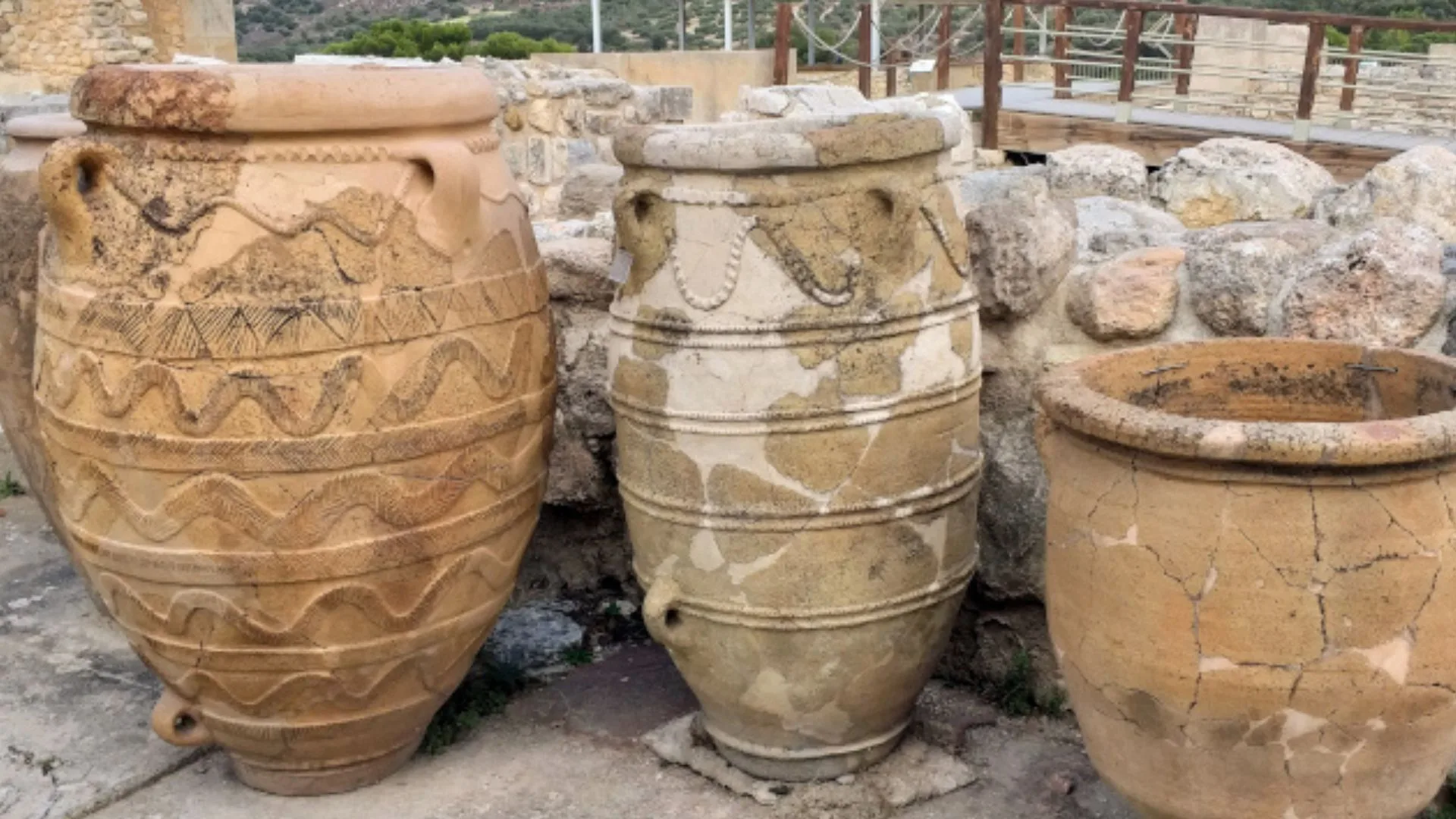
Ancient Athenians included images of olive branches on their coins and worked actual branches into wreaths “to crown the heads of victorious athletes, generals, and kings” (Protopapas-Marneli and Trichopoulou 3). Athletes coated their bodies with olive oil, Olympic champions were crowned with olive wreaths, and Panathenaic Games winners were awarded many large, valuable ceramic pots (amphoras) of olive oil.
“Ancient Greeks regarded olive oil as essential for health,” according to Protopapas-Marneli and Trichopoulou (5). Hippocrates disseminated information about “the healing properties of olive oil” by referring to “treatments with olive oil, as well as its mixture with wine, vinegar and water,” in his treatises. Prominent ancient physicians followed his prescriptions (3).
In addition, olive oil was utilized in ancient Greece “in the preservation of foods, because of its antioxidant properties,” according to Sarpaki and Chatzidimitriou. “With olive oil, the ancient human could certainly preserve meat and dairy products and vegetables. It was also used for lighting (ancient lamps) and in various technical crafts such as perfumery, tanning, and weaving. The by‑products of pressing — the crushed pits and residues — were used as animal feed, while together with olive wood they were used as fuel for cooking” (18).
Olive cultivation and olive oil production continued to spread around the Mediterranean area during the years of the Roman Empire (146 BC to 324 AD). Romans oversaw the import, distribution, and trade of olive oil to enable it to reach areas that had lacked it, Nikos Psilakis and Maria Psilakis explain (20). As they add, “the cultivation of olive trees continued for many centuries to be one of the main forms of occupation for the inhabitants of Greece” (21).
The history of olive oil in Greece: importance through the centuries
Both the export and domestic consumption of olive oil remained consequential during the time of the Byzantine Empire (324-1453), as well as afterwards. Psilakis and Psilakis mention “large-scale production of olive oil in certain areas, such as the Peloponnese,” during the Byzantine period. With olive oil used regularly in cooking, the olive was “the symbol of survival for the inhabitants of many agricultural areas” in the difficult times of the post-Byzantine period that began in 1453 AD and lasted until the 19th century (21).
In Crete, Psilakis and Psilakis explain, olive oil production remained especially important. Starting in the late 16th century and continuing for hundreds of years, Cretan olive oil was in demand as an ingredient in soap production (23). Previously made in France, olive oil soap became a noteworthy Greek product in the 18th and 19th centuries.
Nineteenth-century travelers were also amazed by the quantity of olive oil Cretans ate. “Greeks based their diet on olive products for thousands of years,” Psilakis and Psilakis write. “On Crete, in the south of the Peloponnese, on the islands of the Aegean and in many other areas, olive oil was almost exclusively used as the fat content in food” (6) of all types.
However, only in the middle of the 20th century with the Rockefeller Foundation’s report and the famous Seven Countries Study did the health benefits of olive oil begin to be understood by modern scientists beyond the Mediterranean region. Olive oil’s ancient use as a medicine had persisted in folk traditions. It has now been revived by modern scientific evidence.
Olive oil, trees, and branches in the religions of Greece, from ancient times to the present
“The olive tree was a spiritual treasure for the Greeks,” according to Kostelenos and Kiritsakis (2). Psilakis and Psilakis explain that in ancient Greece, olive oil was used as an offering to the gods, and to anoint the dead (16-18). Some olive trees were worshiped as sacred, and olive branches were important parts of burial customs, supplications for mercy, purification rituals, sacrificial processions, and harvest celebrations (36-41).
For Christians, olive oil “is one of the three blessed products” that God gave to humankind, along with bread and wine, Psilakis and Psilakis observe (27). Olive oil has played a key role in the ceremonies of the Greek Orthodox Church. For example, it is utilized in the baptismal font and on the baptized child, in holy myrrh, in oil lamps, and during special blessings. In Greece, the olive tree has long been associated with goodness, light, hope, and peace (41).
Olive oil in Greek mythology, art, and literature since antiquity
A famous myth explains the name of the city of Athens: the goddess Athena competed with the god Poseidon to see who would produce the most impressive gift for human beings. While Poseidon offered a salt water spring or a horse (depending on the version of the story), Athena produced an olive tree. When the olive tree was judged more valuable, the city of Athens received its name (still “Athina” in Greek today) and its patron goddess.
Olive oil “constituted the symbol of peace and well-being of the Ancient Greeks,” according to Protopapas-Marneli and Trichopoulou (3). Sarpaki points out that the olive was “the tree of life” for the Minoans. Starting with Minoan frescoes and pottery and ancient mythology, and continuing through Homer’s The Iliad and The Odyssey, Aesop’s fables, Solon’s laws, the games of classical Greece, and Aristotle’s writings, right up to the present, the olive tree and its oil have been fundamental to Greek culture and history. As Protopapas-Marneli and Trichopoulou remind us, the olive tree and olive oil “are not only central to the Mediterranean diet but also to the rich, multidimensional Greek tradition” (5).
*Originally published on Greek Liquid Gold: Authentic Extra Virgin Olive Oil (greekliquidgold.com). See that site for recipes with olive oil, photos from Greece, agrotourism and food tourism suggestions, and olive oil news and information.
