By Lisa Radinovsky from Greek Liquid Gold.
In 2003, a wildfire propelled by strong, hot winds from Africa destroyed thousands of ancient olive trees in Crete. Destructive wildfires are tragically common in the dry Greek summers, but the response of one family who lost all their trees is inspiring. On their burnt land, they created the Botanical Park of Crete, a fruitful celebration of nature.
In 2010, following seven years of hard work, the Botanical Park and Gardens opened to the public, along with a restaurant featuring local products. After lunch there one day last spring, Petros Marinakis, founder and managing director of the park, told me how burnt olive groves were transformed into a botanical wonderland.
A Fiery Beginning: The History of Crete’s Botanical Park
The October 2003 fire started with electrical cables in a village near the Marinakis family’s olive groves. Strong winds blowing from Africa at the extreme level of 11 on the Beaufort scale swiftly spread the flames. As Marinakis explains, “in 24 hours we lost everything around us—thousands of olive trees, most of them thousands of years old, from the Minoan, Venetian, and Ottoman periods.”
Tragically, “we lost many trees the same size and age as the Vouves tree”—the 3,000 to 5,000 year old monumental olive tree visited by thousands annually in the village of Ano Vouves. “The disaster after the fire was economic, environmental, and cultural,” Marinakis observed, as some of “the oldest olive groves on the planet were lost.”
“After this catastrophe,” Marinakis said, “I thought about how people in our day live totally differently from the previous thousand years, totally disconnected from the natural environment. It’s the first time people are living in boxes in a technological environment. Young people don’t know how an olive tree looks, or an orange tree.”

Marinakis had grown up in a farming family with a love for nature, then studied tourism business management. He wanted to help the area and his family get back on their feet. “I wanted to do something for the area. I wanted to do something for society.”
Building the Botanical Park of Crete: Vision, Roots, and Ecological Design
Working with two of his three brothers, Kostas and Stratis, Petros Marinakis decided to “create a garden where people can learn” on his family’s 20 hectares of burnt land. His focus was “not a business; it’s more philosophy, to try to connect people with nature. We don’t use chemicals. We have an ecosystem totally balanced, in harmony.”

He also wanted to “be connected with society, promoting everything the area produces. Only coffee and sugar come from abroad. The rest is from the area. We promote the local tastes, connect visitors with the natural environment and our flavors, our products, our economy.”
How did he create that amazing garden? “First,” Marinakis reports, “I studied the property’s temperature, soil, morphology, and peculiarities. I determined where I would plant the tropical, Mediterranean, and alpine plants. I made lists of plants. I found many plants from Greece and the European Union. I brought the tropical and rare plants from Asia, Africa, and America through nurseries in Europe that have a special license to import plants from other continents. For the last 20 years, my mind has been in the botanical garden 24 hours a day.”

Where Three Climate Zones Meet: The Botanical Park of Crete’s Global Garden
Marinakis emphasizes that the uniqueness of the Botanical Park and Gardens of Crete extends beyond its history. “First, it is the only garden in Europe that specializes in spices, herbs, and medicinal plants.” Moreover, “the microclimate is unique,” with surprising variations in a relatively small area. “In the flat area in the valley you see avocadoes and citrus. We grow mangoes and lychee from a tropical environment.”
Higher up, outside the garden, we can see olive trees growing on the hillsides of the foothills of the White Mountains. That is a Mediterranean zone. Above that, where the olive trees stop and little can grow, there is an alpine zone. So in addition to the island being located between Africa, Europe and Asia, with the tall mountains near the garden, there are ideal conditions to grow almost everything from around the world.

Exploring Crete with Kids: Discovering the Botanical Park’s Animals, Nature Trails, and Local Food
As some of the park’s earliest visitors, my family and I have returned regularly, watching the little trees grow as our children did. We introduced friends and family to the Botanical Park and Restaurant. When our children were small and easily tired, the distractions of the ducks, peacocks, donkeys, and other creatures that lived on the garden’s hillsides, valley, and pond were helpful. Our children’s pace eventually exceeded ours, so they reached the hilltop restaurant before we did.
The restaurant became known not only for its lovely view and excellent local products, but also its creative take on Cretan cuisine and attention to artistic detail. Its food features local extra virgin olive oil, mostly from the Tsounati variety. Thirty percent of the olive oil comes from the Marinakis family’s own production, with the rest from small Cretan producers. (Olive oil and other local products are available in the restaurant’s spacious shop.)

As our children grew, the garden’s trees began to provide more shade, and plants filled in the empty spaces. Every year, we noticed new plantings, new rest stops and benches, and other improvements and additions. We spotted Greek pottery and garden ornaments, a whimsical doorway, garden implements hung in a line from a tree, old farming tools and machines among herbs and fruit trees, different bridges positioned over the brook, tunnels of trees and bamboo, even a stone throne where we could sit to survey the lush valley, and a cooling shower for summer walkers.
From Wildfire to Wonder

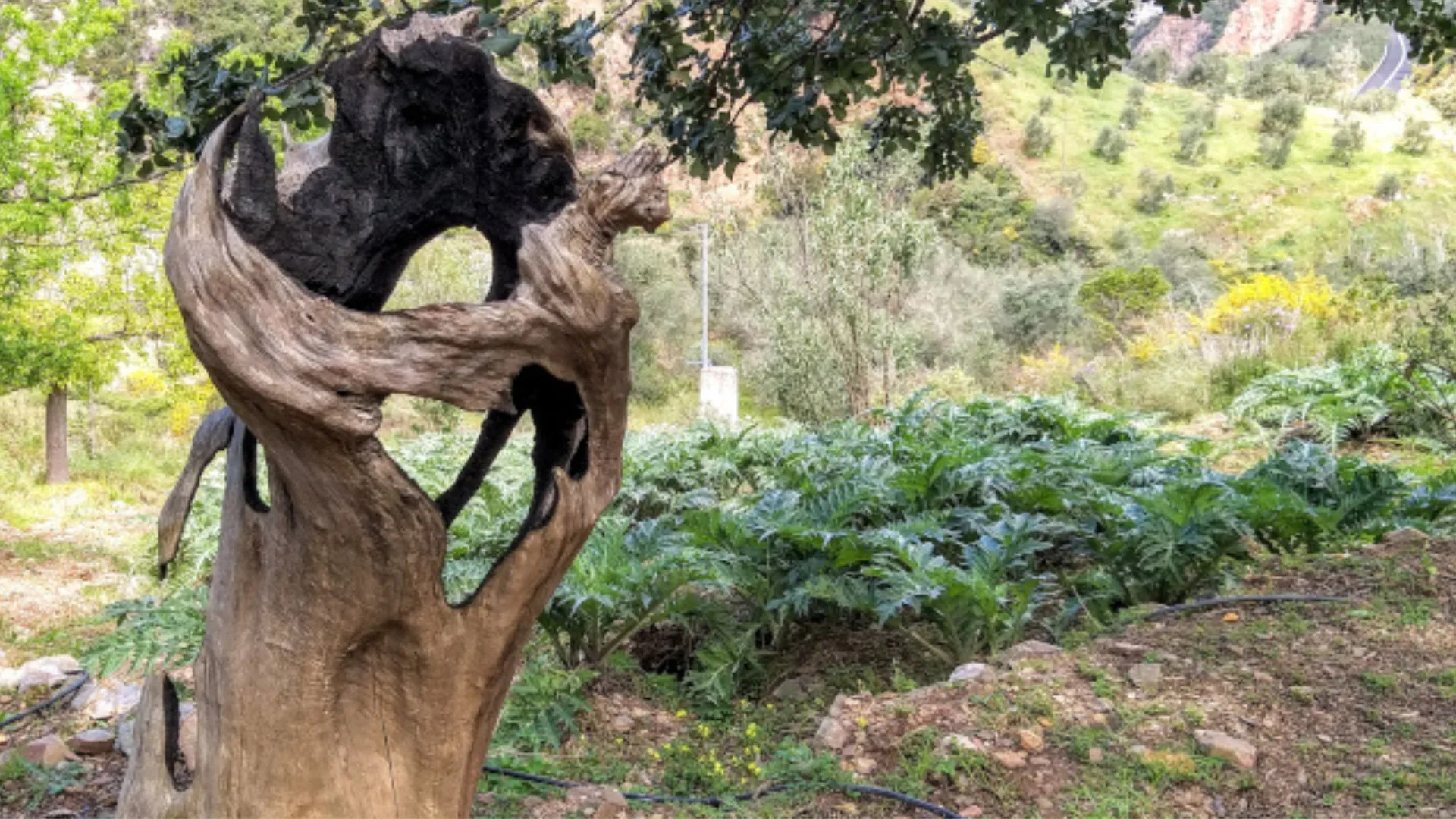
As their website says, “amidst the vibrant, colorful landscape stands a burnt, ancient olive tree, a poignant memorial and reference point to the devastating 2003 fire, marking the history and origin of the Garden.” Beyond the tree, paths wind up and down hills and through the valley, among vibrant orchards and herb gardens, past striking Mediterranean and tropical flowers. Come to admire, observe, exercise, learn, meditate, relax, photograph, eat, drink, and commune with nature. Born from the ashes, this ever-evolving park impresses both locals and visitors from around the world.
*Originally published on Greek Liquid Gold: Authentic Extra Virgin Olive Oil (greekliquidgold.com). See that site for recipes with olive oil, photos from Greece, agrotourism and food tourism suggestions, and olive oil news and information.
