By Lisa Radinovsky from Greek Liquid Gold.
Two flourishing Cretan olive oil companies founded by Greek innovators have begun a unique new collaboration. Now working together in the olive mill at Biolea’s Astrikas Estate in Crete, Biolea and Pamako have presented Crete’s first restaurant in an olive mill and Greece’s first modern production line to operate alongside a stone mill and hydraulic press.
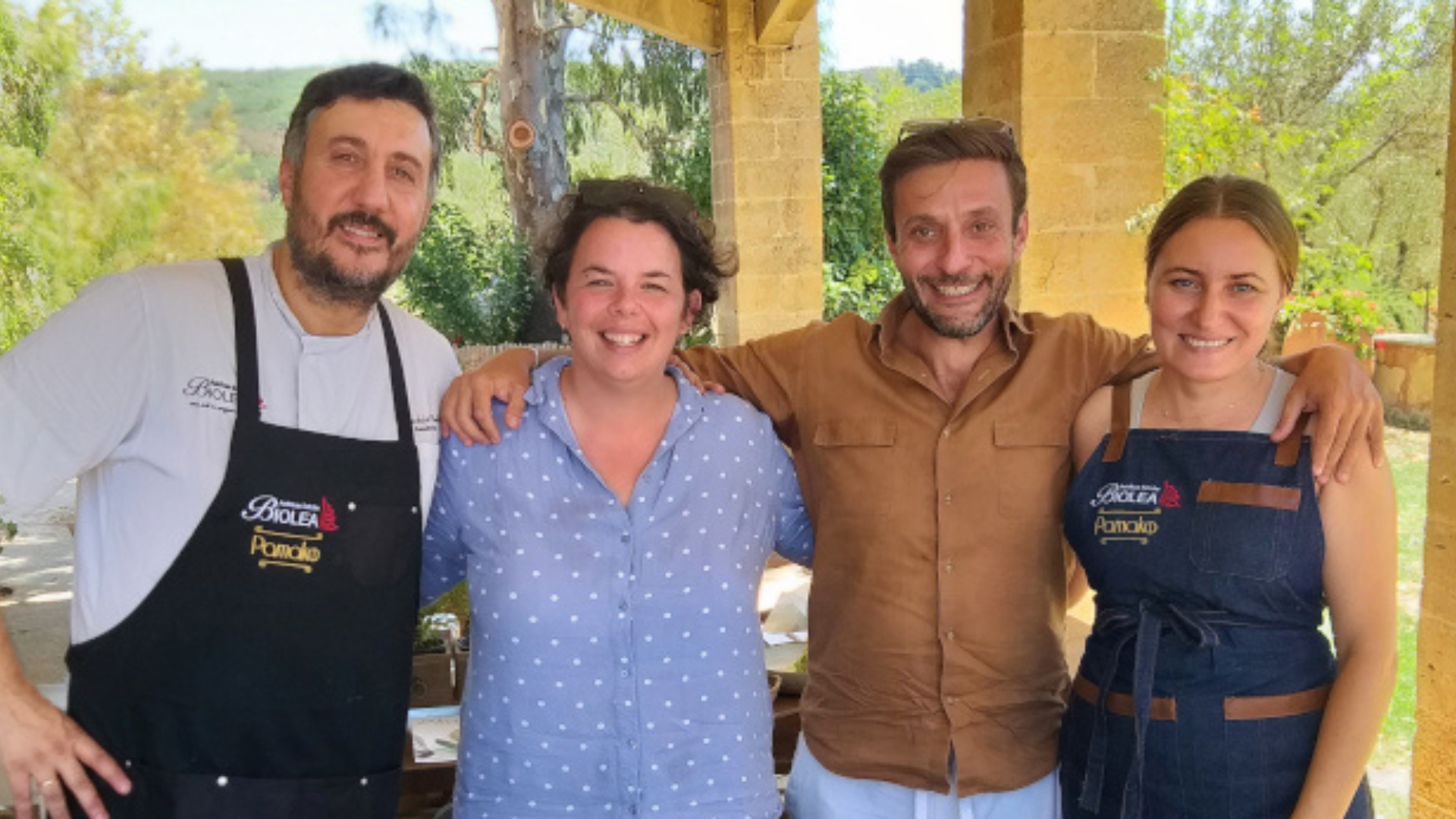
After collaborating for several years on olive oil seminars and tours at Biolea’s updated version of a traditional olive mill, Pamako’s Eftychis Androulakis and Biolea’s Chloe Dimitriadis decided it was time to take their teamwork several steps farther. Building on their enthusiasm, energy, youth, and inventiveness, they plan to create innovative olive oils as they continue to educate visitors about olive oil, and the mill’s restaurant expands its offerings.
These producers will share what they believe to be the only olive mill in Greece with two totally different production lines working side by side to produce olive oil in the old and new ways at the same time, both stone milled / cold pressed and cold extracted in stainless steel machinery. Even the stone mill combines the traditional with modern improvements, and this is hardly a typical modern production line, given its enrichment with adaptations invented by Androulakis and Dimitriadis.

These quality enthusiasts explain that this is the first time two successful olive oil companies in Crete have decided to collaborate in the same building, under the same umbrella. They are confident that their cooperation will be fruitful. Accustomed to working in a modern mill, Androulakis sees things that can be improved in the stone mill that Dimitriadis did not notice, while Dimitriadis looks at the modern line with fresh eyes and comes up with promising ideas that surprise Androulakis.
Her father George taught Dimitriadis how to do everything related to olive oil production, from the grove to the bottle, including fixing mill machinery. After a colleague surprised to see her working with tools in the mill asked her if she was a mechanic, Dimitriadis said, “you have to become a mechanic, especially with a stone mill,” since few people know how to fix things there.
Regarding the mill machines, Androulakis told Greek Liquid Gold, “you may not hear them, but they talk. I know what they say. I know what they need. I know what I’ll do. I always have a plan. I find solutions. This is my playground. This is what I do.” This team has introduced innovations to prevent oxidation during and after stone milling, as well as a temperature-adjusting olive dryer, and in the modern line, a new type of vertical separator, a redesigned disc crusher, and a completely novel heat exchanger / temperature adjuster for olive paste. And this is just the beginning.

Androulakis emphasizes, “we are going to experiment a LOT.” He does not expect to get much sleep during the 2 ½ months of harvesting and olive oil production. They will start by stone milling and pressing Biolea’s Koroneiki olives, as usual, while processing Pamako’s Tsounati olives on the boutique modern line. Dimitriadis says they may also process Koroneiki olives on the new line. Dimitriadis emphasizes, “the goal is quality above all, and to improve that quality, and the sustainability of the production system, every year.”
As Dimitriadis explains, “we chose to collaborate because we feel we will achieve much more together. It’s not about making money; it’s built on trust and mutual excitement about producing olive oil and doing new things, moving forward and moving toward the future.” For Androulakis, their work together is based on “a feeling of cooperation. This is the true meaning of cooperation.”
Androulakis believes “Chloe sees through the eyes of a professional olive miller that understands the market and how things will go in the future, because she is a young woman who views the future as an opportunity to grow as a person, as an olive miller. This is how I feel and how I think. We have the same point of view. We are both organic, have the same view of sustainability, being ecofriendly, reusable.” In fact, their goal is to achieve “zero waste, and use only renewable energy” at the mill and restaurant within two or three years, with composting, in a circular economy. Androulakis asserts, “this is the future—this is the only way.”

They will see thousands of travelers along the way. For many years, Biolea has welcomed tourists to learn about their single-estate organic olive oil production and taste their stone-milled, cold-pressed Koroneiki extra virgin olive oil and olive oils co-milled with organic bitter oranges or organic lemons. Pamako has also escorted visitors to the hard-to-reach mountainside olive groves where Androulakis and his team climb huge old Tsounati olive trees to capture this ancient olive variety at its best and healthiest, before it is fully ripe.
Androulakis, Dimitriadis and their team will continue offering a variety of tours, seminars, and gastronomic experiences on Biolea’s estate, and their spouses, hostess and server Dorotheea Riter and chef Michalis Papadaki, will welcome customers to the mill’s restaurant and special events. The whole team is focused on high quality fresh, healthy, authentic, flavorful products.
Biolea’s restaurant is surely destined for acclaim, given the exquisite flavors, elegant presentation, and fresh local ingredients of its unique offerings—not to mention the creative olive oil-food pairings. The restaurant’s menu has expanded since it evolved from a café into a restaurant last year. Yet it has remained seasonal, changing from week to week. Everything but the bread is prepared from scratch, including the chef’s four-course olive oil pairing surprise menu. Diners enjoy eating while gazing at the stunning view over the olive groves toward steep hills, stark cliffs, and the site of Ancient Rokka in the distance.
As Chef Papadaki told Greek Liquid Gold, “my philosophy is to have the whole menu based on olive oil. I use many raw ingredients to avoid destroying the nutrients in foods. I want the food to be extremely tasty and healthy, since we are a family, and people who eat here are like our family. I wouldn’t give them food I wouldn’t give my children.” Gathering greens in the nearby gorge, he reflects that “Nature outside here is my supermarket”—nature and the olive mill. Like the rest of the team in the mill, Papadaki focuses on quality rather than quantity: “It’s better to feed fewer people and feed them well.”
*Originally published on Greek Liquid Gold: Authentic Extra Virgin Olive Oil (greekliquidgold.com). See that site for recipes with olive oil, photos from Greece, agrotourism and food tourism suggestions, and olive oil news and information.
