The years between 1967 and 1976 became one of the most turbulent and transformative periods in the history of both Greece and Greek Australia.
It was the decade of the military dictatorship in Greece, the rapid expansion of Greek migration to Australia, the beginning of multiculturalism and the emergence of a more politically organised and institutionally confident Greek Australian community.
It was also a defining decade in the history of The Greek Herald.
The newspaper evolved from a largely community-centred migrant publication into a far more politically engaged, nationally influential and technologically ambitious media institution. Throughout the period, the paper documented and shaped debates surrounding democracy, migration, racism, language, identity, education and communal authority.
The decade opened amid enormous uncertainty.
By the late 1960s, tens of thousands of Greek migrants were arriving in Australia each year, transforming suburbs across Sydney, Melbourne, Adelaide and Perth. Greek cafés, factories, milk bars, fish shops, churches, sporting clubs and welfare organisations expanded rapidly as entire migrant networks established themselves permanently within Australian society.
At the same time, Greece itself descended into political crisis.
On 21 April 1967, the military dictatorship seized power in Athens.
Within days, The Greek Herald positioned itself publicly and aggressively against the Junta.
“Democracy will win”
The military coup of April 1967 fundamentally altered the editorial direction of The Greek Herald.
In its edition of 26 April 1967, the newspaper declared on its front page that Greece had been “occupied” by the Junta and adopted the slogan “Democracy will win” beneath its masthead.
The political crisis transformed the newspaper almost overnight.
On the day of the coup itself, The Greek Herald published multiple emergency editions to keep readers informed as events unfolded in Greece. Under the editorial leadership of Angelos Kourlios, the paper quickly became one of the strongest anti-dictatorship voices within the Greek diaspora in Australia.
A week later, on 3 May 1967, the newspaper openly declared that it would fight the dictatorship until democracy was restored in Greece.
The anti-Junta campaign soon expanded far beyond editorials.
The paper regularly published reports on political arrests, censorship, imprisonments, torture allegations and anti-dictatorship movements operating internationally.
The Greek Consulate and supporters of the Junta repeatedly attempted to pressure the newspaper.
In May 1967, The Greek Herald accused Greek consular officials including Consul Rellas and Ambassador Tsiamisis of interfering with its radio broadcasts on Sydney station 2CH, where the paper had operated Greek-language news bulletins since 1964.
The dispute escalated further after the station increasingly aligned itself with pro-Junta messaging.
The newspaper accused the Greek Consulate, sections of the Archdiocese and supporters of the military regime of attempting to silence democratic voices within the diaspora.
The conflict quickly spread throughout organised Greek Australian life.
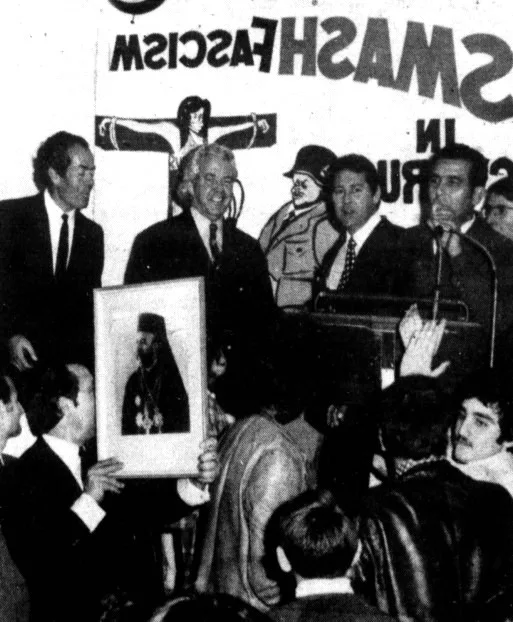
Committees for the Restoration of Democracy were established across Sydney, Melbourne, Adelaide and Brisbane with support from academics, clergy, politicians, unionists and migrant activists.
Prominent Australians including Anglican Bishop John Moyes, Professor E. L. Wheelwright, Colonel Alec Sheppard, Jim Cairns and Frank Galbally publicly condemned the dictatorship and collaborated with Greek Australian democratic organisations.
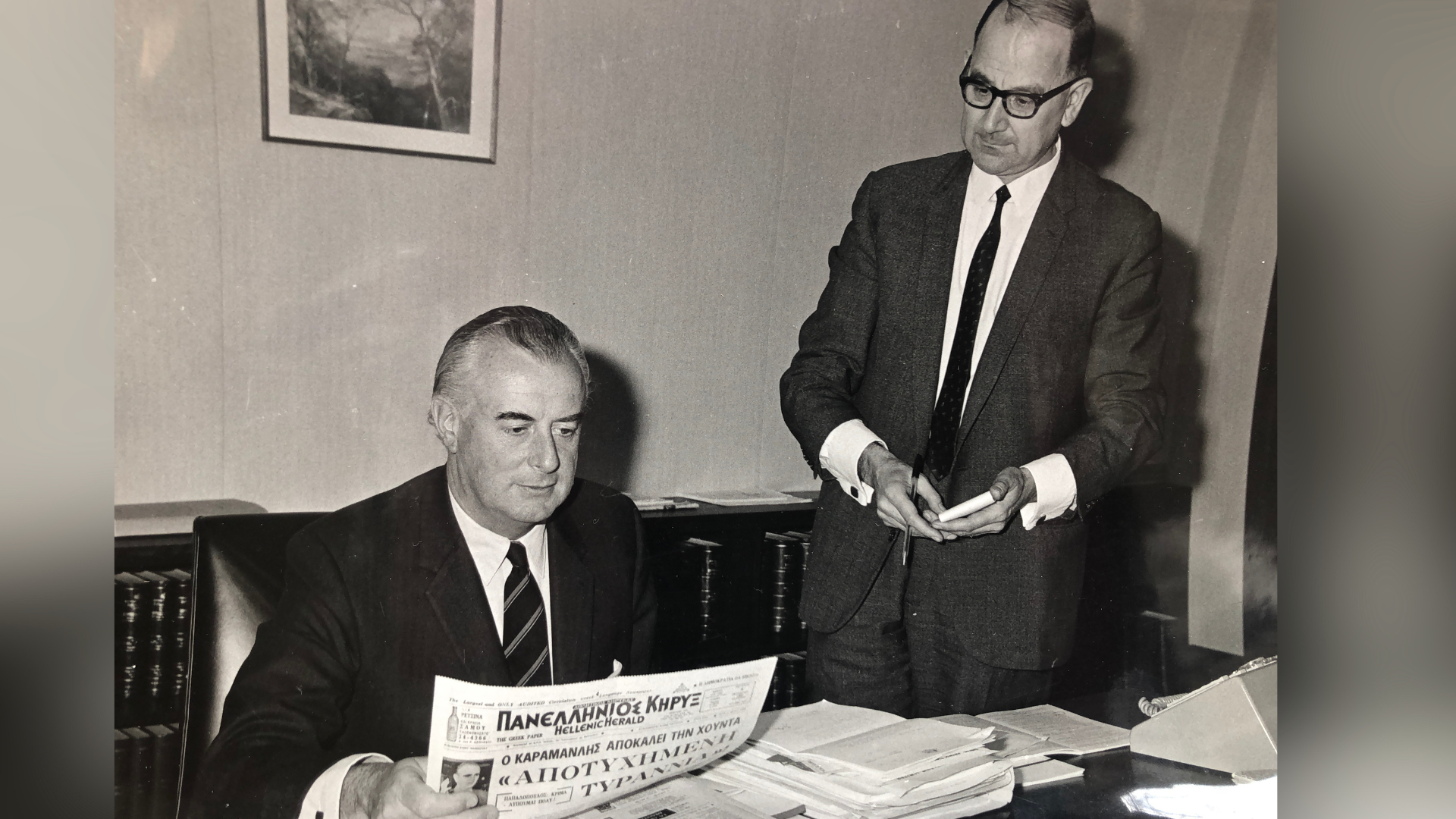
By the early 1970s, senior Australian political figures were increasingly engaging directly with the Greek Australian community through the newspaper itself. Opposition leader Gough Whitlam visited the offices of The Greek Herald in October 1969 to discuss migration and Greek Australian issues with management and staff, before returning again in November 1972 alongside Bill Morrison, Tom Uren and Jim Cope during the federal election campaign.
Following Whitlam’s election victory, the newspaper increasingly portrayed him as one of the strongest Australian political supporters of democratic restoration in Greece and of the Greek and Cypriot causes more broadly.
In September 1973, Whitlam again spoke directly with The Greek Herald in the presence of Greek Australian federal parliamentarians George Georgouras and Peter Morris, further cementing his standing among many Greek Australians as a major philhellene political figure.
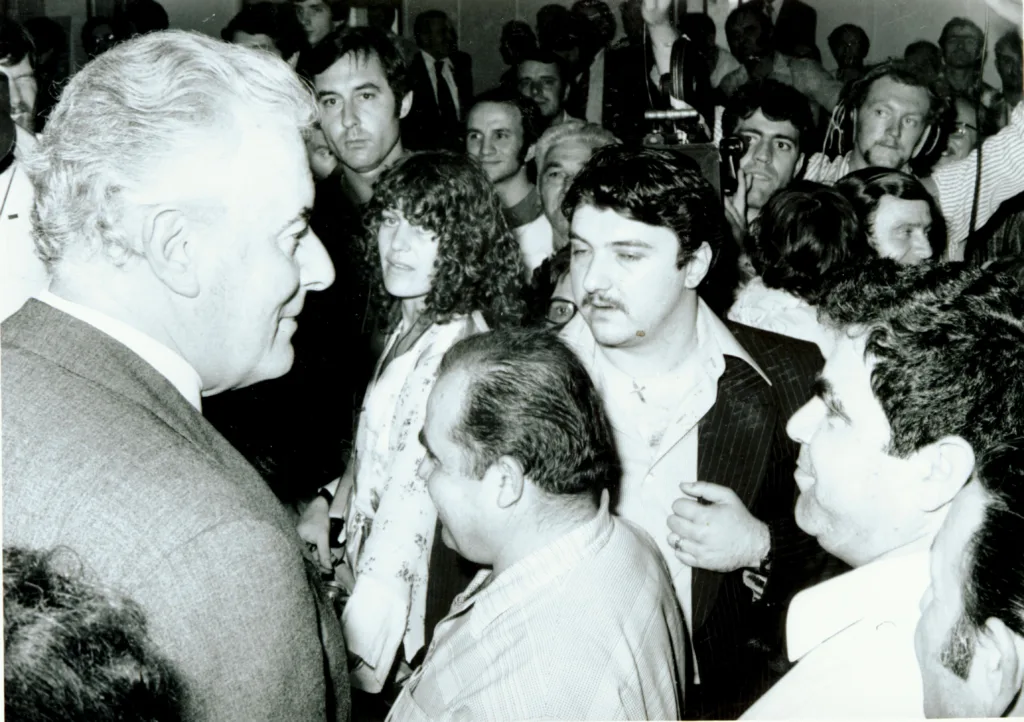
The newspaper documented rallies, public meetings, fundraising events and demonstrations opposing the Junta throughout the late 1960s and early 1970s.
The Greek military dictatorship also deeply divided the Greek Australian community itself.
While many Greek Australians strongly opposed the regime, sections of the Greek Consular authorities, conservative organisations and parts of the ecclesiastical leadership were accused by critics of maintaining a more sympathetic or cautious position.
The newspaper repeatedly attacked those it considered collaborators or apologists for the dictatorship.
The conflict transformed Greek Australian journalism into a battleground of ideology, democracy and identity.
The newspaper extensively covered the arrests of Andreas Papandreou, Mikis Theodorakis and other democratic figures in Greece, while also publishing articles and messages from exiled anti-dictatorship personalities.
In February 1968, Andreas Papandreou addressed Greek Australians directly through the pages of The Greek Herald, urging the diaspora to continue resisting the dictatorship and safeguard democracy.
The anti-Junta struggle also drew wider Australian support.
Writers and intellectuals including Charmian Clift, George Johnston and Martin Johnston publicly criticised the dictatorship, while Australian newspapers increasingly covered Greece’s political repression.
The Sydney Morning Herald, The Western Australian and other mainstream publications were frequently referenced by The Greek Herald in support of anti-Junta arguments.
Migration transforms Australia
At the same time as political upheaval consumed Greece, migration from Greece to Australia continued at extraordinary levels.
The late 1960s represented one of the largest migration waves in Greek Australian history.
In 1967 alone, more than 13,500 Greek migrants arrived in Australia, while government-assisted migration schemes continued bringing thousands more throughout the decade.
The newspaper regularly published demographic statistics, migration updates and stories documenting the realities of migrant settlement.
Greek Australians increasingly transformed the social and economic character of suburbs across Sydney and Melbourne. Entire shopping strips, cafés, fish shops, factories and entertainment venues became overwhelmingly Greek in character.
The newspaper documented both the optimism and hardship of migrant life, covering factory work, dangerous labour conditions, poverty, overcrowded housing, gambling, workplace injuries, loneliness and the emotional strain of separation from Greece.
The demographic imbalance between men and women within the migrant population also became a major issue. By the late 1960s, there were significantly more unmarried Greek men than women in Australia.
The Australian and Greek governments responded by introducing assisted migration programs for Greek women and “brides” to migrate to Australia, with government-funded travel arrangements helping address the gender imbalance.
The newspaper carried large numbers of marriage advertisements and frequently reported on the arrival of Greek brides aboard migrant ships.
At the same time, Greek Australians increasingly confronted racism and prejudice within Australian society. Throughout the decade, The Greek Herald documented anti-migrant hostility, discrimination and public racism directed toward Greeks and other Southern European migrants.
Terms such as “Bloody Dagos” appeared regularly within discussions surrounding prejudice against migrants.
The paper also covered controversies involving RSL clubs prohibiting non-English languages, attacks against Greek-owned businesses and broader assimilationist attitudes.
In 1970, Greeks in Hobart were reportedly subjected to intimidation and extortion attempts by Australians demanding “protection money,” while the newspaper also documented murders, workplace tragedies and serious accidents affecting migrant workers.
One of the worst incidents occurred in January 1969 when a bus carrying Greek labourers in Adelaide plunged from a cliff, killing three workers and injuring many others.
Despite these difficulties, the decade also revealed the rapid economic and social rise of Greek Australians. Greek migrants increasingly moved beyond labouring work into business ownership, manufacturing, fishing, hospitality and professional occupations.
Figures including fishing entrepreneur Michalis Kailis, bakery businessman Chris Christodoulopoulos and numerous café and shop owners reflected the growing entrepreneurial confidence of the community.
The evolution of The Greek Herald
The decade also transformed The Greek Herald itself.
Throughout the late 1960s and early 1970s, the newspaper underwent major structural, technological and editorial change.
By 1967, the paper claimed a circulation of more than 31,000 copies, one of the highest circulation figures in its history.
The newspaper expanded rapidly in both staffing and production.
Under the leadership of Angelos Kourlios and manager Dimitris Kalomoiris, The Greek Herald increasingly modernised its operations while simultaneously facing intense competition from rival Greek-language publications.
The paper expanded its interstate coverage, developed overseas correspondent networks and increasingly positioned itself as a national newspaper representing Greek Australians across the country.
By 1969, The Greek Herald employed approximately 22 full-time journalists and staff while maintaining correspondents in London, Cairo, New York and Athens.
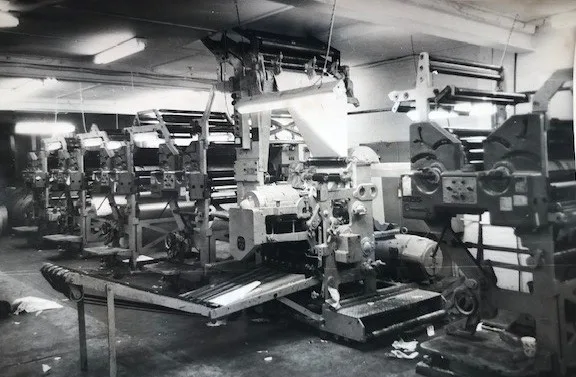
The paper also invested heavily in printing technology and production infrastructure.
In late 1969 and early 1970, The Greek Herald moved operations into a larger multi-level building in Broadway, Sydney, introduced new printing equipment and significantly expanded its page numbers.
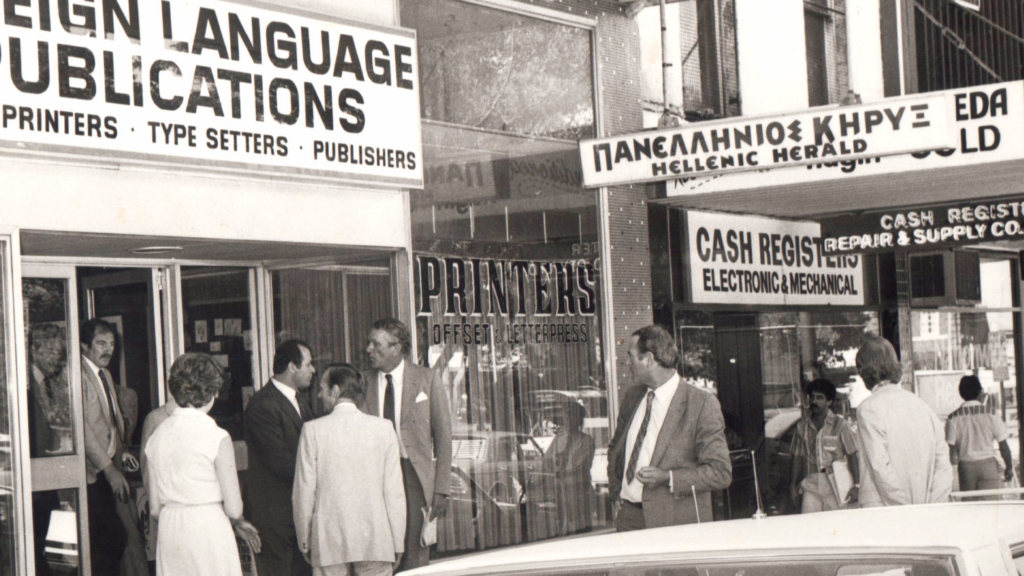
The paper shifted from broadsheet to tabloid format in February 1970, introduced coloured pages and dramatically modernised its presentation.
The changes reflected both commercial competition and the growing scale of the Greek Australian readership itself.
The newspaper increasingly saw itself not simply as a migrant publication, but as a major institution of diaspora Hellenism.
At the same time, The Greek Herald expanded its radio and sporting coverage.
The paper operated Greek-language radio segments through station 2CH, while sport increasingly became central to readership and advertising.
Soccer reporting became particularly important as Greek-backed clubs expanded nationally and migrant communities increasingly rallied around football as an expression of identity and belonging.
The newspaper also expanded lifestyle, women’s and entertainment sections.
Columnists including Molly Hiotis and Takis Kaldis reflected the growing diversification of the readership beyond purely political or migration news.
The paper additionally introduced new initiatives including the “Letters to HH” column, which quickly became one of the most widely read and enduring features of the newspaper.
At the same time, fierce competition emerged between Greek-language newspapers.
The newspaper frequently defended its circulation dominance and editorial independence against rival publications including Neos Kosmos, Kyriaki, Pyrsos and others.
The period also marked a major transition in the newspaper’s own history.
In 1966, Theo Skalkos founded Nea Patrida, establishing himself as an increasingly influential figure within Greek-language media in Australia. Over the following years, he steadily expanded his involvement in The Greek Herald, first securing 50 per cent ownership in 1970 before acquiring full control of the newspaper on 1 November 1972 through the purchase of Dimitris Kalomoiris’ remaining share.
Utilising the production infrastructure of Nea Patrida, Skalkos managed to publish both newspapers on a near-daily rotational basis — The Greek Herald appearing on Monday, Wednesday and Friday, while Nea Patrida circulated on Tuesday, Thursday and Saturday. The arrangement significantly expanded the operational capacity and visibility of Greek-language journalism in Australia during the period.
Under Skalkos’ leadership, the newspaper entered a new era of modernisation and professionalisation, expanding its journalistic operations while investing heavily in improved printing technology, production facilities and national coverage.
The transition symbolised a broader generational shift within Greek Australian media. The era of the paper’s early pioneers — figures such as Marcellos, Stilson, Malachias and Grivas — was gradually giving way to a more modern and institutionally organised form of Greek-language journalism suited to an increasingly established and confident diaspora.
By the end of the decade, competition surrounding ownership, printing technology and circulation increasingly foreshadowed the major transformation that would later occur under the Skalkos era.
Greek language, education and cultural identity
The rapid growth of the Greek population also intensified debates surrounding language, education and cultural preservation.
Throughout the decade, The Greek Herald repeatedly argued that the survival of Hellenism in Australia depended on maintaining the Greek language among younger generations.
Major efforts emerged to establish Modern Greek studies within Australian universities.
In 1968, businessman Nikos Lourantos pledged $100,000 toward establishing the first Chair in Modern Greek at the University of Sydney, one of the most important educational initiatives in Greek Australian history.
The newspaper extensively covered fundraising campaigns, donor support and educational debates connected to the project.
Organisations including AHEPA, community associations and numerous benefactors contributed toward the expansion of Greek education nationally.
The decade also saw the establishment of some of the first formal Modern Greek programs within Australian universities.
The University of New England at Armidale introduced Modern Greek studies under Peter Thomas, while growing numbers of Greek Australian students entered Australian universities more broadly.
In 1970, representatives from Greek student organisations across Australia gathered in Sydney for the first major all-Australian conference of Greek university students.
The conference reflected the emergence of a highly educated second generation increasingly engaged in political, educational and cultural issues.
At the same time, the newspaper consistently linked language preservation with broader questions of identity, religion and communal authority.
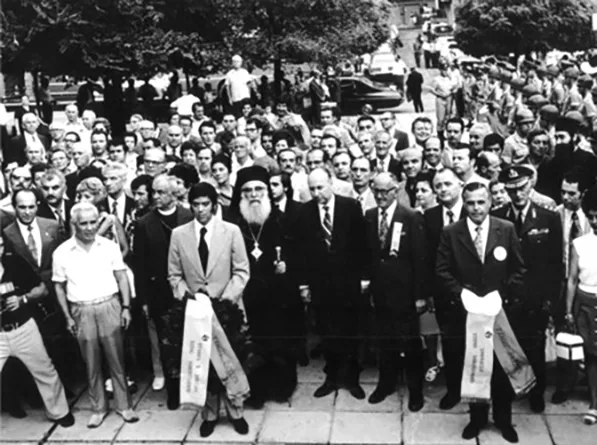
Questions surrounding Macedonia and historical identity also became increasingly prominent during the decade. Greek Macedonian organisations organised commemorative events, public rallies and cultural gatherings across Australia, including celebrations marking the liberation of Thessaloniki at Melbourne’s Shrine of Remembrance in 1971, attended by ecclesiastical and communal representatives including Archbishop Ezekiel and Nikolaos Tsoulias. At the same time, tensions surrounding Slavo-Macedonian identity, naming and political claims increasingly surfaced within both Greek Australian and wider multicultural debates.
Archdiocese, communities and division
The decade also witnessed continuing conflict between the Archdiocese and the historical Greek communities.
Questions surrounding church authority, community constitutions, education and ecclesiastical legitimacy repeatedly generated tension across Sydney and Melbourne.
The newspaper closely followed disputes involving Archbishop Ezekiel, the Ecumenical Patriarchate, community leaders and clergy aligned with opposing factions.
The reappointment of Archbishop Ezekiel in 1969, following a brief resignation for health reasons in 1968, generated especially fierce reaction.
Several communities and churches reportedly protested the decision, while divisions between ecclesiastical and communal leadership intensified.
The newspaper regularly published statements, letters and editorials connected to these disputes.
Prominent community figures including Dimitris Elefantis, Dimitris Tsingris and Panos Gerontakos became central personalities within the broader communal struggles of the period.
The conflicts reflected deeper tensions surrounding who would ultimately control the future direction of Greek Australian communal life.
The arrival of Archbishop Stylianos Charkianakis in 1975 followed the departure of Archbishop Ezekiel in 1974 because he was promoted by the Ecumenical Patriarchate to serve as the Metropolitan of Pisidia (in modern-day Turkey). Archbishop Stylianos’ arrival initially generated cautious optimism among sections of the Greek Australian community, particularly after years of ecclesiastical division under Archbishop Ezekiel.
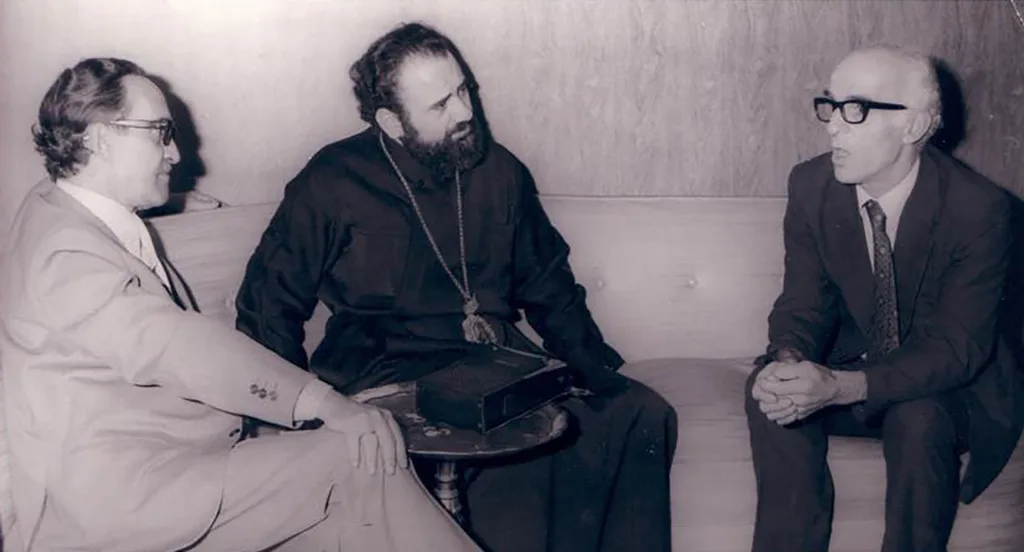
The Greek Herald gave significant coverage to Stylianos’ arrival and inaugural interviews, including meetings involving leading newspaper figures such as Lambis Paschalides and Panos Gerontakos.
Yet beneath the ceremonial optimism, tensions surrounding authority, communal autonomy and the future direction of the Archdiocese remained unresolved. Encounters between senior community figures and the new Archbishop increasingly foreshadowed the major confrontations that would later emerge between the Archdiocese, communities and sections of the Greek-language press.
Cyprus, protest and diaspora mobilisation
The collapse of the Junta in July 1974 following the Turkish invasion of Cyprus transformed the emotional and political atmosphere of the Greek diaspora.
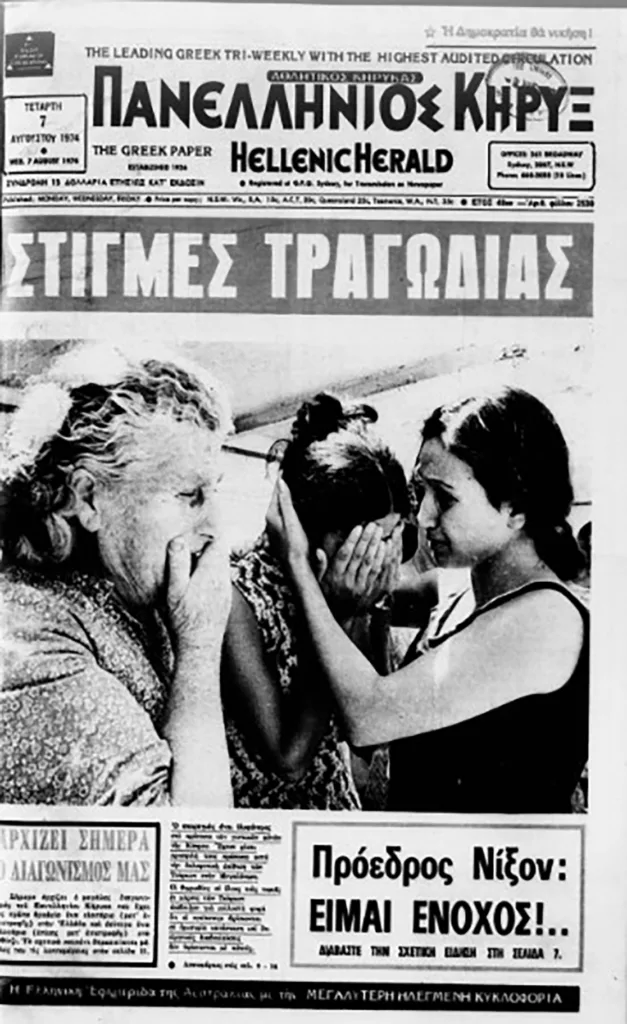
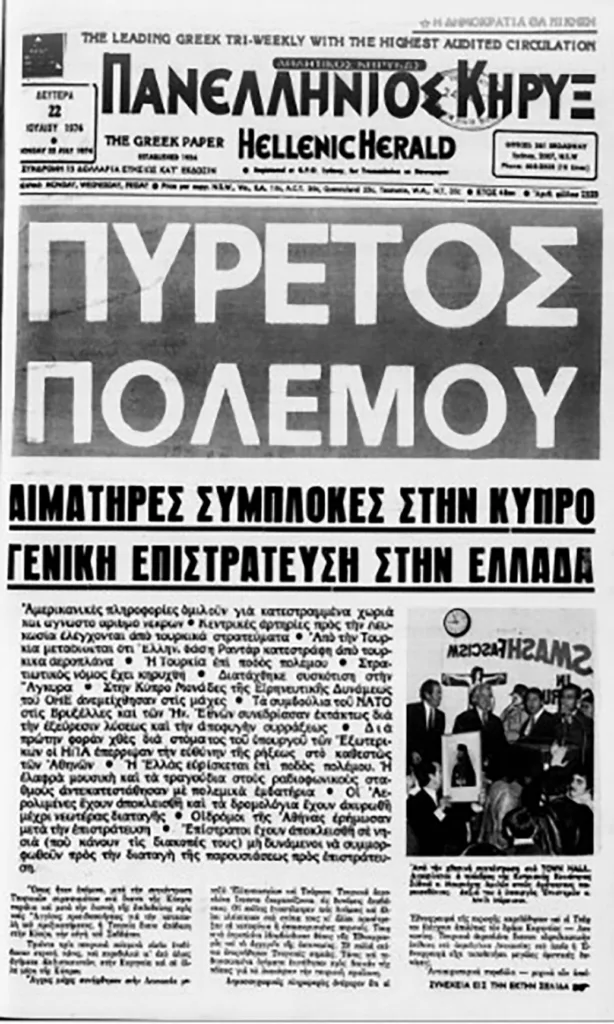
The Cyprus crisis generated enormous shock throughout Greek Australia and became one of the most emotionally charged communal issues of the decade.
The Greek Herald devoted extensive coverage to developments in Cyprus, placing the invasion, refugee crisis and international diplomatic response prominently across its front pages and special reports.
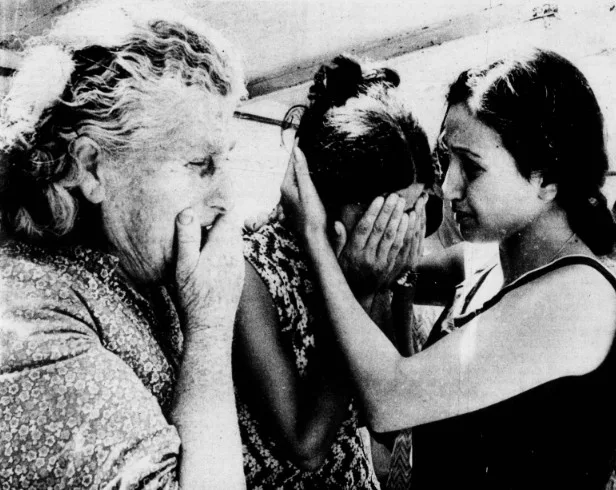
The newspaper documented mass protest rallies, fundraising campaigns, church memorials and political lobbying efforts organised throughout Sydney, Melbourne and Adelaide as Greek and Greek Cypriot communities mobilised in response to the invasion and occupation of northern Cyprus.
Editorials repeatedly condemned the invasion as a violation of international law and called on the international community to support the sovereignty and territorial integrity of Cyprus.
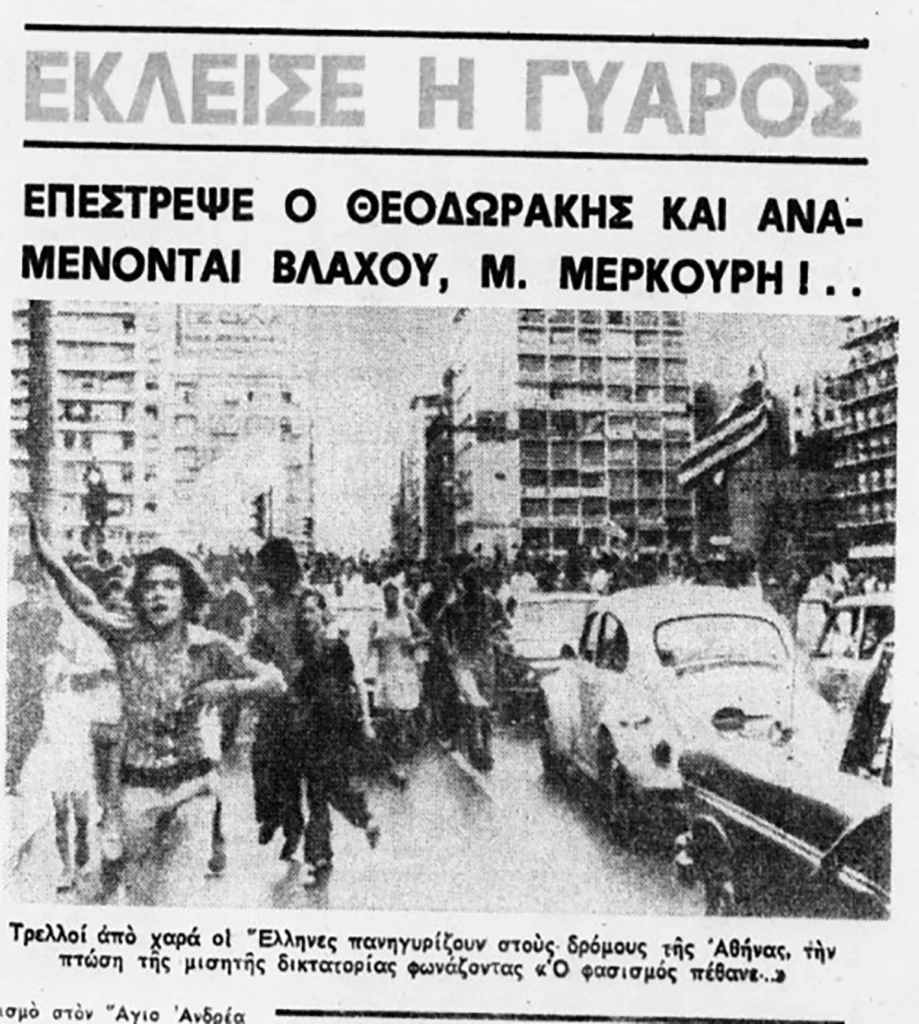
For many Greek Australians, the events of 1974 became a defining moment of collective grief, political mobilisation and diasporic solidarity that transcended earlier ideological divisions within the community.
Greece itself entered a new democratic era following the return of Konstantinos Karamanlis and the restoration of parliamentary democracy after the collapse of the dictatorship.
For the diaspora, the fall of the Junta represented not merely political change, but moral vindication for those who had opposed authoritarianism throughout the preceding years.
Greek culture and the emergence of migrant confidence
Despite political division and migrant hardship, the decade also witnessed the rapid expansion of Greek cultural life across Australia.
Greek theatres, bouzoukia, cafés and entertainment venues multiplied rapidly throughout Sydney and Melbourne, with the newspaper extensively promoting performances, musicians, theatrical productions and nightlife.
By the late 1960s, Greek bouzoukia and music venues had become major centres of social life for migrants seeking familiarity, language and connection.
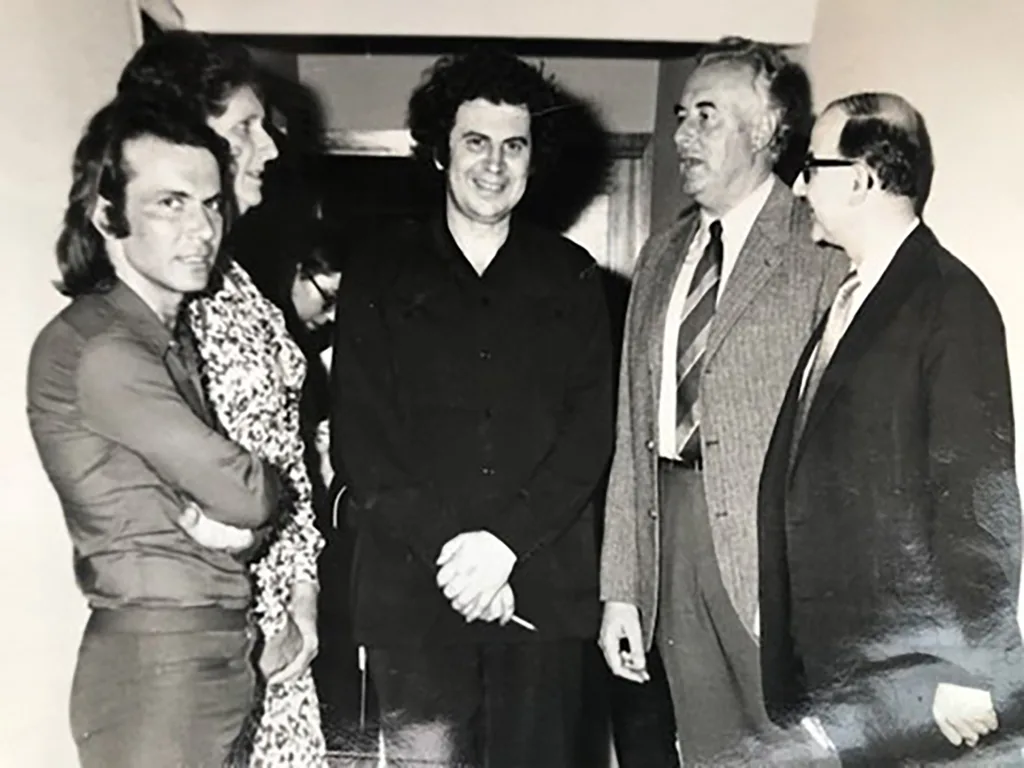
Music and political culture also became deeply intertwined during the anti-dictatorship years. The visits of internationally renowned composer Mikis Theodorakis drew enormous attention across Australia, particularly among politically active migrants and democratic organisations. The Greek Herald closely followed Theodorakis’ relationship with Australian political figures including Gough Whitlam, while the newspaper itself played a mediating role in facilitating communication surrounding proposed national tours and cultural initiatives linked to the restoration of democracy in Greece.
At the same time, Greek sport emerged as another major source of communal identity.
The Greek national soccer team toured Australia in 1969 before large migrant crowds, while Greek-backed clubs increasingly dominated ethnic sporting culture nationally.
Soccer administrators of Greek background also emerged as influential figures within Australian sport itself. Prominent businessman and benefactor Sir Arthur George — alongside figures such as Theseus Marmaras — became deeply associated with the expansion of Australian soccer administration and support for Greek sporting institutions, while Greek-backed clubs increasingly transformed football into one of the most visible expressions of migrant identity in Australia.
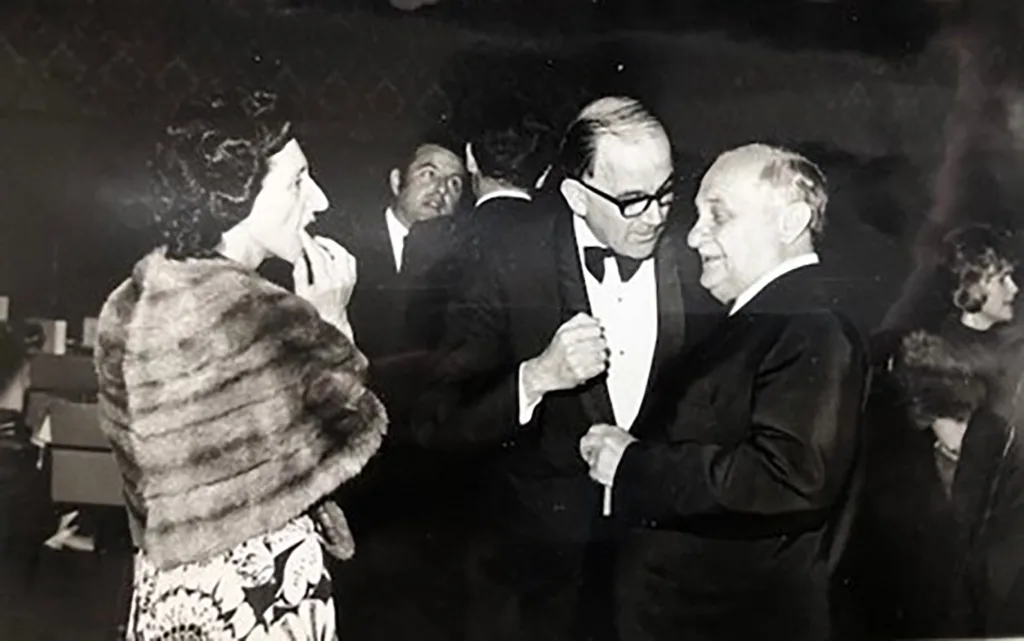
The newspaper also documented the growing visibility of Greek Australians within public institutions.
Appointments involving magistrates, councillors, academics and professionals reflected the gradual emergence of Greek Australians into mainstream Australian public life.
Figures including Kyriakos Kalpis, George Georgouras, Constantinos Zembilas and Evangelos Anastasopoulos represented an emerging generation of Greek Australian political and professional leadership.
By the early 1970s, Australia itself was beginning to move away from older assimilationist attitudes toward the foundations of multicultural policy, with the Greek community increasingly central to that transformation.
A defining decade
By 1976, Greek Australia had changed permanently.
What had once been a relatively small migrant population had evolved into one of the largest, most organised and most visible ethnic communities in Australia.
The decade had been shaped by dictatorship, migration, anti-racism struggles, educational expansion, communal conflict and rapid institutional growth.
At the centre of those developments stood The Greek Herald.
The newspaper documented not only the political upheavals of Greece, but also the difficult and often emotional process through which Greek migrants transformed themselves into a permanent part of Australian society.
The period also laid the foundations for the far more confident, politically influential and institutionally sophisticated Greek Australia that would emerge in the decades that followed.
