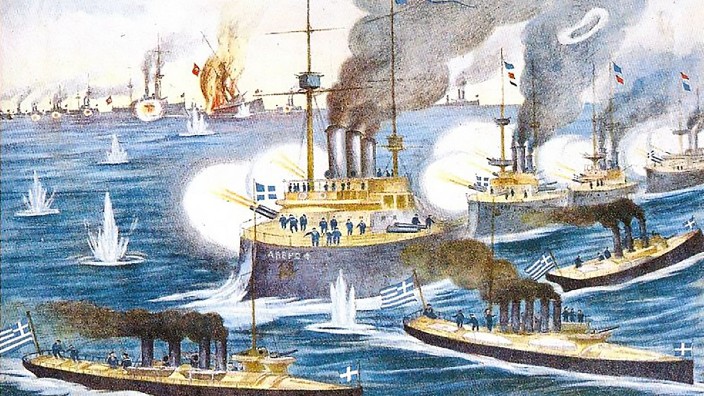
On January 5, 1913, the Battle of Lemnos took place between Greek and Turkish fleets in the North Aegean. It is considered a turning point for the outcome of the First Balkan War as Greece’s victory led to its dominance in the Aegean.
We take a look back at the history of the battle, including its aftermath.
The Battle of Lemnos:
On the morning of January 5, the Turkish cruisers Mesudiye, Barbaros Hayreddin, Turgut Reis and eight more destroyers left the Dardanelles and headed for the Greek island of Lemnos.
The Greek destroyers Leon and Aspis reported the appearance of the enemy fleet to Admiral Pavlos Kountouriotis, who ordered the exit of the Greek fleet from the port of Moudros to face the enemy.
The fleet consisted of the battleships Georgios Averof, Spetsai, Hydra and Psara and seven extra destroyers.
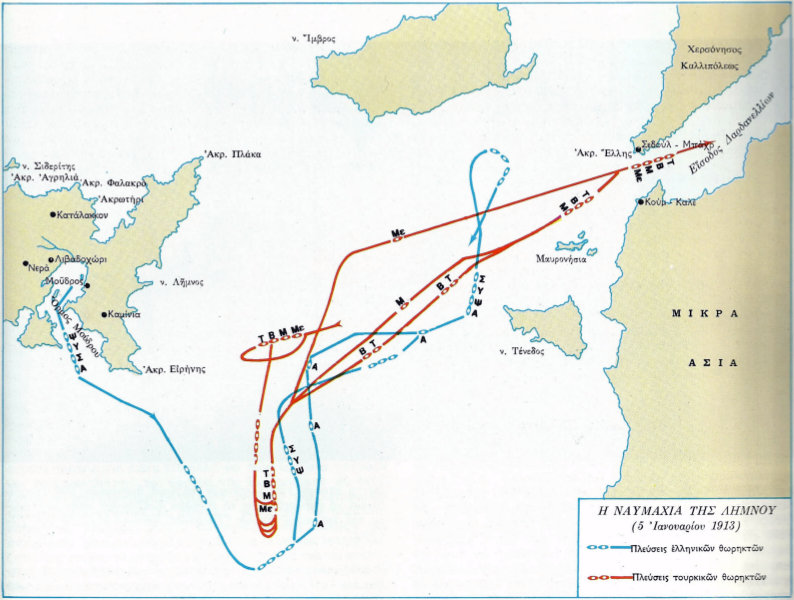
Meanwhile, the Turkish ships reached a distance of a few miles from the eastern end of Lemnos and at 11.34 am began to attack the Greek ships from a distance of 8,400 metres. The Greeks responded immediately with a counter-attack.
At 11.50 am, the two fleets were at a distance of 6,700 metres.
At 11.54 am, the Mesudiye had suffered serious damage. A barrage from the Georgios Averof also caused significant damage and losses to the battleship Barbaros Hayreddin, which withdrew from the battle. This was followed by the relatively intact Turgut Reis. Thus, after a twenty-minute naval battle, the Turkish fleet fled.
At 12.02 pm, the battleship Georgios Averof began to pursue the Turkish fleet and at 1.50pm its missile found the Turgut Reis, causing a crack from which water entered its boiler room.
All three Turkish warships, which had been severely damaged, eventually escaped to the entrance of the Straits and did not attempt another exit throughout the war.
During the naval battle, the Turkish fleet fired a total of 800 shots, about the same as the Greek fleet. However, the Greek shooters were more accurate and killed over 100 people. From the Greek side, only one injury was reported of the trumpeter of the Georgios Averof.
Aftermath of the Battle of Lemnos:
The result of the naval battle of Lemnos undoubtedly contributed to the decision of the Pasha government to proceed with the signing of peace.
Turkish Navy Commander Ramiz Bey was replaced by Captain Tahir Bey and referred to a military tribunal, which acquitted him.
Turkish warships, sent to offshore operations, set about protecting Istanbul from a possible Bulgarian attack.
Source: San Simera.

