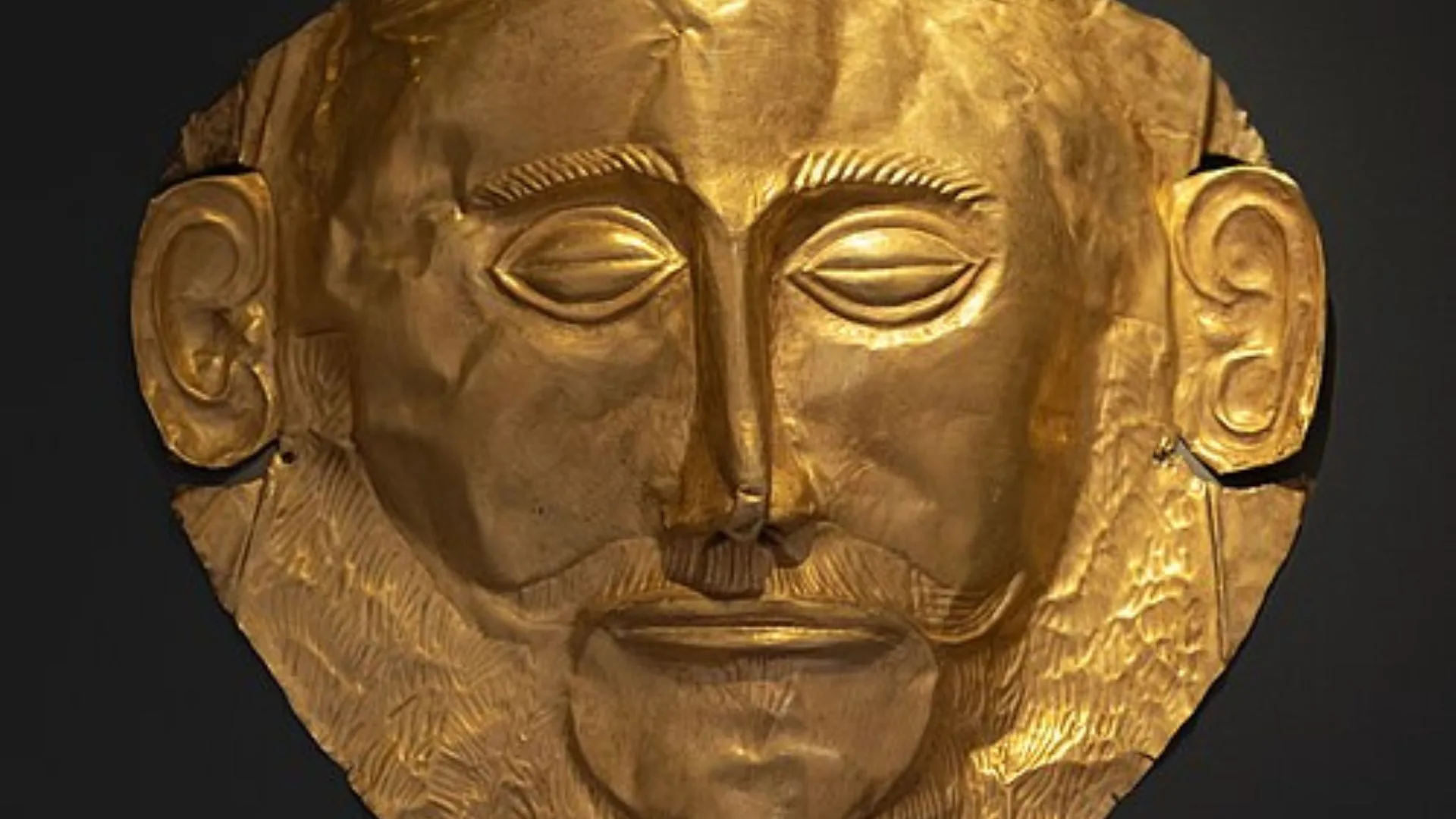
Have you ever wondered what it would be like to look at a mythological figure in the face?
Heinrich Schliemann (1822-1890) asked that same question on the 30 November 1876 at Mycenae in Argolis when he first held this mask made of gold. Starring back at him was a bearded male face. For Schliemann, there was no doubt. He was looking at the face of the legendary king of Mycenae from Homer’s epic cycle The Iliad.
“I have gazed upon the face of Agamemnon,” he telegraphed the King of Greece in Athens; and he would later name his son after the mythological figure.
We now know it not to be Agamemnon, but it is still an extraordinary work of art. Indeed, this very famous object is so iconic that one author has described it as the “Mona Lisa of prehistory” – an image everyone knows.
Schliemann is often described as an archaeologist, but he practised techniques unacceptable to modern archaeology. He began excavations at Mycenae in 1876, after having worked at Troy in the previous decade. His reputation preceded him. Greek authorities insisted that he work under the supervision of Greek archaeologist Panagiotis Stamatakis (c.1835-1885) as a condition of his permit to excavate.
Excavations within Grave Circle A at Mycenae in 1876 found a number of shaft tombs. Presumed to be royal burials, a total of 19 bodies were found, five of which contained death masks including this one from Grave V.
The mask depicts the face of a bearded man, made from a single thick sheet of gold with all of the facial features repousse (hammered). Beneath each ear small holes were created to tie the mask to the deceased face. It weighs 168 grams and is 25 centimetres high. The gold clearly indicates the wealth of its wearer.
Some scholars have questioned its authenticity, accusing Schliemann of fabricating the mask and placing it in the tomb himself. It seems unlikely under Stamatakis’ watchful eyes.
Today, most archaeologists believe the mask to be genuine but to pre-date the era of Trojan War by at least three centuries. Some even date the contents of the grave much earlier to 2500 BCE. Either way, it cannot possibly belong to Agamemnon. Even Schliemann conceded as such later in his life, but by then the name had stuck. Today it has pride of place in the National Museum of Athens.
If you would like to see the death mask locally, the University of Sydney has a modern copy in the Chau Chak Wing Museum – a life-sized electrotype copy manufactured in the 1920s by Emile Gilliéron, the Swiss artist who worked with Schliemann and with Arthur Evans on Crete and oversaw the restorations at Knossos.
See more here: https://www.sydney.edu.au/museums/collections_search/?record=ecatalogue.38272
It’s a beautiful object but not one featuring the face of a figure from Homer’s epic.
