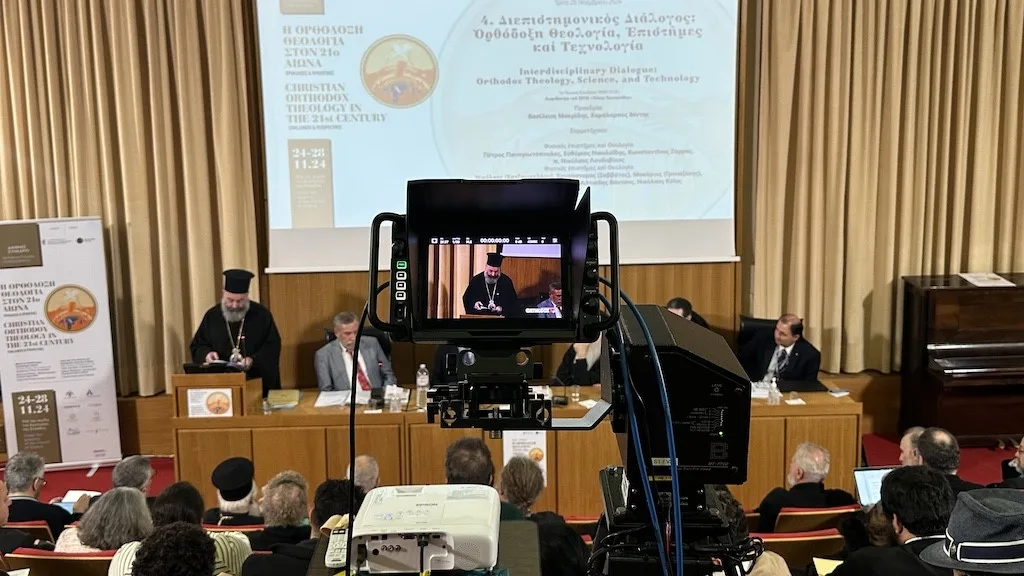
On the third day of the International Theological Conference on “Orthodox Theology in the 21st Century: Challenges and Prospects,” Archbishop Makarios of Australia delivered a presentation on the intersection of Artificial Intelligence (AI) and Orthodox Theology.
The conference, hosted by the National and Kapodistrian University of Athens under the auspices of the Church of Greece, featured discussions on pressing contemporary issues.
Addressing the thematic unit “Biotechnological Sciences and Theology,” Archbishop Makarios examined the concept of the “mind” through patristic teachings, emphasising its distinction from AI.
He stated, “The mind is central in patristic thought and is identified as the locus of God’s image in humanity.” While AI simulates human intelligence, he argued, it cannot replicate the human mind, which in Orthodox theology is uniquely capable of knowing God.
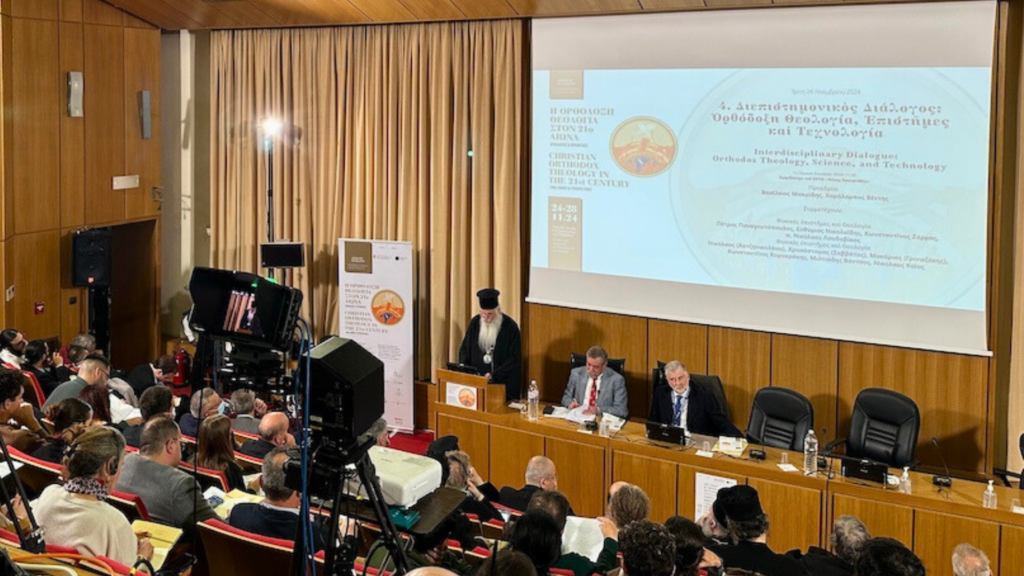
Archbishop Makarios also warned against framing AI as a competitor to human capabilities, asserting, “Artificial intelligence and technological achievements are images of man, not of God. It is man who determines the being and quality of artificial intelligence.”
He advocated for the Church’s active engagement with technological advancements, urging understanding and dialogue rather than criticism or fear.
“The ethos of the Gospel cannot condone a morality where humanity is detached from God,” he remarked, highlighting the Church’s role in addressing AI ethics. He encouraged the Church to approach scientific progress with love and understanding, stating, “Orthodox Theology should provide a foundation where every scientific endeavour is grounded in divine love.”
Archbishop Makarios concluded by challenging the Church to embrace the opportunities and challenges posed by AI, emphasising the need for collaboration between theology and science in service of humanity.
Archbishop Makarios has been accompanying His-All Holiness Ecumenical Patriarch Bartholomew during his visit to Greece this month. On November 17, the Archbishop was also at the Church of Panagia Balino in Constantinople to take part in a Divine Liturgy officiated by the Patriarch.
