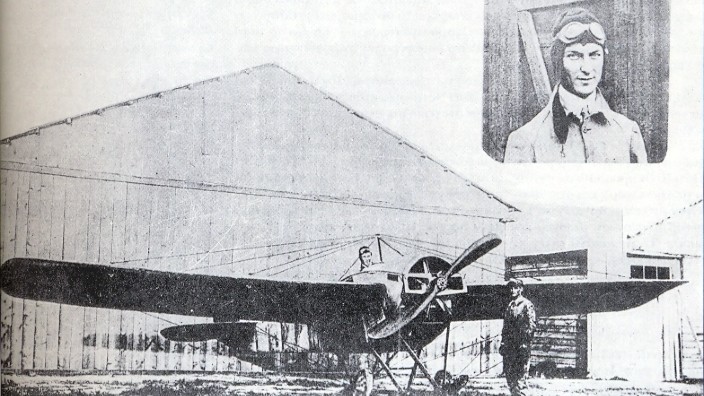
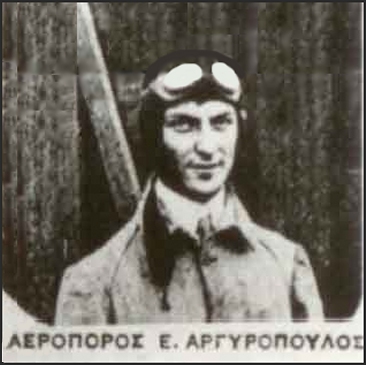
Emmanouil Argyropoulos is known as the first Greek aviator to fly over Greece, as well as the first Greek man to die in the Greek Air Force.
Early Life:
Emmanouil Argyropoulos was born in 1889 and was the son of the diplomat Georgios Argyropoulos, Ambassador of Greece to Russia.
He studied civil engineering in Germany and aviation in France.
In January 1912, he returned to Greece and brought with him his dismantled private plane, a single-seater Nieuport IVG, with 50 horsepower.
First flight over Greece:
With the help of engineers from a military unit in Athens, Argyropoulos re-assembled his private plane and after a few days he was ready for his first flight in the Greek skies.
On February 6, 1912, he announced his project through the Athenian newspapers, defining the area of Rouf in Athens as the place of take-off and time on Wednesday, February 8.
On the scheduled date, crowds flooded the makeshift airport to admire the unprecedented spectacle. At exactly 8.10am, Argyropoulos’ plane “took off” to the applause of the crowd, among whom were King George I, then-Prime Minister Eleftherios Venizelos and many officials.
The flight, which marks the birth of the Greek Air Force, lasted 16 minutes and was a complete success.
An hour later, a second flight took place, with Eleftherios Venizelos as a passenger. The plane made a few circles over the take-off area at an altitude of 80 metres and landed successfully after 4 minutes.
On February 12, 1912, Argyropoulos made another flight over Paleo Faliro. Crowds of people from Athens and Piraeus rushed to admire the fearless Greek aviator. The crowd raised Argyropoulos in their arms and brought him triumphantly to the royal platform, where he received the warm congratulations of King George I.
Later life and Death:
When the Balkan Wars broke out in October 1912, Argyropoulos joined the Armed Forces, with the rank of lieutenant.
On April 4, 1913, he took off from the Lebet airport of Thessaloniki (in today’s Stavroupoli), with a Blerio 11 aircraft (booty from the Turkish army) and fellow fighter and poet Konstantinos Manos. Their mission was to detect the areas occupied by the Bulgarian army near Thessaloniki.
During the flight, his aircraft suffered mechanical damage and crashed near Lagadas, Thessaloniki. Both occupants died instantly. Argyropoulos was only 24 years old and Konstantinos Manos was 44 years old.
Source: San Simera.

