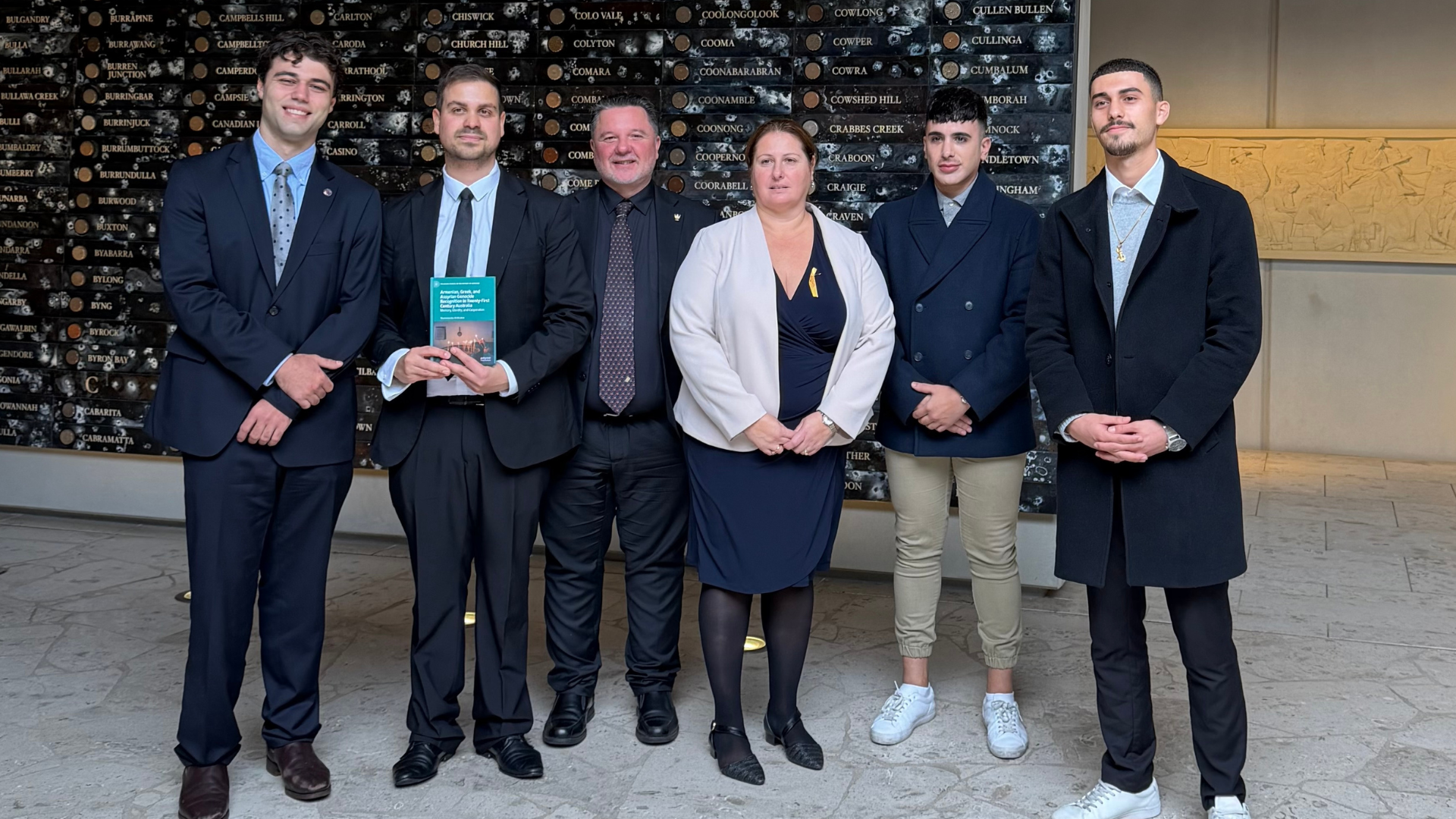
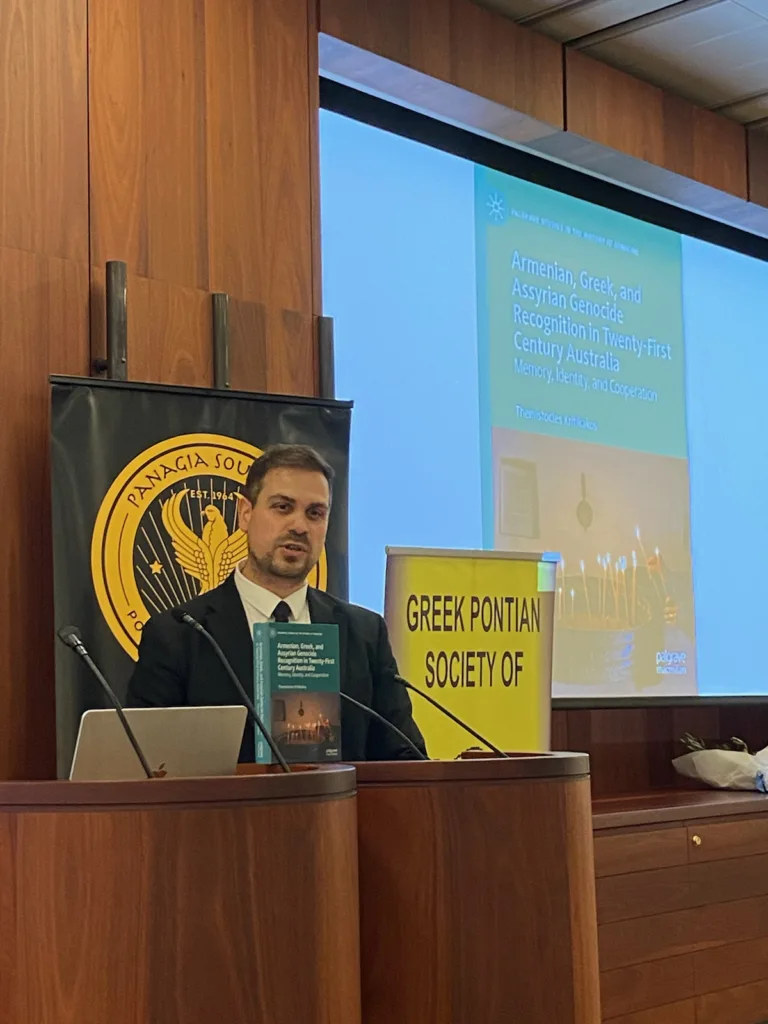
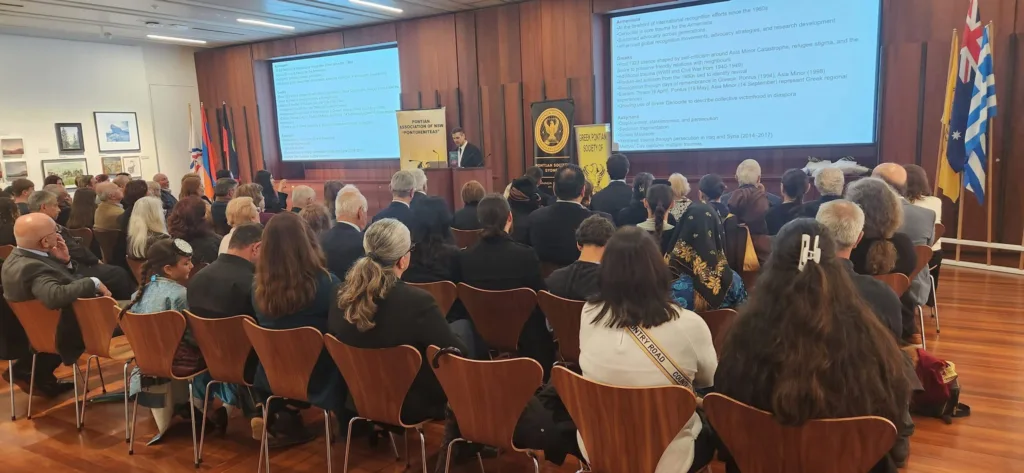
Historian Dr Themistocles Kritikakos presented his book, Armenian, Greek, and Assyrian Genocide Recognition in Twenty-First Century Australia: Memory, Identity, and Cooperation (Palgrave Macmillan, 2026), at the Anzac Memorial in Sydney on 24 May 2026. Approximately 120 people attended.
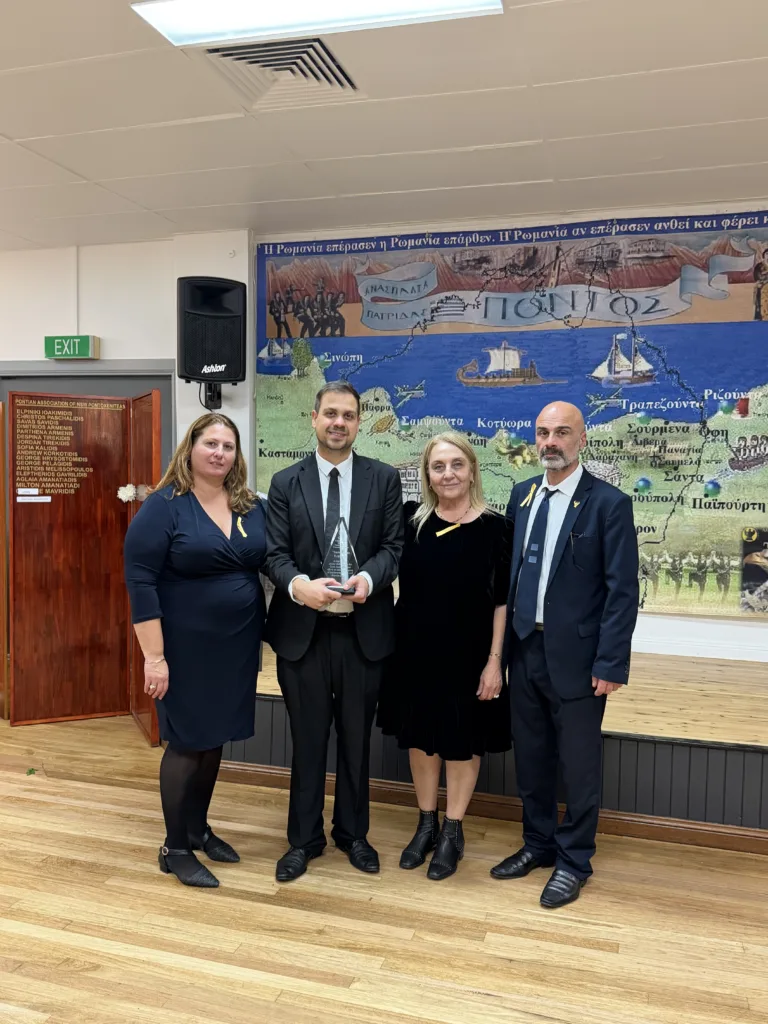
The presentation formed part of a commemorative program marking the Greek Genocide, jointly organised by the Greek Pontian Society of Wollongong “Diogenes”, Panagia Soumela Sydney, and the Pontian Association of NSW “Pontoxeniteas”.
- Your recent book presentation in Sydney focused on silence and intergenerational trauma. Why do you think these themes continue to resonate so strongly today?
I think many descendants of survivors recognise these experiences within their own families. Trauma was not always transmitted through direct storytelling. Often it was carried through silence, emotional reactions, fragmented memories, expressions of grief, and subjects that could never be fully discussed.
For many families, silence was not the absence of memory. It was one of the ways memory was transmitted. In many cases, the absence of a complete narrative itself sparked curiosity and a sense of responsibility to engage with unresolved histories and traumas.
Even generations later, many descendants continue to feel the emotional weight of traumatic events they did not directly experience. These themes continue to resonate because the consequences of genocide did not simply end in the past. They continued within families and communities across generations, shaping identities and memories.
- Your presentation argued that recognition is not simply about the past. Why do these discussions still matter today?
Recognition is about justice for the victims and survivors. However, over a century later and with the passing of the survivor generation, it is also about historical understanding, addressing intergenerational trauma, and the way societies choose to engage with difficult histories and how those choices shape the future.
Denial and omission can deepen the burden carried by descendants because they are often left explaining and justifying family histories and inherited trauma. Denial is also understood as the final stage of the genocidal process, one that seeks to erase the past. Its consequences are not confined to history alone but can continue to shape the present in different ways.
Recognition is therefore about confronting history honestly before memory itself disappears. In many ways, later generations become the custodians of this history, acting on behalf of survivor generations that passed without recognition.
- Representatives from Armenian and Assyrian organisations were present at the commemorations and your book presentation. What significance does that hold?
The presence of Armenian and Assyrian representatives was particularly meaningful because it reflected a shared experience of genocide. While each community has its own distinct narratives and commemorative events, there are also parallel experiences of trauma and historical connections that continue to be expressed through solidarity, mutual understanding, and activism today.
One of the central arguments of my book is that memories of the past and recognition efforts are often strengthened through dialogue and cooperation between communities. Many of these foundations were laid through dialogue that began between Armenian, Greek, and Assyrian communities in Sydney in the late 1990s. These efforts continue to evolve today, creating new opportunities for greater understanding and public awareness of these histories.
- You also reflected on the relationship between Anzac memory and Australia’s humanitarian response to survivors and refugees. Why is this important?
Australians were not only participants in the Gallipoli campaign of 1915. They also became witnesses to aspects of this violence and to the suffering of victims and survivors through Anzac prisoners of war, media reports, humanitarian workers, and relief campaigns.
Australians played an important role in supporting Armenian, Greek, and Assyrian survivors and refugees between 1915 and 1930. Yet this humanitarian history often remains absent from Australian national memory despite emerging from the same historical moment as Gallipoli itself. Anzac Captain Stanley Savige, part of the British mission Operation Dunsterforce, assisted in the evacuation and protection of tens of thousands of Assyrian and Armenian refugees in north-western Persia in July 1918. Australians did not simply learn about these events decades later. Many Australians responded in real time.
Holding the book presentation at the Anzac Memorial was significant because it highlighted the connections between Anzac memory, eyewitness accounts, humanitarian relief efforts, and the experiences of survivors and refugees as well as their descendants. These histories should be understood and remembered together. Doing so expands the historical narrative, tells a more complete story, and deepens public understanding.
- During the commemorations there was a strong presence of younger generations speaking publicly about family histories. What stood out to you most about that?
One of the most striking aspects of the Sydney commemorations was hearing younger generations speak publicly about their family histories, in some cases reflecting on the experiences of not only grandparents, but great-grandparents.
We are increasingly seeing younger generations engage with the past in thoughtful and meaningful ways through commemoration, cultural participation, education, and public discussion.
What is particularly significant is that memory is increasingly entering public spaces in new and intergenerational ways. New generations reinterpret these histories through changing social and cultural contexts, creating new ways of understanding and remembering the past. In many cases, younger generations are not simply inheriting memory; they are actively reshaping how it is expressed and understood.‘
Armenian, Greek, and Assyrian Genocide Recognition in Twenty-First Century Australia: Memory, Identity, and Cooperation (Palgrave Studies in the History of Genocide, 2026)’ is available on Amazon.
