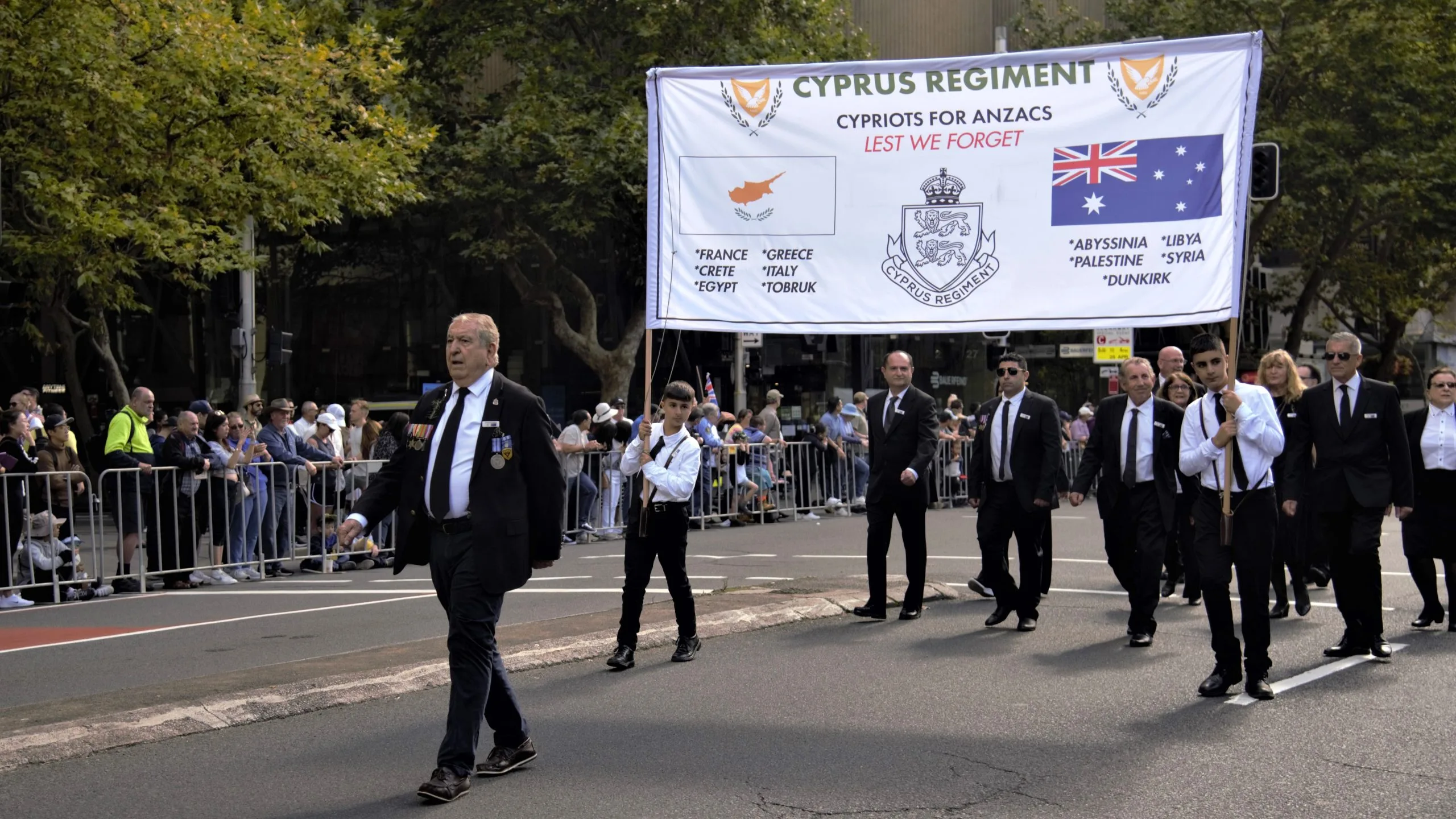
On April 25, Australia will commemorate the 1915 ANZAC landings on a peninsula known in antiquity as Kallipolis, meaning “Beautiful City,” a name given by the ancient Greeks who settled the region.
Situated at the entrance to the Hellespont, the peninsula held longstanding strategic importance, controlling access between the Aegean Sea and the Sea of Marmara. In the ancient Greek world, nearby cities such as Cardia and Sestos were central to trade and military movement, effectively controlling key maritime routes, and the region featured in conflicts as early as the Persian Wars.
The connection between the Hellenic world and Gallipoli extends beyond the events of 1915. It is a landscape long associated with Greek history, geography and strategic significance, known across the Greek world from southern Italy and the Aegean islands to Asia Minor, Crete, mainland Greece and Cyprus.
In the modern era, that connection continued, as men of Greek origin — including those from mainland Greece, Cyprus and the broader Hellenic diaspora in Australia — served in the conflicts of the twentieth century.
Cyprus’ contribution to the First World War alongside the ANZACs, together with its significant contribution to the Second World War, is well documented in military records and examined in academic literature. Cypriots served in support roles during the First World War, most notably through the Cyprus Mule Corps, providing logistical support to Allied and ANZAC forces. That pattern continued in the Second World War, where Cypriots enlisted in substantial numbers in British forces, particularly through the Cyprus Regiment.
Historical sources consistently place Cypriot enlistment at approximately 30,000 individuals. With a total population of approximately 400,000 to 450,000, this represents around 6.5% to 7.5% of the entire population.
Military service was concentrated among men of fighting age. The 1946 Census records 65,884 males aged 20 to 39. When assessed against this cohort, the participation rate is 45.5%. Using a narrower cohort of ages 20 to 34, representing 52,044 males, the participation rate increases to 57.6%.
These figures indicate that between approximately 45% and 58% of Cypriot men in prime military age served during the Second World War.
This means that, within the relevant military-age cohorts, wartime service extended across a substantial proportion of the population. By ordinary demographic standards, this is a high mobilisation rate, reaching broadly across households and family networks rather than being confined to a small group.
What does this mean for their descendants today?
There is no dataset that identifies, on an individual basis, which persons have a father, grandfather or relative who served. However, the scale of the descendant population can be reliably estimated using established statistical methods.
The relevant method is the complement rule in probability theory, which determines the likelihood that at least one event has occurred by calculating the probability that none have occurred and subtracting that value from one.
Applied here, it asks a simple question: if a known proportion of men served, what is the probability that at least one male ancestor in a person’s lineage belonged to that group?
Using the historical participation rates and applying the method conservatively to two male ancestors at grandparent level, the probability that a present-day person of Cypriot ancestry has at least one grandfather who served falls between approximately 70.3% and 82.1%. While this assumes independence between family lines, it remains a sound estimate for population-scale outcomes where complete genealogical data is unavailable.
Based on 2021 Census data, 40,091 Australians identify with Cypriot ancestry, of whom 36.5% reside in New South Wales, producing an estimated population of approximately 14,633 people.
Applying the model to this population produces a range of approximately 10,293 to 12,007 individuals likely to have at least one grandfather who served. On a conservative basis, taking into account statistical margins of error, it is reasonable to conclude that at least 9,000 people in NSW of Cypriot ancestry have a direct wartime family connection.
A mobilisation rate of this scale means the Second World War was embedded across a substantial share of Cypriot family histories. A large number of individuals of Cypriot ancestry in NSW therefore have a genuine basis for descendant commemoration.
Under current RSL NSW arrangements, descendants are eligible to march on April 25.
Australians of Cypriot descent are encouraged to come forward, recognise that service, and ensure that this history is carried forward. The contribution of Cyprus across both world wars was significant, and its formal recognition has been long overdue.
The Community has committed substantial resources to this effort, supported by volunteers who have worked to place this issue on the agenda of governments and institutions in Australia and internationally. That work is increasingly being recognised, including by diplomatic representatives of allied nations in Australia.
The subcommittee is advancing plans to implement a dedicated annual commemoration, comprising a church service and ceremony at the Hyde Park Memorial, to formally recognise the descendants of those who served in all conflicts.
“Lest we forget” carries particular weight for Australians of Cypriot ancestry. It is a duty to remember and honour those who served. ANZAC Day is a moment for all Australians to come together in that spirit – to reflect, acknowledge sacrifice, and ensure that these histories are not lost.
The number of eligible participants able to take part in ANZAC Day and related commemorations is substantial.
All Australians of Cypriot descent are invited to register online at https://thecyprusclub.org.au/anzac-day/
A particular focus is on engaging younger generations. Participation in the Cypriots for Anzacs initiative is open and accessible through the Community’s website, and new members are encouraged to contribute to its ongoing work.
On ANZAC Day, all are invited to come forward, register, and take your place in remembrance.
*Michael Peters Kyriacou is Honorary President of the Cyprus Community of NSW, and Member of the Cypriots for Anzacs Subcommittee
