Turkish archaeologists have uncovered an exceptionally well-preserved fresco depicting Jesus as the “Good Shepherd,” considered one of the most significant early Christian discoveries from Anatolia, euronews.com, has reported.
The artwork, dated to the 3rd century, was found in August inside an underground tomb near Iznik, a town central to Christian history as the site of the adoption of the Nicene Creed in AD 325. The discovery was made in the village of Hisardere, in a tomb believed to have been constructed during a period when Christians were still persecuted within the Roman Empire.
The fresco shows a youthful, clean-shaven Jesus dressed in a Roman toga and carrying a goat on his shoulders. Scholars note that portrayals of Jesus with distinctly Roman features are extremely rare in Anatolia, making this example particularly important. Before the cross became Christianity’s dominant symbol, the Good Shepherd image was widely used to convey protection, salvation and spiritual guidance.
Only a handful of similar depictions have been found in the region, and archaeologists say the Hisardere fresco is the best preserved to date.
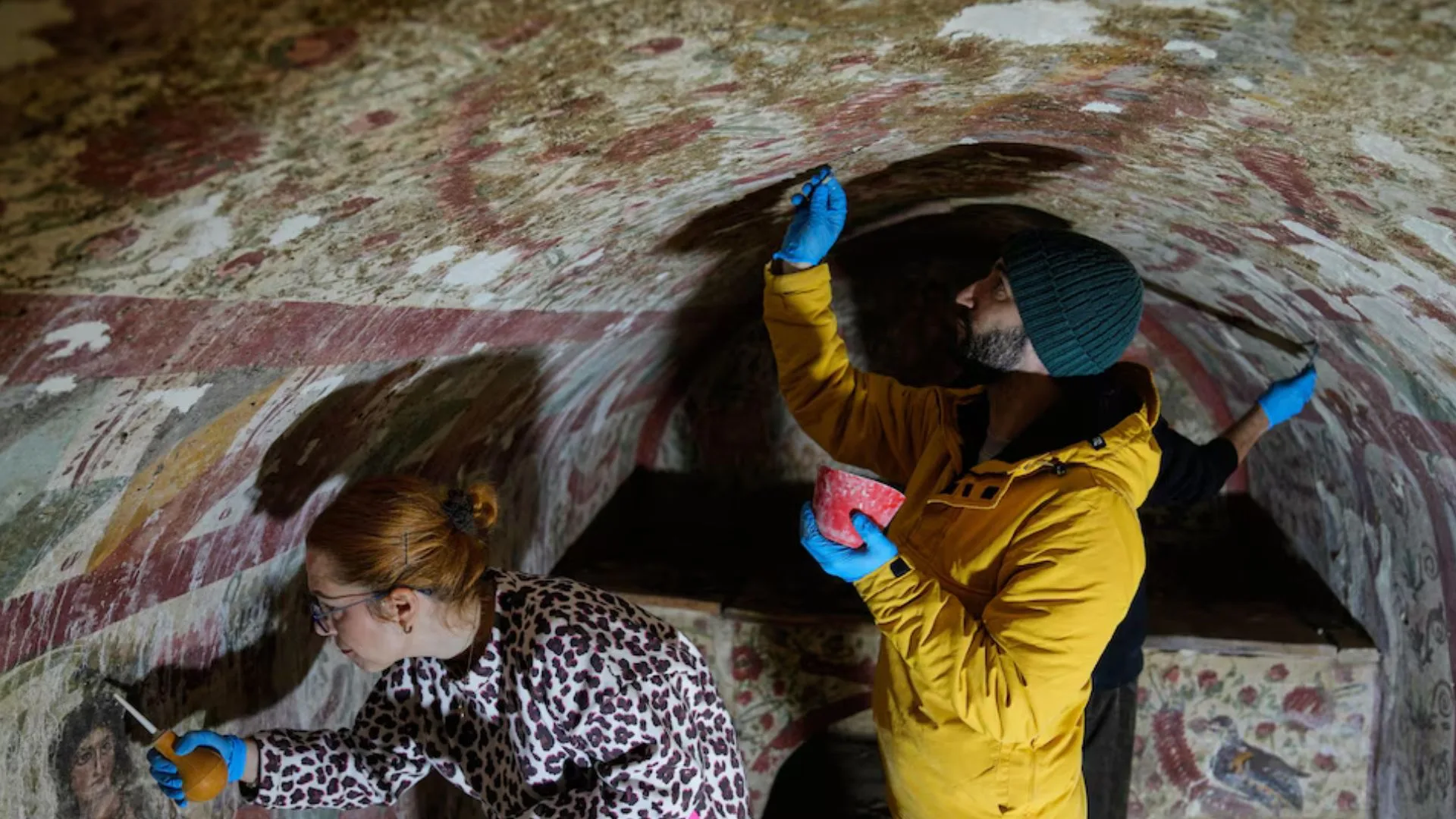
Archaeologists clean and restore frescoes inside a 3rd-century tomb where a rare early Christian depiction of Jesus as the “Good Shepherd” was discovered, in Iznik, Turkey,
Lead archaeologist Gulsen Kutbay described the painting as possibly the “only example of its kind in the region.”
Additional decorations inside the small tomb include bird and plant motifs, as well as portraits of noble men and women attended by slaves. According to Iznik Museum archaeologist Eren Erten Ertem, the imagery reflects “a transition from late paganism to early Christianity, depicting the deceased being sent off to the afterlife in a positive and fitting manner.”
The excavation also revealed the remains of five individuals, including two young adults and a six-month-old infant.
The discovery was recently commemorated when Turkish President Recep Tayyip Erdogan presented a tile artwork of the Good Shepherd to Pope Leo XIV during a visit marking the 1,700th anniversary of the Council of Nicaea.
Source: euronews.com
