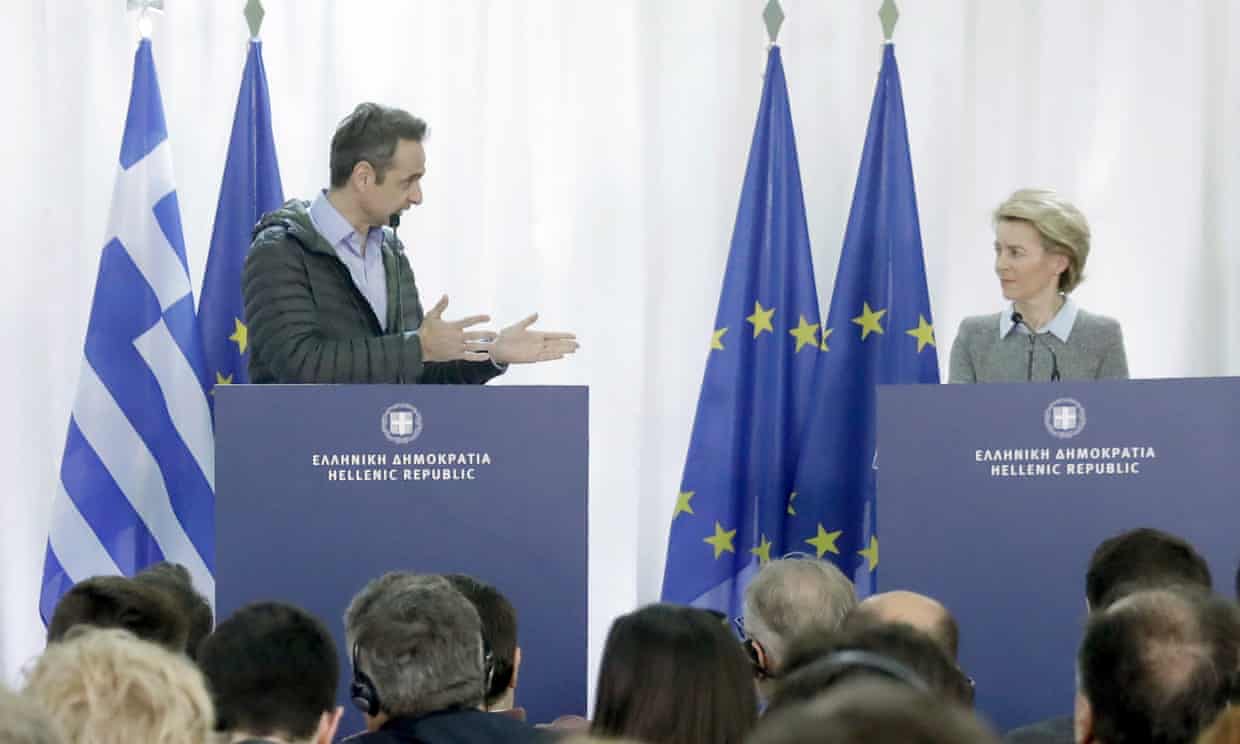
The head of the European Commission has sent a strong message of support to Greece in its attempts to stop migrants crossing its border from Turkey.
Four EU leaders met the Greek prime minister, Kyriakos Mitsotakis, at the border town of Orestiada on Tuesday, near where Greek police have been using teargas to deter hundreds of migrants from attempting to cross from Turkey.
The European commission president, Ursula von der Leyen, said: “This border is not only a Greek border, it is also a European border … I thank Greece for being our European aspida in these times,” which was translated as “shield”.
She announced €700m (£609m) in EU funds for Greece, including €350m available immediately to upgrade infrastructure at the border, The Guardian reports. The EU’s border management agency, Frontex, is scrambling “a rapid border intervention” squad that includes one offshore vessel, six coastal patrol boats, two helicopters, one aircraft, three thermal-vision vehicles, as well as 100 border guards to reinforce 530 Greek officers at land and sea borders.
Read More: Thousands of migrants searching for ways around shut Greek border
Croatia’s prime minister, Andrej Plenković, echoed her words: “Greece is now the shield, the real external border of the European Union and the guarantor of stability for the entire European continent.”
The EU visit came amid an escalating war of words between Athens and Ankara, after Turkey’s foreign minister said – without providing evidence – that Greek soldiers had killed three migrants attempting to enter the country, a claim denied by Greece.
Greek authorities said they thwarted an attempt by about 1,000 people overnight to make their way across the Evros wetland area, at the southern end of the border.
They said that in the 24 hours between Monday and Tuesday morning, they had prevented a total of 5,183 people from entering Greece, and arrested 45 people, mostly from Afghanistan, Pakistan, Morocco and Bangladesh.
Greece has made clear its borders are shut. It has sent military and police reinforcements to the area, which have used tear gas and water cannon to repel mass attempts by migrants to cross into the country. Authorities have also set up cordons of police and army checks on and near the border, arresting those who managed to make it through.
Sourced by: The Guardian
