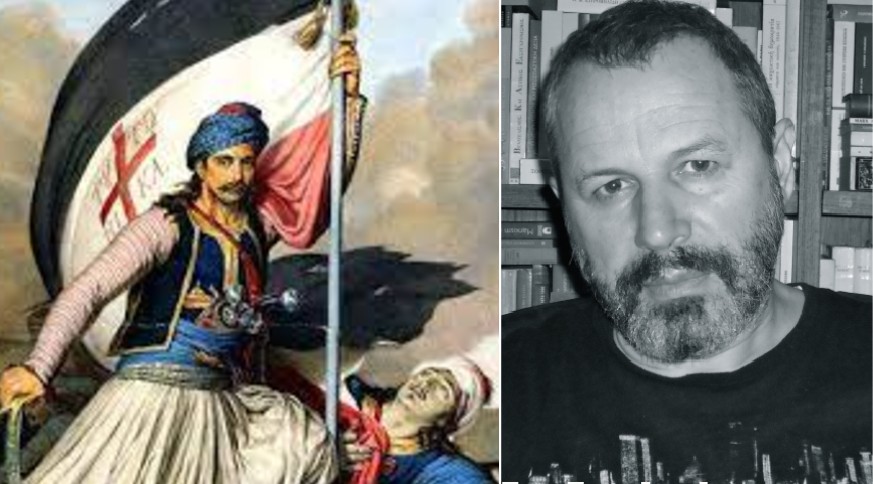
Professor Harry Athanassiadis from the University of Ioanina will present a special online lecture entitled How Do (Can) We Remember 1821?, on Monday 28 June, at 7.00pm, as part of the Greek History and Culture Seminars, offered by the Greek Community of Melbourne.
Those of us who recognize ourselves as Greeks know a lot about the Revolution of 1821. We know a lot, because we have read and heard about it at school, the institution responsible for the socialization of the new younger members of our national community. What past students learned in their student years and what today’s students continue to learn constitute the dominant narrative about the 1821 Revolution, the official one.

It is a narrative that is cognitively coherent and emotionally charged, but which is now far from the modern findings of historical research. When was this official school narrative formed? What are its essential points? Which of them stand up to modern historical research and which do not? And vice versa. Which parts of the narrative is missing from school history and why? An attempt will be made to give some valid answers to these questions. Answers, that are compatible with the modern orientations of history and pedagogy.
Harris Athanasiades is a professor of History of education and Public History at the University of Ioannina (Greece). His research focuses on the social controversy concerning the relation between schooling and nation. Typical, in this respect, are his following publications in English: “Liberals, Conservatives and Romantic Nationalists in interwar education policy in Greece: The High Mountains episode”, History of Education, vol. 44, (1), 2015, pp. 64-82; “The ‘Nation-killing’ textbook. The polemic over the history textbook ‘In modern and contemporary times’ (2006-2007)”, Ricerche Storiche, vol. 44, (1), 2014, pp. 101-120. His latest book is titled: The Withdrawn Books: Nation and School-history in Greece, 1858-2008, 3rd edit: Alexandria Publications, Athens 2018 [in Greek].
When: Monday 28 June 2021, 7pm
Where: Online, through Zoom, Youtube Live, Facebook Live.
