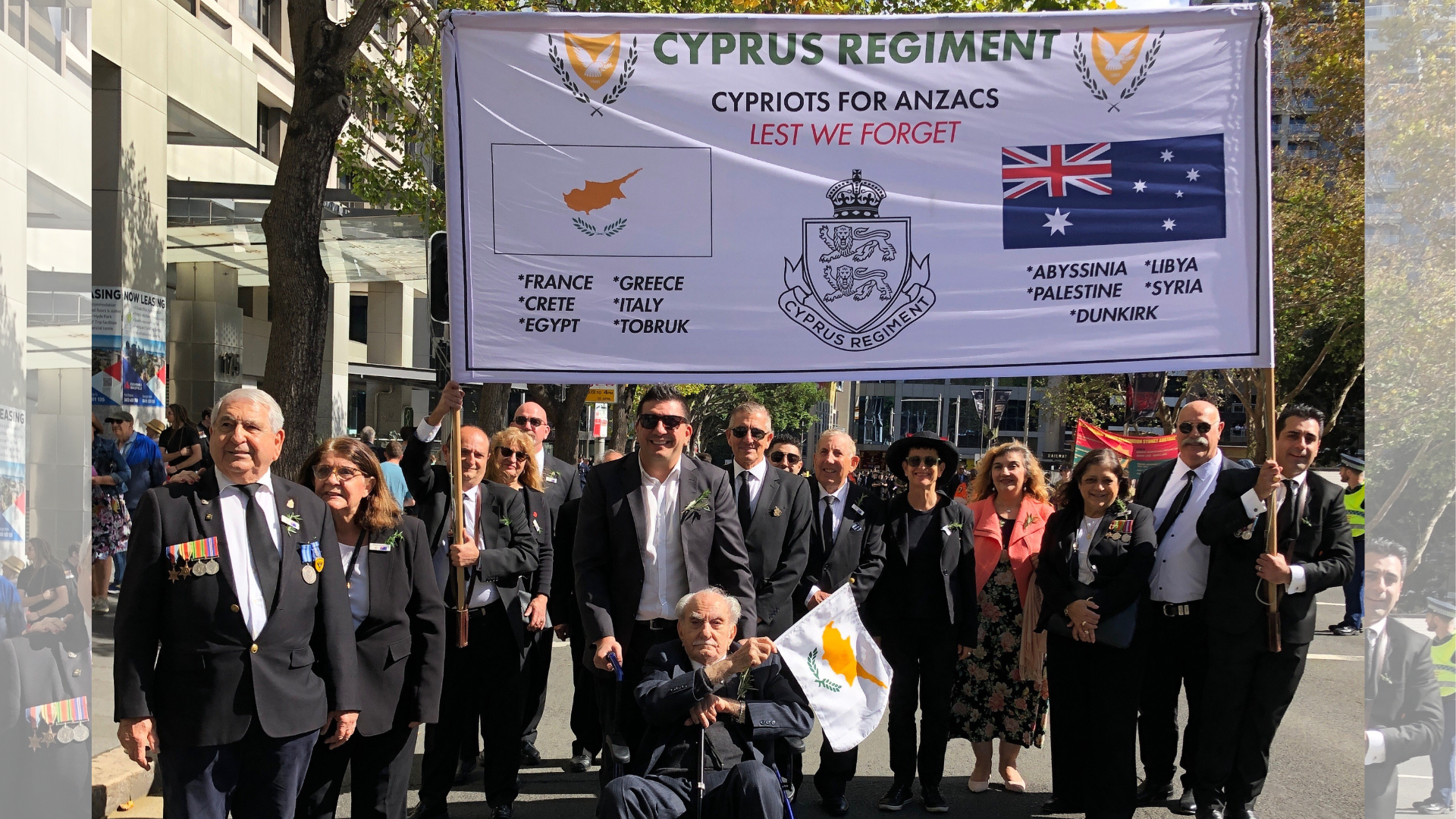
By Michael Peters Kyriacou*
On Anzac Day we commemorate the bravery and good deeds of Australian, New Zealand and Allied forces over many conflicts. One of the Allies sometimes overlooked is Cyprus.
Cyprus, the island often referred to as the world’s largest aircraft carrier, is more than a strategic plaything, its people served as volunteers in both world wars.
In World War One volunteers from Cyprus served with the British and Hellenic armed forces, most notable the Cypriot Mule Corps, also known as the Macedonian Mule Corps – volunteers and their mules providing logistical support on many battle fields.
In 1939 as the clouds of conflict came over Europe, nations were gearing up for war, people started fleeing frontline nations, and in Greece preparations had already begun. The people of Cyprus were well aware of the consequences if Greece was to fall to the Nazi regime.
As an occupied land, the people of Cyprus had no favour with the occupiers, but they did have sympathy for Greece.
Months before the start of the World War Two, locals began preparing to leave for Greece by their means, to enlist in the then Royal Hellenic Forces.
When France was attacked, volunteers found their way to defend what some had seen as a Greek ally that would assist the Hellenic world. In hindsight, this idealistic romantic view of the war became the themes of war time movies like Casablanca.
Cyprus was now a supplier of idealist warriors fighting a cause for the benefit of others, with no nation of their own, just a hope that Greece, France and Britain will repay the bravery of the people of Cyprus.
It was by pure accident that Churchill discovered the enthusiasm for the war in Cyprus and, not missing any opportunity to bolster Britain’s war effort, Britain formed a coalition of local institutions, political and church organisations to recruit adult males to form the Cyprus Regiment. It was a regiment of adventurers, volunteers and amateurs.
Cyprus had more volunteers per person than any other territory / nation anywhere during World War Two. This explains the shortage of males after the war and the economic devastation this caused. It also explains why every single family has a member who has served in World War Two.
During the first week of recruitment, 6,000 joined. By 1945, over 30,000 adult males served with the Greek, French, and British people and with the ANZACs in Greece, Crete, North Africa, Italy, France, and the Middle East.
Commanders of the Greek, French, British and ANZAC forces reported on the valour the courage and commitment of the volunteers, even though they did not belong to any country. Most did consider themselves as Hellenes, and hoped that Cyprus will revert back to its owners as a European nation.
What did set the volunteers of Cyprus apart from others is their sacrifice for an ideal they cherish but did not have access to – liberty.
Among the first to land in Sicily, the first to enter Rome, they served in France, Ethiopia, Palestine, and Italy. They supplied and supported other troops at Monte Cassino, Italy. The volunteers served in the Battle of France, the Battle of Greece, about 600 soldiers taken prisoner at Kalamata in 1941, and the Battles of North Africa.
Many volunteers were taken prisoners and interned at the infamous Stalag VIII-B Lamsdorf, Stalag IV-C at Wistrich near Teplitz in what the Czech Republic is today, and in Stalag IV-B near Dresden, Germany.
In 1943, Winston Churchill said there were “soldiers of the Cyprus Regiment who have served honourably on many fields from Libya to Dunkirk.”
The Cyprus Community of NSW (formerly known as a Brotherhood and established in 1929), has an intimate connection with the veterans from Cyprus. Founded by many who had been veterans or had relatives who were veterans, they brought the core values and mission of the war effort as the founding stone of the Brotherhood.
Sharing common values and the wellbeing of each other is perhaps the Greek version of “mateship” – taking care of others, your mates, looking out for them, defending them, preserving your special bond.
In the 1980s, the Community became a “Club” holding assets and operating gaming and other services. Despite this, it is still a community, a group of volunteers who seek no glory, no benefit, no special privileges. They do not seek recognition. They believe in community.
More recently, some may have confused the company (the Club – major real estate owner) as “community.” Unfortunately, this overshadows the values the veterans and their families brought to Australia. The firm roots of the community, the values, the work done quietly by so many of our compatriots, must be respected.
The ideas encapsulated by the brotherhood of 1929 are not singular to the ideas that drew many to join as volunteers in World War One and Two, in support of community and the cause.
That’s why the community became the first stop for veterans to visit and join.
In 1974, the community was once again the place to visit and belong for another group of veterans from another set of wars, in defence of the Republic of Cyprus by foreign invading troops, who until this day refuse to go home, occupying the north of the island.
Every member or the Cyprus Community of NSW has a veteran relative. To take part in the ANZAC DAY Sydney March this Friday, April 25, or any community event. Register online at: https://cyprus.org.au
*Michael Peters Kyriacou is President of the Cyprus Community of NSW and a Member of the Cypriots for ANZACs Subcommittee
