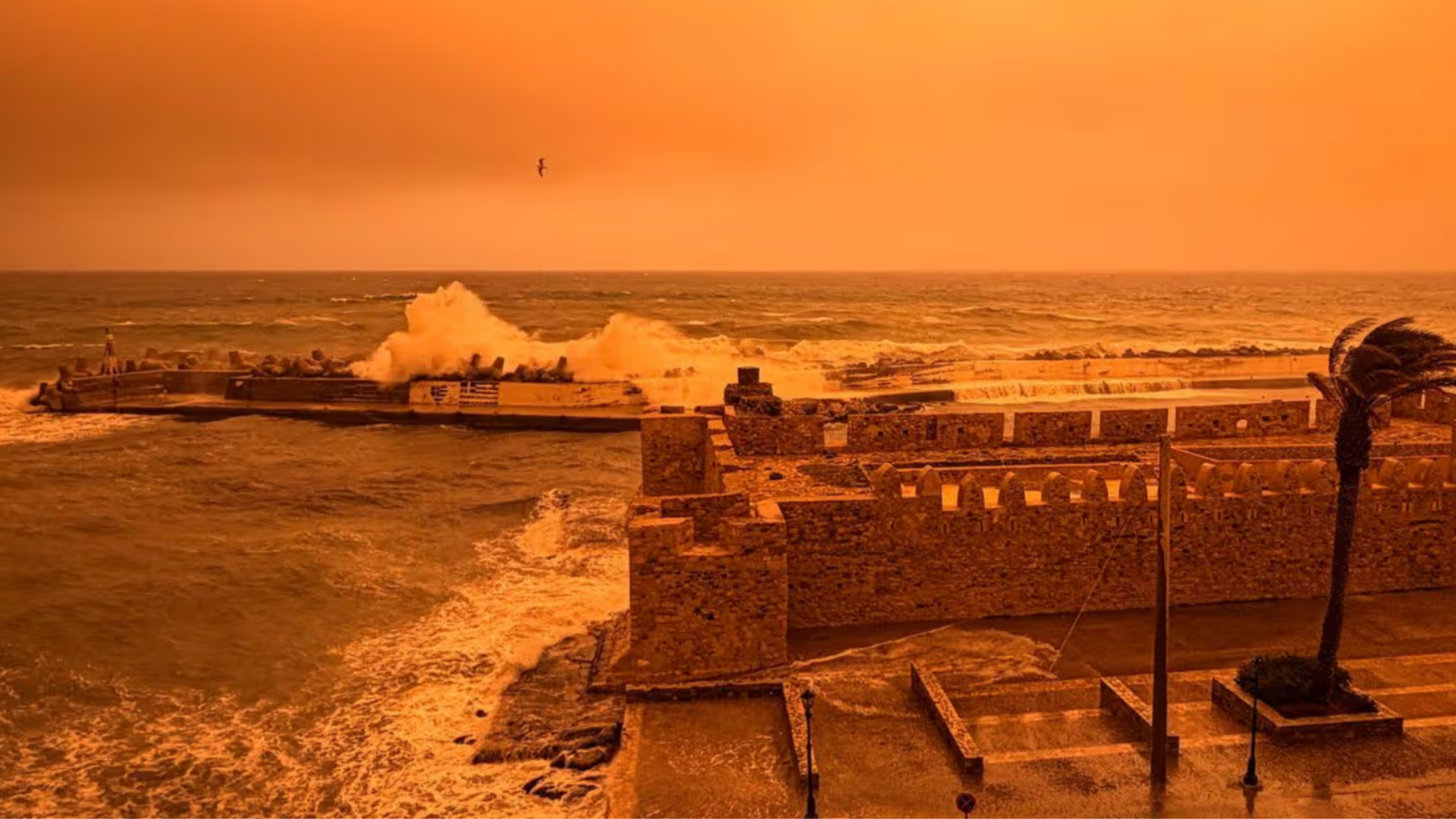
The skies over Crete turned fiery orange when a Saharan dust cloud swept over the island as the region was battered by Storm Erminio, leaving flights to be diverted from the popular tourist destination.
The dusty conditions have been intensified by Storm Erminio, which has brought heavy rainfall, thunderstorms and strong winds across Greece.
The phenomenon is known as “calima”, which is when dust blows over from the Saharan desert, however experts have warned that this calima is more extreme than normal.
Meteorologists have reported extremely high levels of dust, exceeding 1,000 micrograms per cubic meter of air. Health experts advise caution, especially for vulnerable groups who can be impacted by the elevated levels of airborne particles.
Planes were grounded at Heraklion’s main airport and at least two flights were forced to divert after visibility dropped to around 1,000 metres, a level considered unsafe for landing. Fight delays are expected to continue while the dust remains.
A truck was flipped by the storm in the coastal area of Pachia Ammos on Crete. Two pine trees were uprooted by the storm while two greenhouses were damaged and a wall at a ceramics factory collapsed from the force. The first houses along the old town in Ierapetra had huge waves surge over them when strong southerly winds affected coastal conditions.
Authorities say the dust wave is expected to clear within a day.

Greece has enforced emergy labour measures in effect from Wednesday, April 1. Following updated warnings from the National Meteorological Service and consultations with civil protection authorities, the Ministry of Labor and Social Security announced the measures which aim at reducing risks for workers exposed to dangerous conditions.
A mandatory suspension of outdoor work is in place from 6pm to 10pm in Attica, Central Greece, Thessaly — including the Sporades islands — the Peloponnese, the South Aegean, as well as parts of northern Greece.
The measure applies to manual work conducted outdoors and does not apply to sectors such as health care, transportation and public utilities. Employers in these sectors must take all necessary steps to safeguard workers’ health and safety and must provide appropriate protective equipment.
Authorities announced that businesses that fail to comply will face fines of 2,000 euros per employee.
The ministry has also encouraged private-sector employers in affected areas to allow remote work where possible. This will limit travel and will reduce exposure to harsh weather conditions.
Source: Tovima and Daily Mirror
