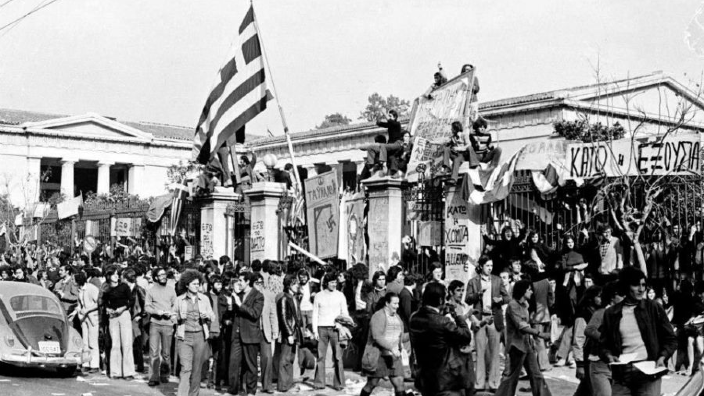
The Polytechnic Uprising in November 1973 took place six years after the Greek Junta had imposed a brutal dictatorship on the country. The protest, while started by a group of university students, ultimately heralded the fall of the Junta and brought a spark of revolution to the people of Greece.
The events of November 1973 were brewed from the increased tension witnessed on February 14 in the same year. On this day, students of Athens gathered at the Polytechnic to protest Law 1347, which dictated compulsory conscription of those who underwent trade union activity during their studies. The police, violating the university asylum, entered the Polytechnic and arrested 11 students.
On the morning of November 14, 1973, students gathered in the courtyard of the Polytechnic and decided to abstain from classes. Together, they protested and issued a resolution, calling for the revocation of the Junta’s decisions to hold student elections, an increase in education spending to 20 percent of the budget, and the revocation of Law 1347.
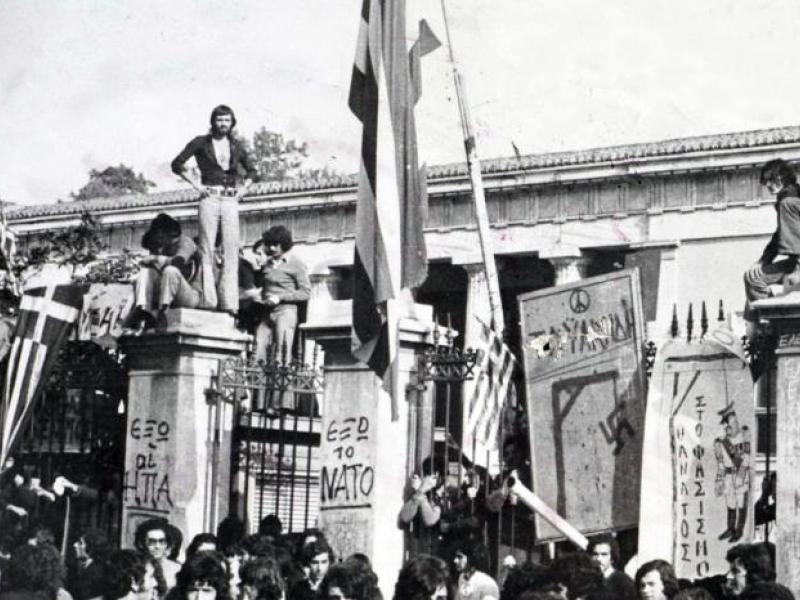
Students put up slogans and graffiti comparing the Greek junta with Nazi Germany. Once police realised they were incapable of stopping the mass-growing crowd, the decision was made to occupy the Polytechnic.
The next day, a committee was set up, comprising of 22 students and 2 workers, helping lead the struggle. A radio station was set up, with speakers Maria Damanaki and Dimitris Papachristou helping inform students and the rest of the world about the decisions of the Coordinating Committee and the student assemblies. This day is known commonly as ‘celebration day’.
On November 16, 1973, chaos ensued. For the first time since the Junta took over, Molotov cocktails were thrown and fires erupted across the city. Central roads were closed as demonstrations and attacks against neighbouring ministries took place.
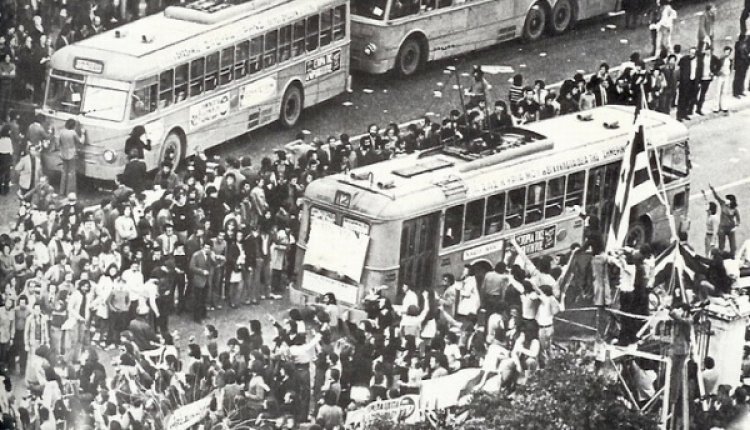
The radio broadcast proclaimed: “Polytechneion here! Polytechneion here! People of Greece, the Polytechneion is the flag bearer of our struggle and your struggle, our common struggle against the dictatorship and for democracy!”
At this point, dictator Papadopoulos realised the police would not be able to enter the Polytechnic, deciding to call in the Greek army.
Three LOC squads and one paratrooper squadron from Thessaloniki gathered, along with three tanks which descended from Goudis to the Polytechnic. Two were parked on Tositsa and Stournara streets, blocking the side gates of the institution and the other took a position opposite the main gate. The Student Coordinating Committee requested negotiations, but their request was rejected.

At 3 a.m. on November 17, the tank opposite the main gate smashed through the Polytechnic University fence. LOC squads bursted in, together with police officer groups, invaded the Polytechnic and chased students who tried to escape to the surrounding streets. Initial reports by police stated that 840 people were arrested, along with 24 civilian deaths.
Later, it was revealed that arrest counts exceeded 2400 people. More recent data, shows that at least 40 civilians were killed, 24 identified and at least 16 unidentified.
Dictator George Papadopoulos had declared martial law, but was overthrown in a coup on November 25 by brigadier Dimitrios Ioannidis. Ioannidis had imposed a harsher regime than that of Papadopoulos, yet collapsed on July 23, 1974, after the Turkish invasion of Cyprus.

