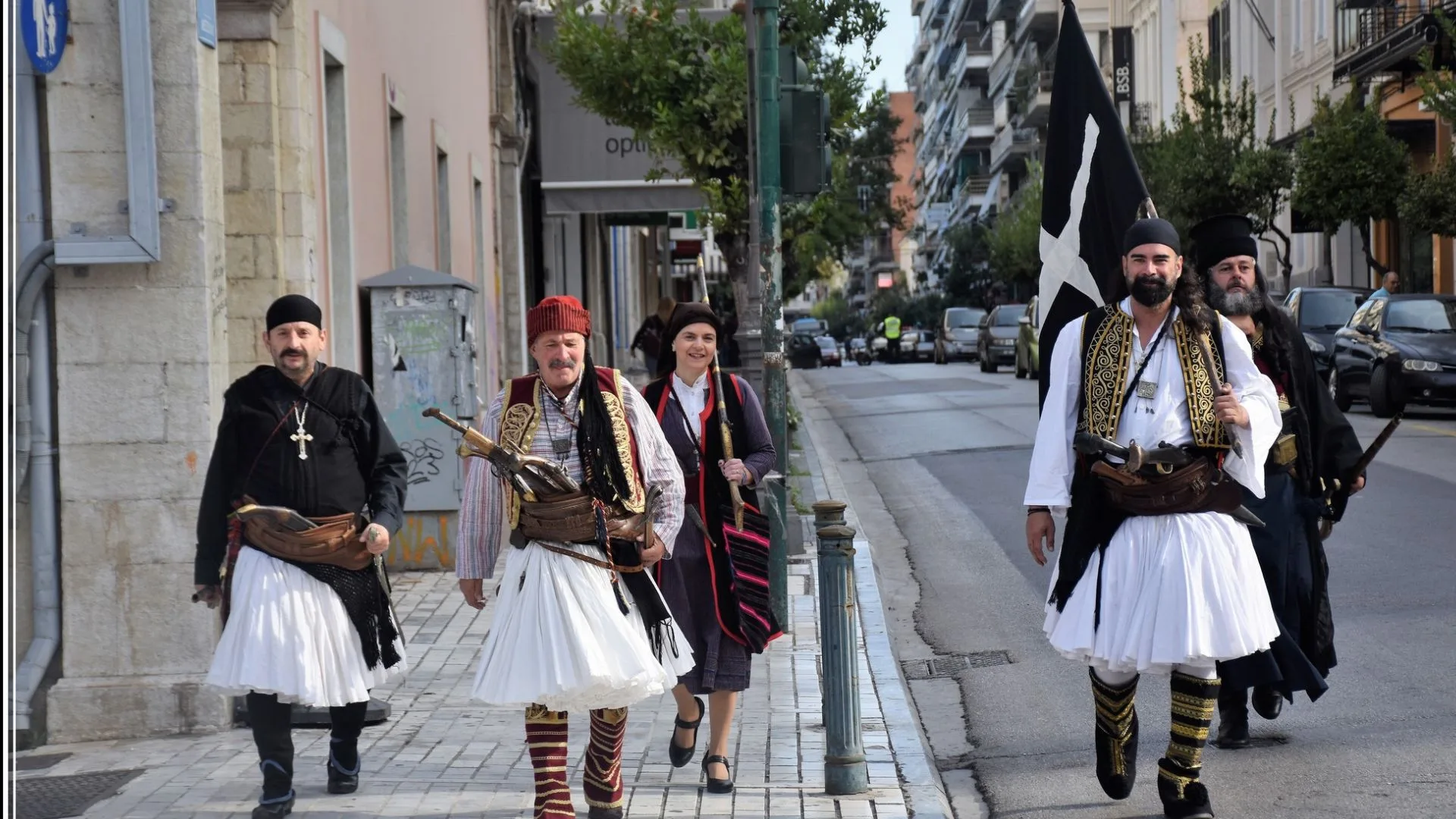
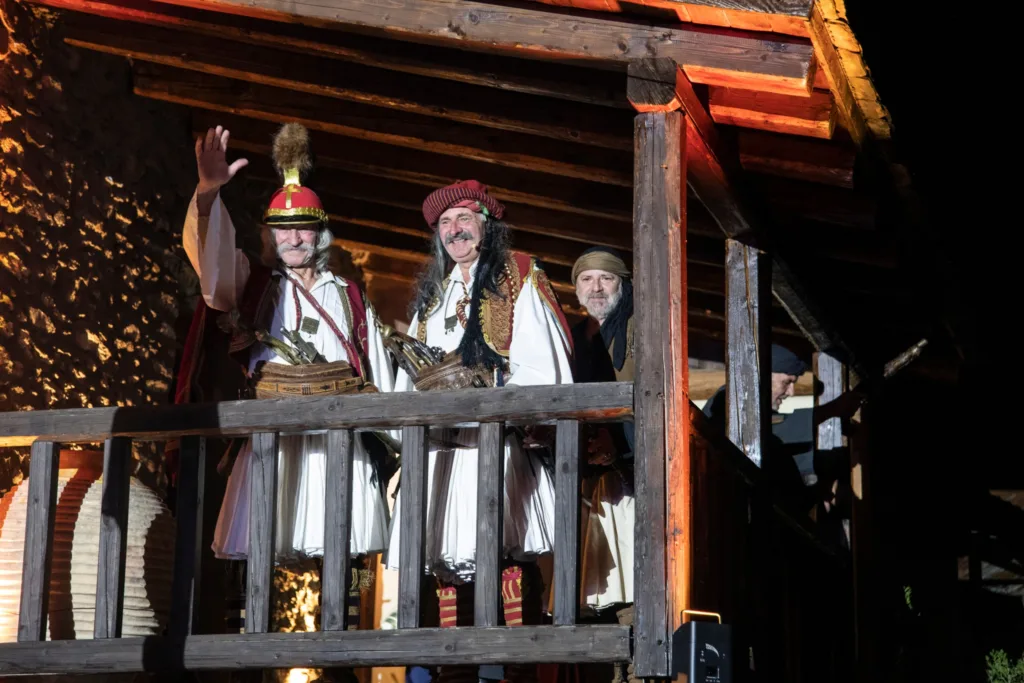
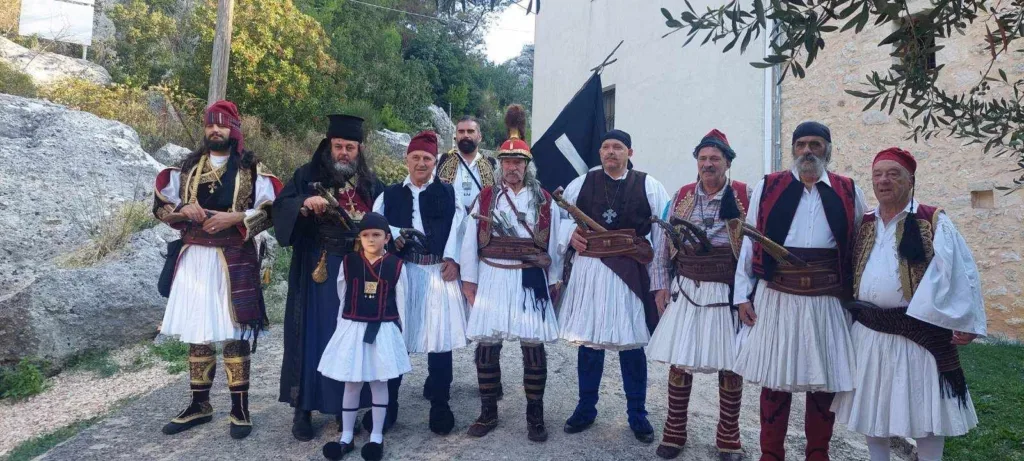
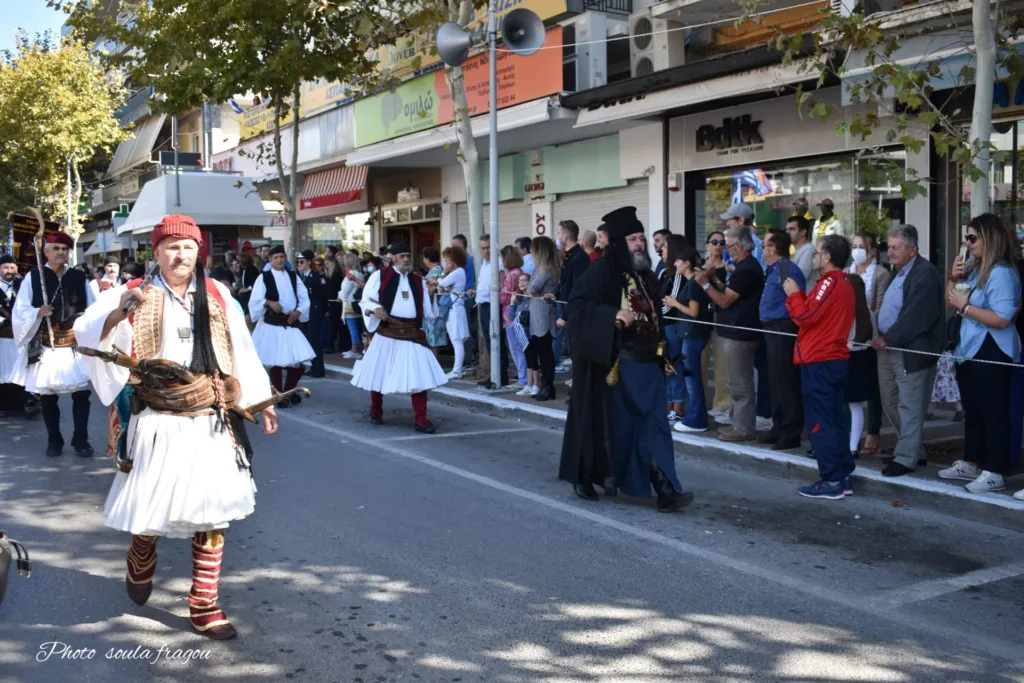
‘Adult dress-up groups’ was what I thought of the mainly medieval costumed people I had come across now and then. A mainly English peculiarity I surmised, until it hit closer to home… through my 60-year-old cousin and his wife here in Greece appearing on Facebook in ‘strange’ costumes resembling Greek Revolutionaries.
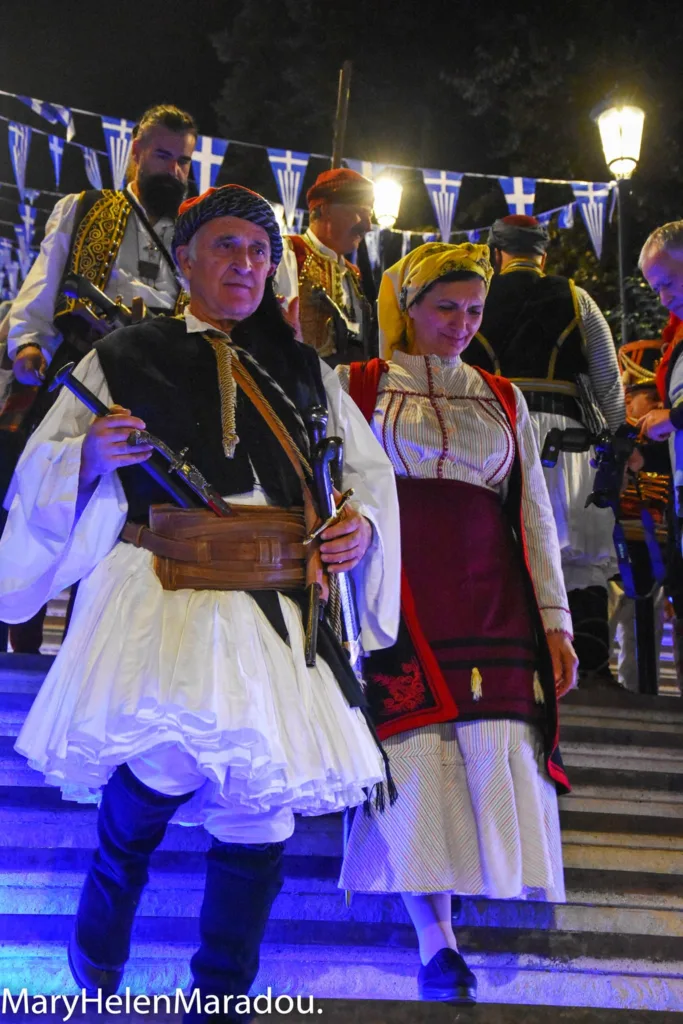
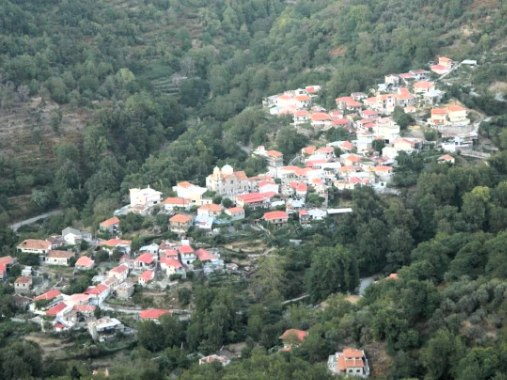
My curiosity now aroused, I wanted to know more about “re-enactment’ groups – the official title of this hobby dressing for historical homage purposes. I was introduced to the leader of my cousin’s group – Panagiotis Batsikouras, President of the Cultural Association of Nedousa (in the mountainous area of the Peloponnese around 20 kilometres above Kalamata).
He confirmed that the group’s dress is indeed that of the 1821 Greek Revolutionary period.
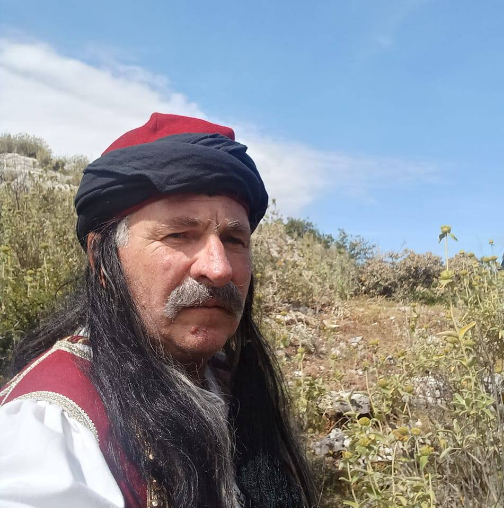
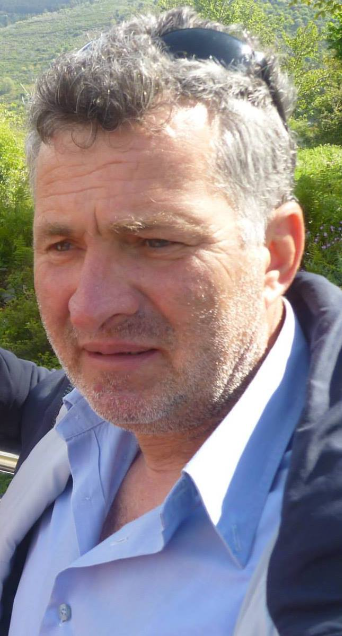
“We aim to re-enact and share with the public the customs and traditions of the Greek Revolution from 1821-1827; this important period of history when after 400 years under Ottoman Turk slavery, we liberated Greece. Our town Nedousa has produced many Greek revolutionary heroes, the most important one being Nikitaras (Nikitas Stamatelopoulos), a renowned brave warrior in his own right and nephew of Greece’s most famous independence fighter, Kolokotronis.”
Mr Batsikouras proudly asserts that Nedousa’s population of 750 people, saw 260 medals of bravery awarded to their revolutionaries in 1836 by King Otto. He also states that the Greek Revolution began on the 23rd of March 1821 in Kalamata, rather than on the generally accepted and celebrated date of 25th March of the same year.
“In a secret meeting in Vostitsa (present-day Aigio) organised by the famous revolutionary Ypsilantis in the presence of other famous chieftains such as the Old Fathers Germanos, Zaimis, Lordos and others, the official Greek Revolution was planned for March 25th,” Mr Batsikouras said.
“But, the attendees wouldn’t agree on the date. As a consequence, Papaflessas, another famous revolutionary at this meeting, declared in frustration that he’d call upon 1,000 Maniots, and 1,000 villagers from Mystra’s back-villages including Nedousa; brave fighter hubs.
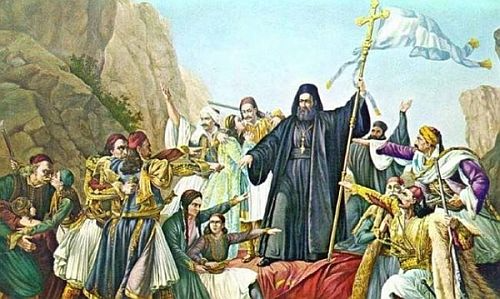
“This outburst saw the others quickly agreeing to the date of 25th March 1821, but it was an accident that caused the Revolution to officially begin in Kalamata on the 23rd March 1821.”
Mr Batsikouras continues: “This accident involved leaked gunpowder from barrels carried by donkeys! When the animals leaned down to drink from a waterhole near Kalamata, their barrels knocked into each other. The gunpowder, originating from secret storage at the famous Madraki Monastery above Nedousa, spilled out.
“This spillage led the Ottomans in the area to rightly suspect that the gunpowder meant Greeks planning a revolt. Kolokotronis and Nikitaras and other Greek fighters stopped the Ottomans taking this news to their administrative centre at Tripolis, by waging battle against them. This is how we, the Greeks, took Kalamata from the Ottomans – hence the first liberation of Greeks beginning on 23rd March, 1821.
“Many other revolutionary activities occurred around Greece after that, such as in Kalavrita, Mesologi, Souli, Karpenissi, Tripoli, Arahova, etc. We parade at these commemorative events along with other related re-enactment groups in Greece.”
Plays and talks at schools and other institutions are another feature of this re-enactment group’s activities. Mr Batsikouras narrates that parading at a children’s Cancer Foundation, he’ll never forget “the wonderment in the children’s eyes, which made me think whether it was us or them granting hope for the future.”
He adds, “We honour those who gave their blood for us, and we’ll only be successful if we pass on the knowledge of our ancestors brave sacrifices to our children.”
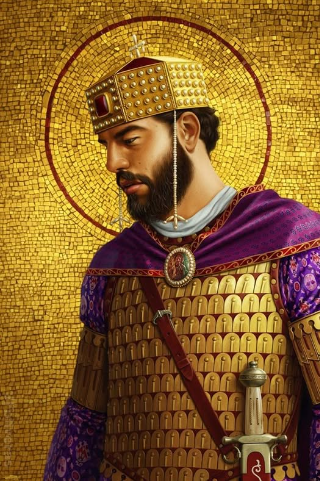
As Mr Batsikouras relates the re-enactments of his Nedousa group, I tell him that the intensity of this link between past and present leads me to envisage myself in Revolutionary attire! He asserts that some of their re-enactment attire has been made on an old loom, and that the women’s costume is based on old Byzantine Mystra dress (Nedousa belonged to that precinct).
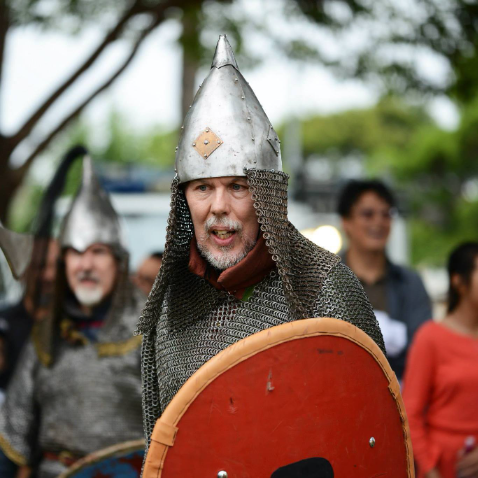
Referring to Byzantine, I also spoke with an Australian, Sydney based re-enactment group member of ‘The New Varangian Guard’, who deal with the Byzantine period of
history. Mr Chris Barnes, patiently explains to me that the Varangian Guard were the private army of the Byzantine emperor in the 10th century.
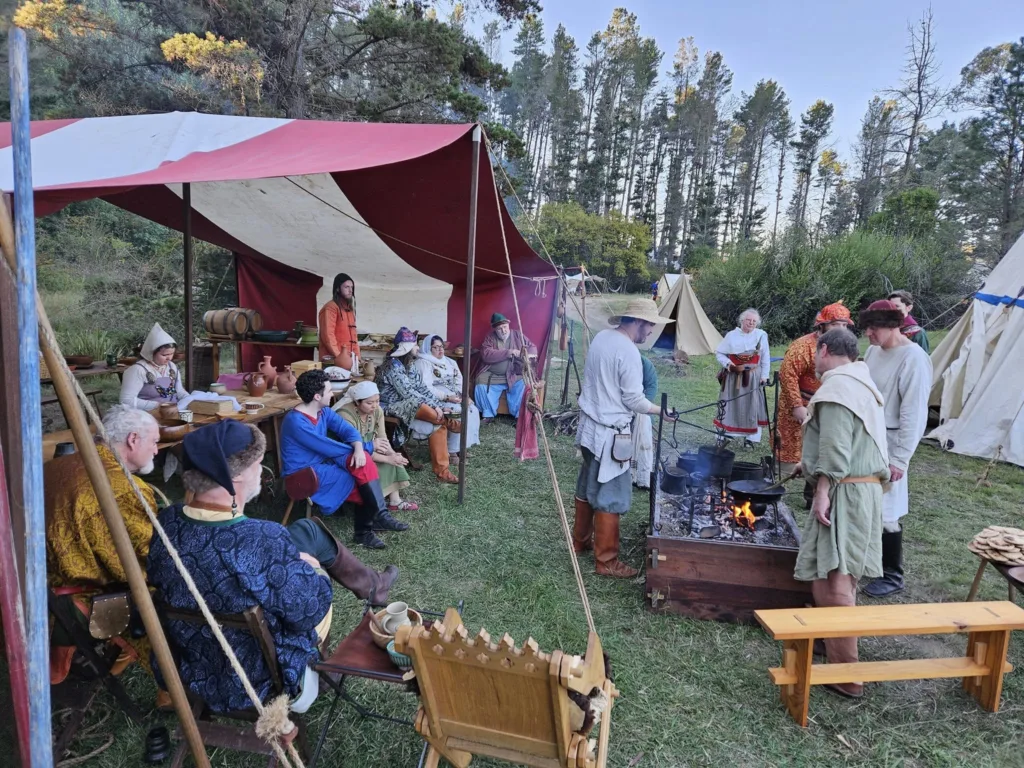
“The groups name ‘New’ Varangian Guard refers to that early period when 6,000 Rus and Norse warriors went there to serve the Emperor Basil II in 988, as part of the treaty between Basil and Prince Vladimir of Kiev at that time,” Mr Barnes said.
“The Guard lasted for centuries afterwards, and included many peoples such as Anglo-Saxons after the Norman conquest of England. Though we emulate that old, original group of Rus and Scandinavian warriors, we’re also open to club members who want to recreate the native Byzantine soldiers and people of the same period in Constantinople and the Empire. These include peoples such as the Khazars, Pechenegs, Bulgars and Arabic nationalities.”
Mr Barnes explains that he chose the ‘The New Varangian Guard’ period because of its broad focus for re-enactment.
“It was a rich empire, with many trade routes from East and West, meaning that we have more choices of people and materials to focus on. Silk fabrics and eastern spices are acceptable for us, whereas they were not so common in Anglo-Saxon England, for example. And it allows us to choose to represent a Rus warrior, or a Swedish trader, or a Khazar horseman, or a Byzantine Cataphract soldier, or many other options, as we choose,” he said.
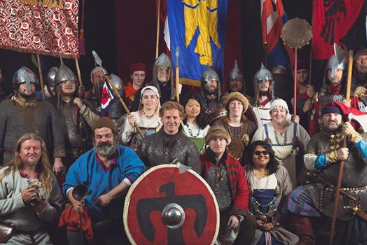
This group, like the Nedousa group, also provides enjoyment through spending time with like-minded people. Mr Barnes mentions ‘The Gathering’ in a pine forest every two years at Easter in Armidale, NSW.
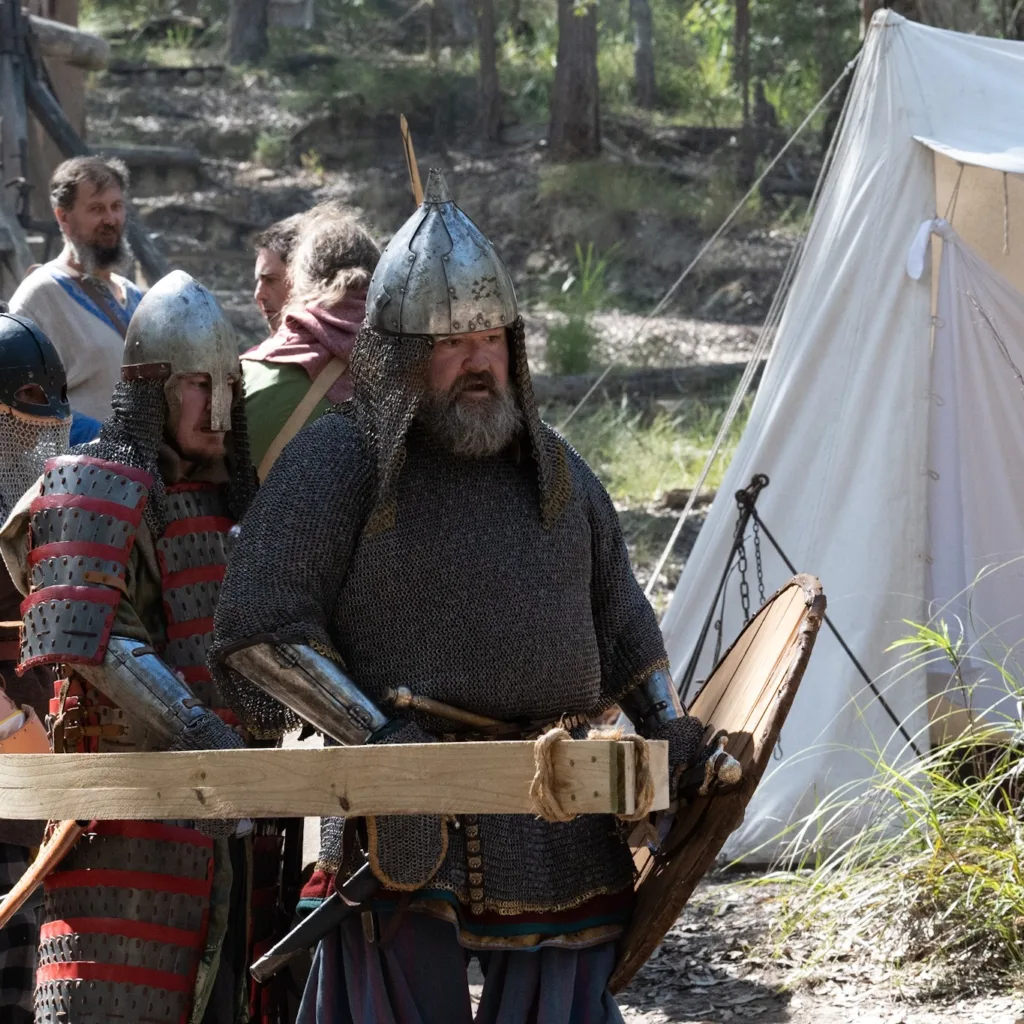
“Several hundred people from all these similar groups come together for a big camping event which includes battles, feasts and music,” he said.
Apart from leisure, Mr Barnes emphasises that he appreciates the research, care and commitment that goes into re-enacting.
“We look for authentic period documents and archaeology that tell us in detail about their clothing, their armour and weapons, the food they ate and so on. We want to wear what they wore, fight as they fought, eat as they ate,” he said.
“As much as possible, we use the same materials such as linen, wool and silk fabrics; dyes and colours that they could have used; the types of shoes and boots they wore and so on. There is plenty of good quality information on these subjects, both from academic experts and from some historical re-enactors who have also done excellent research.
“There are some aspects of the past that we can’t really recreate; for example, their religious beliefs and their understanding of the world are too far removed for us to emulate, even if we wanted to. So we don’t pretend that we are recreating everything … I think that in most respects we have better lives now. I like living in the age of electricity, internet, and modern medicine. But there is certainly something about the simplicity of past times that is attractive.”
Both Mr Batsikouras in Greece and Mr Barnes in Australia, unite in a different Greek Australian context, through the historical connection of their re-enactment groups: Byzantine and Modern Greece. Both feel a deep respect, awe and curiousity for the history of their fellow human beings who for various reasons tried to better their lives.

Apart from recognising it’s important historical and educational allure, Mr Barnes sums up re-enacting i
n a practical context as “a great way to just generally get away from the modern world for a little while… we all need a break from it sometimes!”
