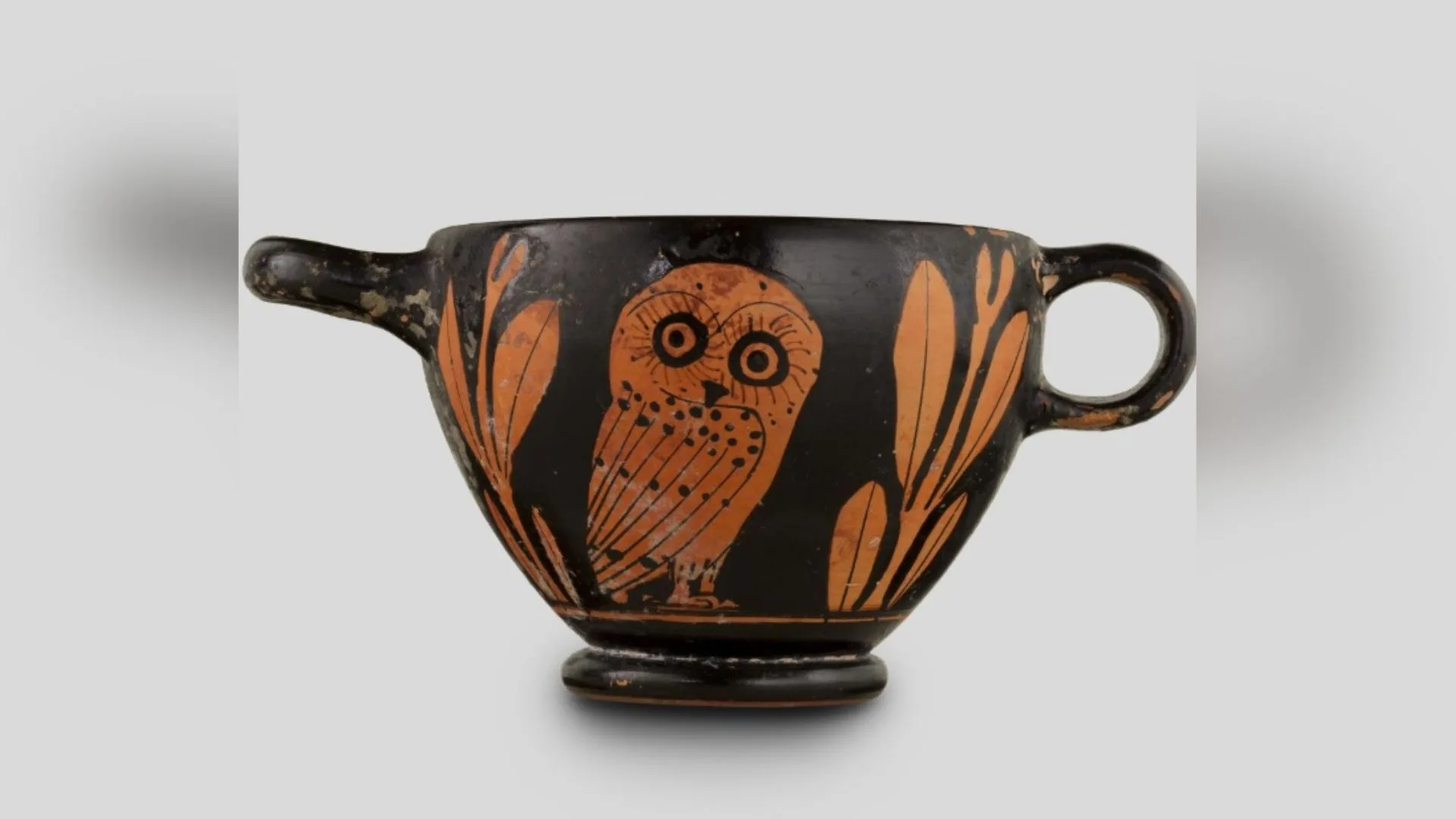
The owl is one of the most famous symbols of ancient Greece. Particularly associated with the goddess Athena, the bird was one identifying symbol of the ancient city of Athens, appearing on the city’s coinage for centuries.
In a major study of owls in Greek culture published in 2022 zoologists Bontzorlos, Johnson, Poirazidis and Roulin argued that “for five millennia, Greek civilization… used owls as a dominant symbol in major cultural expressions. Consequently, a broad spectrum of social beliefs evolved towards owls.”
Initially associated with funerary rituals, they were a creature of fear and respect. In the Classical period, when this vase was made, the birds were powerful symbol of wisdom, justice and power. Owls disappeared from the artistic repertoire of Byzantine Greece, but when they re-emerge over the past few hundred years, they have often had folkloric association with bad omens.
Even the ancient Greek name for the bird, glaux, represents this complexity. It is believed to have derived from the word glaukos or “brightness” which was probably in reference to their gleaming eyes.
This vase is in the collection of the National Gallery of Victoria in Melbourne and has been in Australia since the 1890s. It is currently on public display. The vase was made in Athens and manufactured at the height of the city’s experiment with democracy in 450-425 BCE.
It is made in the most popular style of vase decoration of the era, what we now refer to as red-figured. The black-coloured background is created by the application of a slip that turns black during firing, as are detail lines in the bird and leaves. The reddish colour of the figure is the natural colour of the clay of the vase.
The vase is a shape called a skyphos. Skyphoi were two-handled deep wine-cups with a low base, and two handles. It was a shape that was popular for centuries. But there was a specific form of skyphos that had one horizontal handle and one vertical thumb-hold handle. Guess what this types of vase was called? The glaux!
The glaux were thought to represent the shape of the owl and were incredibly popular when Athens was at its most powerful in the second half of the fifth century BCE. It’s even been suggested by some scholars they may have be used almost like souvenir mugs are today.
The cup in Melbourne features an image of an owl between two sprays of laurel; an image repeated on both sides of the cup. Feathers are decorated with black dots and the birds have dark eyes.
The owls watch us; all-powerful and all-wise.
Artefact details:
Red-figured glaux skphos
c. 450-425 BCE
Unknown findspot
National Gallery of Victoria, Melbourne, Inv. 80R-D1Ahttps://www.ngv.vic.gov.au/explore/collection/work/485/
