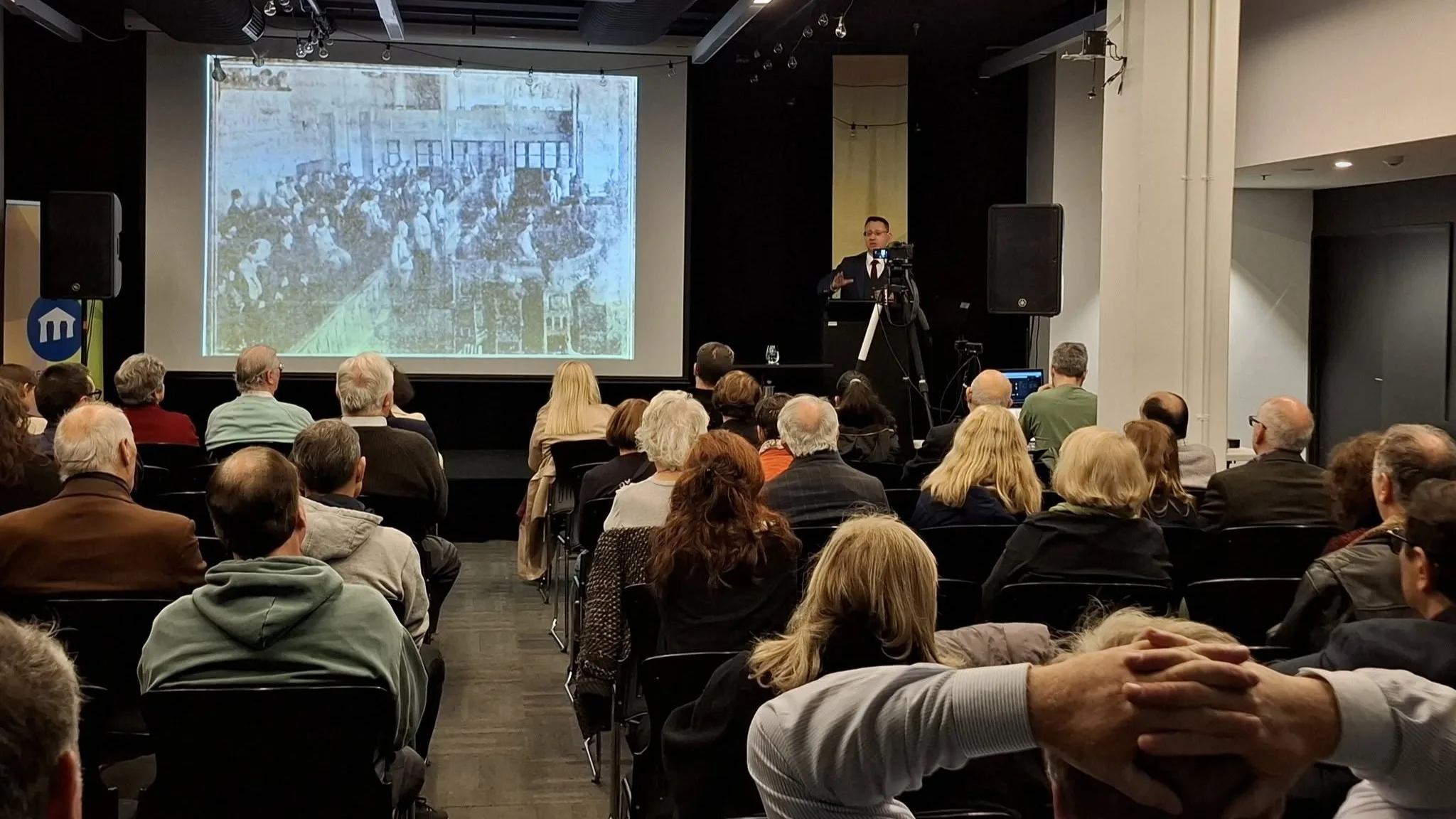
In a packed auditorium at the Greek Centre in Melbourne on Thursday, May 22, noted writer and lawyer Dean Kalimniou delivered a stirring lecture on one of the least-discussed chapters of post-World War I justice: the 1919 Constantinople Military Trials.
His talk, titled “Judgment Day: The Ottoman Empire’s Reckoning with Itself,” offered a rare and in-depth look into the series of court proceedings that sought to hold Ottoman leaders accountable for war crimes— including the Greek and Armenian Genocide.
“The Constnatinople Trials were an early, imperfect attempt at transitional justice — long before the term even existed,” Mr Kalimniou told the audience. “They revealed not just the depth of state-sponsored violence, but also the fragility of legal systems under political pressure.”
The 1919 tribunals, convened by the short-lived post-war Ottoman government under Allied occupation, aimed to investigate and prosecute members of the Committee of Union and Progress (CUP), the ruling faction during the war. Key leaders such as Talaat Pasha and Enver Pasha were indicted for their roles in orchestrating the mass deportations and killings of Armenians and Greeks — acts now widely recognised by historians as genocide.
Mr Kalimniou traced the arc of the trials, noting that while some lower-level officials were convicted, most high-ranking leaders evaded justice by fleeing the country. Many were tried in absentia. The trials ultimately collapsed with the rise of the Turkish nationalist movement led by Mustafa Kemal Atatürk, and their records were suppressed or forgotten for decades.
“These proceedings matter because they show that the Ottoman state — at least for a brief moment — acknowledged wrongdoing,” Mr Kalimniou maintained. “Even though justice was not fully served, the trials documented crimes that were otherwise denied or ignored.”
The lecture concluded with a Q&A session during which audience members asked about the trials’ relevance to modern international law. Mr Kalimniou pointed out that the Constantinople Trials set a precedent, however flawed, for the later Nuremberg Trials and contemporary war crimes tribunals.
The event was co-organised by Pontiaki Estia as one of the events commemorating the Greek Genocide and the Greek Orthodox Community of Melbourne as part of its weekly History and Culture Seminars. The organisers expressed the hope that the lecture sparks a broader conversation about historical accountability and the effectiveness of international jurisprudence in preventing crimes of Genocide.
At the conclusion of the lecture, Pontiaki Estia President Kon Tseprailidis referred to Mr Kalimniou’s important role in raising awareness of the Greek Genocide and campaigning for its recognition, presenting him with a memento to mark 25 years of continuous activism in this field.
