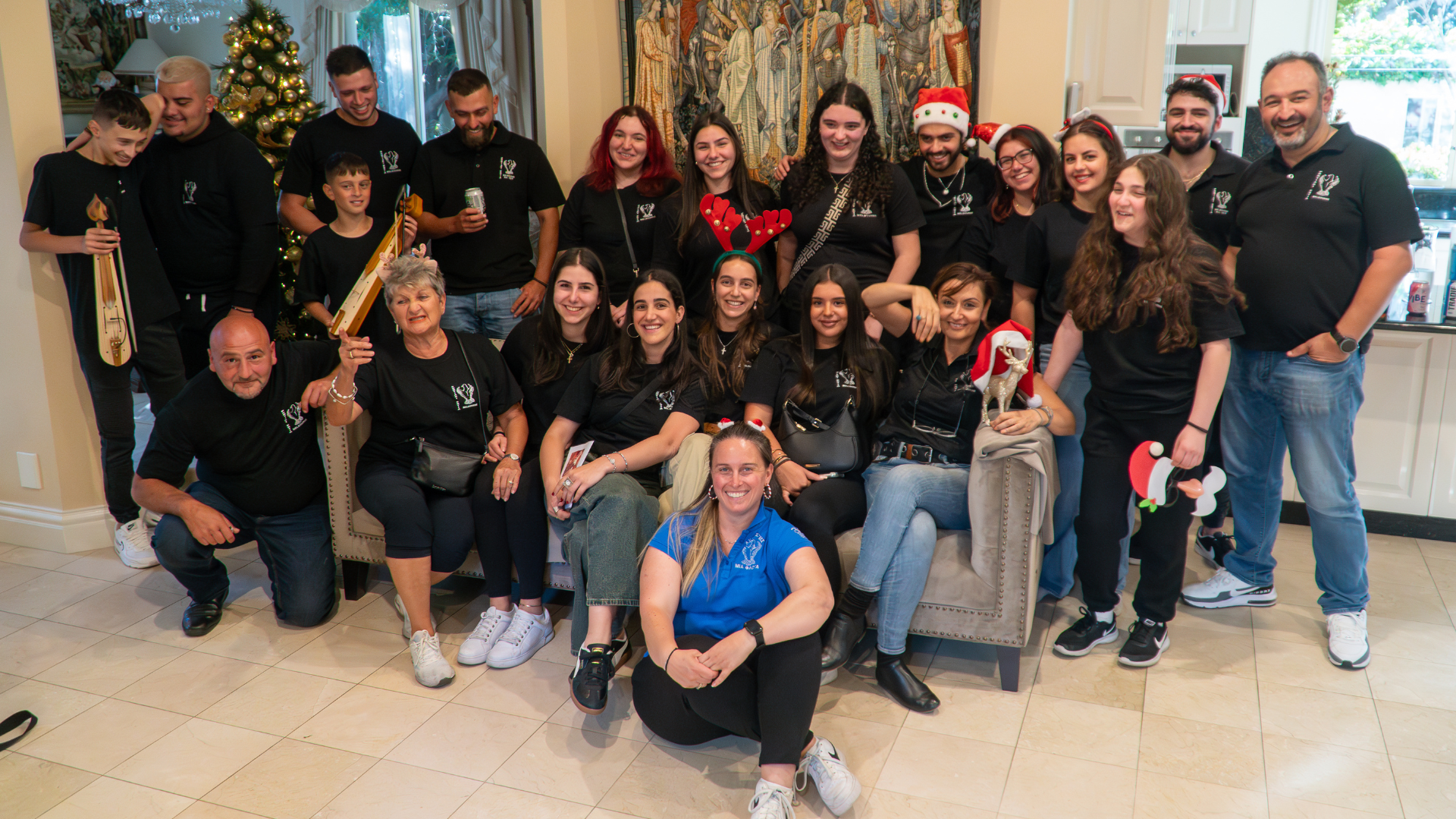
Step inside the Stamatopoulos home on Christmas Day and the heat outside evaporates. Around the table sit yiayia Ioanna Eleftheriadis, Simela and Jim Stamatopoulos, and their now adult children, Martha and Panos. The extended family also fill the house. Generations gather, laughing, tuning a Pontian lyra, and flooding their Melbourne home with the unmistakable warmth of a Greek Christmas.
Inside, the air smells of roasting meats and pites; the lyra warms up for carols; children thread tinsel through the branches. It’s part Pontos, part Macedonia, part Sparta, entirely Melbourne, and unmistakably Greek.
It all started with Ioanna
Yiayia Ioanna arrived in Australia on 18 November 1972, pregnant with Simela and overwhelmed.
“My sister had this giant Christmas tree with lights and decorations,” she recalls. “But it was so hot. Christmas without snow? I didn’t understand anything.”
Back in her Macedonian village, Christmas was a winter fairy tale: fresh snow, hand-cut trees stuffed with cotton, new shoes and coats, and the long, magical walk to church at dawn. Her mother cooked the Pontian classic keshkek (chicken with wheat) – “the most delicious thing in the world,” Ioanna still sighs.
She never recreated the dish in Melbourne, though she still has the recipe. What she did carry, and pass on, was something deeper.
“The feeling is what you keep,” she says. “When you experience something as a child, you love it forever.”

Simela’s childhood
Greek school concerts. Koumbaroi visits. A house overflowing with relatives. And the annual trapezi, the sprawling Christmas table straight out of the Alphavitario with etchings by Kostas Grammatikopoulos – the classic Greek schoolbook that portrayed traditional life, big families, and tables glowing with love and connection.
“Christmas is a day that symbolises family,” Simela says. “The warmth you find at home, you don’t find anywhere else.”
And then there were the kalanta, a joy many Greek Australian children never experience.
“We went door to door,” she laughs. “People cooking pites would pull one straight from the oven and hand it to us. We’d come home full just from treats.”
The cassette tapes and keyboards of the ’80s eventually gave way to lyres, modern Greek kalanta eventually were sung in the Pontian dialect. Today, the younger generation arrives at doorsteps with three Pontian lyres, playing carols house to house, a Melbourne tradition the neighbours hear long before they see.
Pontian Estia provided the rest: Christmas parties, gifts, dances, music, belonging.
“We were never alone,” Simela says. “We never felt like a minority.”
Jim, the Spartan perspective
Her husband Jim didn’t grow up with Greek associations or Greek school; his Hellenism was formed in Sparta itself during childhood visits.
“In ’74 and ’80 we went back to Greece,” he recalls. “Life was different there. We felt free. That feeling never left me.”
With his Australian friends, Greek culture wasn’t discussed. With his children, it would be different.
“If my kids ever rejected their culture, I’d take them to Greece,” he says. “After that, it’s their choice.”
In his household, tradition isn’t gendered. “There are no men’s or women’s jobs,” Jim says. “Whoever can help, helps.”
A quiet but radical shift from Ioanna’s era.
Martha keeps the magic alive
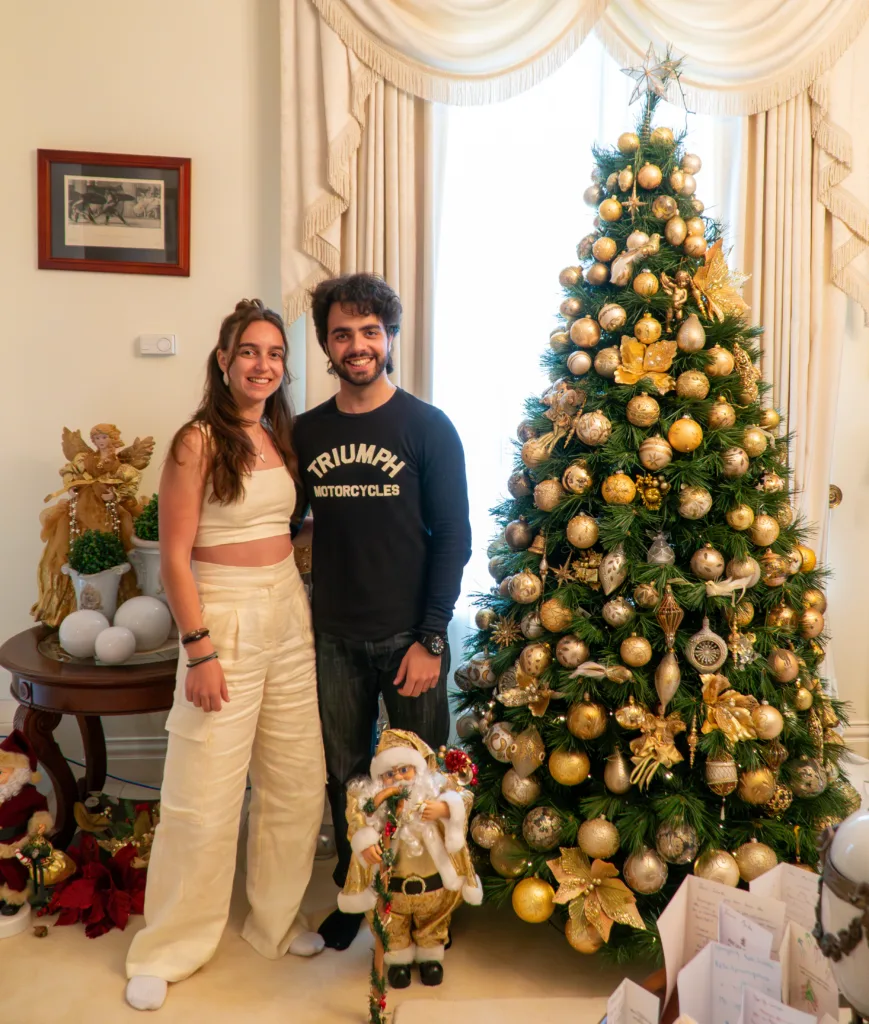
Martha’s childhood memories are golden: decorating the tree, writing letters to Santa, sprinting to the living room on Christmas morning, singing kalanta with Pontian Estia, then driving through Ivanhoe to see the lights. Year after year, photos were taken under the same tree, an archive of growing up Pontian Greek in Melbourne.
She still honours the Greek custom of opening gifts on New Year’s. “If someone gave me a present early, I’d leave it under the tree,” she says. “Otherwise it ruined the magic.”
Now active in Pontian Estia, the Pallaconian Brotherhood, and even Cretan groups, she has become a young custodian of Greek identity. As education officer, she even pushed NUGAS to speak Greek for ten minutes at every meeting. “It worked,” she smiles.
Panos brings the philosophy
“When you’re a kid, you don’t ask why you do traditions,” he says. “You just follow them without realising. When you grow up, you understand their importance.”
Greeks who keep traditions, he believes, understand each other instantly “in a way that can’t be expressed in words.”
It’s a connection forged through upbringing, a creation of an identity that he sometimes sees shifting away in Greece but his upbringing, he says, is the Hellenism he knows.
When the lyra comes out, Panos says he doesn’t intellectualise it as being Greek or following customs and traditions. “It’s just what we do,” he says, an organic part of his identity.
Together, youth play Pontian versions of the kalanta, echoing the tradition revived each year when Pontian youth serenade households and community centres, just as villagers once did. Music connects generations.
A Stamatopoulos Christmas
A Stamatopoulos Christmas isn’t a collection of separate moments – it’s a living tapestry.
It’s Greece of yesterday and Australia of today woven into one story, keeping the best of values.
Three generations shape this feast: Ioanna brings the nostalgia. Simela and Jim bring the balance. Martha and Panos bring the future.
Together, they’ve created something special: a Christmas lived, loved, sung, roasted, photographed, danced, and passed on, one warm, noisy, heartfelt December at a time.
