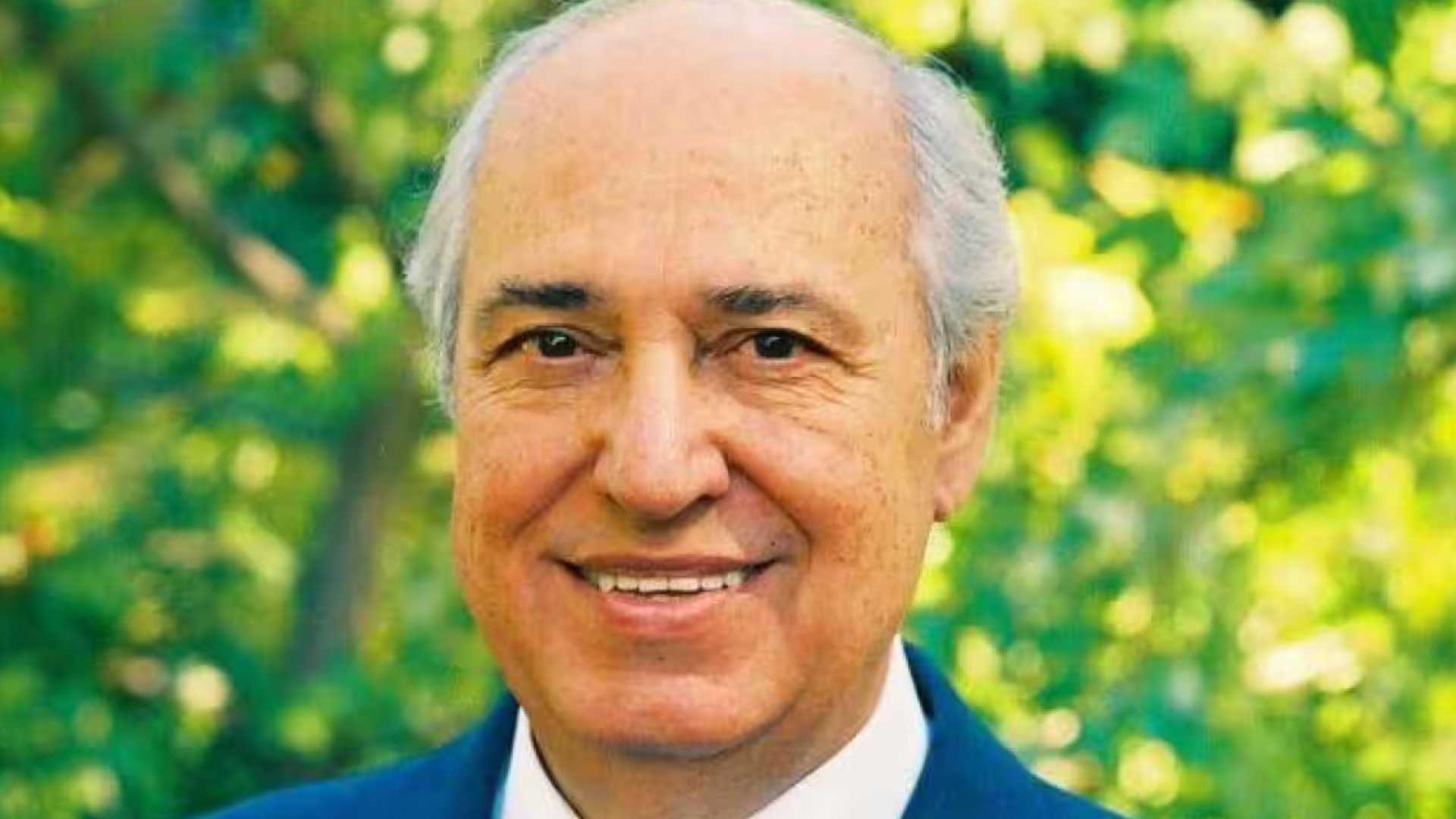
By Theodoros Dalmaris
Professor George Kanarakis, of the School of Humanities and Social Sciences at Charles Sturt University in Australia, has passed away — yet through his work, he remains very much alive. His scholarship, perhaps uniquely, demonstrates the diachronic contribution of the Greek language to other languages of the world.
A scholar who did what institutions did not
As linguist Nikolaos Kondosopoulos, Ph.D., observed in his foreword to Kanarakis’ seminal work The Diachronic Contribution of Greek to Other Languages, such a task should have been undertaken by Greece’s philological faculties, the Academy of Athens, or by established linguists. “It was done by George Kanarakis,” he wrote.
In this work, Kanarakis identified and documented the Greek influence across more than 30 world languages — a list spanning Latin, Italian, French, Spanish, Portuguese, Romanian, English, German, Dutch, Afrikaans, Swedish, Danish, Russian, Polish, Bulgarian, Croatian, Albanian, Finnish, Hungarian, Turkish, Georgian, Hebrew, Arabic, Maltese, Thai, Korean, Japanese and Chinese. He also noted that this catalogue did not exclude many other global tongues where Greek’s imprint can still be found.
The voice of scholars across centuries
Kanarakis’ research was reinforced by the testimony of eminent linguists and thinkers:
- David Crystal, emeritus Professor of the University of Wales: “Some writers have begun to speak of … Euro-Greek.”
- Horace (Quintus Horatius Flaccus): “… both the new words and the newly-minted will be trustworthy if they spring from a Greek source, sparingly altered.”
- Francisco Rodriguez Adrados, emeritus Professor of Linguistics, Spain: “Our European languages are a kind of crypto-Greek.”
- Professor Kornthartim of Ramkhamhaeng University, Thailand: “It would be fitting to fashion a new, more comprehensive term, such as ‘global-Greek’.”
Other scholars have stressed that only two languages — Greek and Chinese — have survived unbroken for 3,500 years while exercising profound cultural and linguistic influence beyond their borders.
The Greek language, with its unparalleled wealth of vocabulary and ability to generate new words, remains embedded in modern European tongues, sometimes hidden, sometimes transparent, but always alive.
A life shaped by history
Kanarakis’ intellectual journey was deeply rooted in his personal history. A descendant of Asia Minor Greeks uprooted by the Ottomans, he carried the trauma of displacement but transformed it into a life’s mission.
He travelled the world, mastered linguistics, and traced the origins of Greek civilisation and language to their furthest reaches. Through his research, he opened “a window onto this unique miracle,” offering a renewed vision of Greek cultural and linguistic achievement.
This contribution, particularly at a time when Hellenism faces decline, is invaluable. As one tribute put it, his work represents “an inestimable contribution to the revitalisation of the Greeks, who unfortunately, in their steep descent, emit their death-rattle.”
Mentor, thinker, human being
Beyond his academic accomplishments, Kanarakis was remembered as a mentor and guide. I had the fortune to know him both in Athens and in Australia, and the honour that he was one of my mentors and an enthusiastic reader of my books.
He characterised them as works of special interest, priceless and of historical importance, which touch deeply the heart of the reader, educate and awaken, while providing continuous noble motivation for the younger generations of Greece and for Hellenism scattered across the world. For me, he was a guide.
Professor Kanarakis possessed a rare combination of simplicity, wisdom and scholarly rigour. He managed to break the boundaries of time and become immortal. Together with thousands more initiates of the unparalleled Greek spirit, he showed that the Greek did not come to die, but to glorify the human race and to give meaning to the miracle of Creation.
Eternal memory
For Hellenism, Professor Kanarakis will remain a beacon. His scholarship has enshrined Greek’s enduring contribution to world culture and language, while his character and life story reflect the resilience of a people who transformed exile and displacement into knowledge and light.
His memory will be eternal, a beacon to guide us, together with countless luminous pioneers, through difficult times, along the way of immaculate light.
