The future of Greek Australian media will be in the spotlight next week during a special panel discussion with some of the industry’s leading publishers and editors.
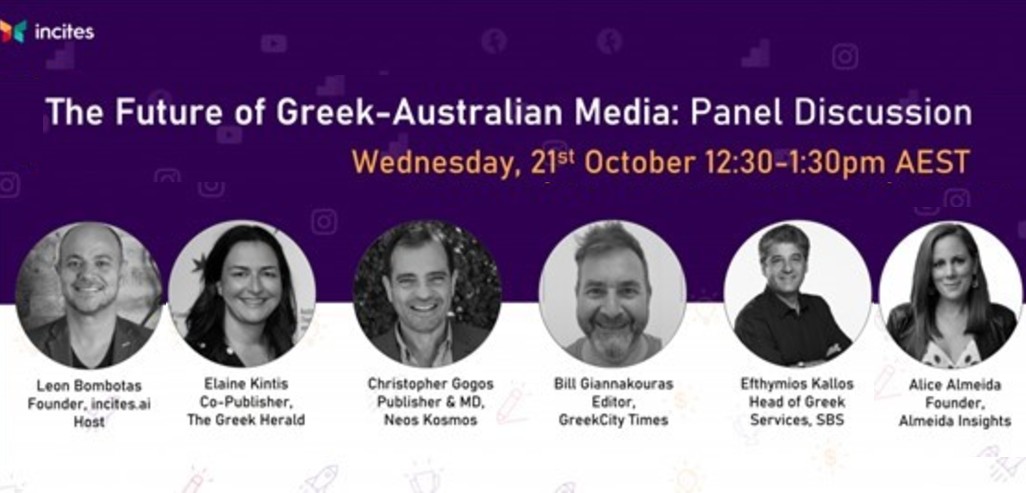
The event, organised by next-generation analytics platform Incites, will be held via Zoom on October 21st from 12.30pm – 1.30pm, and will address the current issues faced by the Greek language media in Australia.
Hosted by Leon Bombotas, the founder of Incites, the panel discussion will feature co-publisher of The Greek Herald, Elaine Kintis, Publisher and MD of Neos Kosmos, Christopher Gogos, Editor of Greek City Times, Bill Giannakouras, Head of Greek Services at SBS, Ethymios Kallos, and founder of Almeida Insights, Alice Almeida.
“Greek Australian media is an essential part of the historical and cultural identity of the Greek diaspora in Australia. The Greek Herald is the largest national daily publication and has been a part of our tapestry for 94 years,” co-publisher of The Greek Herald, Elaine Kintis, says.
“With our recent digital transformation, we have a significant role to play in shaping the future of Hellenism in Australia by promoting Greek values, language and culture for years to come.”

Some current challenges faced by Greek Australian media which will be discussed during the panel include:
- The Greek-Australian population is large but the numbers of Greek speakers are in decline. Roughly 420,000 people identified as Greek in the 2016 Census. Of these, 237,000 speak Greek at home, making Greek the 6th most spoken language (other than English). While this is a large group, it has been in decline since the last Census.
- Print is in decline and while digital media is still growing, it is difficult to monetise. While the internet and digital media has helped brands reach new audiences and grow a following very quickly, Google and Facebook are making it difficult for anyone to generate revenue from advertising.
- COVID-19 has been a massive game-changer in terms of how people use live video online.
- There is an appetite for stories written by Greek-Australians that provide a unique lens on local and global events. But is there enough of an appetite to pay for this content through advertising, subscription or other means?
If you would like to attend, there are only 100 places and registration is necessary via this link.