By Lisa Radinovsky from Greek Liquid Gold.
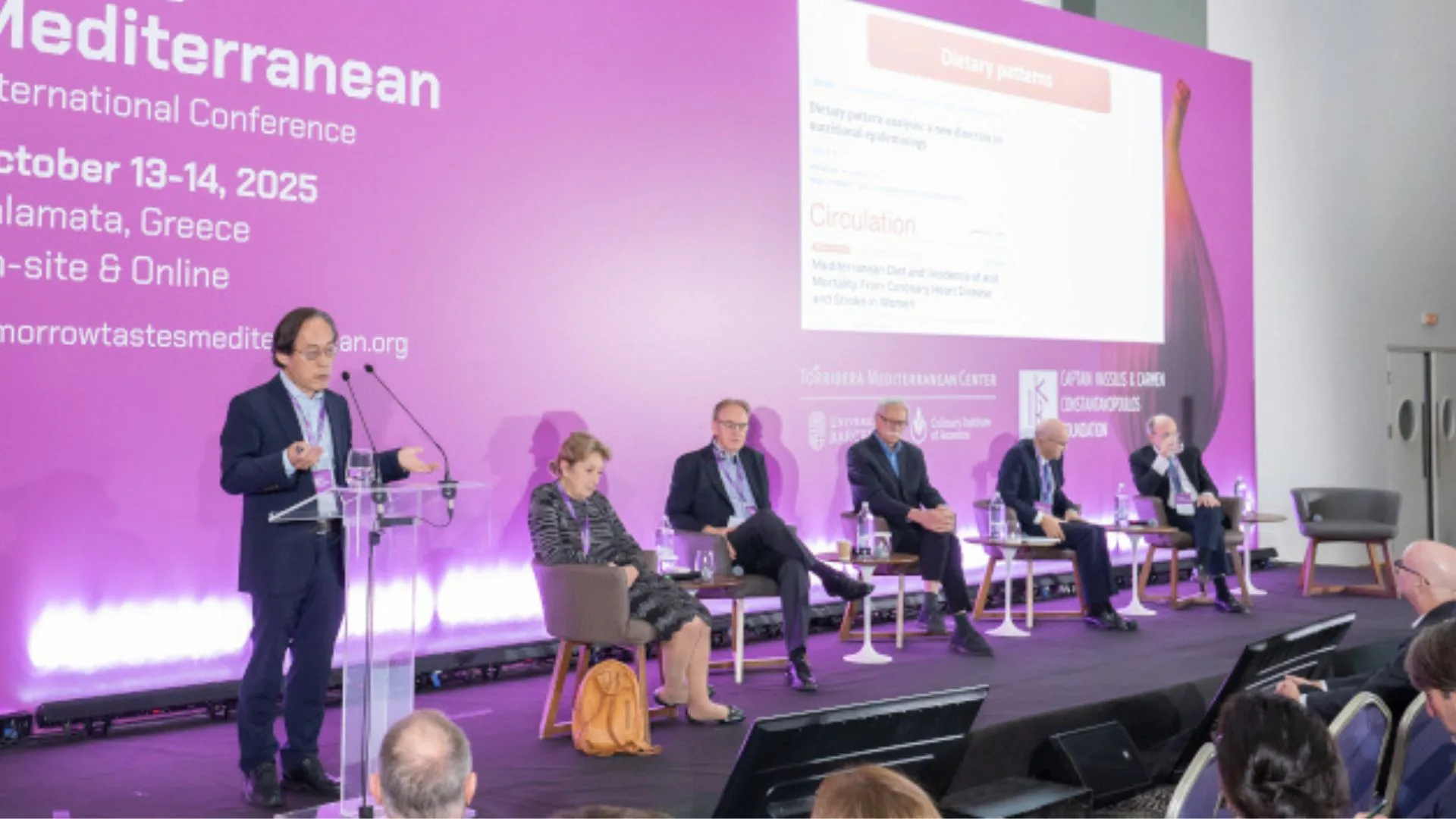
A Mediterranean diet conference drew globally acclaimed researchers to Kalamata, Greece October 13-14. They joined a multi-disciplinary group of professionals to discuss that traditional diet’s potential benefits for human and planetary health. Speakers called for the widespread adoption of plant-rich diets like the Mediterranean or Planetary Health Diet.
Looking back to the past and the origin and treatment of the traditional Mediterranean diet, presenters at the 6th International “Tomorrow Tastes Mediterranean” conference emphasized the importance of dietary decisions for the future of the planet and its inhabitants. Considering modern studies and technology in such fields as genomics and metabolomics, scientists provided extensive evidence for health and sustainability benefits rooted in past practices and traditional Mediterranean dietary patterns. Valuing lessons and customs from previous generations, chefs and communicators also celebrated contemporary variations of Mediterranean dishes likely to appeal to consumers today and tomorrow.
Tradition and Innovation, Connection and Diversity at the Mediterranean Diet Conference
Chef, author, and TV host Diane Kochilas talked about “balancing tradition and innovation” in “a story of continuity and creativity, of roots and renewal” based on Mediterranean cuisine and lifestyle. Greek Wine Federation president Stelios Boutaris advised, “take the heritage, and bring it to the next level.” Gastronomic director María José San Roman proposed that chefs can be educators who act as both “ambassadors of change” and “custodians of cultural heritage,” engaging in “innovation with roots.” Greek chef Manolis Papoutsakis encouraged listeners to “understand tradition so deeply that you can reinterpret it.”
In a session on the Mediterranean Diet in the World, one of San Roman’s slides highlighted “The Great Convergence” of foods from Latin America, Asia, and Africa in the Mediterranean region. “This ‘nuclear fusion’ ignited the Mediterranean spirit—a cuisine born from connection and diversity.” We might add that the people of the olive growing areas around the Mediterranean Sea combined tomatoes and potatoes originating in Latin America, rice and citrus from Asia, and pulses and slow cooking methods from Africa in a set of cuisines bound together by olive oil.
The EAT-Lancet 2.0 Commission Report at the Mediterranean Diet Conference
The focus of discussions at the conference ranged from healthy microscopic bioactive compounds found in foods such as greens, herbs, mastic, olive oil, and tomatoes, to a consideration of the huge impact global food systems have on the planet, its climate, and its people. One of many newsworthy sessions was dedicated to the just-published 2025 update of a 2019 report by the EAT-Lancet 2.0 Commission on Healthy Diets from Sustainable Food Systems.
As Ellen Cecilie Wright, Senior Science Officer at the international non-profit organization EAT, explained, the Commission’s goal is to overcome a variety of challenges to make “healthy food accessible to all—produced, processed, distributed, and consumed fairly within planetary boundaries”—that is, within the limits of what the earth can handle without worsening the negative effects of climate change. (The full EAT-Lancet report is available here, while a brief summary appears here.)
The Mediterranean Diet and the Planetary Health Diet
The Planetary Health Diet (PHD) is the Commission’s proposed model for a healthy, sustainable, just diet. Walter Willett, Professor of Epidemiology and Nutrition at Harvard T.H. Chan School of Public Health and Co-Chair of the EAT-Lancet Commission, reported that there has been growing scientific evidence for the health benefits of the PHD since it was first presented in 2019. According to Willett, the Planetary Health Diet includes
• plenty of fruit and vegetables, whole grains, healthy fats, nuts, and legumes
• (optional) modest quantities of meat, poultry, dairy, and eggs
• little or no red meat or added sugar
“That’s really a description of the traditional Mediterranean diet that’s mostly plant forward,” Willett observed. It enables “lots of flexibility,” since it is important “to provide as many paths to a healthy, sustainable diet as possible.” Traditional diets in many other parts of the world also resemble the PHD.
In addition to benefitting human health, the Planetary Health Diet can lead to substantial decreases in
• fertilizer and irrigation water use
• greenhouse gas emissions
• cropland use
Willett believes “we are on a path leading to ecological disasters and a sick and unstable global population.” On the other hand, if the PHD is widely adopted, it will be possible to feed “10 billion people a healthy and sustainable diet,” while leaving “our children a viable planet.”
The Mediterranean / Planetary Diet, To Save Humanity from a Broken Food System
Dimitris Karavellas, CEO of WWF Greece, agrees that “the global food system we have today is broken; it’s entirely unsustainable. It’s responsible for about a third of our global greenhouse gas emissions. It’s the main driver of biodiversity loss and tropical deforestation. And on top of that, … our dietary choices are also damaging our health” due to “either excess or insufficiency.”
Karavellas goes so far as to suggest that “today unhealthy diets pose a greater risk of disease and mortality than – many would say – unsafe sex, alcohol, drugs, and tobacco use combined.” However, Karavellas is encouraged by the EAT-Lancet report’s claim that “sustainable diets could actually save up to 15 million lives every year, and cut food related emissions.” He calls for the widespread adoption of plant-based diets in order to both feed the world and restore nature, so humans can continue to live on earth.
Natassa Kannavou, Co-Founder of the Digital Democracy Foundation, believes many people find environmentalist arguments unconvincing. So she encourages communicators to advocate actions that can help us save ourselves and our health—which actually involves saving the planet as well.
In another session, EAT’s Ellen Cecilie Wright asserted that two-way communication is crucial. Everyone needs to understand the scientific evidence for a healthy, plant-forward diet, and also provide “feedback on what they need” to “translate this into action.” For example, she expects farmers to need practical and financial support if they are asked to switch from livestock to crops. If farmers are shown how recommendations will benefit them, Vasilios Gkisakis, a researcher at the Greek National Agricultural Research Foundation, believes they will act, perhaps by planting cover crops or using compost.
Olive Oil’s Importance for People and the Planet
International Olive Council Executive Director Jaime Lillo pointed out that the olive oil that is central to the traditional Mediterranean diet is an important part of the recipe for both human and planetary health. As Lillo reported, olive groves can
• support biodiversity and soil conservation
• act as a barrier to desertification
• help combat climate change
“Olive trees act as carbon sinks. They store CO2 in their woody structures and the soil in a permanent and stable manner. Olive groves capture 4.58 tonnes of CO2 per hectare annually. Producing 1 liter of olive oil removes 10.65 kg of CO2 from the atmosphere.” Fortunately, olive oil production has doubled worldwide since the early 1990s. Consumption has also grown. From “the center of the Mediterranean diet,” olive oil use has been “expanding in the planetary diet,” helping people eat more vegetables in a plant-forward diet.
As Extra Virgin Alliance Director Alexandra Kicenik Devarenne pointed out, olive oil is “healthy for the person, it’s healthy for the planet, and it makes cooking easier. Olive oil makes healthy food delicious.” How can people easily make this delicious food at home? Chef Manolis Papoutsakis advises using plenty of olive oil and focusing on seasonality, locality, sustainability, and simplicity—all features of a traditional Mediterranean or Planetary Health Diet.
*Originally published on Greek Liquid Gold: Authentic Extra Virgin Olive Oil (greekliquidgold.com). See that site for recipes with olive oil, photos from Greece, agrotourism and food tourism suggestions, and olive oil news and information.
