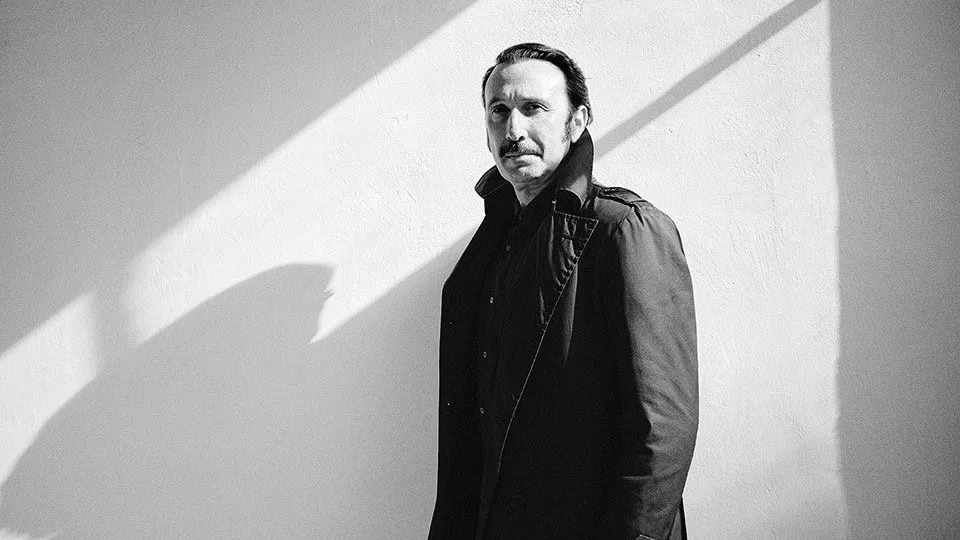
By Ilias Karagiannis
Sometimes life feels like a film. Not because reality imitates imagination, but because imagination becomes the only way to endure reality.
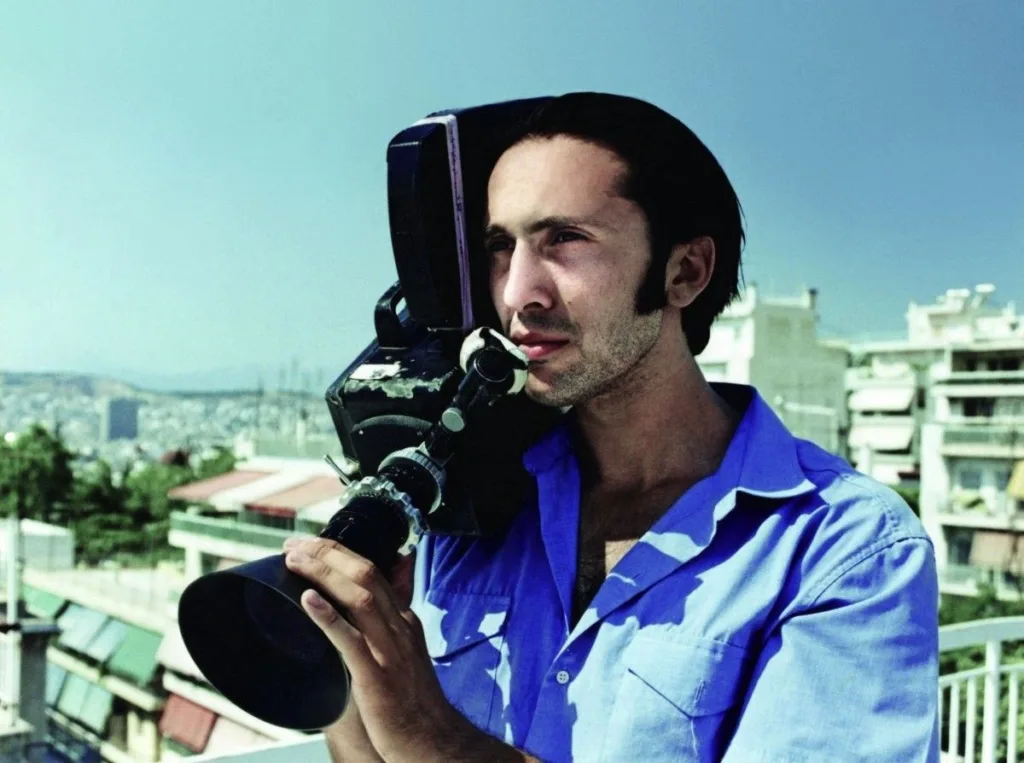
Renos Haralambidis knows this better than most. At just 25, he made No Budget Story with no money but an unstoppable drive. Nearly three decades later, with The Night Announcer, his journey has been anything but straightforward.
Marked by silences, collapses that mirrored Greece’s own struggles, and a persistent obsession — the need to turn life into story — Haralambidis has carved out a unique cinematic path.
Now, with five films behind him and at the age of 55, he faces something he never expected so soon: a retrospective of his work at the 30th Greek Film Festival (14–26 October 2025) in Sydney and Melbourne.
“We do not need to reach old age in order for us to be remembered,” he tells The Greek Herald in this exclusive interview.
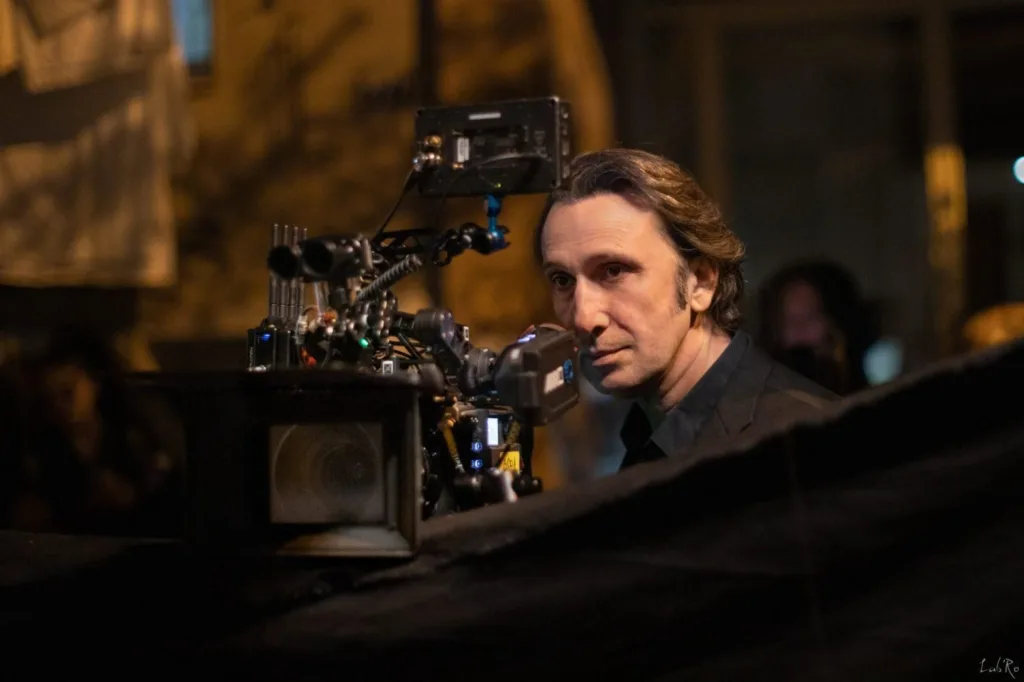
Although you are a relatively young creator, a retrospective of your career is being presented within the framework of the 30th Greek Film Festival. How did this idea arise?
I must admit that the Sydney and Melbourne Festival has a pioneering outlook on Greek cinema. Within this outlook, the idea of a retrospective arose. It is an unprecedented concept, especially for a creator who is only 55 years old.
It helps greatly because we Greeks do not need to wait until deep old age before tributes are made to our work. This way, the audience can see our work as a whole, revisit films that were forgotten or overlooked, and allow them a new life.
Cinema is not like television, which often fades and disappears. Films can be watched many times and repeatedly. Other film festivals worldwide should take example from those of Melbourne and Sydney and dare to present retrospectives not only to the great masters, but also to those of us still in the most creative phase of our lives.
Did the proposal surprise you?
The proposal was a polite handshake, which moved me. It also gave me a little anxiety — a sense of responsibility. I will be facing a retrospective, which is not as simple as it sounds.
I am one of those creators who travel with their films. I go to festivals, I watch them, I speak with the audience, I am present at screenings, and I observe the reactions of the moment.
Now, with Hellenism literally on the other side of the planet from Greece, it will be very interesting for me to see the reactions and the communication I will have with them, when they view my work as a whole. I started very young, at 25. Today, at 55, I have made five films — enough to present in a retrospective.
My films, because they are personal, developed together with me. They are a life course of a man of cinema. Especially for the Greeks… outside Greek territory, it will be interesting. I say outside Greek territory, because Greece and Romiosyni have no borders. Romiosyni is something much broader than the Greek space.
How are you preparing, then, for your first visit to Australia?
I am going very well prepared because I will be introducing the films, and I do not leave these things to chance. I want to know whom I am addressing. Recently I learned that the first Greeks in Australia arrived in 1826 as prisoners transferred by the English, who later became great merchants. That means I will be facing an audience with a very particular history. It makes me approach this as a performer preparing for a performance.
This journey is not one of leisure; it is a journey of self-knowledge. When my films are screened before audiences of Romiosyni — the wider Romiosyni — I feel that I myself also live a journey of self-knowledge.
There was a long pause from Four Black Suits in 2010 until The Night Announcer in 2024. Why did this happen?
Three things contributed to this pause.
First, I followed the fate of Greece and collapsed along with it.
Second, I decided to devote those years to my parents and to care for them in their old age.
And third, I simply had nothing to say, so I remained silent. These are three truths.
So I understand that at this moment, you are in one of your most creative phases. Should we expect something new?
My new film will be released in January 2026, marking 30 years since No Budget Story. It is a continuation of that film, directly taking up its thread.
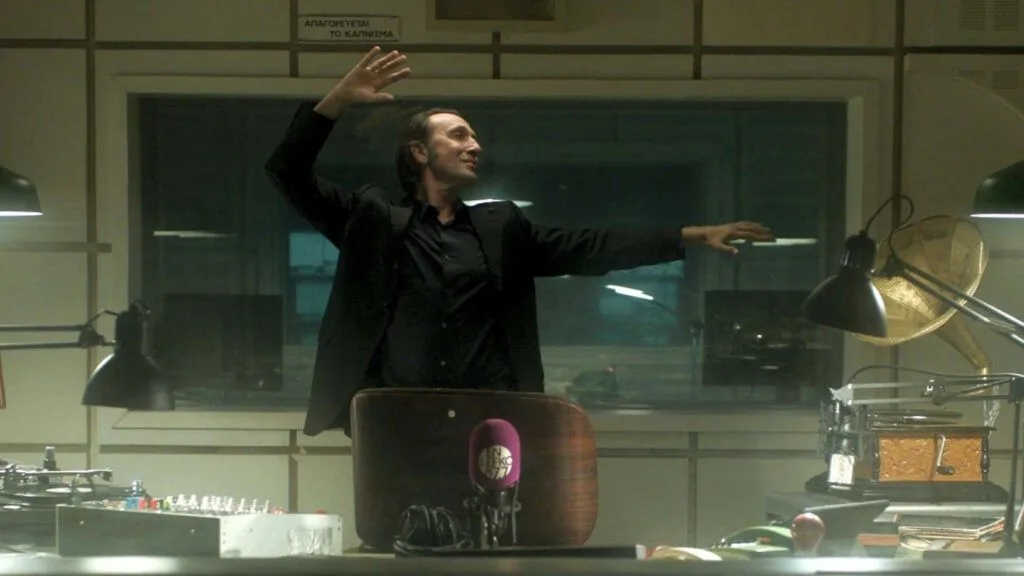
Returning to Greek cinema, which will be celebrated in Australia at the festival, can it help the diaspora keep its identity alive?
With the digital revolution and social media, globalisation means that young people in Sydney, Melbourne and Adelaide are now very close to the news of Greece.
We no longer live in an era when cinema was the only way to see what was happening in your homeland. Now we have digital television and the internet — everything connects you instantly.
Cinema today has another role. It must become part of our popular tradition, a common point of reference for Greeks.
This is difficult, something new, but necessary. Just as Greek films of the 1950s took root deep within us — like stories our grandmothers might have told — so too must contemporary films take root. They must enter our culture, our Romiosyni.
In this new framework you describe, does the advance of Artificial Intelligence worry you?
My father was a farrier in a small village in Northern Evros called Spilaio. When tractors arrived, farriery ended. The first revolution my generation experienced was the shock my father felt when he lost everything, went from being the lord of the village to a migrant in Athens, and later in Germany.
Now our generation faces another revolution — the digital one — full of riddles, but one we must live through.
I am not afraid. I am first an artist, and only then an actor or a director. Artificial Intelligence cannot be an artist. But it can be an assistant to the artist — and that is how I want to approach it.
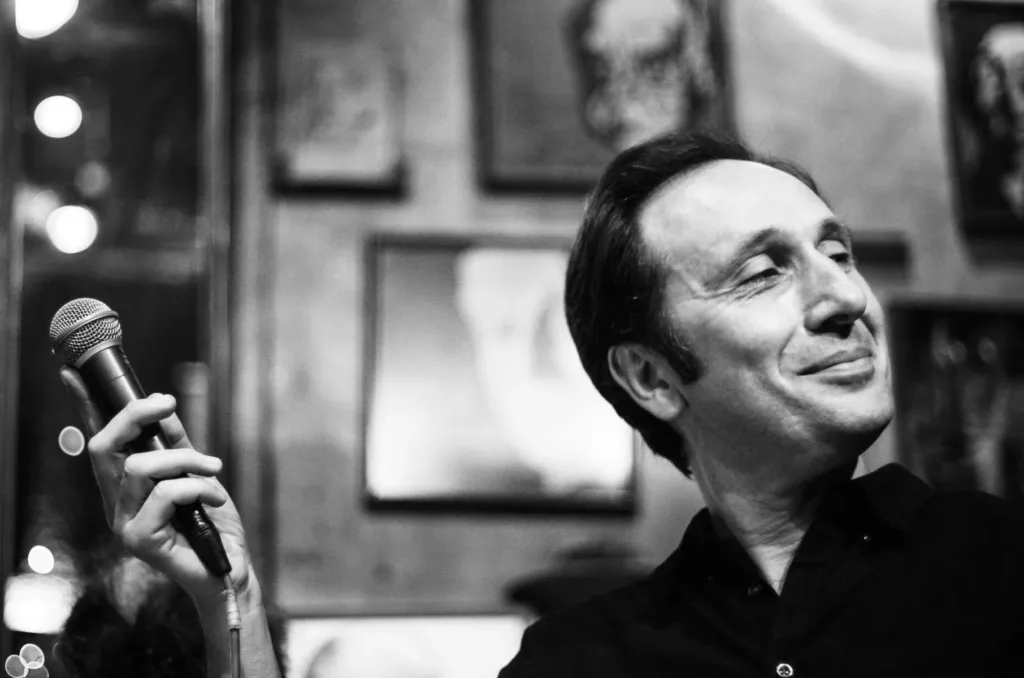
Are there some Greek Australians or Australian artists you admire, whose work you have studied?
I am a devoted fan of Nick Cave, who loves Greece very much and has many Greek friends. I feel close to Australia through Nick Cave. I also greatly admire Mad Max, directed by George Miller of Greek origin, whom I will meet.
One of my bold travel dreams was to visit Oceania. For the first time in my life I will be changing hemisphere — that is very important for me. But I will be going somewhere with so many Greeks that the journey will feel geometric rather than existential. It will be like returning home.
At the close of the discussion, Haralambidis returns to the image that seems to move him most. Australia, he says, is not far.
“I want us to abolish the notion that it is at the other end of the world. Melbourne, Sydney, Adelaide are not cities of Greek territory but of Romiosyni. Wherever there is Romiosyni, there is a centre of Hellenism. That moves me and fills me with responsibility.”
Thus, his journey to Australia does not resemble a flight into the distant, but a return to the familiar. Another Greece awaits him here — perhaps more alive, more persistent, than the homeland itself.
Event Details:
- What: Retrospective and visit of Renos Haralambidis as part of the 30th Greek Film Festival Sydney
- When: 24th – 27th October 2025
- Where: Palace Cinema Norton St, 99 Norton St, Leichardt, NSW 2040 & Palace Cinema Moore Park, 122 Lang Rd, Moore Park NSW 2021
- Tickets & Full Program: https://greekfilmfestival.com.au/sydney
Further details on the upcoming Film Festival, including how to buy tickets, can be found at https://greekfilmfestival.com.au/sydney
