By Dean Kalymniou
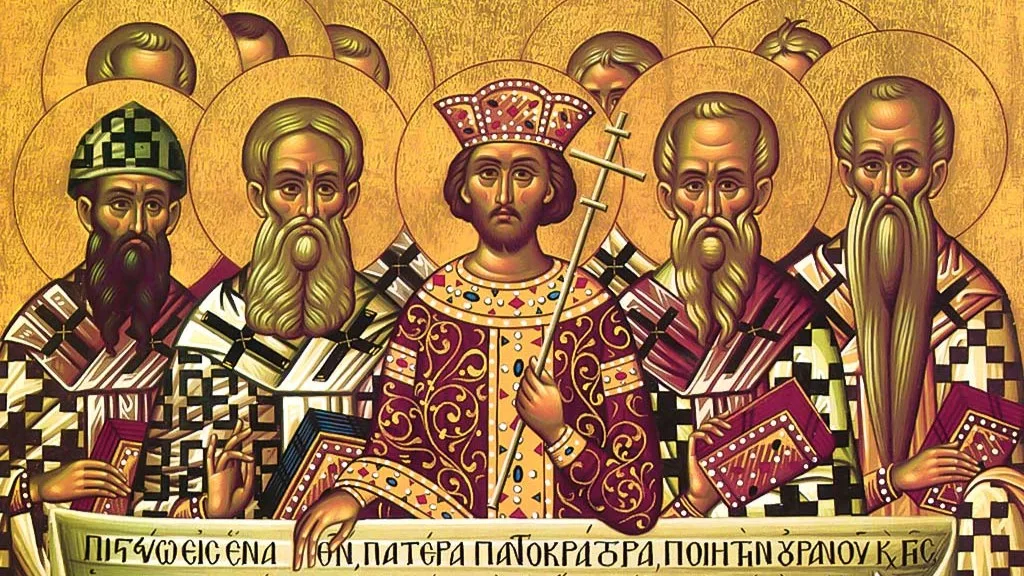
The First Ecumenical Council of Nicaea, convened in 325 AD by Emperor Constantine the Great, stands as a pivotal event in Christian history. Not only did it shape the theological foundations of the Orthodox Church, but it also marked a profound intersection between early Christianity and Hellenistic culture.
Its decisions reverberate through the doctrines of the Church to this day, while its context and outcomes influenced the historical development of Christianity. Despite the multiplicity of Christian sects, most of these, like the Orthodox Church, see the Council of Nicaea as a touchstone and a foundation point for their doctrinal tradition.
Historical Context and Purpose
In the early fourth century, the Roman Empire was emerging from periods of intense Christian persecution. Emperor Constantine’s Edict of Milan in 313 AD legalised Christianity and allowed it to flourish openly. However, theological divisions threatened the unity of the Church. Chief among these was the Arian controversy. Arius, a priest from Alexandria, taught that the Son of God was not co-eternal with the Father and was a created being. This view gained traction in parts of the Eastern Roman Empire, leading to widespread conflict.
To address this, Constantine convened the First Ecumenical Council in Nicaea bringing together around 300 bishops from across the Christian world, primarily from the East. Their goal was to achieve doctrinal unity and ensure the peace of the Church. The Council convened from May until the end of July 325.
Key Decisions and Theological Legacy
The most significant outcome of the Council was the formulation of the original Nicene Creed, a declaration of faith affirming the divinity of Christ. It stated that the Son is “begotten, not made, of one essence (ὁμοούσιος) with the Father,” directly countering Arianism. This marked a watershed moment in Christian theology, establishing the doctrine of the Holy Trinity as a cornerstone of Orthodox belief.
Additionally, the Council addressed other matters:
- It set a uniform date for the celebration of Pascha (Easter), distancing it from Jewish Passover to emphasise Christianity’s distinct identity.
- It issued 20 canons regulating Church discipline, including the structure of ecclesiastical authority and the handling of heretical groups.
Importance to the Orthodox Church
For the Orthodox Church, the Council of Nicaea is not merely a historical event—it is a spiritual milestone. It affirmed the Church’s ability, through conciliarity, to define doctrine guided by the Holy Spirit. The conciliar model remains central to Orthodox ecclesiology, reflected in the synods that govern Church affairs.
Moreover, the Nicene Creed, expanded in later councils, is still recited in the Divine Liturgy every Sunday. Its theological clarity and spiritual depth express the Orthodox understanding of the mystery of the Trinity and the Incarnation.
By establishing a unified theological voice, the Council is held to have protected the Church from fragmentation and preserved the apostolic faith.
Hellenism and the Council
The Council also illustrates the profound influence of Hellenism on early Christianity. Greek was the lingua franca of the Eastern Roman Empire and the language of theological discourse. The very term ὁμοούσιος (homoousios) was drawn from Greek philosophical traditions to articulate Christian truths.
Many of the bishops at Nicaea were educated in Hellenistic philosophy and rhetoric. Important figures such as Saint Athanasius of Alexandria, although not yet a bishop at the time, employed Greek concepts to argue against Arius. This synthesis of Christian theology and Greek philosophical thought became a hallmark of Eastern Orthodoxy, where faith and reason coexisted harmoniously.
Through the Council, Hellenism found new vitality—not as a pagan tradition, but as a cultural and intellectual vehicle for expressing the Christian revelation. This alliance helped shape the Byzantine synthesis that would define Eastern Christianity for centuries.
Common Misconceptions
Numerous myths surround the Council of Nicaea, often propagated by popular media and pseudo-historical narratives:
- “The Council invented the divinity of Jesus.”
This is false. The divinity of Christ was a foundational belief long before Nicaea, rooted in Scripture and the teachings of the early Church Fathers. The Council did not invent this belief but clarified and defended it against Arian distortion. - “The Bible was compiled at Nicaea.”
Contrary to popular claims, especially those made famous by fictional works like The Da Vinci Code, the canon of Scripture was not established at Nicaea. The Council dealt with Christological issues and ecclesiastical discipline, not biblical canonisation, which developed gradually and was affirmed in later synods. - “Constantine dictated theological outcomes.”
While Constantine convened and presided over the Council as a political and imperial figure, he did not impose doctrinal decisions. The bishops engaged in rigorous theological debate and made determinations independently. Constantine’s role was to support unity, not define doctrine.
The First Ecumenical Council of Nicaea is generally considered a landmark in the history of Christianity. For the Orthodox Church, it represents a triumph of truth over heresy, unity over division, and divine revelation over philosophical speculation. Its conciliar deliberations also provided an enduring framework for the resolution of theological questions, moving forward, as is evidenced by the subsequent Ecumenical Councils. For Hellenism, it marked a transformation of Greek thought into a servant of Christian theology, laying the groundwork for the rich intellectual and spiritual tradition of Byzantium. Far from being a mere political exercise, Nicaea was a sacred moment in which the Church, guided by the Holy Spirit, articulated the faith once delivered to the Saints. Understanding its true nature allows us to appreciate not only the depth of Orthodox theology but also the enduring legacy of Helleno-Christian
