Artist Tina Stefanou’s latest exhibition, You Can’t See Speed, now showing at the Australian Centre for Contemporary Art (ACCA), delves into the complexities of life on Melbourne’s urban fringe—specifically in Doreen, a rapidly developing area that blurs the boundaries between suburb and bush.
Stefanou uses a range of media—installation, sculpture, sound, and video—to explore this transitional landscape where ecological, economic, cultural, and social forces collide.
The exhibition positions the urban fringe not as a cultural void but as a dynamic, mythic space of negotiation.
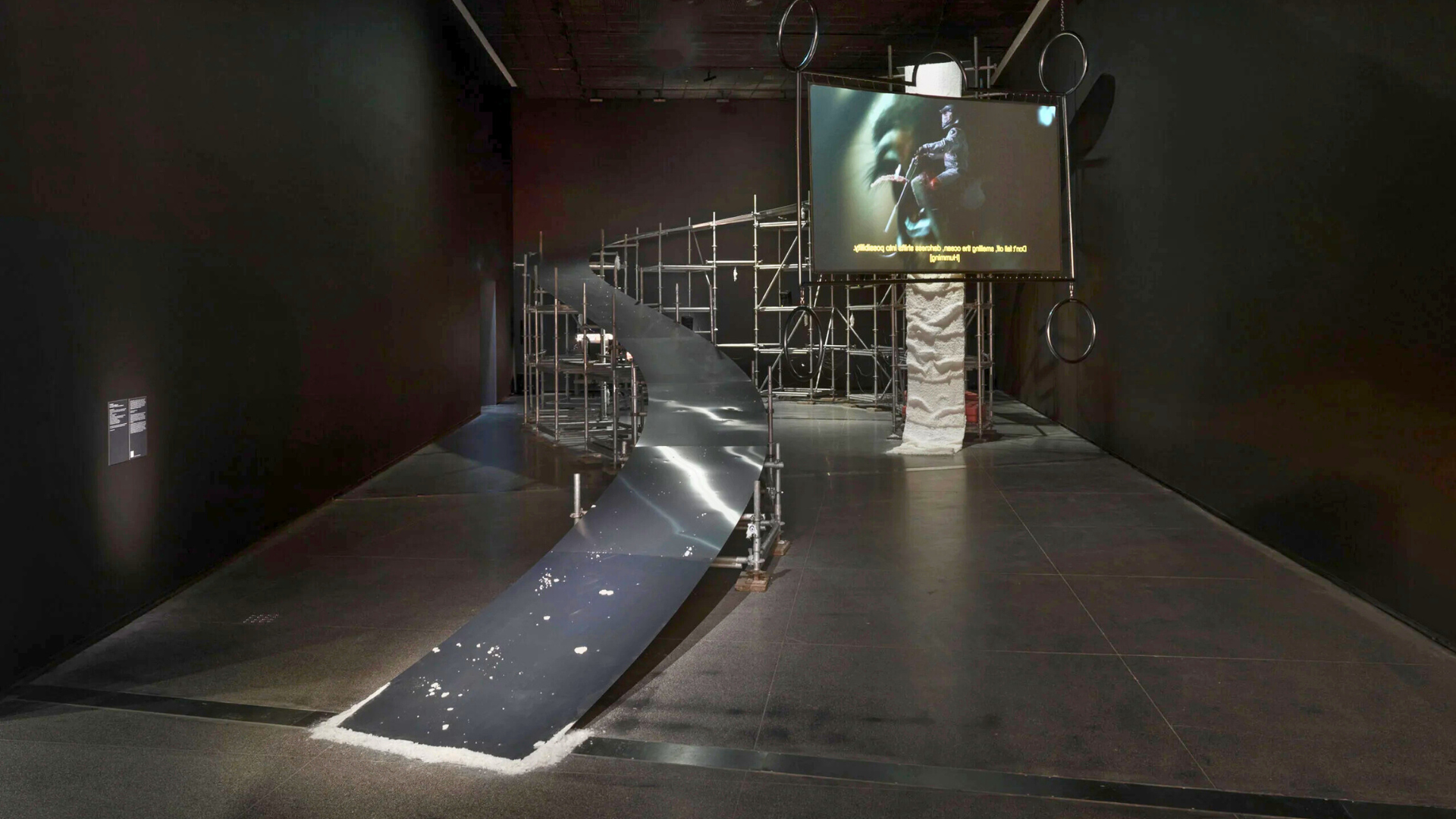
Drawing on her Greek heritage and mythological symbolism, Stefanou presents works like Grief Ramp (2025), a towering black motorbike ramp accompanied by a collaborative film with blind rider Matthew Cassar.
Cassar, guided by voice instructions, navigates a scrubby paddock, echoing ancient Greek notions of blindness as a path to deeper insight.
Another video work, Hym(e)nals (2022), features ghostly figures—teen girls and horses—emerging from shadows to a haunting soundtrack, challenging gender tropes while linking the suburban fringe to ancient symbolism.
The exhibition explores how girls’ affinity with horses often reflects a desire for agency and emotional expression in otherwise gendered social spaces.
Field of Triggers: Agri-temple (2025), an eight-channel video installation, reflects on the contributions of Greek migrants, many of whom settled on the urban fringe to sustain agricultural lifestyles.
The work honours their role in shaping a multicultural Australia.
Stefanou avoids didacticism, instead creating open-ended experiences shaped by sensory immersion, mythic references, and nonlinear video algorithms.
Scattered throughout the exhibition are surreal elements like salt-encrusted glass eyes and wax casts of horses’ legs, blending classical Greek art with commentary on environmental and social neglect.
Through a collaborative and participatory approach, You Can’t See Speed invites viewers to reconsider the overlooked edges of Australian life as rich with meaning, contradiction, and cultural possibility.
Tina Stefanou: You Can’t See Speed runs at ACCA until June 9.
Source: The Saturday Paper.
.)