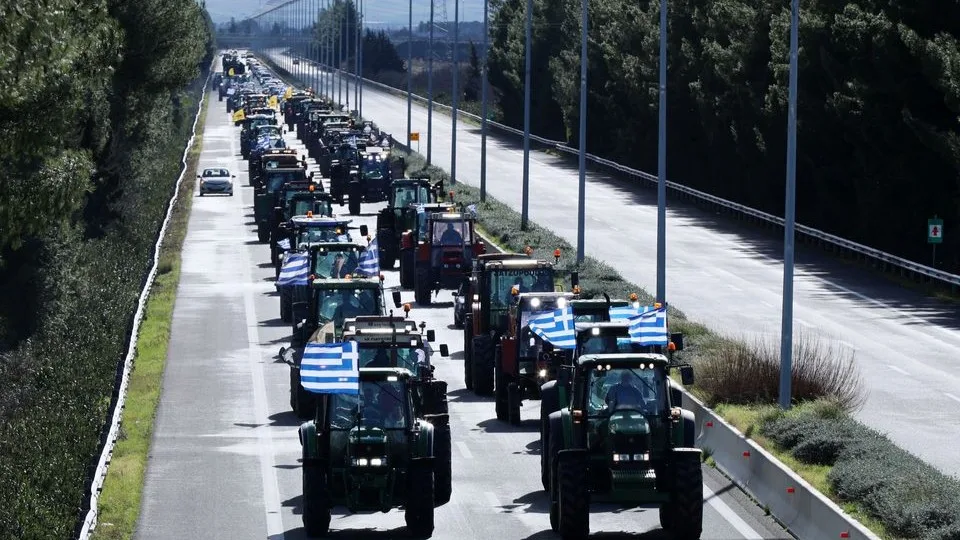
Farmers across Greece escalated nationwide protests on Thursday, January 8, launching coordinated 48-hour blockades of major highways, toll stations and border crossings after talks with the government failed to meet their demands over rising production costs and declining incomes.
From early morning, tractors and heavy vehicles were positioned on key transport routes linking Athens with northern and western Greece, severely disrupting domestic travel and cross-border trade.
One of the most significant closures occurred on the Athens–Lamia national highway near Kastro in Viotia, where traffic in both directions was halted and diverted onto secondary roads, causing lengthy delays.
Further blockades were reported in central Greece at the Vale of Tempe, in western Greece on the Antirrio–Ioannina highway at the Angelokastro toll station, and near Thessaloniki, including the Malgara tolls on the Athens–Thessaloniki highway. Routes towards Edessa and the Halkidiki peninsula were also affected.
Protests extended to northern Greece’s key border crossings. At Promachonas, farmers blocked freight trucks travelling between Greece and the Balkans, while similar restrictions were imposed at Exochi, Niki and Evzones, where trucks were barred and passenger vehicles allowed through only intermittently or in emergencies.
The government reiterated its willingness to engage in dialogue but insisted that negotiations could not take place while roads remained blocked.
Deputy Minister to the Prime Minister and government spokesperson Pavlos Marinakis, speaking to Newsbomb, issued a renewed invitation to farmers.
“We are here for dialogue, we say it again. We are united in this effort, and we want to emphasise clearly that we wish for this situation to come to a resolution. I am making another invitation to the farmers for Tuesday, January 13, when the Prime Minister will be in his office, to meet under two clear conditions,” Marinakis said.
“First, the level of representation must be proportional; that is, all mobilisations must be represented, because in order to find a solution, everyone must have a voice. Second, the dialogue must take place with the roads open, as there can be no dialogue while blockades remain in place.”
Farmers argue that government concessions announced on Wednesday – including cheaper electricity rates and fuel tax rebates – fall short of addressing the scale of the crisis.
The protests, which began in November, were initially triggered by soaring production costs, delayed subsidy payments linked to a fraud scandal, and a sheep and goat pox outbreak.
Anger has also focused on the proposed EU–Mercosur agreement, which would create a vast free-trade zone between Europe and South American nations including Brazil and Argentina. Greek farmers fear the deal would flood the market with cheaper imports and threaten domestic agriculture.
Protest organiser Vangelis Roubis warned that the agreement could have devastating consequences.
Farmers have vowed to continue disrupting travel, supply chains and trade unless the government offers concrete concessions and rejects the trade deal, amid warnings from authorities that prolonged nationwide blockades will not be tolerated.
Source: Ekathimerini and AP News
