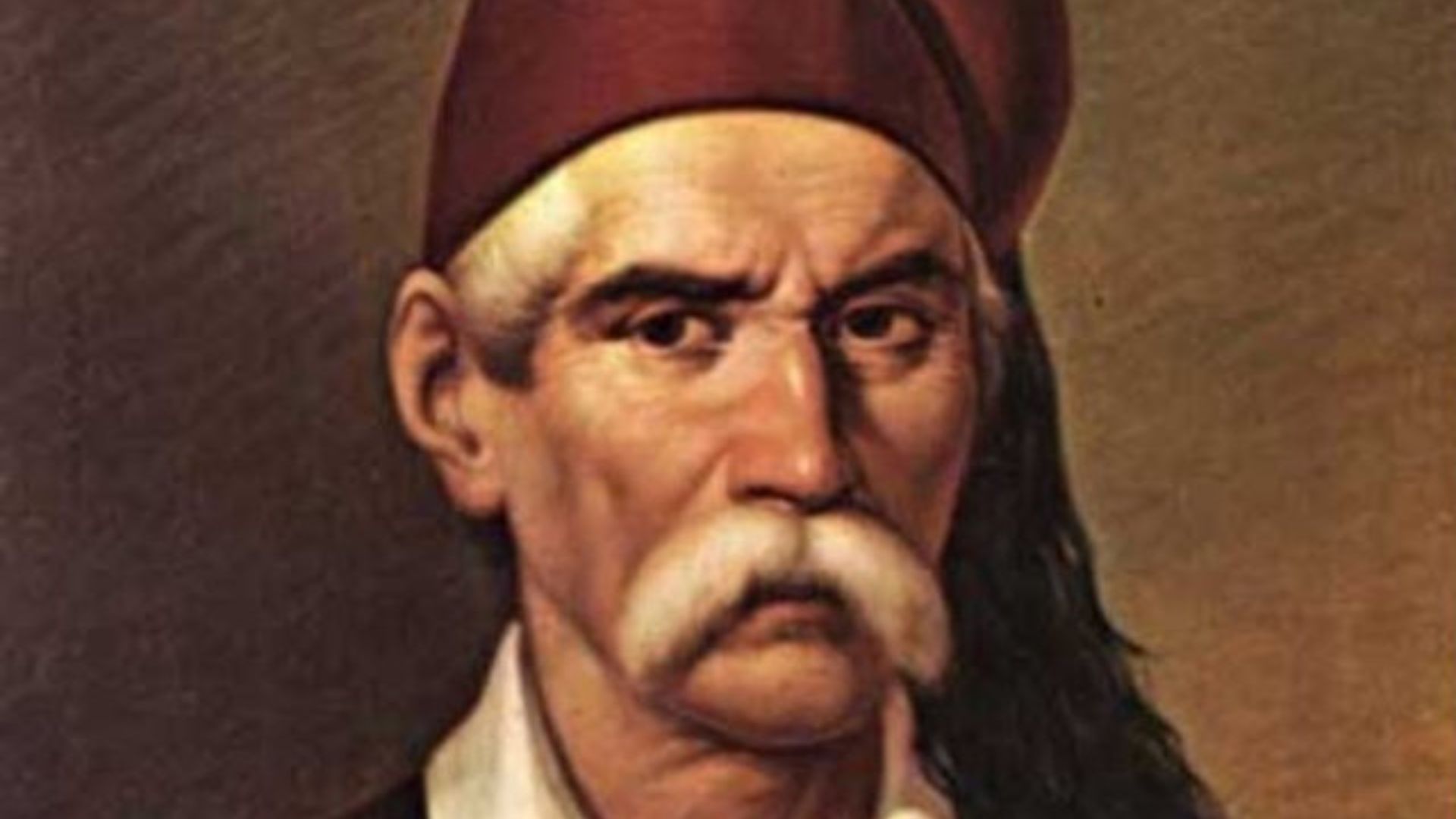
Nikitas Stamatelopoulos was one of the greatest heroes and protagonists of the Greek War of Independence, next to his uncle, Theodore Kolokotronis.
He was known by many different names such as Tourkophagos (Turk-eater) and Nikitaras, a play on his name meaning “victory”.
Early Life:
He was born in 1782 in the village of Tourkoleka in Megalopolis and was the son of the thief Stamatelos Tourkolekas and Sofia Karoutsou, sister of the wife of Theodoros Kolokotronis.
At the age of 11 he went out on the branch with his father’s team and then joined the body of the first thief Zacharias Barbitsiotis, whose daughter Angelina he later married.
Greek Revolution:
On March 23, 1821, Nikitaras joined Kolokotronis and entered in Kalamata. On May 12th of the same year, Nikitaras led an army of 800 troops victoriously against the Ottomans in the Battle of Valtetsi, thus granting the Greeks a victory in one of the most important battles during the war.
Soon thereafter, he proved his military skills and valor in the Battle of Doliana, where he defeated 6000 Ottomans with an army of 200 Greek men. These two battles rendered him one of the most heroic fighters of the war.
He continued in the Battle of Vervena, where he won the battles one after the other. Finally, on September 23rd of the same year, Nikitaras, together with Theodore Kolokotronis, Demetrios Plapoutas, Anagnostaras, Petrobey Mavromichalis and Demetrios Hypsilantis fought in the siege of Tripolitsa, ultimately reclaiming the capitol of Moria and decimating the Turkish and Jewish population.
The apex of his heroic virtue was in the Battle of Dervenakia, the most important battle of the Greek War of Independence. The Greeks, led by Theodore Kolokotronis put an end to Dramali’s descent to Peloponnesus by facing 3000 Turks in the small mountain pass of Dervenakia.
Nikitaras was also present here, alongside Demetrios Plapoutas, Demetrios Hypsilantis, Papaflessas and Panos Kolokotronis. It was in this battle that Nikitaras earned the nickname “Turk-eater” because during the battle he broke 3 of his sword from the force he was striking.
Death:
In 1847 he was appointed a member of the Senate, and two years later, on September 25, 1849, he passed away at the age of 67 from Diabetes.
Nikitaras had two daughters and a son, Ioannis Stamatelopoulos, who pursued a military career.

