
By Billy Cotsis
As I sat by the 1920s style Greek owned cafe opposite the harbour, I reflected on two simple questions I asked locals.
The first was in relation to a great poet. “Do you know where I can find the House of Cavafy?” I asked an Egyptian, who replied, “you mean the Greek poet?”
The second, “do you know where I can find the Greek Community Club?”, I asked another Egyptian. “Ah you are a Greek man, you will see the Alexander the Great Statue on the main road, he is Greek too.”
It was a fair indication that the people of Alexandria are comfortable with recognising the Greek past.


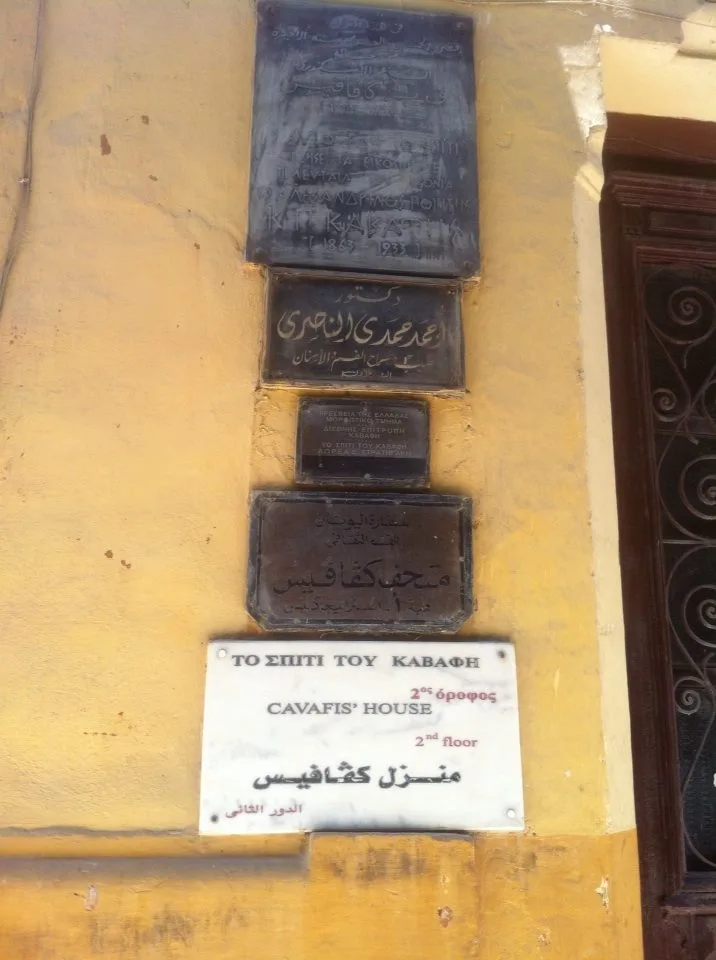
In the 1950s and 1960s, the once vibrant Greek community of Alexandria was emptied out. Driven out due to the nationalism under President Nasser. Numbers vary but it is likely that there were close to 400,000. I have bumped into people who were either born there or have parents from the city of Alexander. In London, Athens, Cyprus, Sydney, Melbourne, New York.
I was in Alexandria and was able to meet the remainder of the Greek Community, those who chose to stay. I was told that there are over 4,000 people of Greek origin in Alexandria and perhaps 10,000 in Egypt all up.
Every day I would play a game of spot the Greek shop, hoping to meet Greek speakers. Excitedly, I would enter an establishment such as Atheneos and ask if the owner was there. Sadly, just about all of them were no longer owned by Greek people. What was interesting is that out of respect to the previous Greek ownership, they keep the name of the business.


Possibly the most famous citizen was Cleopatra, the last Hellenic queen of Egypt. How can this be true, I hear you ask?
When Alexander the Great conquered Egypt in 334, he established an amazing new city called Alexandria. When Alexander died in 323BC, one of his favourite generals Ptolemy took control of Egypt and the surrounding lands, establishing the Ptolemaic kingdom. The Hellenic city of Alexandria was the capital, a city that was rivalled only by Babylon, Athens, Rome and Constantinople.
This Kingdom was unique. Royalty only spoke Greek and intermarried (we now call that incest) to protect the bloodline. Conversely, they also called themselves successors to the Pharaohs. A smart policy that Alexander had created as he sought to blend Greek with local cultures.
Ptolemy adopted many local customs to keep the local population on side. His successors never learnt the local language. Cleopatra was the first to speak a language other than Greek or Latin! Actually, if you were a Greek living in Egypt, you were subject only to Hellenic law.
The Ptolemaic Kingdom ended in 30 BC when Cleopatra, having chosen to side with Marc Antony, was defeated by Rome. She was only 39 years old.
Cleopatra is one of the most famous women of all time, perhaps the most famous. Pity though that the Ptolemaic Kingdom is not as well known.
At its peak, the Kingdom included Libya, Cyprus, Egypt and part of the Middle East. They also encouraged the migration of tens of thousands of Greek speakers who formed the elite ruling class.

Prior to the arrival of the all conquering Alexandros, a city called Naucratis existed. The proximity of Egypt to Greece ensured there was a continuous presence of commercial traders, with archaeological evidence suggesting this extends as far back as Minoan times. The small settlement of circa 570 is not too far inland from where Alexandria was built, on the Nile. Naucratis was built for Greek merchants, becoming one of the most important ancient Hellenic cities in Africa, the first permanent Greek city in Egypt.
However, Herodotus tells of a story whereby shipwrecked Greek renegades land in Egypt. The ousted Pharaoh Psammetichus had been foretold of their arrival via an Oracle and employed the men to regain power. As a reward they may have been given land on the Nile, which could be the ancient city of Daphnae, creating their own colony.
Ptolemy, like the other Diadochi generals in the Hellenistic Era, initially claimed to rule on behalf of the Macedon (Alexander) dynasty. Within a year, the wars of the Diadochi were taking place and he defended Egypt from an invasion by Perdiccas. Thereafter he consolidated territory in Egypt and its surrounds; this included Palestine/Judea, Cyprus and a foray into Greece. Confident that he was the master of the region by 305, he declared himself King of Ptolemaic Egypt and taking the title of Saviour, “Soter.” Whilst he may have been master, he lost Cyprus and earned the wrath of the Seleucids of Syria for extending his empire into Asia.
In 295 he recaptured Cyprus. A number of other Greek cities were created and Greek education flourished. Ptolemy retired in 285, succeeded by his Queen Berenice and their son Ptolemy II. Most of their successors would be called Ptolemy. Just like the Greek Seleucids in Asia, they didn’t seem to deviate much in the name department.
The second Ptolemy was known as Philadelphus. Whilst being known as one who was highly educated and cultured, he conquered many Aegean islands and parts of Asia Minor.
By 270, Philadelphus expanded further south in Egypt against the Kushite Kingdom (Sudan) which once controlled Egypt. What is important about this development is that Hellenic culture spread deeper into Africa.
Philaddelphus became the patron of arts and scientific research whilst the great Library of Alexandria was expanded significantly.
Ptolemy Eugergetes came to power in 246, conquering more territory in Asia at the expense of the Seleucids, whilst he ventured further north in Greece as far as Thrace.
Ptolemy IV Philopator rode out the remainder of the century to 205, again a King who married his sister. His reign was known for native Egyptian rebellions.
His infant son ruled to 181 and took the surname Epiphanes. Agathocles was the initial regent whilst the child remained a minor, only to be replaced by an incompetent administration.
With Macedon and the Seleucids circling, the former had regained possessions in Thrace and the Aegean, the Ptolemies took a highly unusual step. One that earmarked them for eventual conquest. They took the phone a friend option and brought in Lepidus from Rome. He helped them reorganise Egyptian affairs including the military set up. In turn he brought in Thessalian Aristomenes to help manage state affairs.
The competent Aristomenes was poisoned by the young King around the time of his being 17. Epiphanes was in turn murdered by his own military officers.
He was then succeeded by his seven-year-old son. Yet again a child ruler; fortunately his mother, another Cleopatra, was an able administrator.
By 170, the Ptolemies invaded Syria unsuccessfully and were easily repulsed by King Antiochus. Had it not been for a second intervention by Rome, Egypt may have been conquered. This incident highlighted two issues. The stupidity to invade a fellow Hellenic empire which is a constant theme in Greek history, and the almost “unalienable right” of Rome to interfere in Ptolemaic Egypt.
Over the next eight decades, a series of rulers quarrelled and fought within their family, leading to civil war and the consistent intervention of Rome. At one stage the Kingdom was split between Egypt proper, and Cyprus as rival brothers reigned, Dionysos and Auletes.
Around 55BC, the latter, previously driven out of Egypt by the local population, was returned to his throne by Pompey. No Greek or Egyptian was keen to fight the Roman forces which by now controlled most of the Mediterranean. The once mighty Ptolemies were now on the brink of collapse.
The King was succeeded by his teenage daughter Cleopatra in 51 and her 13-year-old brother, who became her husband! Not content with sharing rule of Egypt, civil war broke out, leading her to flee Egypt. This is where Julius Caesar comes to the rescue as a Prince Charming and protector.
By 48 they had regained Egypt. Cleopatra, though installed to the throne, was forced to marry her other brother. She had him poisoned four years later.
Cleopatra remained ruler until the romantic end in 30. Her liaison with Marc Antony resulted in disastrous consequences for both of them. Whilst it was only a matter of time before Egypt was officially conquered, one cannot help thinking that Marc was the wrong choice as lover and protector. Tinder didn’t exist then!
As a noble queen, Cleopatra, defeated in battle, took her own life. Thus, ended the Ptolemaic Empire, arguably the equal of the Seleucids as the best Hellenic entity to emerge post Alexander, and is the greatest Hellenic empire in Africa.
The competition for this title includes Cyrene in Libya, the Byzantine presence (534 – 711 AD) and the short-lived Alexandrian empire. Each of these had a profound impact on their time, however they were short lived. It is the Ptolemies who had a lasting impact as they produced a plethora of writers, artists, philosophers, scientists, linguists and architectural triumphs.
One of the most influential Greek astronomers and mathematicians is Ptolemy Claudius, a Greek from Alexandria. Hundreds of poets such as Palladas or mathematicians such as Aristaeus the Elder, Thedorus the philosopher or Euclid the patron of geometry were born here. Add the talented librarian Eratosthenes; he was the man who understood chronology, geography and measuring the circumference of the earth. Ctesibius created the compressed air (a pump is an example). The list is endless and attributable to the prominence of Alexandria and the ability of the Ptolemies to recognise the importance of elements that contributed to progress, from science to theology.
Even the first King created a new God based on Egyptian and Greek influences. He was known as Serapis and would be used as the medium to worship the Ptolemies as a new lineage of the Pharaohs.
Upon the ending of the empire, the Greek language remained a useful tool in civic/bureaucratic circles under the Romans. When the Byzantine Greek forces conquered Egypt in 534 AD under Belisarius, they inherited a region that still had a Greek upper class and institutions.
In 641 AD, Constantinople, which had control of most of Egypt, was defeated by Arab forces; a counterattack was launched with initial success until a total collapse by 646 to a reinvigorated Arab military.

To understand the importance of Alexandria (and Ptolemaic Egypt), the city is comparable to modern London, a hub for writers, artists, merchants and religious types. It remained important for Africa and the Mediterranean until the exodus of Greeks and other Europeans a few decades ago.
Alexandria is what it is, a Hellenic built and developed city that has stood the test of time. Whilst the Greek Community may have dwindled, the imposing spirit of Alexander and Cleopatra will always loom large. If you don’t believe me, just ask one of the locals.
*Billy Cotsis is the author of Aristotle Roberto Carlos Smithopoulos
