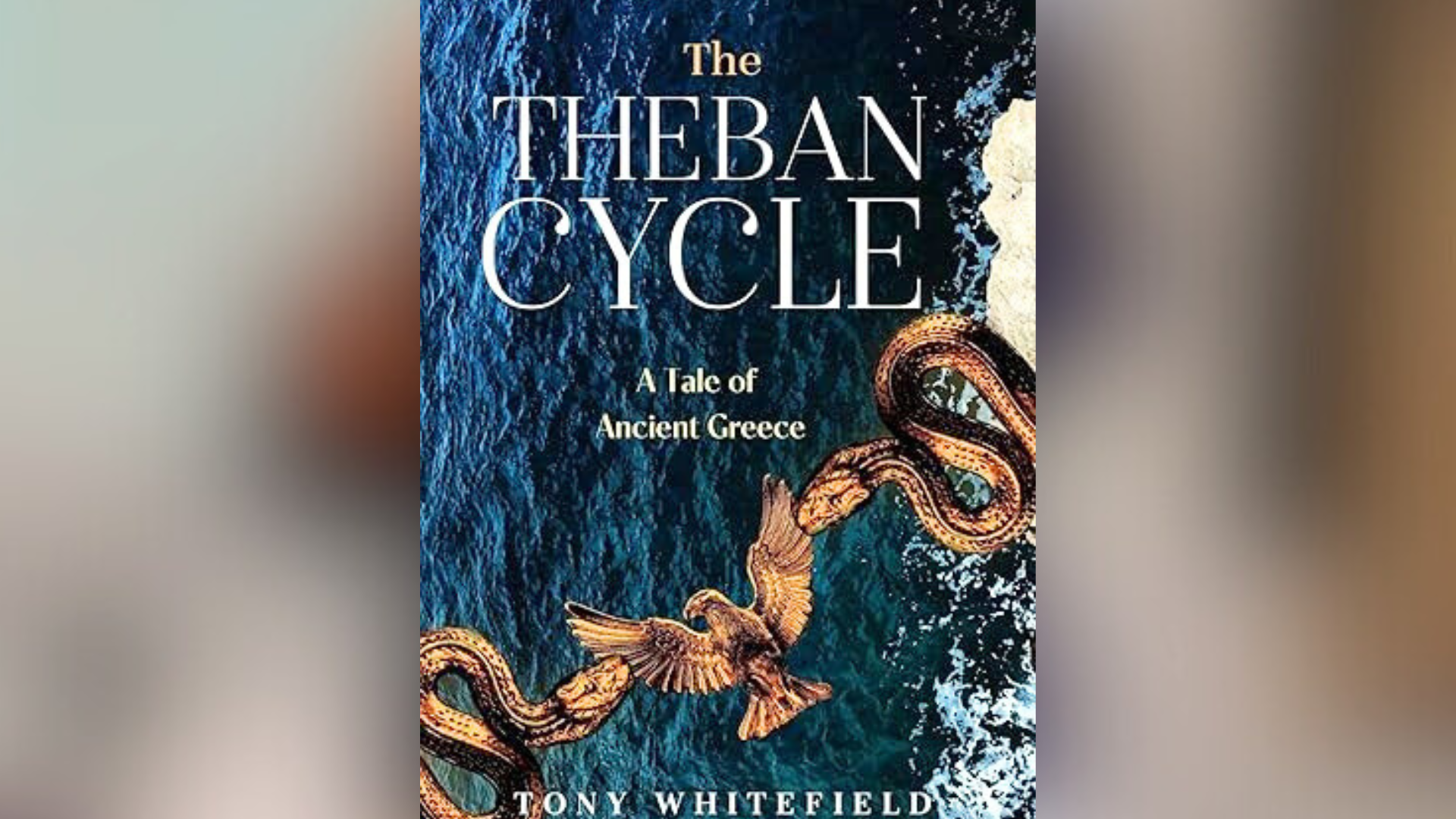
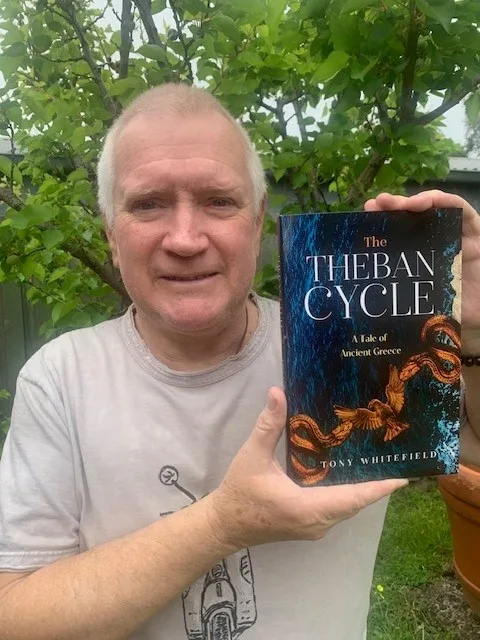
Philhellene author and academic, Tony Whitefield welcomes readers to gather close and immerse themselves in the Thebes of 1189 BCE and beyond, delving deep into the echoes of Greek mythology and ancient atmospheres that are now spoken of as legend.
As most stories often do, this retelling of historical fiction commences with a heartfelt dedication. Whitefield’s, in this case, preserves the memory of his daughter Katerina, ensuring her presence remains within the fabric of the book’s coin-capped 30 chapters and 300 pages.
Plunging into the myth-dwelling, aqueous cover from the onset, cyclic symbolism flows where an eagle can be seen between two snakes – enchanting all to read on and discover the “fated” fables, “prophetic” wedding gifts, and what makes “more gold than sense”.
Whitefield masterfully reimagines the fragmented yet sacred legacy of the Theban Cycle’s four historic Greek epics, enveloped in a tapestry embroidered with both tragedy and heroism.
Uninhibited and woven with whimsical annotations, the author’s tone is laced with a thought-provoking essence and educational “offerings”, serving to help determine the accuracy of many “pre-destined” events.
Mythophiles will be bestowed with a more “mundane” yet digestible version of the lives, loves, and losses of the “triple-cursed”, “pitiable” and “exiled royal” Oedipus, his mother and wife, Queen Jocasta, the blind and “wise” seer Tiresias and his daughter Manto, sacrificial Antigone, Alcmaeon of the “Epigoni”, and even the “Suppliant Women” of Argos.
From the very beginning, inextricably linked themes of loyalty, power and atonement float throughout the “miasma” as time highlights the book’s core purpose – learning from the past and asking ourselves, “what harm comes from truth?” – especially when it’s “mixed up with gods”, “falling kingdoms”, and “hallucinogenic oracle concoctions”.
Before King Kadmus sets the soul-seeking ventures in motion by journeying to find his lost sister, Europa, the primary protagonist ponders on his “lacklustre existence”, helping to reflect a greater universal human conundrum – “surely there is more to life than this?”
Like every cycle, an inescapable nature of repetition remains at the forefront and aftermath of each multi-faceted narrative within, which is abundantly clear in the case of King Laius’ neglectful “defiance” and “tyrant” Creon’s “arrogant hubris”.
Whitefield’s “grain-of-salt” approach and straightforward storytelling, along a shifting timeline, allows for a more nuanced, flexible, and less dramatic interpretation of the “inherited consequences” faced by all controversial figures involved.
Fearless in his mythographic exploration, the author keeps it unmistakably unfiltered when integrating even the day-to-day human need for “colonic cleansing” amid the “blood-soaked beds” and brother vs. brother battles, as in the case of Polynices and Eteocles.
He showcases just how some “unwittingly, unknowingly, and very much unfortunately” devastating patterns can entangle everyone for the sake of simply desiring to belong somewhere or to something – “Why are we attacking Thebes?” “I don’t know” “Did they do anything to us? “I don’t know”.
Riddles, age-old customs, the effect of the Nemean Games, and the allegiance between King Adrastus and “boar-emblazoned” Prince Tydeus in the “Seven Against Thebes”, all earn their place alongside even the most infamous heroes in that of “Argonauts leader”, Jason, his Limnian queen, and mighty “Hercules”.
Finally, for detailed references and further insight, entire sections on “main characters”, “the Theban Cycle from history”, “author’s notes”, “additional readings”, and “videos and podcasts” bring the story full circle following a present-day reflection of the Temple of Apollo at Delphi.
All in all, there is certainly something unique about a plot that invites its audience to pause on occasion, “drink some wine”, and insists on its “ambushed” and “surrendered” characters taking “refuge from the midday sun” despite the permeating chaos.
On this note, we could certainly raise a glass to Mr Whitefield’s grounding evaluation, which helps to bridge the gap between myth and reality… an iteration of the Theban Cycle that will only get better with age, just like a connoisseur’s favourite red or white.
Στην υγειά σας! (to your health!)
