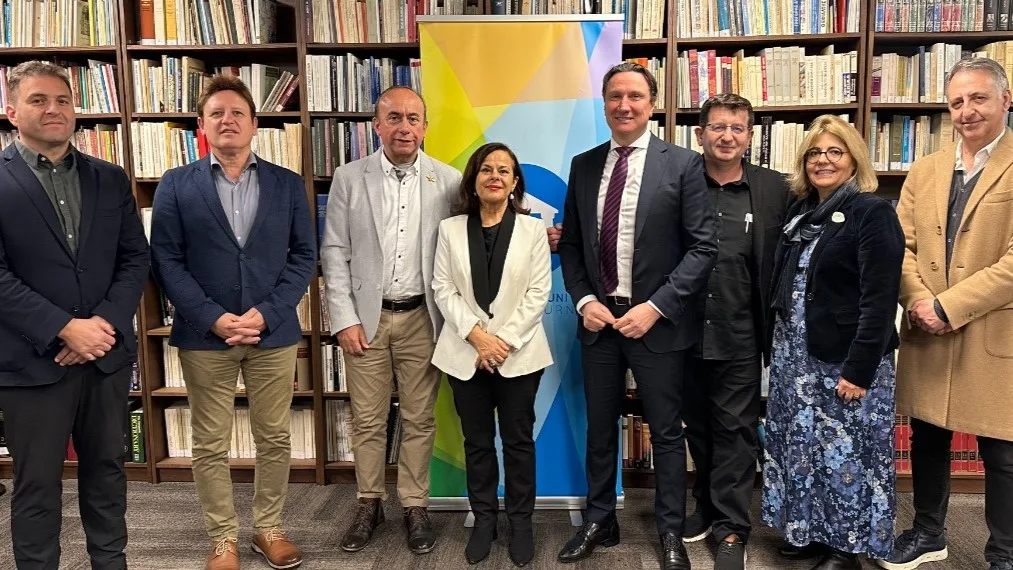
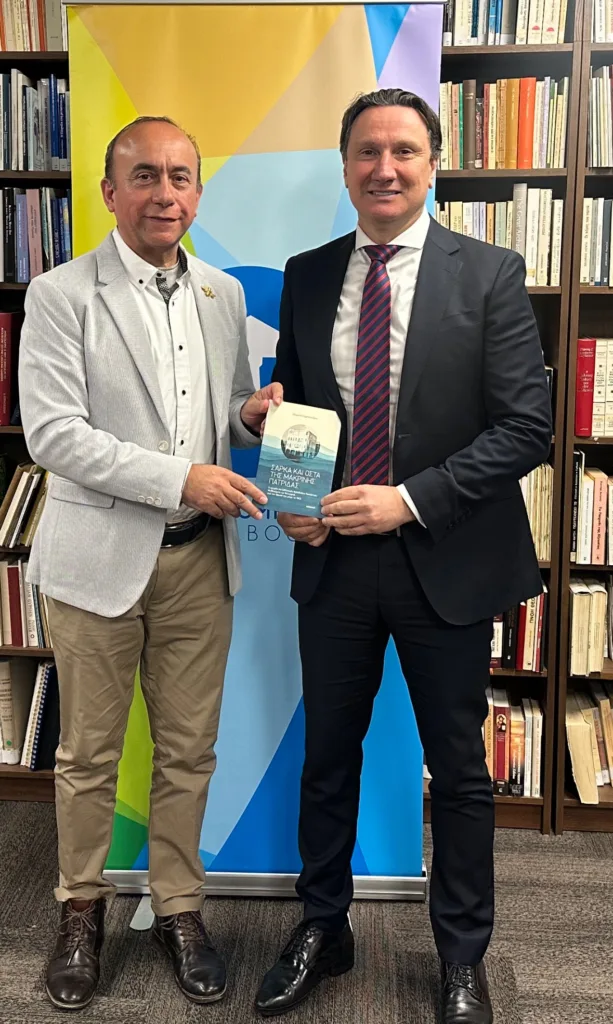
At the initiative of the Greek Community of New South Wales and Dr Helen Vatsikopoulos, Professional Industry Fellow of Journalism and Writing in the Faculty of Arts and Social Sciences, the President of the Greek Community of Tashkent, Costas Politis visited Sydney.
Accompanied by Dr Vatsikopoulos, he also made a short trip to Melbourne, where he gave a seminar and had the opportunity to meet the Board of Directors of the Greek Community of Melbourne (GCM). In attendance were President Bill Papastergiadis OAM, Vice Presidents Michael Karamitos, Dr Jim Bossinakis, and Dr Nick Dallas, Secretary Nick Koukouvitakis, and Assistant Secretary Vicky Kyritsis.
Mr Papastergiadis stressed that “The GCM is willing to assist Mr Politis in his efforts and will be considering bringing the photographic exhibition to Melbourne.”
Education convenor Dr Dallas added, “I’m sure the Community of Tashkent can leverage some of the experience we have in educational and cultural programming.”
Mr Politis commented on his vision for the Tashkent Community: “Although the Tashkent Community has made great strides in the performing arts, there are very few people who speak Greek. Creating a robust Greek language program in the near future is a key priority.”
Mr Politis was asked about his future vision for the Tashkent Greek Community, including its challenges and obstacles. He replied, “I’m realistic; I won’t be here forever. At some stage down the track, the reins must be passed on to younger generations living here.”
“I’m trying to mentor a team of young locals by giving them more responsibilities and assigning them ownership of projects so that they acquire experience,” he added.
“The absence of the Greek state in Tashkent is a problem, and everything takes longer when it comes to dealing with Greece, especially visas. We’re expecting a new embassy and ambassador to be in place by the end of the year. This decision was made during Covid, hence the delay in its implementation. Hopefully, one day we can also receive seconded teachers; it will make a big difference in reviving the language.”
Mr Politis’ lightning visit to Melbourne also included visits to Alphington Grammar School, Evangelismos Church, and the GCM’s advanced language campus in Bentleigh. When asked about his first impressions of the GCM, Mr Politis was in awe.
“The size of the community, its vast infrastructure, and its multi-level activity in various fields are truly impressive,” he said.
“The dedication and quality of those employed in delivering various programs are to be commended. I was really impressed by the educational facilities and teaching staff.”
A few words about Costas Politis
Thessaloniki-born Costas Politis is an architect, restorer, museologist, and many other things by trade. Costas landed in Tashkent, the capital of Uzbekistan, 20 years ago. It was supposed to be a short assignment, but additional work kept coming his way. Although he deliberately kept his distance from the dwindling local Greek Community, four years ago, he was invited to engineer a turnaround. Those of Greek background remaining in Uzbekistan, probably around 1,000, are mainly descendants, children, and grandchildren of political refugees who arrived in 1949 after the Greek Civil War.
Although the community’s numbers at one stage approached 40,000, the fall of the junta in Greece, the recognition of the National Resistance by the Andreas Papandreou government, and the fall of the Soviet Union were all factors that accelerated repatriation efforts. Those that remained often did not have the financial means, connections, or relationships to consider repatriation. With a shrinking community, also accelerated by mismanagement and inactiveness, it’s not hard to see how declining fortunes set in. By renovating the Community’s facilities and re-energising its cultural programming, Costas, as president of the Greek Cultural Centre, has been able to reinvigorate and put the Community back on the map.
There may be declining Greek communities in the diaspora’s periphery, but with the right people, collaboration, and openness, their fortunes can be reversed. The Greek Community of Tashkent is a perfect example.