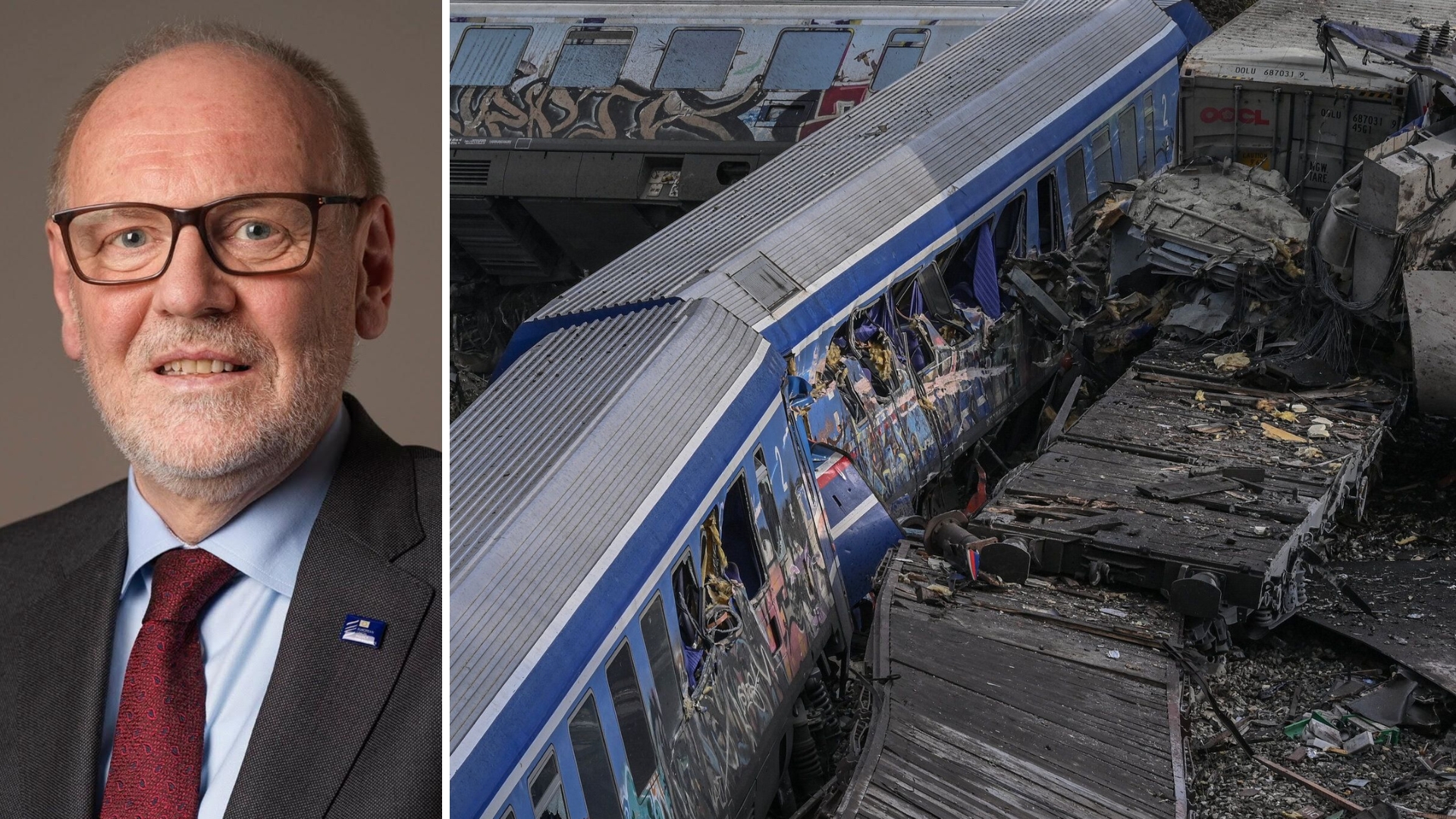
By Ilias Karagiannis.
Early on the morning of Wednesday, March 1, the Executive Director of the European Union Agency for Railways (ERA), Josef Doppelbauer, was traveling to Brussels in Belgium.
The shroud of the disaster at Tempi had been spread over Greece. The country immobilised by the horrifying image of the collision of two trains and the loss of so many human lives.
Mr Doppelbauer, one of the most qualified experts in railway safety, understood at the time that more work was needed in Greece to improve train travel safety. This was a point he confessed to The Greek Herald in an interview.
“First of all, I would like to express my sincere condolences to the families of the victims and to the citizens of Greece. Such accidents are always a sad tragedy,” Mr Doppelbauer said in the interview.
“My first thoughts were that we as a railway safety organisation have a key priority to contribute to improving the safety of the railway network in Greece and Europe. My reaction was that we still have a lot of work ahead of us and we are ready to help the Greek authorities when asked.”
Why such an accident happened in Greece in 2023 is on everyone’s lips and Mr Doppelbauer calls for an independent investigation that will clarify the causes of the accident.

“The first priority should be to ensure an independent investigation to shed light on the causes of the accident. This is the highest priority for me. We must learn from every accident the direct cause and the indirect causes. Then let’s take care to prevent future accidents as much as possible,” he said.
“The first step is to understand what happened and then take the appropriate measures to mitigate the risk. If we find in the independent investigation that something is wrong, we must fix it immediately. And then we need to ensure that a long-term plan is put in place that reduces the threat of such accidents across the country.”
At the moment, there are ongoing discussions between the Greek government, the European Commission and the “ERA.” In fact, at the time of writing and after this interview, Mr Doppelbauer himself had arrived in Greece and held a meeting with the country’s Prime Minister Kyriakos Mitsotakis.
“We will discuss with the government the possible actions that can be taken and then the Greek government can ask for our help if it is needed. Of course we are ready to help.” But we will see more during the debates this week.”

The European management system and security gaps highlighted
The Greek Herald asked Mr Doppelbauer if the remote control system recently mentioned by Mitsotakis could have prevented the accident.
“Without having the results of the investigation into what caused the accident, without knowing its root causes, it is very difficult to tell you,” he answered.
“But what I can say from my side is that with technical systems, such as the European Rail Traffic Management System (ERTMS), we could have reduced the possibility of human error. We can say that. But I want to say again that without the results of the investigation we cannot be sure that the accident could have been prevented.”
We pressed this issue further with the EU official and he said: “The purpose of the system is to reduce the possibility of human error. So, if the system was installed, then the level of safety in Greece would improve. I want to repeat, however, that without knowing the exact causes of the accident, we cannot yet say more.”
The Executive Director of the ERA said, however, that safety gaps in Greece’s rail system were pointed out even in their most recent study at the end of 2022.
“We, as an organisation, receive information on railway safety from European Union member states at an aggregated level,” he said.
“That way, from the Greek authorities we received what we call the ‘sum’ of the mutual indicators of safety – which are based on the number of casualties. That number was always quite high in the past few years.
“So we are aware of the fact that there is a fairly significant level of fatalities in Greece but we do not have research that determines the conditions under which these incidents occur. It is something that we have proposed to start at the level of the EU. To receive more detailed information so that we can more accurately analyse the causes of accidents.”

“The ERA’s main task is to record and publish data on the safety of rail networks in Europe. From 2019, we have the obligation to supervise the safety authorities of each member state.
“So, in this case, we control the Railway Regulatory Authority (RAS) of Greece. In 2022, we completed our second RAS audit and submitted our report on December 22.
“We documented a number of safety gaps and made recommendations to which RAS responded with a specific action plan.
“Now, we have a duty to oversee the implementation of this action plan. So this is one area where we have specific powers so that we can monitor the Rail Regulator and be able to highlight any deficiencies.
“Then we go to the European Commission and if the actions have not been fulfilled then the Commission can take legal action.”
We saw these legal actions recently when the European Commission decided to refer Greece to the European Court of Justice for not fulfilling its obligations to create a single European railway area. A few days later, the train crash happened.
“I cannot speak, as you understand, on behalf of the European Commission. As far as I know this referral to the European Court had nothing to do with railway safety. It involved legal issues and therefore cannot be linked to the accident,” Mr Doppelbauer said.
We ended the interview with a provocative question. We asked Mr Doppelbauer which means of transport he would choose during his visit to Greece if he needed to travel from Athens to Thessaloniki. Train, plane or car?
“I would still use the train today. Despite the rare accidents that occur, it remains a very safe means of transport,” he answered.
“In general, trains are a safe means of transport. Such accidents are rare. For this reason they cause shock. Unlike car accidents that happen every day on the roads and rarely reach the media.
“But what I must emphasise is that even though the train is a safe means of transport, it does not mean we should stop trying to improve the safety of travel. There is always the risk of an accident and the key to the rail network is managing the potential risk.”

